
Geology Optional PYQs Topic-wise for UPSC Mains (1995–2026) are listed below unit by unit, in the order of the official syllabus – 1531 questions in all. Click any unit to open all its previous year questions, arranged topic-wise with the latest first.
Want full papers instead? Open the Geology Optional year-wise question papers for Paper I and Paper II.
Paper I
| Unit | Topic (click to open PYQs) | Sub-topics | Questions | Link |
|---|---|---|---|---|
| 1 | General Geology | 5 | 110 | Click here → |
| 2 | Geomorphology and Remote Sensing | 6 | 154 | Click here → |
| 3 | Structural Geology | 5 | 126 | Click here → |
| 4 | Paleontology | 5 | 111 | Click here → |
| 5 | Indian Stratigraphy | 6 | 163 | Click here → |
| 6 | Hydrogeology and Engineering Geology | 6 | 121 | Click here → |
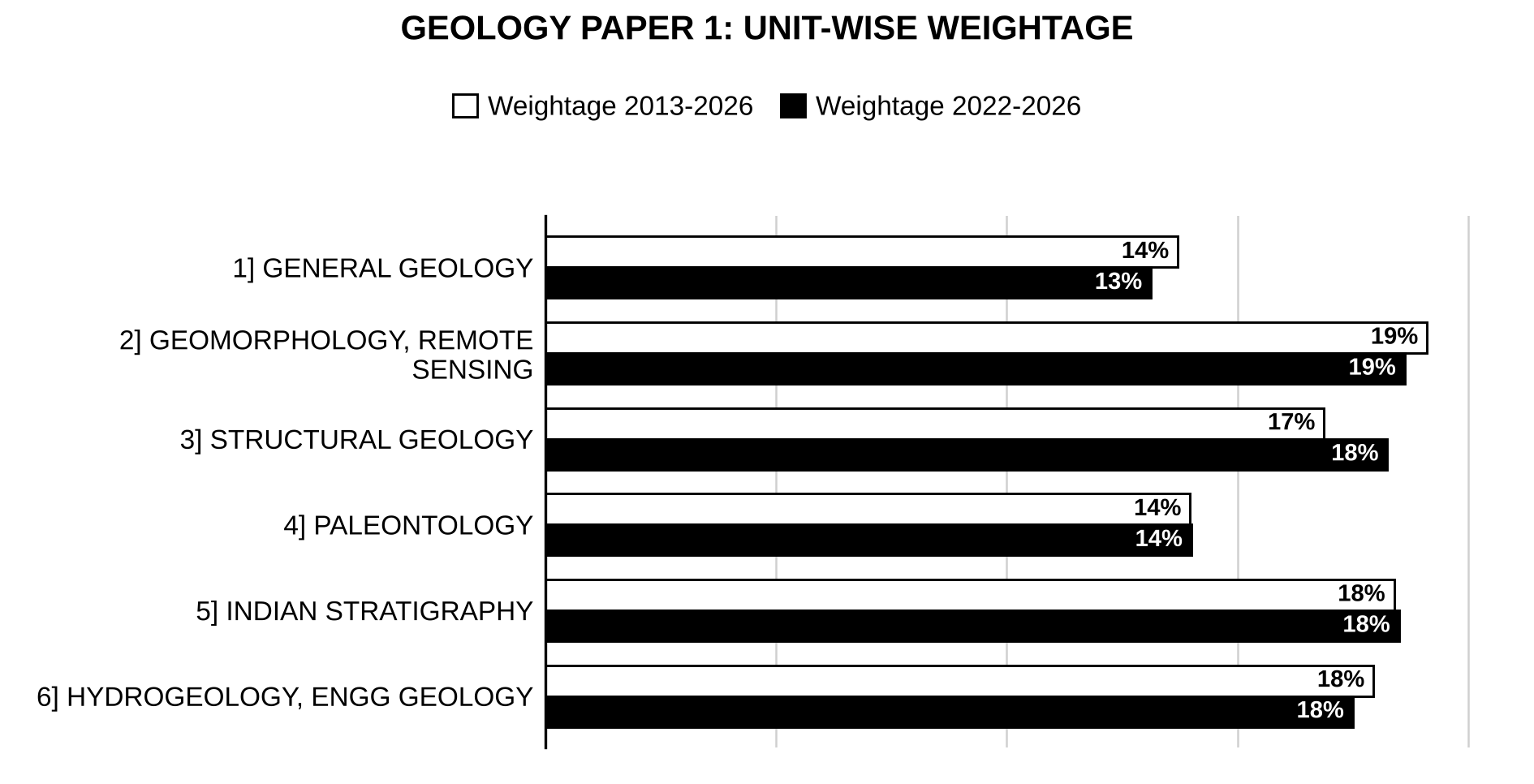
Trend: Paper I is spread fairly evenly over its six units. Geomorphology and Remote Sensing (about 19%), Indian Stratigraphy (about 18%), Hydrogeology and Engineering Geology (about 18%) and Structural Geology (17–18%) carry the most marks, followed by Paleontology (about 14%) and General Geology (13–14%), with little change between 2013–2026 and 2022–2026. The most-asked topics since 2013 are geomorphic processes and landforms (2.1), plate tectonics (1.4) and remote sensing (2.5), the Precambrian and Phanerozoic of India (5.2, 5.3), groundwater exploration and management (6.4), engineering geology (6.5) and vertebrate evolution (4.4). In 2022–2026 the Precambrian of India (5.2) has taken a clearly larger share, and folds (3.3), landslides and earthquake-resistant structures (6.6) and groundwater chemistry (6.3) have come up more often, while the tectonic framework of India and the Himalayas (5.6) and engineering geology (6.5) have been asked less.

Preparing for Prelims too?
Our UPSC Prelims Topic-wise PYQ eBook covers every Prelims question with detailed explanations, so you can see exactly where UPSC asks from.
View the BookDownload Free SamplePaper II
| Unit | Topic (click to open PYQs) | Sub-topics | Questions | Link |
|---|---|---|---|---|
| 1 | Mineralogy | 5 | 129 | Click here → |
| 2 | Igneous and Metamorphic Petrology | 7 | 154 | Click here → |
| 3 | Sedimentary Petrology | 5 | 88 | Click here → |
| 4 | Economic Geology | 6 | 145 | Click here → |
| 5 | Mining Geology | 4 | 98 | Click here → |
| 6 | Geochemistry and Environmental Geology | 6 | 132 | Click here → |
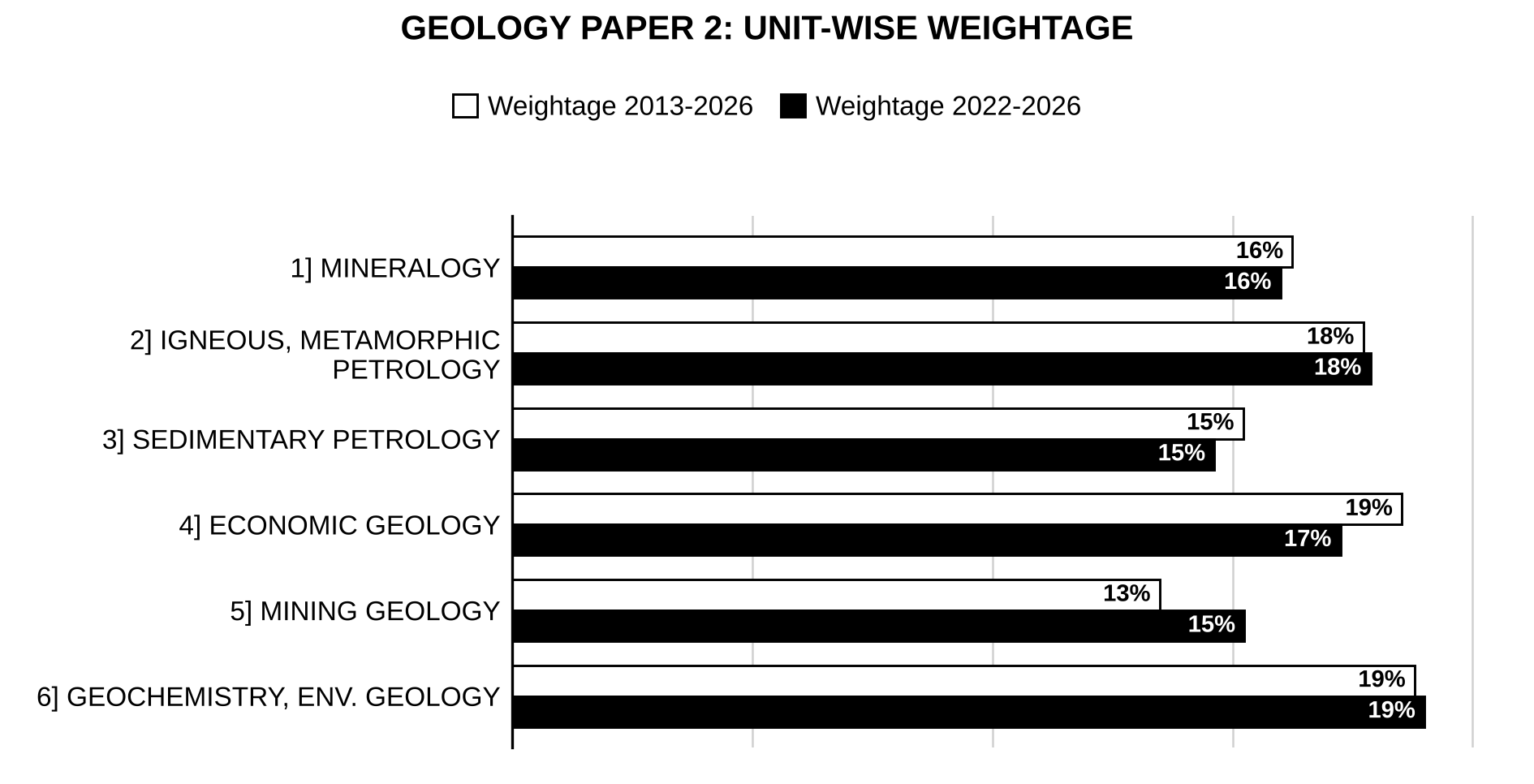
Trend: Paper II is also evenly balanced: Geochemistry and Environmental Geology (about 19%), Economic Geology (17–18%) and Igneous and Metamorphic Petrology (about 18%) are slightly ahead of Mineralogy (about 16%), Sedimentary Petrology (about 15%) and Mining Geology (13–15%). The most-asked topics since 2013 are ore genesis (4.1), prospecting methods (5.1), sedimentary rocks (3.2), cosmic and earth geochemistry (6.1), silicate minerals (1.3), crystallography (1.1), optical mineralogy (1.5), magma generation and crystallisation (2.1) and igneous rock types (2.4). In 2022–2026 Mining Geology has gained, chiefly through sampling and ore-reserve estimation numericals (5.2), and crystallography (1.1), sedimentary processes (3.1) and granulites, migmatites and metasomatism (2.7) have come up more often, while optical mineralogy (1.5), Indian metallic deposits (4.3) and coal and petroleum (4.5) have been asked less.
How this collection is organised
Considering the changing exam pattern over the years, we felt it necessary to declare some practices we’ve adopted in this collection.
Units follow the official syllabus – Paper 1: 1 General Geology, 2 Geomorphology and Remote Sensing, 3 Structural Geology, 4 Paleontology, 5 Indian Stratigraphy, 6 Hydrogeology and Engineering Geology; Paper 2: 1 Mineralogy, 2 Igneous and Metamorphic Petrology, 3 Sedimentary Petrology, 4 Economic Geology, 5 Mining Geology, 6 Geochemistry and Environmental Geology. The official syllabus has been divided into numbered topics (e.g. Paper 1 – 5.2 Precambrian of India) to arrange the questions.
Questions on areas the syllabus does not name separately are placed under the nearest topic: for example, invertebrate fossil groups (trilobites, brachiopods, ammonoids) under megafossils (Paper 1 – 4.3); palaeomagnetism and dating of rocks under the origin, interior and age of the earth (1.1); in Paper 2, phase-rule calculations under crystal chemistry and thermodynamics (6.2); and gossans under prospecting (5.1).
Until 2008 the two papers followed an older syllabus, and some subjects (for example hydrogeology, engineering geology, aerial photographs and sedimentary environments) appeared in the other paper. Such questions of 1995–2007 are placed under the topic of the present syllabus, even when that topic is now in the other paper; Part III shows each paper as set. From 2009 every question is kept in its own paper.
Some questions cover more than one topic. We’ve kept such questions in each topic of relevance.
Every diagram printed with a question is given as a complete description in square brackets – [Figure: …] – with every numbered pointer and label shown, so that the question can be solved from the description. Standard tables attached to a paper are not reproduced.
Graphs at the start of each paper show the weightage of every unit in that paper, and graphs for each unit show the weightage of its topics. Weightage is the share of marks asked from a unit or topic, compared for 2013–2026 (white bars) and the last five years, 2022–2026 (black bars). A question placed under two topics has its marks split equally between them.
Each of the topicwise question is suffixed by a question code like this [2024/20m/2a]. This code indicates a) year in which the question was asked, b) maximum marks the question carried, c) prescribed word limit (where UPSC set one, e.g. 200w) and, d) the question number in actual paper, in given order.
Until 2012, each paper carried 300 marks (60 per question); since 2013 each paper carries 250 marks (50 per question). Where a compulsory question offered more parts than were to be answered (“any three” of four), every part is included with its own marks. Where a retyped copy of an older paper prints no marks for a part, the code carries the marks implied by the question. Split marks such as 15+5=20 are kept as printed.
The 2026 papers are transcribed from the official UPSC question papers, 2009–2025 from scans of the printed papers, and 1995–2007 from typed copies (where two copies were found, they go back to one typing). The 1995–2000 copies print no marks (and 2001 lacks them for two questions); for these the code carries the marks implied by the question pattern. No copy of the 2008 papers could be found.
The wording, figures and data of the questions are as printed, including the papers’ own grammar and apparent misprints such as misspelt mineral or place names. Where a question refers to a map that is not printed in the paper, the question is given as printed.
Spotted an error? Use the “Report an Error” box at the end of any page – we review every report and update the page.

Strengthen your GS papers
Our UPSC Mains Topic-wise & Year-wise PYQ eBook (2013–2026) maps every GS question to the syllabus, so you know what UPSC asks and how often.
View the BookDownload Free SampleLast updated: 31 October 2026