
Here are all 129 Mineralogy questions asked in UPSC Geology Optional Paper II from 1995 to 2026, arranged under the 5 topics of the official syllabus. Within each topic the latest questions come first.
Each question ends with a code such as [2024/15m/3b] – the year, the marks, the word limit (where UPSC set one) and the question number in the paper.
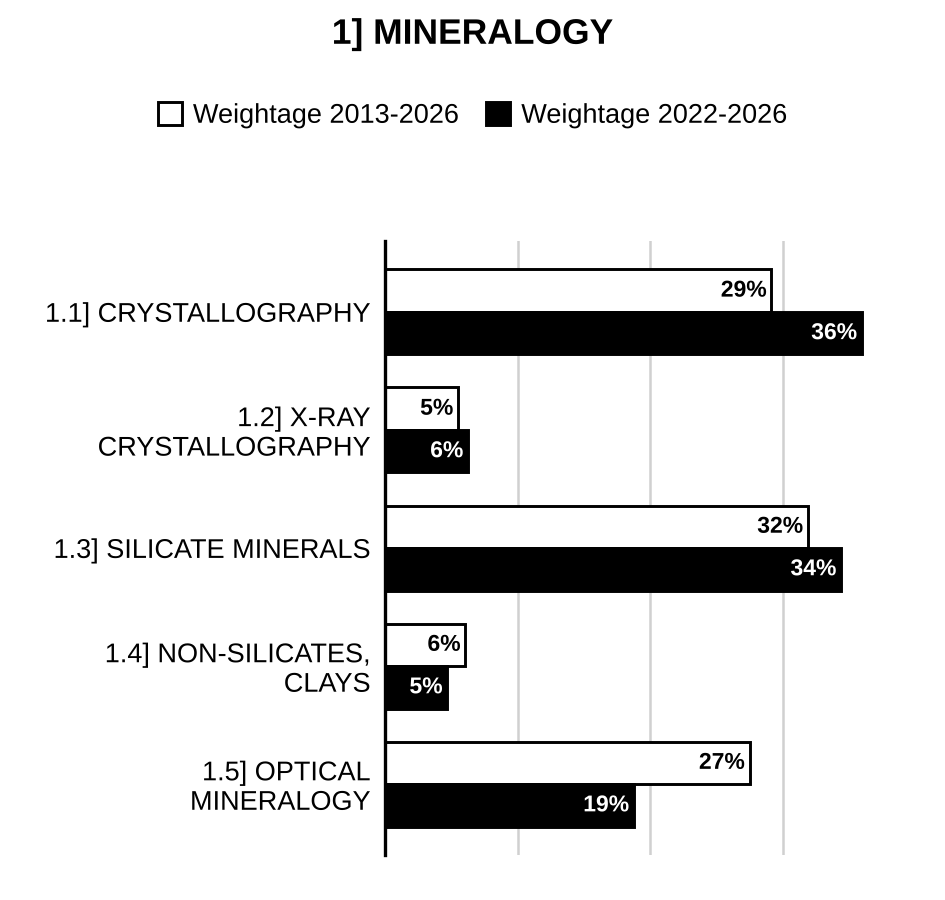
1.1] Crystallography
39 questions
Describe the classification of crystals into crystal systems, and add a note on the types of symmetry shown by crystals. [2026/10m/150w/1a]
What is twinning? Discuss the different types of twinning found in the feldspar group of minerals. [2026/20m/2c]
Describe the symmetry elements shown by the normal class of the orthorhombic system. What are the different forms for this class? Draw the sketch stereogram of the form {h k l}. Give examples of two minerals that crystallize in this system. [2025/10m/150w/1a]
Give a detailed account related to the classification of crystals into different crystallographic systems based on symmetry elements. [2025/15m/2a]
What are the different types of rotational axes of symmetry present in a crystal? What are the different types of twinning observed in quartz? [2024/10m/150w/1a]
What are the symmetry elements present in the normal class of an isometric system? Write the Hermann-Mauguin notation of the normal class of isometric system. Plot the face (hkl) and deduce the form generated by operation of symmetry elements from the face (hkl) on a stereogram of the normal class of isometric system. [2024/15m/2a]
How are the symmetry elements in a crystal of class 6/m 2/m 2/m oriented with respect to its crystallographic axes? [2023/10m/150w/1a]
How are Miller Indices of a crystal face calculated? Calculate Miller Indices of following two crystal faces: (i) A face intersects all three crystallographic axes at 3-unit distance. (ii) A face intersects a-axis at 4-unit distance and is parallel to b and c axes. [2022/10m/150w/1a]
What are symmetry elements present in normal class of orthorhombic system? Show the stereographic projection of a crystal face (hkl) for normal class of orthorhombic system. Write down Hermann-Mauguin notations of all classes of orthorhombic system. [2022/15m/2b]
How does one designate mirror plane, rotational axes of symmetry and centre of symmetry in Hermann-Mauguin notation? A crystal has one 4-fold axis, four 2-fold axes, five mirror planes and centre of symmetry. What will be its Hermann-Mauguin notation? Show on a stereographic projection diagram the symmetry elements of the above crystal and plot the faces of the form (hkl). [2021/10m/150w/1a]
Define ‘twin plane’, ‘twin axis’ and ‘composition plane’ in crystals. State different types of twinning observed in feldspars. [2021/10m/2c]
Write about the symmetry elements of a crystal. [2020/10m/1b]
Briefly write about the crystal forms of hexagonal system using projection diagrams. [2020/20m/2b]
What are the principles of Miller Indices and Hermann Maugin notation for a crystal face? Calculate Miller Indices of a crystal face which intersects a-axis at 2 unit distance, b-axis at 3 unit distance and is parallel to c-axis. [2019/10m/1a]
Describe using projection diagram various crystal-forms developed in the normal class of tetragonal system. [2019/10m/2c]
‘Five-fold rotational symmetry is not possible in minerals’ – justify the statement. [2018/10m/1a]
Explain the symmetry elements in a stereogram of general form in the hexagonal-scalenohedral class. [2018/10m/1b]
Describe briefly the different types of twinning commonly found in minerals. Comment upon causes of twinning. [2016/10m/1d]
With neat sketches describe the symmetry elements and forms of the normal class of the orthorhombic system. Name three minerals of this class. [2016/20m/2a]
Explain the phenomenon of twinning and discuss the twinning in feldspars with neat sketches. [2015/10m/1b]
With neat sketches describe the symmetry elements and forms of the normal class of the isometric system. Name three minerals belonging to this class. [2015/20m/2a]
Write on the principle of stereographic projection of crystals. Draw a sketch of the stereogram of a tetragonal crystal. [2012/20m/2c]
Types of twin laws applicable to feldspar and determination of Ab : An ratio. [2011/10m/1a]
Elements of symmetry and crystallographic notations. [2011/20m/2b]
Symmetry elements in crystals. [2010/20m/2c]
Application of Projection Diagrams in Studying Crystal Symmetry. [2007/20m/200w/1a]
Twinning in Feldspars. [2007/20m/200w/1b]
In about 200 words each, explain any three of the following: Crystallographic axes. [2006/20m/200w/1a]
(i) Explain differences in the elements of symmetry of Holohedral classes of the Tetragonal and Orthorhombic systems (ii) Draw qualitative Laue diffractograms taken with X-ray beam parallel to c-axis of a tetragonal and an orthorhombic mineral. [2005/20m/200w/1a]
In about 200 words, explain any three of the following: Symmetry of Isometric System with forms and examples. [2004/20m/200w/1a]
In about 200 words each, explain any three of the following: Give an account of twinning in minerals. [2002/20m/200w/1a]
In about 200 words each, write notes on any three of the following: Space lattices. [2000/20m/200w/1a]
Twin Laws. [1999/20m/200w/1a]
Stereographic projection. [1999/20m/200w/1b]
Stereographic projection. [1997/20m/200w/1a]
Space-lattices. [1996/20m/200w/1b]
Crystallographic notation. [1996/20m/200w/1c]
Monoclinic Crystal Symmetry. [1995/20m/200w/1b]
What is stereographic projection? Describe with example, its use to represent crystal symmetry. [1995/60m/2]
1.2] X-ray crystallography
8 questions
How does the Bragg equation explain X-ray diffraction from a crystal? [2023/20m/2a]
Explain Bragg’s law of diffraction of X-rays by a crystal with suitable diagram. [2017/10m/1a]
Derive Bragg’s law for X-ray diffraction. Calculate the inter-planar spacing in a crystal for a plane that gives a sharp reflection at for CuK radiation ( Å) in a powder X-ray diffraction experiment. [2013/20m/2c]
Principle of X-ray diffraction study of a crystalline mineral. [2012/12m/1b]
Write notes on the following with diagrams. (i) Dispersion of axial angle in brookite () (ii) Powder X-ray diffraction method (iii) Granulose structure and its origin (iv) Trachytic and graphic texture. [2012/40m/3b]
Bragg’s equation and X-ray diffraction techniques for mineral studies. [2011/20m/2a]
(i) Explain differences in the elements of symmetry of Holohedral classes of the Tetragonal and Orthorhombic systems (ii) Draw qualitative Laue diffractograms taken with X-ray beam parallel to c-axis of a tetragonal and an orthorhombic mineral. [2005/20m/200w/1a]
Laue diffraction pattern. [1998/20m/200w/1a]

Preparing for Prelims too?
Our UPSC Prelims Topic-wise PYQ eBook covers every Prelims question with detailed explanations, so you can see exactly where UPSC asks from.
View the BookDownload Free Sample1.3] Silicate minerals
33 questions
Discuss the classification of silicate mineral structures. [2026/10m/150w/1b]
Describe common minerals of igneous and metamorphic rocks, and the diagnostic features of these minerals. [2026/15m/2a]
Describe the structure of the pyroxene group of minerals with suitable diagrams. Discuss the chemical compositions and optical properties of orthopyroxene. [2025/15m/2b]
Describe the structural classification of silicates with neat sketches. Give one example for each type. [2025/20m/2c]
Draw and describe the structure of mica group of minerals. Describe the chemical composition and optical properties of minerals of mica group. [2024/15m/2b]
How does Si-O polymerism help to classify silicate minerals? Give one example for each of these silicate subclasses. [2023/15m/2b]
Describe the crystallographic, physical, optical and chemical properties of garnet group of minerals. Give examples of rocks in which each species of garnet occurs as an essential mineral. [2022/20m/2a]
Give the classification scheme of silicate minerals on the basis of atomic structure, ratio and number of shared oxygen. Give suitable examples of each class. [2021/20m/2a]
Write about the crystal structure of monoclinic amphiboles and cite mineral examples along with their formula. Add a note on their paragenesis. [2020/20m/2a]
Discuss classification, composition and structure of pyroxene group of minerals. Comment upon optical properties and occurrence of hypersthene. [2019/20m/2b]
Illustrate with neat sketches internal structure of pyroxene group of minerals. Give a generalized classification of pyroxene group based on composition. [2018/20m/2a]
Describe the structural classification of silicates with neat sketches and mineralogical examples. [2017/20m/2a]
Give an account of the crystal structure, chemical composition and optical properties of the minerals of the feldspar group. [2017/20m/2b]
Discuss the basic differences in the crystal structures, physical and optical properties of pyroxene and amphibole. [2016/10m/1b]
Give an account of the atomic structure, chemical composition, and physical and optical properties of the minerals of mica group. [2016/20m/2b]
Discuss the structures of inosilicates with neat sketches and mineralogical examples. [2015/10m/1a]
Write the classification of silicate structure with neat sketches. [2014/20m/2a]
Discuss basis of classification of silicate structures of minerals. [2012/20m/2a]
Describe with a diagram the approximate limits of solid solution in the felspar group of minerals. [2012/20m/2b]
Explain how on the bases of chemistry and optical properties, the various feldspars differ from one another. [2010/15m/150w/1b]
What are the differences between (i) cleavage and external crystal form and (ii) colour and streak of a mineral? [2010/20m/3c]
Write an account of structural classification of Silicates. Discuss in detail physical properties and give chemical composition of five common rock forming minerals belonging to Amphibole Group. Add a note on their mode of occurrence. [2007/60m/2]
What are tectosilicates? Describe the minerals of feldspar group giving their chemical composition physical properties and occurrence. [2006/60m/2]
What do you understand by terms like calcic pyroxenes, Mg-Fe pyroxenes, and sodic pyroxenes? Name one mineral in each category, giving its physical and optical properties. [2005/60m/2]
Give the salient features of structural classification of silicates. Describe any one mineral group belonging to the Nesosilicate class, giving the chemical composition, physical properties and occurrence. [2004/60m/2]
Give the chemical composition and optical properties of Amphibole group of minerals. Add a note on their classification. [2002/60m/2]
Give the chemical composition and optical properties of Felspathoid group of minerals. Name the rocks containing the minerals of this group. [2000/60m/2]
Structure of Amphibole group of minerals. [1999/20m/200w/1d]
Describe Amphiboles. Add a note on their occurrence and alteration. [1997/60m/2]
Give a comprehensive account of structural classification of Silicates. [1997/60m/3]
Describe Garnet group of minerals. [1996/60m/2]
Hardness of minerals. [1995/20m/200w/1c]
Describe Plagioclase felspars and their alteration products. [1995/60m/3]
1.4] Non-silicate and clay minerals
7 questions
List all major differences among kaolinite, smectite and illite groups of clay minerals. [2023/15m/2c]
Illustrate with neat sketches internal structure of calcite. How would you explain the differences in the internal structure of calcite and its polymorph aragonite? [2018/20m/2b]
Discuss the classification and chemistry of clay minerals. [2015/20m/2b]
Can ice be called a mineral? [2010/4m/150w/1c(ii)]
Can a glacier be called a rock? [2010/4m/150w/1c(iii)]
Describe the chemical composition, physical properties and mode of occurrence of Phosphate group of minerals. [2003/60m/2]
Give the general chemical composition, physical properties and occurrence of sulphide group of minerals. [2001/60m/2]
1.5] Optical mineralogy
42 questions
Give an account of the optical properties of common rock-forming minerals. How can these properties be used to identify minerals under the microscope? [2026/15m/2b]
Discuss in brief the characteristic optical properties of hornblende and augite under petrological microscope. [2025/10m/150w/1b]
How does one define “Double refraction” and “Birefringence” of an anisotropic mineral? Write with the help of suitable sketches. [2024/10m/150w/1b]
Why do some minerals show pleochroism? Explain. [2023/10m/150w/1b]
Why does an anisotropic mineral, viewed under crossed polars, suffer four times of complete extinction during a 360° rotation of microscope stage? What is pleochroism and how is it determined? [2022/15m/2c]
Define ‘birefringence’ and ‘extinction angle’ in minerals. How does one proceed to measure extinction angle of a mineral under microscope? Substantiate your answer with suitable sketches. [2021/20m/2b]
How do you measure refractive index of minerals and distinguish high and low relief minerals under microscope? [2020/10m/1a]
Define pleochroism of minerals and write about the utility of pleochroism to distinguish minerals and provide examples. [2020/10m/2c]
What is interference figure? What are the conditions required for the formation of interference figures for uniaxial minerals. Draw optic axis for uniaxial negative and positive crystals. [2019/20m/2a]
Explain with the help of indicatrix diagram how the birefringence of a uniaxial mineral depends on crystallographic orientation of the mineral thin-section when studied under petrological microscope. [2018/10m/2c]
With a suitable diagram, explain how the optic sign of a uniaxial mineral is determined. [2017/10m/2c]
Explain why all pleochroic minerals are anisotropic but all anisotropic minerals are not pleochroic. [2016/10m/1e]
A mineral section remains dark in all positions under crossed polars. How would you proceed to determine whether the mineral is (i) isotropic, (ii) uniaxial or (iii) biaxial? [2016/10m/2c]
In a mineral, the refractive indices are determined as and . Calculate the birefringence of the mineral and comment on its optic nature. [2016/10m/5a]
Explain why all quartz grains in a rock section do not show first order yellow interference colour when viewed under crossed polars. [2014/10m/1a]
What is pleochroism? Explain why a section of biotite cut parallel to cleavage does not show any pleochroism but when it is cut oblique to cleavage shows pleochroism. [2014/10m/1b]
Discuss briefly on the construction of Nicol prism. Why it is necessary to cut and recement the calcite crystal in the classification of Nicol prism? [2014/15m/2b]
A mineral section remains dark in all positions under crossed polars – explain how it is possible and how will you proceed to determine the optic sign of the mineral, if applicable. [2014/15m/2c]
With theoretical details, discuss (i) optical indicatrix, and (ii) determination of sign of elongation of uniaxial minerals. [2013/15m/2a]
With suitable examples, discuss the causes behind and effects of (i) pleochroism and (ii) birefringence in minerals. [2013/15m/2b]
Acute bisectrix interference figure of a biaxial crystal. [2012/12m/1a]
Show how you determine the pleochroic scheme of a biaxial mineral. [2012/20m/3a]
Write notes on the following with diagrams. (i) Dispersion of axial angle in brookite () (ii) Powder X-ray diffraction method (iii) Granulose structure and its origin (iv) Trachytic and graphic texture. [2012/40m/3b]
Types of twin laws applicable to feldspar and determination of Ab : An ratio. [2011/10m/1a]
Optical indicatrix of uniaxial and biaxial minerals, and how it helps determining the optically positive and negative crystals. [2011/20m/2c]
Explain how on the bases of chemistry and optical properties, the various feldspars differ from one another. [2010/15m/150w/1b]
Double refraction. [2010/20m/2a]
Determination of optic sign of biaxial minerals. [2010/20m/2b]
Compare the optical properties of the following mineral pairs, with at least two diagnostic optical properties: (i) quartz and plagioclase (ii) hornblende and diopside (iii) chlorite and muscovite, and (iv) kyanite and sillimanite. [2009/20m/200w/1c]
With theoretical details, discuss the (i) optical indicatrix (ii) interference figure and (iii) optic sign determination of uniaxial minerals. [2009/30m/2a]
With suitable examples, discuss the causes behind and effects of (i) pleochroism (ii) extinction angles and (iii) birefringence in minerals. [2009/30m/2b]
In about 200 words each, explain any three of the following: Double refraction and birefringence. [2003/20m/200w/1a]
Give the chemical composition and optical properties of Amphibole group of minerals. Add a note on their classification. [2002/60m/2]
In about 200 words each, explain any three of the following: Pleochroism in minerals of pyroxene and amphibole groups. [2001/20m/200w/1a]
In about 200 words each, write notes on any three of the following: Uniaxial and Biaxial Indicatrix. [2000/20m/200w/1b]
Describe optical indicatrix. How would you optically differentiate between uniaxial and biaxial minerals? [1999/60m/2]
Optic-orientation in crystals. [1998/20m/200w/1c]
What are “Interference Figures”? Describe them. [1998/60m/3]
Angle of extinction. [1997/20m/200w/1c]
Quartz Wedge and its applications. [1997/20m/200w/1d]
Summarize the behaviour of light in biaxial crystals. [1996/60m/3]
Indicatrix. [1995/20m/200w/1a]

Strengthen your GS papers
Our UPSC Mains Topic-wise & Year-wise PYQ eBook (2013–2026) maps every GS question to the syllabus, so you know what UPSC asks and how often.
View the BookDownload Free Sample« Previous: Hydrogeology and Engineering Geology | Next: Igneous and Metamorphic Petrology »
Back to: Geology Optional PYQs – Topic-wise | Also see: Geology Optional year-wise question papers
Last updated: 31 October 2026