
Here are all 126 Structural Geology questions asked in UPSC Geology Optional Paper I from 1995 to 2026, arranged under the 5 topics of the official syllabus. Within each topic the latest questions come first.
Each question ends with a code such as [2024/15m/3b] – the year, the marks, the word limit (where UPSC set one) and the question number in the paper.
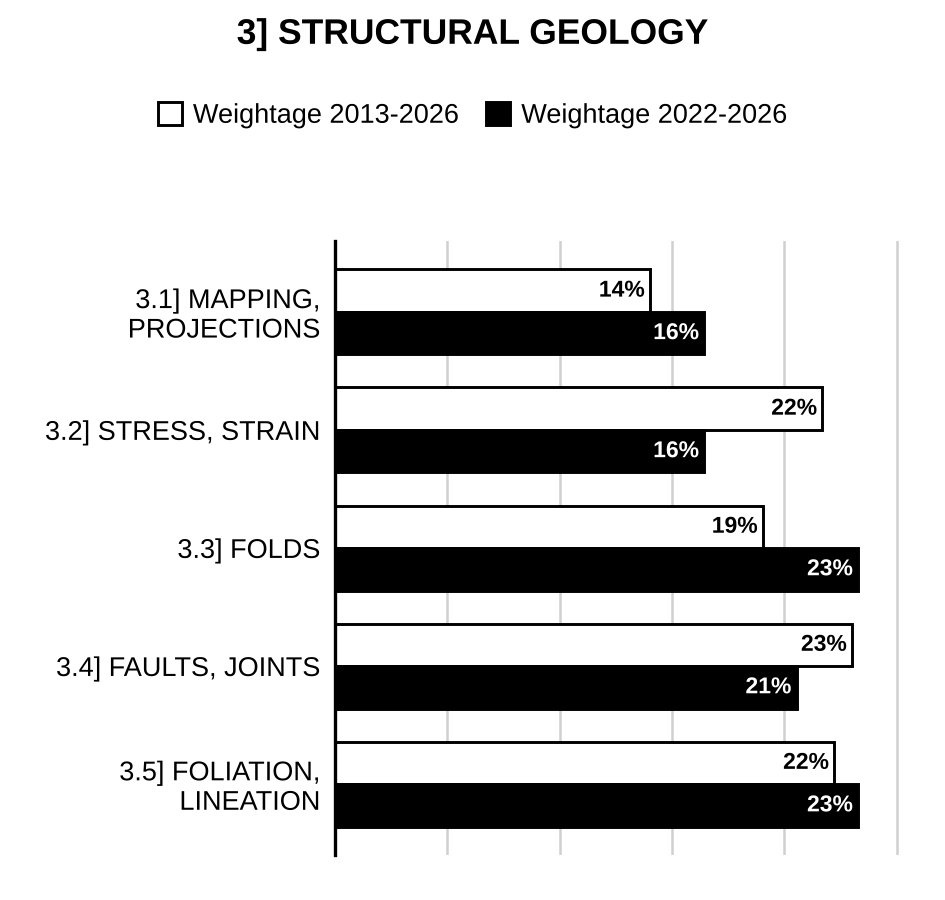
3.1] Geologic mapping and projections
14 questions
Describe the principles of geological mapping. Using sketches, describe the different types of symbols used in geological mapping. [2026/20m/2a]
Define dip of a rock bed. What is true dip and apparent dip? Find the strike direction of a bed which dips 30°; towards North 30° East. [2024/10m/150w/1e]
What do contours represent in a toposheet? How do the contour lines help to identify the different geomorphic features of an area? Explain with neat diagrams. [2024/15m/2c]
Illustrate the principles of stereographic projection. How are the ‘pi’ and ‘beta’ diagrams useful to analyze fold structure? [2022/15m/3c]
What is stereographic projection in structural geology? Discuss its types, nomenclature and different types of geological plotting technique in a stereonet. [2021/10m/150w/1d]
What does attitude of a bed mean? Define strike, dip direction and dip amount of a bed and explain how these are represented on a map for vertical, horizontal and inclined strata. [2021/15m/2c]
How do we determine the top of beds from primary features? [2020/10m/150w/1d]
With the help of neat sketches, describe the effect of faults on outcrop pattern. [2019/15m/3b]
Enumerate the tools and equipments required to undertake geological mapping. Explain the importance of geological mapping. [2016/20m/4a]
Why equal area stereographic projection is preferred for plotting and analyzing structural data? [2014/10m/3c]
Give an account of each of the following: Significance of stereographic projection in structural analyses. [2011/20m/4c]
Indexing of topographic map of India. [2010/15m/150w/1c]
Principles of geologic mapping and map reading. [2007/20m/200w/1d]
Principles of geological mapping. [2006/20m/200w/1d]
3.2] Stress and strain
25 questions
Describe the homogeneous and heterogeneous deformation of rocks. Add a note on progressive deformation. [2026/15m/3c]
How does strain analysis help in understanding the nature of rock deformation. Discuss centre to centre method of estimation of two dimensional strain. [2025/15m/4c]
What is a Shear Zone? Describe the different Shear Sense indicators. [2023/20m/4a]
Illustrate the common brittle-ductile shear zone structures. Using the stress ellipsoid, deduce the mechanism of faults. [2022/20m/4a]
Discuss stress and strain ellipsoids using neat diagrams. [2021/10m/150w/1e]
What is a shear zone and what are the conditions of its formation? Discuss its general characteristics and types based on deformation type. [2020/15m/3c]
Discuss Mohr’s stress diagram and its significance. What is its relevance in interpreting different stress conditions in rocks? [2020/20m/4a]
How do you differentiate between brittle and ductile deformation in rocks? [2019/10m/150w/1e]
What are shear zones? Explain diagrammatically the transition from brittle fault to ductile shear at depth. [2018/15m/2c]
What are strain markers? Discuss their significance. [2018/15m/3c]
Describe strain markers and their significance. [2016/15m/3c]
What is Mohr’s stress diagram? Describe its significance. [2015/15m/4c]
Plotting of strain ellipsoids on a two-dimensional diagram. [2014/10m/150w/1d]
What is the significance of strain markers in quantification of deformation? [2014/10m/4c]
Difference between brittle and ductile deformation. [2013/10m/150w/1d]
Effect of time on rock deformation. [2012/12m/150w/1e]
Intragranular movements in plastic deformation of rocks. [2012/20m/250w/4c]
Give an account of each of the following: Behaviour of mineral and rocks under deformation conditions. [2011/20m/4a]
Mylonites. [2010/15m/150w/1b]
Types of strain ellipsoid. [2009/20m/200w/1b]
Discuss in detail the behaviour of minerals and rocks under deformation conditions. Illustrate your answer with neat sketches. [2007/60m/4]
Strain markers in deformed rocks. [2005/20m/200w/1d]
Stress-strain relationship in elastic materials. [2004/20m/200w/1d]
Draw a stress and strain ellipsoid for a deformed rock. [2000/20m/200w/1d]
Stress and strain ellipsoid, and rock deformation. [1997/15m/3a]

Preparing for Prelims too?
Our UPSC Prelims Topic-wise PYQ eBook covers every Prelims question with detailed explanations, so you can see exactly where UPSC asks from.
View the BookDownload Free Sample3.3] Folds
22 questions
Discuss the types of folds. Add a note on the classification of folds based on the mechanism of folds. [2026/15m/3b]
What are sheath folds? Discuss the deformational conditions of their formation. [2025/10m/150w/1b]
On the basis of dip isogons describe the classification of folds with neat diagrams. [2025/20m/4a]
Describe fold geometry. Illustrate various types of folds on the basis of their symmetry, orientation of axial plane and the trend of the fold axis. [2024/20m/4a]
Discuss the differences between Symmetrical and Asymmetrical folds with the help of neat diagrams. [2023/10m/150w/1e]
Explain through neat sketches what drag folds are, and how they can be used to determine major fold structure. [2022/10m/150w/1d]
What is a fold domain? Discuss any eight types of folds depending on the closure of fold domain. [2021/15m/3c]
Briefly describe the classification of fold on the basis of fold attitude (dip and plunge). [2020/10m/150w/1e]
What are folds? Describe the morphology of the folds. Discuss the criteria of their recognition in the field. [2019/20m/2a]
Explain, how the geometry of minor folds are helpful in deciphering the geometry of regional folds in an area. [2017/15m/4b]
Using appropriate diagrams, describe Ramsay’s classification of folds in detail. [2015/20m/3a]
Fold classification based on orientation of axial plane and hinge line. [2014/10m/150w/1e]
Importance of structural studies in location of an oil field. [2014/10m/150w/5b]
Classification of folds based on dip isogon. [2012/20m/250w/4b]
With the help of neat sketches, describe the following: Classification of folds based on the orientation of axis and axial plane. [2009/30m/2a]
Discuss the classification and mechanics of folds. Make neat sketches to illustrate your answer. [2004/60m/4]
Differentiate between the following pairs: (i) Dome and basin (ii) Horst and graben (iii) Overthrust and underthrust faults (iv) Hanging wall and footwall. [2003/20m/1d]
Reversal of dips. [2001/15m/4a]
Monocline and Homocline. [2000/15m/4d]
Describe and discuss how folds and faults can be identified in the field. What is the relevance of these for the society? [1999/60m/2]
What are folds? Explain the mechanism of folding and distinguish between Recumbent and Reclined folds. [1998/60m/2]
Comment on the classification of folds, Illustrate your answer with neat sketches. [1996/60m/2]
3.4] Faults and joints
33 questions
What are transform and transcurrent faults? Illustrate them using neat sketches. [2026/10m/150w/1a]
Using neat sketches describe various types of Thrust geometries formed in a compressional regime. [2025/15m/3c]
Diagrammatically explain the formation of normal fault, strike-slip fault and thrust fault with the help of stress ellipsoid. [2024/15m/3c]
Briefly describe the Cataclasite and Pseudotachylite rocks. [2023/10m/150w/1d]
What are joints? Describe the Geometric and Genetic classification of joints with neat diagrams. [2023/15m/2c]
Illustrate the common brittle-ductile shear zone structures. Using the stress ellipsoid, deduce the mechanism of faults. [2022/20m/4a]
What are hanging wall and footwall of a fault? Describe the different classes of faults based on relative movement of walls. [2021/20m/4a]
With the help of neat sketches, describe the effect of faults on outcrop pattern. [2019/15m/3b]
Discuss the mechanism of faulting. [2018/20m/4a]
Fault zone rocks. [2017/10m/150w/1e]
What are joints? Discuss the types of joints developed during folding. [2017/15m/2c]
How would you differentiate between a fault and an unconformity in the field? [2017/20m/3b]
Describe the genetic classification of faults, aided with neat sketches. [2016/15m/2b]
Using neat sketches, describe the types of faults in relation to the orientation of the stress axes. [2015/10m/150w/1d]
What are major differences between transform and transcurrent faults? [2014/10m/2c]
Importance of structural studies in location of an oil field. [2014/10m/150w/5b]
The classification and mechanics of faults. [2013/20m/3a]
Orientation of stress ellipsoid and the types of faults. [2012/20m/250w/4a]
Give an account of each of the following: Shear and tension joints. [2011/20m/4b]
Overthrust, Klippe and Fenster with the help of labelled diagrams. [2010/30m/2b]
Geometrical parameters of joints measured during a survey of rock joints. [2010/30m/3a]
With the help of neat sketches, explain the effects of strike faults on the inclined strata. [2009/30m/3b]
With the help of neat sketches, discuss the following: Geometric analysis of fracture systems in 3-dimension. [2009/30m/4b]
Discuss the classification and mechanics of Faults. Illustrate your answer with neat sketches. [2005/60m/4]
Differentiate between the following pairs: (i) Dome and basin (ii) Horst and graben (iii) Overthrust and underthrust faults (iv) Hanging wall and footwall. [2003/20m/1d]
How are faults identified in the field? [2002/20m/4a]
Classify faults based on their geometry and movement. [2002/20m/4b]
Explain the mechanism of rock failure leading to faulting. [2001/20m/200w/1d]
Nappe. [2001/15m/4b]
Describe and discuss how folds and faults can be identified in the field. What is the relevance of these for the society? [1999/60m/2]
Describe different fault geometries [?] and their relationship with the principal stresses. [1997/60m/2]
Repetition and omission of strata due to structures and other processes. [1995/20m/200w/1d]
Distinguishing characters of a bedding plane from a joint plane. [1995/12m/4a]
3.5] Foliations, lineations and unconformities
32 questions
Describe the types of unconformities with neat sketches. Add a note on their significance. [2026/10m/150w/1c]
What are foliations? Discuss the various types and processes of formation of foliations. [2026/15m/4c]
Discuss the types of Penetrative and Non-penetrative lineations with the help of suitable diagrams and throw light on their genesis. [2025/10m/150w/1e]
What are the planar and linear structures of a rock? Discuss the genesis of boudins. [2024/10m/150w/1b]
What is a rock cleavage? Describe the different types of rock cleavages with the help of neat diagrams. [2023/15m/3c]
Describe the structures showing gap in stratigraphic sequence caused by erosion and non-depositions. [2022/10m/150w/1e]
Illustrate and describe the linear structures of deformed rocks. [2022/15m/2c]
What is an unconformity and what are its structural and stratigraphic importances? Discuss four different types of unconformities with neat sketches. [2020/15m/2c]
What is rock cleavage? Give the significance of cleavage in deciphering the structure of a folded area. [2019/15m/4c]
Write about different types of unconformities and their significance. [2018/10m/150w/1e]
Morphological classification of rock cleavage. [2017/10m/150w/1d]
How would you differentiate between a fault and an unconformity in the field? [2017/20m/3b]
Describe the significance of unconformities in establishing stratigraphic record. [2016/10m/150w/1a]
Describe the importance of cleavage in geological studies. [2016/10m/150w/1d]
Discuss the geometric relationship between cleavage and folding. [2015/10m/150w/1e]
What are tectonites? Describe their types and their significance using neat sketches. [2015/15m/2c]
Types of unconformities and their significance. [2013/20m/3b]
Significance of unconformities. [2011/15m/150w/1d]
With the help of neat sketches, describe the following: Different types of lineation with special reference to their origin. [2009/30m/2b]
With the help of neat sketches, discuss the following: Application of foliation in establishing major structures. [2009/30m/4a]
What are different types of unconformities? Why are they significant in the study of geological history? [2006/60m/4]
Define unconformity and describe its various types. How can they be recognized in the field? [2003/60m/4]
Plunge of folds and direction of movement in fault-planes can be traced by some lineations. There are other lineations as well produced during folding/faulting episodes. Describe these lineations. [2002/20m/200w/1d]
What are Outlier, Window, Tatrot beds and Gangamopteris? [2002/20m/200w/5b]
Inlier and Outlier. [2001/15m/4c]
Paraconformity. [2001/15m/4d]
Significance of Linear and Planar structures. [1999/12m/4c]
Boudinage and its significance. [1998/20m/200w/1c]
Axial plane cleavages. [1998/12m/3b]
Linear and Planar structures, their genetic significance. [1997/20m/200w/1c]
Unconformities. [1996/20m/200w/1d]
Describe any six common linear formed by deformation. Describe briefly their geometry and mode of formation. [1995/60m/2]

Strengthen your GS papers
Our UPSC Mains Topic-wise & Year-wise PYQ eBook (2013–2026) maps every GS question to the syllabus, so you know what UPSC asks and how often.
View the BookDownload Free Sample« Previous: Geomorphology and Remote Sensing | Next: Paleontology »
Back to: Geology Optional PYQs – Topic-wise | Also see: Geology Optional year-wise question papers
Last updated: 31 October 2026