
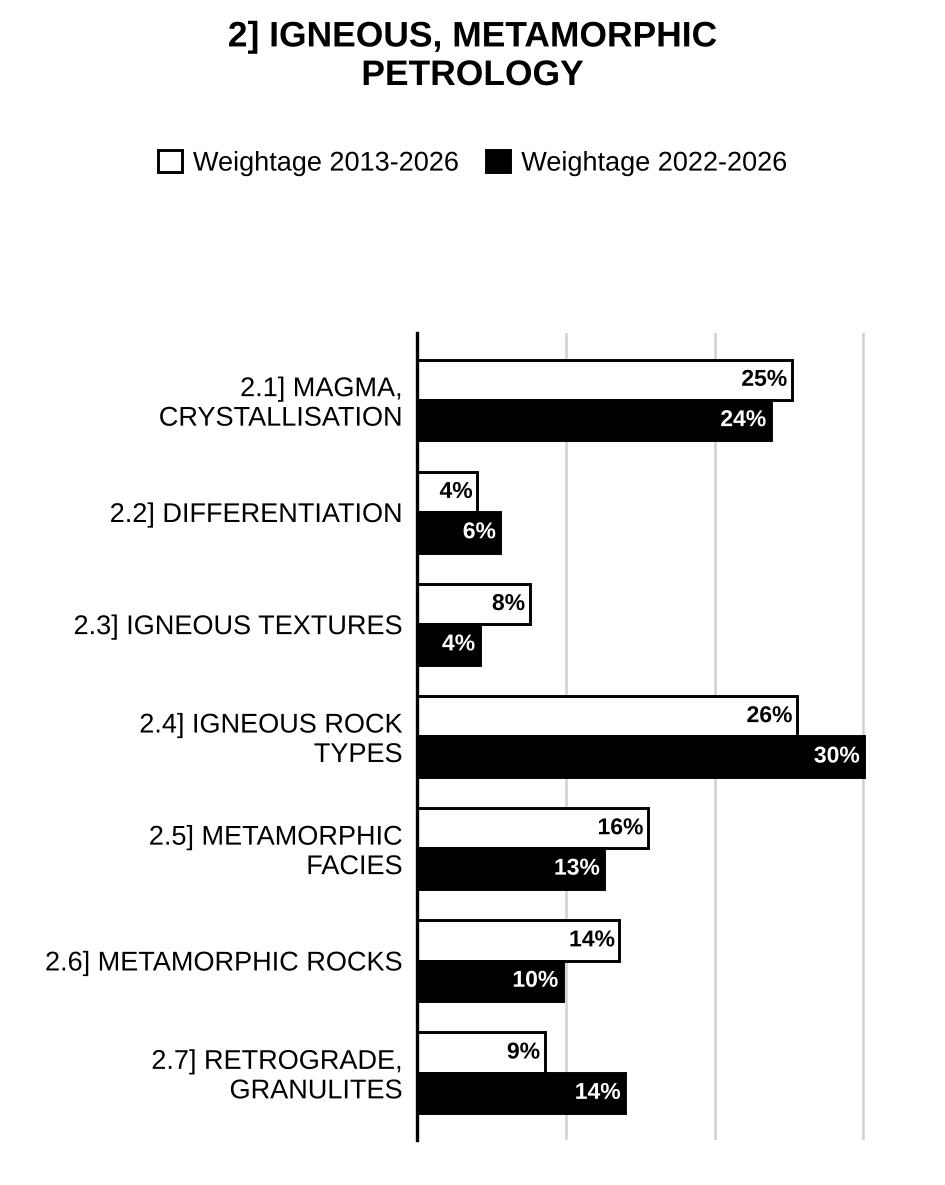
Here are all 154 Igneous and Metamorphic Petrology questions asked in UPSC Geology Optional Paper II from 1995 to 2026, arranged under the 7 topics of the official syllabus. Within each topic the latest questions come first.
Each question ends with a code such as [2024/15m/3b] – the year, the marks, the word limit (where UPSC set one) and the question number in the paper.
2.1] Magma generation and crystallisation
37 questions
Draw a neat labelled diagram for perthite texture. Explain the formation of perthite with the help of a suitable phase diagram. [2025/10m/150w/1c]
Draw a neat labelled sketch for the albite-anorthite phase diagram (1 atm, dry). Trace the course of crystallization of an initial melt – within this system. How can you interpret zoning in plagioclase with this system? [2025/15m/3b]
Show diagrammatically the characteristics of binary eutectic system under 1 atmosphere (1 atm pressure). How does one explain the formation of porphyritic basic rock with phenocryst of plagioclase in a groundmass with plagioclase and clinopyroxene with the help of a suitable binary eutectic system? [2024/10m/150w/1c]
Discuss the process of magma generation in the Earth’s interior and its causes. [2024/20m/3c]
Describe the changes in crystallized solid composition in albite-anorthite system at 1 atm pressure during cooling of a liquid of composition from 1500 °C temperature. [2023/20m/3a]
Define different types of zoning observed in minerals. Discuss processes of formation of different types of zoning in plagioclase with the help of Albite-Anorthite system. [2022/15m/3b]
Discuss with the help of a suitable diagram the crystallization of a melt having composition Diopside–70 and Anorthite–30 under 1 atmospheric pressure. After complete crystallization, what would be the texture of the rock? [2021/10m/150w/1b]
Describe ‘continuous’ and ‘discontinuous’ reaction series of minerals proposed by Bowen. Why is one series called as ‘continuous’ and the other as ‘discontinuous’? [2021/10m/150w/1c]
Discuss briefly the processes of magma generation in the Earth’s interior. How is grain size of an igneous rock related to the rate of cooling of magma? Discuss the role of fractional crystallization and assimilation in magmatic differentiation. [2021/20m/3a]
Explain with suitable examples the implications of albite-anorthite solid solutions in the understanding of crystallisation of magma. [2020/10m/1d]
Define ‘partial melting’. Discuss the role of partial melting in magma generation. [2019/10m/1c]
Explain using phase rule the binary eutectic nature of diopside-anorthite system. Comment upon textures produced during crystallization of basaltic magmas rich in diopside and anorthite components. [2019/10m/3a]
Explain the role of decompression in magma generation. [2018/10m/1c]
Illustrate with neat sketches the formation of porphyritic and ophitic textures in gabbroic rocks using suitable binary phase diagram of pyroxene and plagioclase feldspar. [2018/10m/1d]
Differentiate between normal and reverse zoning in minerals with neat sketches. [2017/10m/1b]
Discuss Bowen’s Reaction Series. What is its significance in the process of crystallization of magma? [2016/20m/3a]
What is a peritectic? Discuss an appropriate reaction that represents a peritectic. [2015/10m/1c]
Considering the Bowen’s reaction series, discuss how an igneous rock will be affected during retrogressive transformation. [2015/10m/4c]
Explain the petrogenetic significance of the Diopside-Anorthite system (at 1 atm. dry). Draw labelled sketches. [2014/10m/3a(i)]
How will you explain zoning in plagioclase by taking help of albite-anorthite system. [2014/5m/3a(ii)]
Explain why in any igneous rock, primary forsterite and quartz cannot stably coexist. [2013/10m/1d]
Thin sections of three basaltic rocks contain (i) phenocrysts of Ca-rich plagioclase in diopside matrix, (ii) phenocrysts of diopside in Ca-rich plagioclase matrix, and (iii) coexisting phenocrysts of both Ca-rich plagioclase and diopside. On the basis of phase diagram in the diopside-anorthite system, describe the initial melt composition and temperatures, along with crystallization behavior of the above rocks. [2013/20m/3a]
Draw the diagram of and write its implication in the crystallization of basic magma. [2012/20m/4b]
Crystallization and differentiation of basaltic magma with reference to Bowen’s reaction series. [2011/10m/1b]
How and where is the magma generated? Illustrate with neatly labelled diagram, the plate tectonics and various magma generation sites on the Earth. [2011/20m/3b]
Discuss the factors that control melting temperature in igneous rocks. How magmas of different composition evolve? [2010/15m/150w/1d]
Explain how depending on magma composition, some lavas flow a great distance, while others barely move. [2009/20m/200w/1d]
Discuss the role of in the albite–orthoclase–silica– system. Explain the rarity of rhyolites and preponderance of granites in the rock record. [2009/30m/4b]
Describe sequence of Crystallization in Diopside-Anorthite binary system. Give the resultant characteristic textures of the rocks. [2007/20m/200w/1c]
If a melt in the Albite-Anorthite system has composition An 40, describe its crystallization path when crystals maintain perfect equilibrium with melt. [2005/20m/200w/1b]
In about 200 words, explain any three of the following: Zoning in plagioclase feldspar and its genesis. [2004/20m/200w/1b]
In about 200 words each, explain any three of the following: Diopside-anorthite system. [2002/20m/200w/1b]
In about 200 words each, explain any three of the following: Albite-Anorthite silicate system. [2001/20m/200w/1c]
Bowen’s Reaction Principle and magmatic differentiation process. [2001/30m/3a]
In about 200 words each, write notes on any three of the following: Types of magmas and their composition. [2000/20m/200w/1c]
Enumerate the generation and evolution of different magmas. [2000/60m/3]
What are the main characteristics of primary basaltic magma? How is it generated in the mantle? [1999/60m/3]
2.2] Magmatic differentiation and assimilation
11 questions
Explain the processes involved in magmatic differentiation. [2024/10m/150w/1d]
Describe the compositional changes in the magnesium-rich magma due to progressive removal of olivine. [2023/10m/150w/1c]
Discuss briefly the processes of magma generation in the Earth’s interior. How is grain size of an igneous rock related to the rate of cooling of magma? Discuss the role of fractional crystallization and assimilation in magmatic differentiation. [2021/20m/3a]
Differentiate between magmatic differentiation and assimilation. [2016/10m/1a]
Crystallization and differentiation of basaltic magma with reference to Bowen’s reaction series. [2011/10m/1b]
Discuss the factors that control melting temperature in igneous rocks. How magmas of different composition evolve? [2010/15m/150w/1d]
In about 200 words each, explain any three of the following: Crystal fractionation in magmas. [2006/20m/200w/1c]
Bowen’s Reaction Principle and magmatic differentiation process. [2001/30m/3a]
Enumerate the generation and evolution of different magmas. [2000/60m/3]
Discuss the processes of Magmatic differentiation. Cite suitable examples. [1997/60m/4]
Assimilation. [1997/20m/200w/5a]
2.3] Igneous textures and structures
12 questions
Draw a neat labelled diagram for perthite texture. Explain the formation of perthite with the help of a suitable phase diagram. [2025/10m/150w/1c]
Describe with suitable sketches ‘intergranular’ and ‘sub-ophitic’ textures. How do you explain presence of both these textures in a mafic rock? [2022/10m/150w/1c]
What do you understand by the term texture of a rock? How do you relate the textures of igneous rocks with the process of magmatic crystallisation? [2020/20m/3a]
What are ‘porphyritic’ and ‘vitrophyric’ textures? Describe with the help of suitable sketches. Comment on petrogenetic significance of vitrophyric texture. [2019/10m/1b]
Illustrate with neat sketches the formation of porphyritic and ophitic textures in gabbroic rocks using suitable binary phase diagram of pyroxene and plagioclase feldspar. [2018/10m/1d]
Distinguish between ‘concordant’ and ‘discordant’ bodies of igneous rocks. Illustrate the following with block diagrams (i) laccolith and (ii) lopolith. [2014/10m/1d]
Elucidate petrogenetic significance of following: (i) porphyritic texture (ii) perthitic texture and (iii) corona structure. [2014/15m/3b]
Discuss various types of textures found in volcanic rocks. Comment upon their petrogenetic significance. [2011/20m/3a]
What role do gases play in volcanism? What does “Pillow Structures” indicate about the environment of volcanism? What determines the viscosity of a lava? Why are extrusive rocks fine grained? [2010/30m/4b]
In about 200 words each, explain any three of the following: Textures in volcanic rocks: petrogenetic significance. [2003/20m/200w/1b]
Briefly describe textures found in Igneous Rocks. [1998/60m/4]
Give an account of the classification of igneous rocks. [1996/60m/4]

Preparing for Prelims too?
Our UPSC Prelims Topic-wise PYQ eBook covers every Prelims question with detailed explanations, so you can see exactly where UPSC asks from.
View the BookDownload Free Sample2.4] Igneous rock types
30 questions
Discuss the petrogenesis of carbonatite rocks. [2026/15m/3a]
Discuss the evolution of the Deccan Volcanic Province of India. [2026/20m/3c]
Briefly write on the characteristics of I, S, M and A type granites. Elucidate the petrographic and petrogenetic attributes for each type. [2025/12m/3c(i)]
Write a brief account on the Deccan Flood Basalt Volcanism in India. [2025/8m/3c(ii)]
Write the mineralogy and texture of basalt. How does basaltic magma form in deep earth? [2024/15m/3b]
How is a granite defined? Discuss petrogenesis of a calc-alkaline peraluminous granite. [2023/15m/3b]
State the petrographic characters of different types of anorthosites. Write a note on petrogenesis of anorthosites. [2022/15m/3c]
How are diamond bearing kimberlites formed? Write a note on Majhgawan kimberlite and Wajrakarur kimberlite field. [2022/15m/6b]
Critically discuss the petrogenesis of anorthosites. Comment on the tectonic significance on the distribution of anorthosites. [2020/20m/3b]
What is the characteristic mineralogy and chemistry of alkaline rocks? Discuss tectono magmatic setting and magma generation of alkaline rocks. [2019/20m/3b]
What are continental flood basalts? Illustrate with example from India. Discuss the petrogenesis and tectonic significance of such basalts. [2018/20m/3a]
Discuss with the help of neat diagram the IUGS classification of phaneritic ultrabasic rocks. [2017/10m/1c]
Give various types of granitoids and discuss the classification based on tectonic settings. Add a note on the role of mantle in the genesis of granitoids. [2017/20m/3a]
Discuss the mineralogy, chemical characters and origin of carbonatites. Give suitable Indian examples. [2017/10m/3c]
Discuss the origin of anorthosites. [2016/20m/4a]
What is a Komatiite? What is the reason for the spinifex texture shown by Komatiites? From your answer discuss the possible reason why Komatiites are found mostly in the Archean. [2015/20m/3c]
“Deccan volcanism marks an important event in Indian Geology” – Explain this statement with logic. [2014/6m/3c]
Distinguish andesite from dolerite by studies in thin sections. [2012/12m/1c]
Anorthosite provinces of India and their origin. [2012/20m/7c]
Classification of alkaline rocks, and age and duration of Deccan volcanism. [2011/10m/1d]
Petrography and Petrogenesis of Alkaline rocks. Give suitable Indian examples. [2007/30m/3a]
Deccan Trap volcanic province in India. [2006/30m/3a]
Anorthosite in the Precambrian Shield of the Indian Peninsula. [2005/30m/3a]
Ultramafic rocks in Ophiolite sequence, their petrography and petrogenesis. [2004/30m/3a]
Carbonatites; their mode of occurrence, petrography and petrogenesis. [2003/30m/3a]
Give classification and describe petrography and petrogenesis of charnockites. [2002/30m/3a]
Anatexis and the genesis of granitic rocks. [2001/30m/3b]
What are charnockites and how do they originate? Give salient features of Indian charnockites. [2000/60m/7]
Charnockite. [1998/20m/200w/1b]
Discuss the problem of ‘granites and granites’. [1995/60m/4]
2.5] Metamorphism: types, grades and facies
29 questions
Describe ultrahigh-pressure and ultrahigh-temperature metamorphism. [2025/10m/150w/1e]
What are the assumptions involved for plotting quartz-bearing metamorphic rocks of basaltic composition in an ACF triangular diagram? [2023/15m/3c]
How do increasing pressure and temperature either singularly or jointly, metamorphose a rock? [2022/10m/150w/1d]
What are different types of metamorphism and what are their controlling factors? State characteristic mineral assemblages which appear under different facies during regional metamorphism of pelitic rocks. [2022/20m/3a]
Define thermodynamic phase rule and state its mathematical expression. Determine the degree of freedom for a system under equilibrium with 8 components and 5 mineral phases. Briefly discuss the principle of ACF diagram. [2019/10m/1d]
What is the concept of ‘facies’ and ‘grade’ in metamorphism? Discuss important facies associations in regionally and thermally metamorphosed rock. [2019/20m/3c]
Discuss metamorphic facies and series. Citing mafic assemblages of low grades, distinguish greenschist facies of metamorphism from prehnite-pumpellyite facies of metamorphism. [2017/20m/3b]
Write notes on (i) ACF diagram (ii) AKF diagram. [2016/10m/4c]
Explain how granulite facies rocks can be texturally and mineralogically differentiated from amphibolite facies rocks. [2015/10m/1d]
What do the following two series signify and what is the difference between the two? (i) Chlorite → Biotite → Garnet → Staurolite → Kyanite → Sillimanite (ii) Shale → Slate → Phyllite → Schist → Gneiss. [2015/10m/3b]
Citing an example of polymorphs, draw T-P phase diagram. Discuss its significance in metamorphism. [2014/6m/3d]
Discuss briefly on ‘Paired Metamorphic Belt’. [2014/8m/3e]
With suitable examples, enumerate the essential difference between regional dynamothermal metamorphism and contact metamorphism. [2013/10m/1c]
In a P-T diagram show the domains of various metamorphic facies and briefly explain these facies. [2013/15m/3c]
Write on zones of metamorphism with special reference to an area in India. [2012/12m/1e]
Mineral assemblages for granulite facies of metamorphism of metabasites (using ACF and AKF diagrams) [2011/10m/1c]
What are the effects of temperature, confining pressure and different stresses on metamorphic minerals and textures of metamorphism in rocks? What are the different sources of heat for metamorphism? [2010/20m/3b]
In about 200 words each, explain any three of the following: Phase rule. [2006/20m/200w/1d]
Prehnite-Pumpellyite metamorphic facies. [2005/30m/3b]
In about 200 words, explain any three of the following: Phase rule and metamorphism. [2004/20m/200w/1c]
Facies of contact metamorphism and their characteristics. [2004/30m/3b]
In about 200 words each, explain any three of the following: Facies of regional metamorphism. [2002/20m/200w/1c]
ACF and AKF diagrams and their utility. [2002/30m/3b]
In about 200 words each, explain any three of the following: Metamorphic zones in medium grade metamorphism of pelitic rocks. [2001/20m/200w/1b]
In about 200 words each, write notes on any three of the following: ACF diagrams and their utility. [2000/20m/200w/5a]
Pneumatolytic metamorphism. [1999/20m/200w/5a]
ACF diagrams. [1997/20m/200w/5c]
AEM diagram. [1996/20m/200w/1d]
Metamorphic grades. [1995/20m/200w/1d]
2.6] Metamorphic textures and rocks
20 questions
Describe the mineral reactions in prograde metamorphism of argillaceous sedimentary rocks with appropriate diagrams. [2024/15m/3a]
Given a mafic protolith, what would be the characteristic mineral assemblages in (i) greenschist facies, (ii) amphibolite facies and (iii) granulite facies metamorphism? [2023/10m/150w/1d]
What are different types of metamorphism and what are their controlling factors? State characteristic mineral assemblages which appear under different facies during regional metamorphism of pelitic rocks. [2022/20m/3a]
Describe with suitable sketches four different types of structures/textures found in metamorphic rocks and add brief notes on their origin. [2021/20m/3b]
Explain the salient features exhibited by rocks due to thermal metamorphism. [2020/10m/1c]
Explain the effects of prograde metamorphism on impure carbonate rocks. [2020/10m/3c]
Illustrate with appropriate mineral reactions prograde metamorphism of argillaceous sedimentary rocks. [2018/20m/3b]
What is the process of recrystallization? Discuss the textures associated with the contact metamorphism. [2017/10m/1d]
With neat sketches describe the textures and structures of metamorphic rocks. [2016/10m/3c]
What do the following two series signify and what is the difference between the two? (i) Chlorite → Biotite → Garnet → Staurolite → Kyanite → Sillimanite (ii) Shale → Slate → Phyllite → Schist → Gneiss. [2015/10m/3b]
By suitable reactions, discuss various mineralogical and mineral-chemical changes that take place during metamorphism of a basaltic rock at the greenschist-amphibolite facies transition. [2013/15m/3b]
Write on the metamorphism of argillaceous rocks. [2012/20m/4c]
Define geothermometer and geobarometer with examples from metamorphic petrology. [2011/15m/4a]
Explain for the confinement of glaucophane at high pressure and hornblende at high temperature metamorphism of basic rocks. [2011/15m/4b]
Account for the appearance of garnet in greenschist facies metapelites. [2011/15m/4c]
Write the mineral reactions that take place in pelitic rocks in amphibolite facies metamorphism. [2011/15m/4d]
What are the effects of temperature, confining pressure and different stresses on metamorphic minerals and textures of metamorphism in rocks? What are the different sources of heat for metamorphism? [2010/20m/3b]
By suitable reactions, discuss various mineralogical and mineral chemical changes, that take place during metamorphism of a gabbroic rock at the greenschist-amphibolite facies transition. [2009/30m/3b]
(i) If Calcite-Wollastonite-Forsterite assemblage occurs at the contact between a gabbro and a marble, name and describe two assemblages progressively away from the contact. (ii) What are pressure shadows and how are they formed? [2005/20m/200w/1c]
In about 200 words each, explain any three of the following: Metamorphic zones in medium grade metamorphism of pelitic rocks. [2001/20m/200w/1b]
2.7] Retrograde metamorphism, metasomatism and granulites
15 questions
What is granitization? Explain with reference to the rock forming process. [2026/10m/150w/1c]
Based on texture, how is it possible to identify granulites? Which are the granulite-associated metamorphic terrains of India? [2026/10m/150w/1d]
What is metasomatic replacement? What is the role of the chemical composition of host rocks in this process? [2026/15m/3b]
What are migmatites? Describe the important types of migmatites and the processes of their formation. [2025/15m/3a]
Define ‘prograde’ and ‘retrograde’ metamorphism with suitable examples. Discuss the process of metasomatism. [2021/10m/150w/1d]
Define ‘migmatite’. How does the process of migmatization help to understand the origin of granites? [2021/10m/3c]
What are migmatites? Comment on their origin. [2018/10m/3c]
Considering the Bowen’s reaction series, discuss how an igneous rock will be affected during retrogressive transformation. [2015/10m/4c]
What do you understand by migmatites? Discuss about the theories of granitization. [2011/20m/3c]
Migmatites: Their types, petrographic characters and petrogenesis. [2007/30m/3b]
Metasomatism and granitisation. [2006/30m/3b]
In about 200 words each, explain any three of the following: Retrograde metamorphism: the assemblage minerals, textures and their significance. [2003/20m/200w/1c]
Granulite terrains of India: their mineral assemblages and petrogenetic characteristics. [2003/30m/3b]
Anatexis and the genesis of granitic rocks. [2001/30m/3b]
Discuss the problem of ‘granites and granites’. [1995/60m/4]

Strengthen your GS papers
Our UPSC Mains Topic-wise & Year-wise PYQ eBook (2013–2026) maps every GS question to the syllabus, so you know what UPSC asks and how often.
View the BookDownload Free Sample« Previous: Mineralogy | Next: Sedimentary Petrology »
Back to: Geology Optional PYQs – Topic-wise | Also see: Geology Optional year-wise question papers
Last updated: 31 October 2026