
Here are all 121 Hydrogeology and Engineering Geology questions asked in UPSC Geology Optional Paper I from 1995 to 2026, arranged under the 6 topics of the official syllabus. Within each topic the latest questions come first.
Each question ends with a code such as [2024/15m/3b] – the year, the marks, the word limit (where UPSC set one) and the question number in the paper.
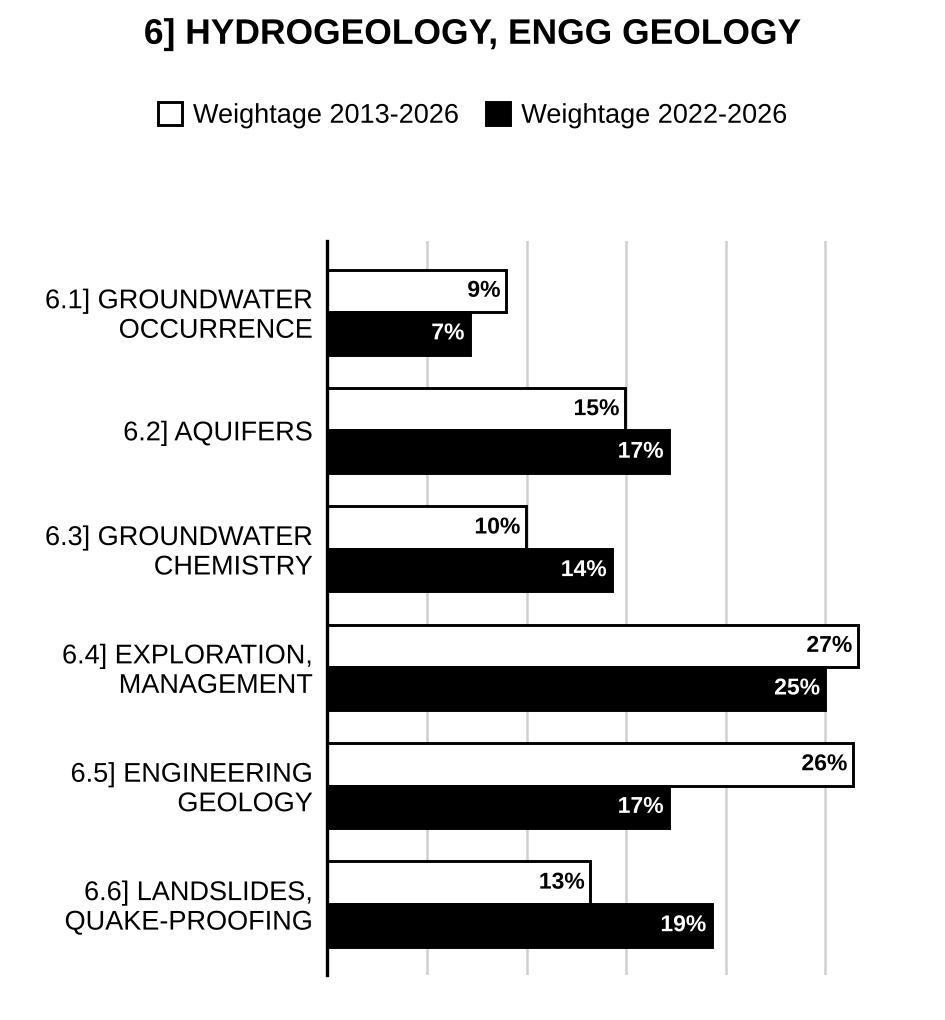
6.1] Occurrence and movement of groundwater
11 questions
What is hydrologic cycle? Explain the importance of rainwater harvesting in groundwater management. [2026/10m/150w/5d]
Explain different generic type of water and their significance in water supply. [2025/10m/150w/5e]
Describe how Darcy’s law and Reynolds’ number are related to the types of fluid flow in aquifers. [2024/10m/150w/5d]
Explain the factors influencing the groundwater movement and storage. [2020/10m/150w/5d]
What do you understand by spring sanctuaries? Describe the various types of springs. [2018/15m/8b]
Subsurface distribution of water. [2016/10m/150w/5e]
What are springs? Give an account of various types of springs. [2016/15m/8a]
Explain Hydrological cycle with neat diagram. [2013/20m/7b]
Springs and oasis. [2011/20m/200w/8c]
Hydrologic cycle. [2007/20m/200w/5c]
Water table. [1995/20m/200w/5d]
6.2] Aquifers
19 questions
Discuss the hydrogeological properties of different rock types and their role in groundwater studies. [2026/15m/6c]
Discuss the interrelationship amongst Porosity, Permeability and Hydraulic conductivity. How they are important in groundwater movement? A sediment sample with a cross section area of is tested in a permeameter with a length of 30 cm. Water flows through the sample at a rate of with a head difference 20 cm. Calculate the Hydraulic conductivity. [2025/20m/8a]
Describe briefly the characteristics of different types of aquifers and also discuss the important properties that an aquifer should possess. [2024/15m/6c]
Briefly discuss the water-bearing properties of rocks. [2023/10m/150w/5d]
Discuss characteristics of confined and unconfined aquifers. [2021/10m/150w/5d]
Explain the factors influencing the groundwater movement and storage. [2020/10m/150w/5d]
Describe different types of aquifers and list the characteristics of a good aquifer. [2019/10m/150w/5e]
Describe the groundwater provinces of India and comment on their hydrogeological potential. [2019/20m/7a]
Define ‘specific yield’ and ‘specific retention’ of aquifers. Explain how they are related to porosity with the help of equations. [2019/15m/8b]
Water bearing characteristics of rocks. [2017/10m/150w/5c]
Water bearing characteristics of sedimentary and igneous rocks. [2014/10m/150w/5d]
How is quality of Aquifer related to porosity and permeability? [2013/10m/150w/5e]
How are aquifers classified? Briefly describe each type. [2012/20m/250w/8a]
Properties of a good aquifer rock. [2011/20m/200w/8b]
Elaborate on the following: Computation of aquifer parameters. [2009/30m/8a]
Classification of aquifers. [2005/20m/200w/5c]
Water-bearing characteristics of rocks. [2005/30m/8a]
While certain rocks are excellently water-bearing, others do exist without containing a drop of water. Discuss if this is possible. [2002/30m/8a]
Types of aquifers. [2000/20m/8c]
6.3] Groundwater chemistry and salt water intrusion
10 questions
Discuss briefly how do chemical, physical and bacteriological properties determine the usability of ground-water. [2023/20m/8a]
What are the different sources for saline water intrusion in aquifers? Describe Ghyben-Herzberg relation. [2022/10m/150w/5d]
Give an account of interpretation of groundwater chemical quality through various graphic representation methods. [2022/20m/8a]
Give a brief account of sources of groundwater pollution in India and discuss the management of groundwater resources. [2021/20m/8a]
Explain the process of saltwater intrusion with neat sketches. Give examples from India. [2020/15m/6c]
Giving suitable examples discuss the strategies which may be adopted to control river water pollution. [2017/15m/3c]
What is salt water intrusion? How can it be prevented? [2014/10m/6c]
Quality classification of irrigation water. [2012/12m/150w/5d]
Ground water chemistry. [2007/30m/8a]
Problem of salt-water intrusion in coastal areas and remedial measures. [2001/30m/8a]

Preparing for Prelims too?
Our UPSC Prelims Topic-wise PYQ eBook covers every Prelims question with detailed explanations, so you can see exactly where UPSC asks from.
View the BookDownload Free Sample6.4] Groundwater exploration and management
32 questions
What is hydrologic cycle? Explain the importance of rainwater harvesting in groundwater management. [2026/10m/150w/5d]
Explain the morphometry of a drainage basin and its significance in groundwater studies. [2026/10m/150w/5e]
Explain how the Remote Sensing and Geographic Information System (GIS) may help in delineation of Groundwater potential zone? [2025/15m/3b]
What are different type of wells used for the extraction of groundwater? How and why the well field should be protected? [2025/15m/6c]
Explain the concept of drainage basin morphometry. How do morphometric parameters influence the groundwater conditions of an area? [2024/20m/8a]
What is “Rainwater harvesting”? Describe its technique with neat sketches. [2023/15m/6c]
Describe the surface investigation methods of groundwater. [2022/15m/6c]
Discuss briefly as to why artificial recharge is essentially required in confined aquifers. Explain with suitable diagrams a typical injection well for roof-top harvesting of water. [2021/15m/6c]
Give a brief account of sources of groundwater pollution in India and discuss the management of groundwater resources. [2021/20m/8a]
Explain the natural and artificial recharge processes to enhance the groundwater potential in hard and soft rock terrains. [2020/20m/8a]
What are stream order and mean bifurcation ratio of a drainage basin? Discuss their significance in the morphometric analysis of a drainage basin. [2018/10m/150w/1b]
State the methods of groundwater exploration. [2018/10m/150w/5c]
Concept of rainwater harvesting. [2017/10m/150w/5d]
What do you understand by groundwater recharge? Describe various methods used in this process. [2017/15m/8a]
Give an account of seismic refraction method in the exploration for groundwater. [2016/20m/6a]
Explain the principle of electrical resistivity method in the exploration of groundwater. Add a note on vertical electrical sounding. [2015/15m/7b]
Give an account of various types of rainwater harvesting methods. [2015/15m/8c]
Describe various methods of ground water recharge. [2014/20m/8b]
Describe various methods for Ground water exploration. [2013/20m/7a]
Morphometric analysis of drainage basins. [2011/20m/3a]
The salient features of groundwater exploration in gneissic terrains. [2010/20m/200w/8a]
Different methods of morphometric analysis of river basins. [2010/20m/200w/8c]
Morphometric parameters and their interrelationships. [2009/20m/200w/5c]
Rain water harvesting. [2007/20m/200w/5d]
Importance of rain-water harvesting. [2006/20m/200w/5c]
Ground water recharge and various recharging methods. [2006/30m/8a]
Management of groundwater. [2004/30m/8a]
Importance of rain water harvesting for living beings. [2003/30m/8a]
Ground-water recharge. [2002/20m/200w/5d]
Describe the role played by the hydrogeological studies in the welfare of human civilization. [2001/20m/200w/5d]
Explain the resistivity method as applied to groundwater exploration. [1999/60m/8]
Groundwater recharge. [1998/20m/200w/5d]
6.5] Engineering geology
36 questions
Discuss the geological challenges encountered in limestone terrains while building a tunnel. What specific remedial measures would you propose? [2026/15m/7c]
What engineering properties make Marble, Sandstone and Granite useful as building stone? [2025/10m/150w/5d]
Describe the types of geological investigation required before construction of a highway in the Himalayas. [2024/15m/7c]
What are the engineering properties of rocks that make them suitable for use as building materials? [2023/10m/150w/5e]
What are the geological investigations required for civil engineering projects of dams, reservoirs and tunnels? [2022/10m/150w/5e]
Describe various types of Dam with suitable sketches. Comment on the geological conditions required for site selection for each type of Dam. [2021/15m/7c]
Discuss five engineering properties of rocks. [2020/10m/150w/5e]
Describe the geological factors to be considered in the construction of tunnels. [2019/10m/150w/5d]
What are the factors that must be considered during the geological investigation for locating a dam site? [2019/15m/6c]
Explain the geological considerations for construction of roads in hilly terrain. [2018/10m/150w/5d]
Discuss the geological considerations for selection of sites for bridges. [2018/20m/8a]
Geological considerations for construction of tunnels in deformed geological terrain. [2017/15m/6b]
Discuss the geological considerations for selection of a dam site in Himalayan terrain. [2017/20m/7c]
Types of forces acting on a dam. [2016/10m/150w/5d]
Buttress dams. [2015/10m/150w/5d]
Alkali-aggregate reaction. [2015/10m/150w/5e]
What are the essential characters of rocks to be considered as a construction material? Add a note on aggregates. [2015/20m/6a]
Engineering properties of granite, sandstone, and deccan trap basalt. [2014/10m/150w/5c]
What are the geological investigations required for construction of a gravity dam? [2014/10m/7c]
Geological investigations in construction of Hydro-Power projects in Himalaya. [2013/20m/6a]
Criteria for selecting suitable building stone. [2012/12m/150w/5e]
Explain the influence of folding in the foundation rocks of a dam site and in tunnels. [2012/20m/250w/8b]
Rock as construction material. [2011/15m/150w/5b]
Elaborate on the following: Geological investigations for constructing tunnels in a highly sheared area. [2009/30m/8b]
Geological investigation for bridges. [2007/30m/8b]
Factors controlling the choice of bridge sites. [2006/20m/200w/5d]
Geological investigations for tunnel alignment. [2006/30m/8b]
Engineering properties of rocks. [2005/30m/8b]
Rocks as construction material. [2004/20m/200w/5d]
Geological investigations of a Dam site. [2004/30m/8b]
Role of geologists in the construction of bridge. [2003/20m/200w/5b]
Answer the questions.
(i) What aspects a geologist should investigate for selecting a tunnel site on a hill-slope? [2002/22m/8b(i)]
(ii) Which rocks are chosen for heavy construction purpose? [2002/8m/8b(ii)]
Geological considerations in dam construction. [2001/30m/8b]
Give a brief critical account of geological knowledge as applied in the construction of Dams and Tunnels. [1997/60m/8]
Briefly discuss application of geological knowledge in various engineering works. [1996/60m/8]
Describe geological considerations in Tunnelling. [1995/60m/7]
6.6] Landslides and earthquake-resistant structures
13 questions
What are landslides and avalanches? Discuss the causes and effects of landslides. Enumerate the remedial measures to prevent landslides. [2026/20m/8a]
Why Earthquake resistant structures are needed? Discuss the geological considerations required for developing the Earthquake resistant structures. [2025/15m/7c]
Describe the rehabilitation measures required in landslide-affected area to restore the community and the ecology of the area affected. [2024/10m/150w/5e]
How does an Earthquake occur? Describe the construction patterns of earthquake resistant structures. [2023/15m/7c]
Describe the types of landslide, and discuss its factors and mitigation measures. [2022/15m/7c]
Discuss briefly characteristics of earthquake resistant structures. [2021/10m/150w/5e]
What is a landslide? Explain the different types and their causes. Give two examples from India. [2020/15m/7c]
What are the different types of landslides? Discuss their controlling measures. [2018/20m/7a]
What are landslides? Explain the causes of landslides and the measures that can be taken to overcome this phenomenon. [2016/20m/7a]
What are the preventive measures adopted for landslides? Explain them briefly. [2012/20m/250w/8c]
Precautions required in construction of a tall building in an earthquake-prone area. [2011/20m/200w/8a]
Landslide-its causes and prevention. [2005/20m/200w/5d]
Precautions in construction of buildings in earthquake-prone zones. [2003/30m/8b]

Strengthen your GS papers
Our UPSC Mains Topic-wise & Year-wise PYQ eBook (2013–2026) maps every GS question to the syllabus, so you know what UPSC asks and how often.
View the BookDownload Free Sample« Previous: Indian Stratigraphy | Next: Mineralogy »
Back to: Geology Optional PYQs – Topic-wise | Also see: Geology Optional year-wise question papers
Last updated: 31 October 2026