
Kannada Literature Optional PYQs Topic-wise for UPSC Mains (2008–2026) are listed below unit by unit, in the order of the official syllabus – 965 questions in all. Click any unit to open all its previous year questions, arranged topic-wise with the latest first.
Want full papers instead? Open the Kannada Literature Optional year-wise question papers for Paper 1 and Paper 2, or the official syllabus.
Want the trends behind these questions? See the Kannada Literature Optional PYQ analysis: marks by unit, repeated questions and a paper-wise analysis for every year from 2020 to 2026.
Paper I
| Unit | Topic (click to open PYQs) | Sub-topics | Questions | Link |
|---|---|---|---|---|
| 1 | ಕನ್ನಡ ಭಾಷೆಯ ಚರಿತ್ರೆ | 7 | 57 | Click here → |
| 2 | ಕನ್ನಡ ಸಾಹಿತ್ಯ ಚರಿತ್ರೆ | 11 | 143 | Click here → |
| 3 | ಆಧುನಿಕ ಕನ್ನಡ ಸಾಹಿತ್ಯ | 5 | 89 | Click here → |
| 4 | ಕಾವ್ಯಮೀಮಾಂಸೆ ಮತ್ತು ಸಾಹಿತ್ಯ ವಿಮರ್ಶೆ | 13 | 127 | Click here → |
| 5 | ಕರ್ನಾಟಕದ ಸಾಂಸ್ಕೃತಿಕ ಚರಿತ್ರೆ | 8 | 120 | Click here → |
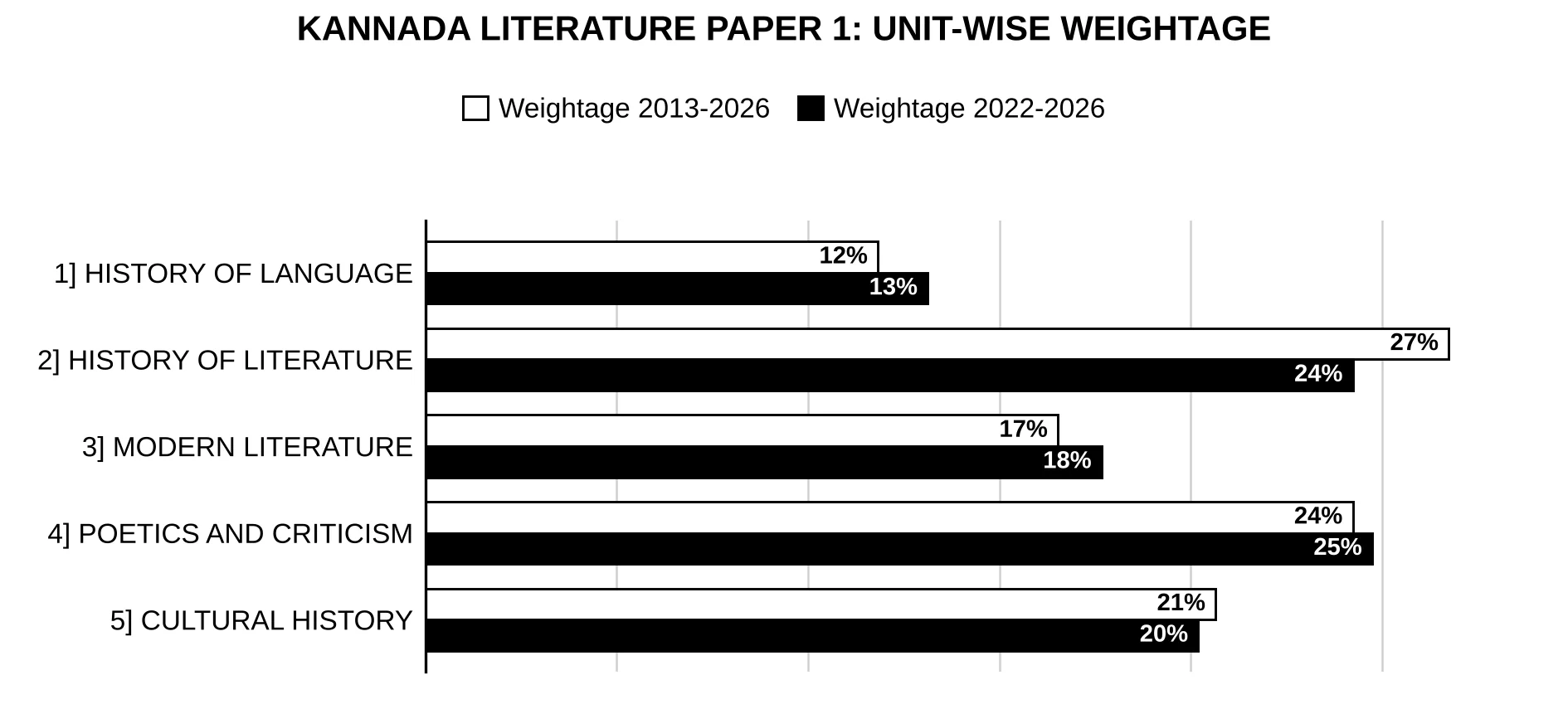
Trend: Over 2013–2026 the history of Kannada literature (Unit 2) carries the largest share of marks, about 27%, followed by poetics and criticism (about 24%), the cultural history of Karnataka (about 21%), modern Kannada literature (about 17%) and the history of the language (about 12%); the shares are almost the same in 2022–2026. In literary history, vachana literature (2.6) and dasa literature (2.10) lead, with Pampa (2.2) close behind and rising in recent years. Dalit–Bandaya (3.5) and Navodaya (3.2) are the most-asked modern movements; in poetics, modern trends in criticism (4.8) and rasa (4.5) lead, and rasa is the single largest topic of the unit in 2022–2026. In cultural history, the arts (5.7) and the religions of Karnataka (5.6) take the most marks, and in the language unit the Dravidian family (1.2) and dialects (1.5), the latter the largest in the last five years.

Preparing for Prelims too?
Our UPSC Prelims Topic-wise PYQ Book covers every Prelims question with detailed explanations, so you can see exactly where UPSC asks from. Now available as a hard copy and an eBook.
Buy Hard Copy on AmazonBuy eBook (PDF)Paper II
| Unit | Topic (click to open PYQs) | Sub-topics | Questions | Link |
|---|---|---|---|---|
| 1 | ವಿಭಾಗ ಅ: ಹಳಗನ್ನಡ ಸಾಹಿತ್ಯ | 2 | 58 | Click here → |
| 2 | ವಿಭಾಗ ಅ: ನಡುಗನ್ನಡ ಸಾಹಿತ್ಯ | 5 | 176 | Click here → |
| 3 | ವಿಭಾಗ ಬ: ಆಧುನಿಕ ಕನ್ನಡ ಸಾಹಿತ್ಯ | 8 | 153 | Click here → |
| 4 | ವಿಭಾಗ ಬ: ಜಾನಪದ ಸಾಹಿತ್ಯ | 5 | 64 | Click here → |
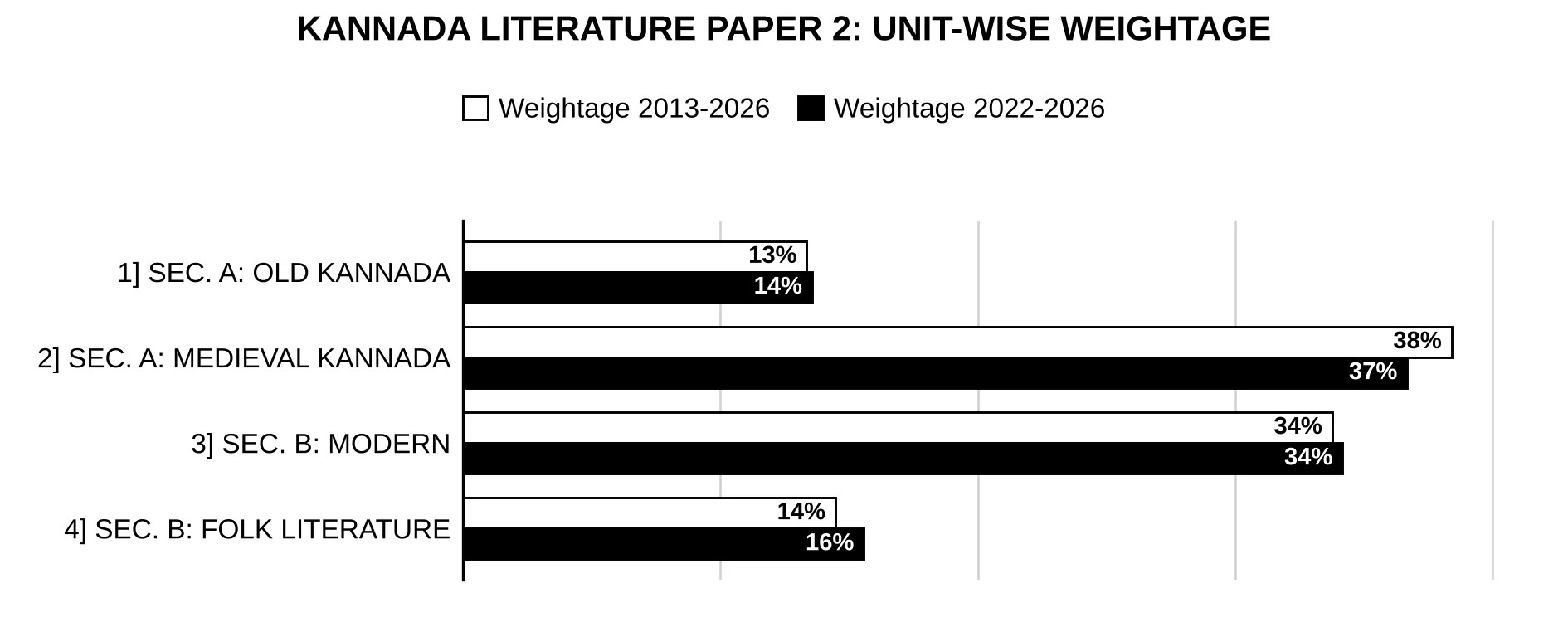
Trend: Medieval Kannada (Unit 2) carries the largest share, about 38% over 2013–2026 and 37% in 2022–2026, followed by modern Kannada literature (about 34%), folk literature (about 15%) and Old Kannada (about 13%). ‘ವಚನ ಕಮ್ಮಟ’ is the most-asked text of the medieval unit, ahead of Kumaravyasa’s Karnaparva, ‘ಭರತೇಶ ವೈಭವ’, Kanaka and ‘ನಂಬಿಯಣ್ಣನ ರಗಳೆ’; in Old Kannada, Pampa takes about three-fifths of the marks and ‘ವಡ್ಡಾರಾಧನೆ’ the rest. In the modern unit the anthologies ‘ಹೊಸಗನ್ನಡ ಕವಿತೆ’ and ‘ಕನ್ನಡ ಸಣ್ಣ ಕತೆಗಳು’ lead, with ‘ದೇವರು’ rising in 2022–2026; among the folk texts, ‘ಕನ್ನಡ ಜಾನಪದ ಕತೆಗಳು’ leads over the whole period, while in the last five years it shares the lead with ‘ಜಾನಪದ ಸ್ವರೂಪ’ and the proverbs.
More questions
Other questions (outside the present syllabus) – 2 questions
Frequently asked questions
How many Kannada Literature Optional PYQs are there?
There are 965 Kannada Literature Optional questions from 2008 to 2026, across Paper I and Paper II, arranged under 9 units of the official syllabus. A question that covers two topics is listed under both.
Which Kannada Literature Optional units are asked most often?
By number of questions – ವಿಭಾಗ ಅ: ನಡುಗನ್ನಡ ಸಾಹಿತ್ಯ (Paper II, 176); ವಿಭಾಗ ಬ: ಆಧುನಿಕ ಕನ್ನಡ ಸಾಹಿತ್ಯ (Paper II, 153); ಕನ್ನಡ ಸಾಹಿತ್ಯ ಚರಿತ್ರೆ (Paper I, 143); ಕಾವ್ಯಮೀಮಾಂಸೆ ಮತ್ತು ಸಾಹಿತ್ಯ ವಿಮರ್ಶೆ (Paper I, 127). The weightage graphs on these pages compare the share of marks across periods.
What does a code like [2024/15m/3b] after a question mean?
It gives the year, the marks, the word limit (where UPSC set one) and the question number in the paper. So [2024/15m/3b] is Question 3(b) of the 2024 paper, worth 15 marks.
Where can I download the full Kannada Literature Optional question papers?
Every available paper is free as a PDF on our Kannada Literature Optional year-wise question papers page, for both Paper 1 and Paper 2.
How should we use these PYQs in our preparation?
Read the syllabus for a unit first, then go through its questions, starting with the most recent years. In Paper II, read each prescribed text in the original and note which passages and themes UPSC returns to. Practise writing answers within the word limit and time.
How this collection is organised
Units follow the official syllabus – Paper 1: 1 ಕನ್ನಡ ಭಾಷೆಯ ಚರಿತ್ರೆ, 2 ಕನ್ನಡ ಸಾಹಿತ್ಯ ಚರಿತ್ರೆ, 3 ಆಧುನಿಕ ಕನ್ನಡ ಸಾಹಿತ್ಯ, 4 ಕಾವ್ಯಮೀಮಾಂಸೆ ಮತ್ತು ಸಾಹಿತ್ಯ ವಿಮರ್ಶೆ and 5 ಕರ್ನಾಟಕದ ಸಾಂಸ್ಕೃತಿಕ ಚರಿತ್ರೆ (for example Paper 1 – 2.9 ಕುಮಾರವ್ಯಾಸ); Paper 2: 1 ವಿಭಾಗ ಅ: ಹಳಗನ್ನಡ ಸಾಹಿತ್ಯ, 2 ವಿಭಾಗ ಅ: ನಡುಗನ್ನಡ ಸಾಹಿತ್ಯ, 3 ವಿಭಾಗ ಬ: ಆಧುನಿಕ ಕನ್ನಡ ಸಾಹಿತ್ಯ and 4 ವಿಭಾಗ ಬ: ಜಾನಪದ ಸಾಹಿತ್ಯ, with each prescribed text as a topic of its own (for example Paper 2 – 3.7 ಗಿರೀಶ ಕಾರ್ನಾಡ ‘ತುಘಲಕ್’). Topic names are given in Kannada.
Every passage printed for explanation in Paper 2 is placed under the prescribed text it is taken from. Where the paper does not name the source, it has been identified editorially from the passage itself – its form (ಚಂಪೂ verse, ವಚನ, ಕೀರ್ತನೆ, ರಗಳೆ, ಭಾಮಿನಿ ಷಟ್ಪದಿ, ಸಾಂಗತ್ಯ), its ಅಂಕಿತ and its characters; a few attributions remain open to correction. One verse from ‘ಕವಿರಾಜಮಾರ್ಗ’ (2024), which is not a prescribed text, is placed under Outside the present syllabus.
Questions on writers in Paper 1 are placed under the poet’s own topic where the syllabus names him (for example ಜನ್ನ, ರಾಘವಾಂಕ), and otherwise under the period or movement they belong to (for example ರನ್ನ under ಪ್ರಾಚೀನ ಕನ್ನಡ ಸಾಹಿತ್ಯ, ದೇವನೂರ ಮಹಾದೇವ under ದಲಿತ ಮತ್ತು ಬಂಡಾಯ).
Some questions cover more than one topic. We’ve kept such questions in each topic of relevance.
Graphs at the start of each paper show the weightage of every unit in that paper, and graphs for each unit show the weightage of its topics. Weightage is the share of marks asked from a unit or topic, compared for 2013–2026 (white bars) and the last five years, 2022–2026 (black bars). A question placed under two topics has its marks split equally between them.
Each of the topicwise question is suffixed by a question code like this [2024/20m/2a]. This code indicates a) year in which the question was asked, b) maximum marks the question carried and, c) the question number in actual paper, in given order. Where UPSC printed a word limit (Paper 2 of 2013), it is kept in the question text.
Until 2012, each paper carried 300 marks (60 per question); since 2013 each paper carries 250 marks (50 per question). Where a question offered more parts than were to be answered (“any three” of four in Q1 and Q5 of 2008–2010), every part is included with its own marks.
All papers are transcribed from scans of the UPSC question papers. Every page was transcribed and then checked a second time by an independent reader against the scan. The wording, spelling and punctuation are as printed, including the papers’ own misprints. No copy of Paper 2 of 2008 could be found, and Section B (Q5–Q8) of Paper 2 of 2016 is missing from the only copy available; these parts are not included. The 2008 Paper 1 survives only as a blurred photograph: four words that could not be read with certainty are marked [?], and the marks of Q6–Q8, cut off at the margin, follow the paper’s rule that all questions carry equal marks. Q8 of Paper 2 of 2015 was read from a very poor scan.
Spotted an error? Use the “Report an Error” box at the end of any page – we review every report and update the page.

Strengthen your GS papers
Our UPSC Mains Topic-wise & Year-wise PYQ Book (2013–2026) maps every GS question to the syllabus, so you know what UPSC asks and how often. Now available as a hard copy and an eBook.
Buy Hard Copy on AmazonBuy eBook (PDF)Last updated: 2 November 2026