
Mathematics Optional PYQs Topic-wise for UPSC Mains (2008–2026) are listed below unit by unit, in the order of the official syllabus – 1203 questions in all. Click any unit to open all its previous year questions, arranged topic-wise with the latest first.
Want full papers instead? Open the Mathematics Optional year-wise question papers for Paper I and Paper II.
Paper I
| Unit | Topic (click to open PYQs) | Sub-topics | Questions | Link |
|---|---|---|---|---|
| 1 | Linear Algebra | 4 | 118 | Click here → |
| 2 | Calculus | 5 | 107 | Click here → |
| 3 | Analytic Geometry | 3 | 89 | Click here → |
| 4 | Ordinary Differential Equations | 5 | 118 | Click here → |
| 5 | Dynamics and Statics | 5 | 100 | Click here → |
| 6 | Vector Analysis | 3 | 89 | Click here → |
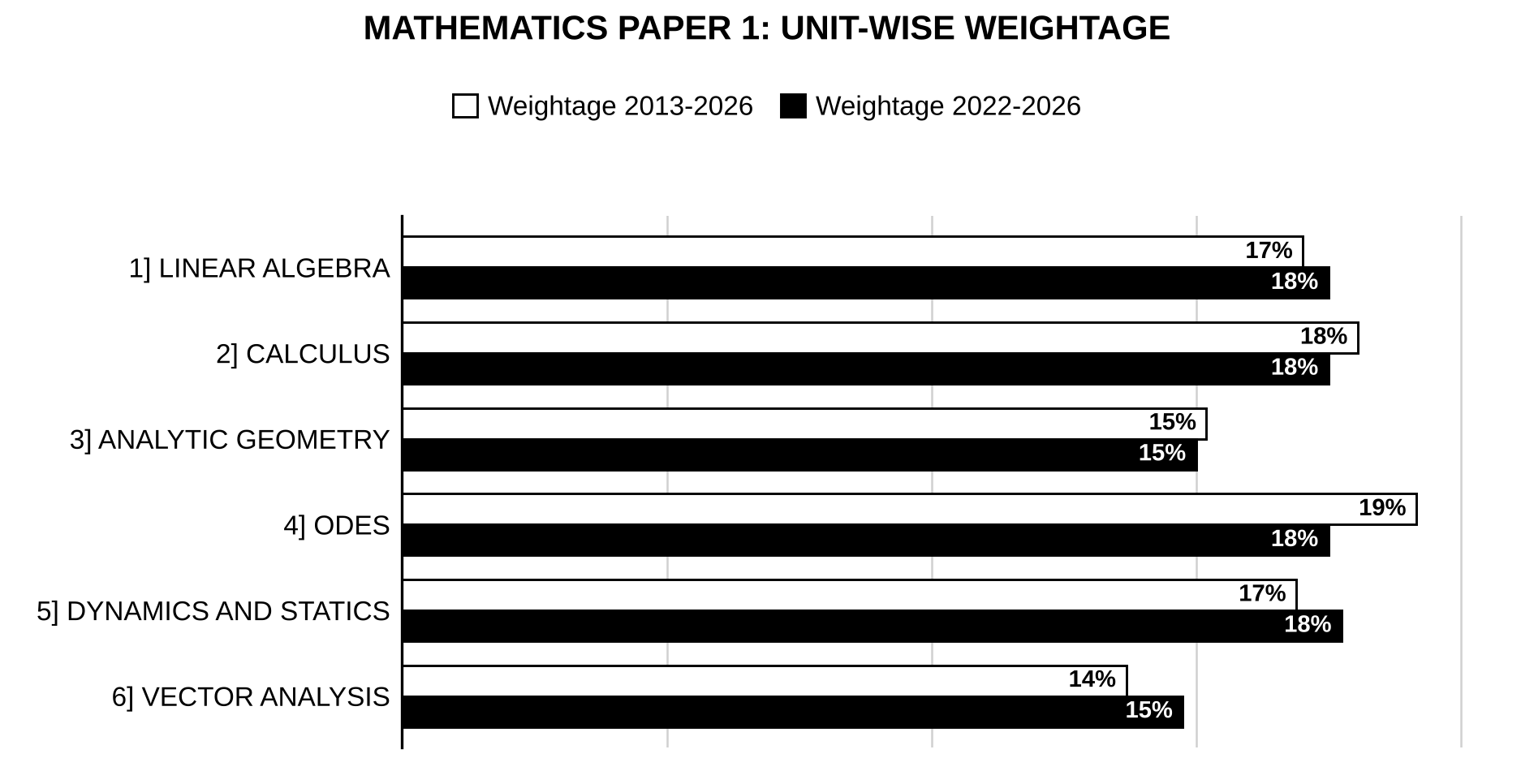
Trend: Paper I is spread almost evenly over its six units, each taking between about 14% and 19% of the marks, both since 2013 and in the last five years: Ordinary Differential Equations (about 18–19%), Calculus, Dynamics and Statics and Linear Algebra (about 17–18% each), Analytic Geometry (about 15%) and Vector Analysis (about 14–15%). Within the units, eigenvalues and special matrices (topic 1.4) and linear transformations (1.2), functions of two or three variables (2.3) and multiple integrals (2.5), sphere, cone and cylinder (3.2), equations with variable coefficients (4.4) and first-order equations (4.1), equilibrium and friction (5.4) and the integral theorems of Gauss, Stokes and Green (6.3) have been asked most often since 2013. In 2022–2026 linear transformations (1.2), maxima, minima and curve tracing (2.2), sphere, cone and cylinder (3.2), Laplace transforms (4.5) and virtual work and stability (5.5) have come up more often.

Preparing for Prelims too?
Our UPSC Prelims Topic-wise PYQ eBook covers every Prelims question with detailed explanations, so you can see exactly where UPSC asks from.
View the BookDownload Free SamplePaper II
| Unit | Topic (click to open PYQs) | Sub-topics | Questions | Link |
|---|---|---|---|---|
| 1 | Algebra | 5 | 85 | Click here → |
| 2 | Real Analysis | 6 | 89 | Click here → |
| 3 | Complex Analysis | 4 | 67 | Click here → |
| 4 | Linear Programming | 3 | 55 | Click here → |
| 5 | Partial Differential Equations | 4 | 86 | Click here → |
| 6 | Numerical Analysis and Computer Programming | 7 | 114 | Click here → |
| 7 | Mechanics and Fluid Dynamics | 5 | 86 | Click here → |
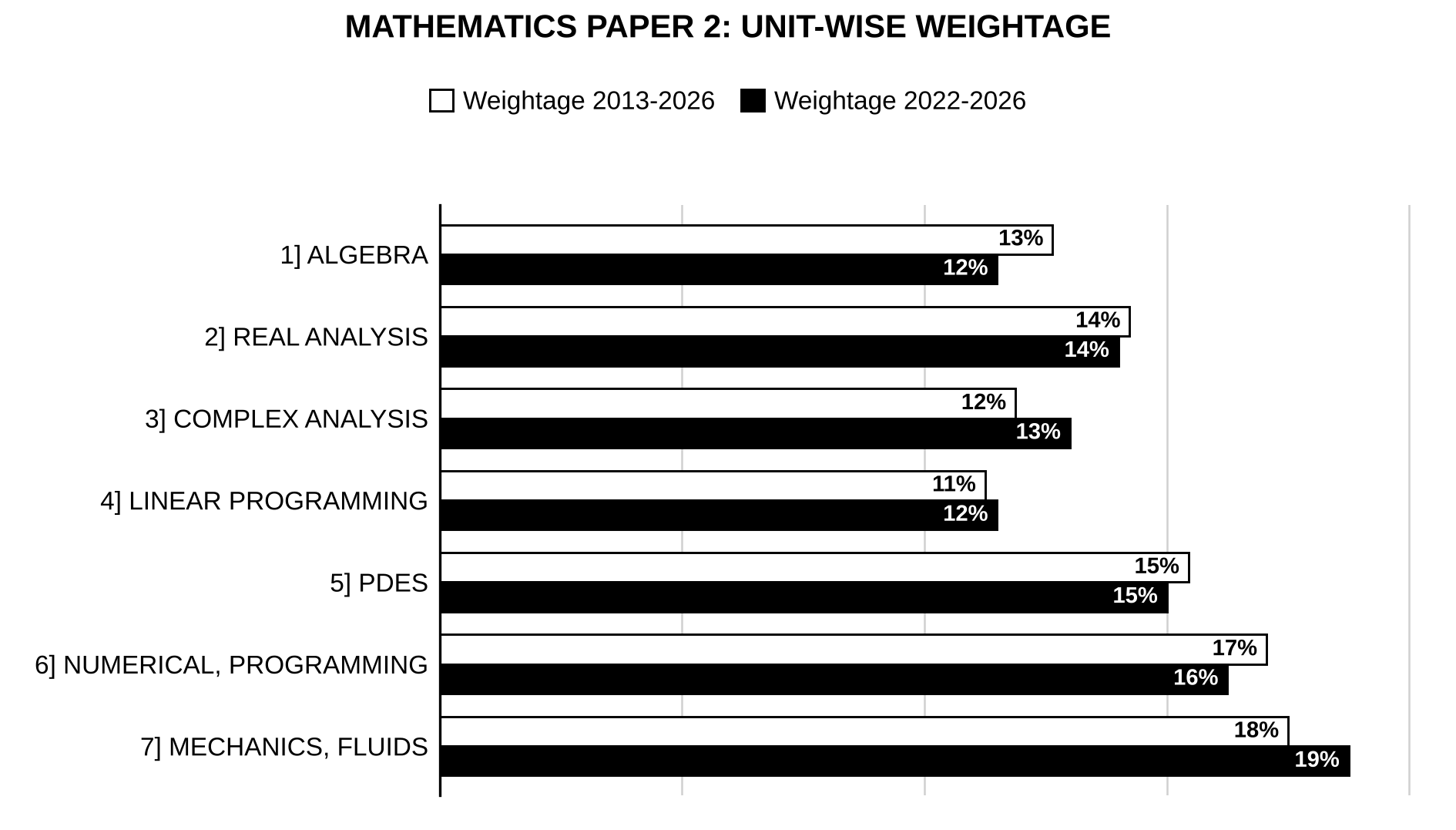
Trend: Paper II is also evenly spread: Mechanics and Fluid Dynamics (about 18–19%), Numerical Analysis and Computer Programming (about 16–17%), Partial Differential Equations (15%), Real Analysis (14%), Complex Analysis (12–13%), Algebra (12–13%) and Linear Programming (about 11%). The most-asked topics since 2013 are integral domains and fields (1.5) and normal subgroups and homomorphisms (1.2), the Riemann integral (2.4) and functions of several variables (2.6), residues and contour integration (3.4), the simplex method (4.1) and transportation and assignment problems (4.3), second-order linear PDEs (5.3) and the wave, heat and Laplace equations (5.4), solution of equations (6.1) and Boolean algebra and logic gates (6.6), and two-dimensional flows (7.4) and Lagrangian and Hamiltonian mechanics (7.1). In 2022–2026 homomorphisms (1.2), transportation and assignment (4.3), second-order PDEs (5.3) and rigid-body motion (7.2) have come up more often.
How this collection is organised
Considering the changing exam pattern over the years, we felt it necessary to declare some practices we’ve adopted in this book.
Units follow the official syllabus – Paper 1: 1 Linear Algebra, 2 Calculus, 3 Analytic Geometry, 4 Ordinary Differential Equations, 5 Dynamics and Statics, 6 Vector Analysis; Paper 2: 1 Algebra, 2 Real Analysis, 3 Complex Analysis, 4 Linear Programming, 5 Partial Differential Equations, 6 Numerical Analysis and Computer Programming, 7 Mechanics and Fluid Dynamics. The official syllabus has been divided into numbered topics (e.g. Paper 1 – 4.5 Laplace transforms) to arrange the questions.
Questions on areas the syllabus does not name separately are placed under the nearest topic: for example, quadratic forms under the algebra of matrices (Paper 1 – 1.3); beta and gamma functions under integration (2.4); radius of curvature of plane curves under curve tracing (2.2); vector algebra under vector differentiation (6.1); in Paper 2, Sylow theorems and the class equation under permutation groups (1.3); one-variable calculus under continuity (2.3); conformal mappings under analytic functions (3.1); and Big-M and two-phase methods under the simplex method (4.1).
Some questions cover more than one topic. We’ve kept such questions in each topic of relevance.
Every figure printed with a question is given as a complete description in square brackets – [Figure: …] – with every point, line, value and label shown, so that the question can be solved from the description. Standard tables attached to a paper are not reproduced.
Graphs at the start of each paper show the weightage of every unit in that paper, and graphs for each unit show the weightage of its topics. Weightage is the share of marks asked from a unit or topic, compared for 2013–2026 (white bars) and the last five years, 2022–2026 (black bars). A question placed under two topics has its marks split equally between them.
Each of the topicwise question is suffixed by a question code like this [2024/20m/2a]. This code indicates a) year in which the question was asked, b) maximum marks the question carried, c) prescribed word limit (where UPSC set one, e.g. 200w) and, d) the question number in actual paper, in given order.
Until 2012, each paper carried 300 marks (60 per question); since 2013 each paper carries 250 marks (50 per question). Where a compulsory question offered more parts than were to be answered (“any three” of four), every part is included with its own marks. Where a retyped copy of an older paper prints no marks for a part, the code carries the marks implied by the question. Where a paper prints a combined figure for sub-parts (e.g. 10+10 or 8+7=15), it is kept as printed.
2014–2026 papers are transcribed from the official UPSC question papers, 2009–2013 from scans of the official papers, and 2008 from a retyped copy. Papers before 2008 are not included in this edition.
The wording, figures and data of the questions are as printed, including the papers’ own grammar and apparent misprints such as wrong units.
If you have any queries or suggestions, feel free to reach us at educationprovince.com

Strengthen your GS papers
Our UPSC Mains Topic-wise & Year-wise PYQ eBook (2013–2026) maps every GS question to the syllabus, so you know what UPSC asks and how often.
View the BookDownload Free SampleLast updated: 30 October 2026