
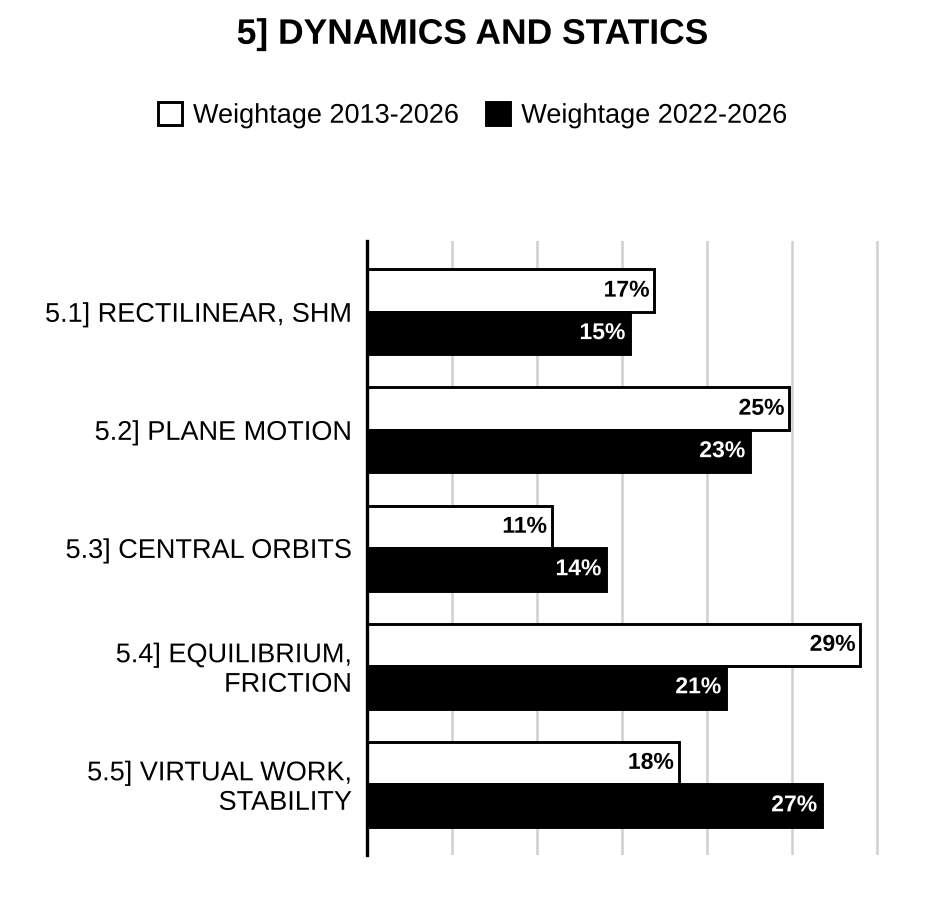
Here are all 100 Dynamics and Statics questions asked in UPSC Mathematics Optional Paper I from 2008 to 2026, arranged under the 5 topics of the official syllabus. Within each topic the latest questions come first.
Each question ends with a code such as [2024/10m/1a] – the year, the marks and the question number in the paper.
5.1] Rectilinear motion and SHM
20 questions
A light elastic string of natural length has one extremity fixed at a point and the other attached to a stone (mass ) the weight of which in equilibrium would extend the string to a length . Show that if the stone be dropped from rest at , it will come to instantaneous rest at a depth below the equilibrium position and this depth is attained in time Prove also that if the greatest depth below be , then the modulus of elasticity is . [2026/15m/7a]
One end of an elastic string, having natural length , is fixed at some point and a heavy particle is attached to the other end of the string. The string is drawn vertically downward till it is four times its natural length at the point and then released. If the modulus of elasticity of the string is equal to the weight of the particle, then show that the particle will return to the same point in the time . [2025/15m/6b]
A particle executes simple harmonic motion such that in two of its positions, velocities are and , and the two corresponding accelerations are and . For what value(s) of , the distance between the two positions is ? Show also that the amplitude of the motion is [2024/15m/6b]
A particle is moving under Simple Harmonic Motion of period about a centre . It passes through the point with velocity along the direction and . Find the time that elapses before the particle returns to the point . What will be the value of when the elapsed time is ? [2023/10m/5d]
If a planet, which revolves around the Sun in a circular orbit, is suddenly stopped in its orbit, then find the time in which it would fall into the Sun. Also, find the ratio of its falling time to the period of revolution of the planet. [2021/10m/5d]
The force of attraction of a particle by the earth is inversely proportional to the square of its distance from the earth’s centre. A particle, whose weight on the surface of the earth is , falls to the surface of the earth from a height above it. Show that the magnitude of work done by the earth’s attraction force is , where is the radius of the earth. [2019/10m/5d]
A particle moving along the -axis has an acceleration towards the origin, where is a positive and even function of . The periodic time, when the particle vibrates between and , is . Show that where and are the greatest and the least values of within the range . Further, show that when a simple pendulum of length oscillates through on either side of the vertical line, lies between and . [2019/20m/7c]
A particle moving with simple harmonic motion in a straight line has velocities and at distances and respectively from the centre of its path. Find the period of its motion. [2018/12m/6b]
A particle moves in a straight line. Its acceleration is directed towards a fixed point in the line and is always equal to when it is at a distance from . If it starts from rest at a distance from , then find the time, the particle will arrive at . [2016/15m/8c]
A body moving under SHM has an amplitude ‘‘ and time period ‘‘. If the velocity is trebled, when the distance from mean position is ‘‘, the period being unaltered, find the new amplitude. [2015/10m/5c]
A mass starts from rest at a distance ‘‘ from the centre of force which attracts inversely as the distance. Find the time of arriving at the centre. [2015/13m/6d]
A particle is performing a simple harmonic motion (S.H.M.) of period about a centre with amplitude and it passes through a point , where in the direction . Prove that the time which elapses before it returns to is . [2014/10m/5c]
A body is performing S.H.M. in a straight line . Its velocity is zero at points and whose distances from are and respectively and its velocity is at the mid-point between and . Find the time of one complete oscillation. [2013/10m/5c]
A particle moves with an acceleration towards the origin. If it starts from rest at a distance from the origin, find its velocity when its distance from the origin is . [2012/12m/5d]
The velocity of a train increases from 0 to at a constant acceleration , then remains constant for an interval and again decreases to 0 at a constant retardation . If the total distance described is , find the total time taken. [2011/10m/5c]
A mass of 560 kg. moving with a velocity of 240 m/sec strikes a fixed target and is brought to rest in sec. Find the impulse of the blow on the target and assuming the resistance to be uniform throughout the time taken by the body in coming to rest, find the distance through which it penetrates. [2011/20m/7a]
After a ball has been falling under gravity for 5 seconds it passes through a pane of glass and loses half its velocity. If it now reaches the ground in 1 second, find the height of glass above the ground. [2011/10m/7c(i)]
A particle of mass moves on straight line under an attractive force towards a point on the line, where is the distance from . If and when , find for any time . [2011/10m/7c(ii)]
One end of a light elastic string of natural length and modulus of elasticity is attached to a fixed point and the other end to a particle of mass . The particle initially held at rest at is let fall. Find the greatest extension of the string during the motion and show that the particle will reach again after a time [2009/20m/7a]
A shell lying in a straight smooth horizontal tube suddenly breaks into two portions of masses and . If be the distance between the two masses inside the tube after time , show that the work done by the explosion can be written as equal to [2008/15m/7b]
5.2] Motion in a plane and constrained motion
25 questions
A particle falls from rest at the vertex of an inverted catenary. Prove that the particle will leave the curve when the path described is times the vertical distance through which the particle has fallen. [2026/10m/5d]
A battleship is steaming ahead with velocity . A gun is mounted on the ship so as to point straight backwards and is set at an angle of elevation . If be the velocity of projection relative to the gun, show that the range is and the angle for maximum range is where stands for acceleration due to gravity. [2026/10m/6b(i)]
A particle is projected inside a fixed smooth cylinder with circular cross-section in a vertical plane from the lowest point with initial horizontal velocity . Show that for (i) ; the particle oscillates about the mean position in the lower half, (ii) ; the particle executes complete circular motion, and (iii) ; the particle will leave the curve in a tangential direction, making an angle with the horizontal such that . [2025/20m/8c]
A heavy particle hanging vertically from a fixed point by a light inextensible string of length starts to move with initial velocity in a circle so as to make a complete revolution in a vertical plane. Show that the sum of tensions at the ends of any diameter is constant. [2024/15m/7b]
When a particle is projected from a point on the sea level with a velocity and angle of projection with the horizon in a vertical plane, its horizontal range is . If it is further projected from a point , which is vertically above at a height in the same vertical plane, with the same velocity and same angle with the horizon, its horizontal range is . Prove that and is equal to [2023/15m/6b]
A projectile is fired from a point with velocity and hits a tangent at the point in the plane, the axes and being horizontal and vertically downward lines through the point , respectively. Show that if the two possible directions of projection be at right angles, then and then one of the possible directions of projection bisects the angle . [2022/10m/5d]
A heavy particle hangs by an inextensible string of length from a fixed point and is then projected horizontally with a velocity . If , then prove that the circular motion ceases when the particle has reached the height from the point of projection. Also, prove that the greatest height ever reached by the particle above the point of projection is . [2021/15m/7c]
Describe the motion and path of a particle of mass which is projected in a vertical plane through a point of projection with velocity in a direction making an angle with the horizontal direction. Further, if particles are projected from that point in the same vertical plane with velocity , then determine the locus of vertices of their paths. [2021/15m/8b]
A light rigid rod has three particles each of mass attached to it at , and . The rod is struck by a blow at right angles to it at a point distant from equal to . Prove that the kinetic energy set up is , where and . [2020/10m/5e]
A four-wheeled railway truck has a total mass , the mass and radius of gyration of each pair of wheels and axle are and respectively, and the radius of each wheel is . Prove that if the truck is propelled along a level track by a force , the acceleration is , and find the horizontal force exerted on each axle by the truck. The axle friction and wind resistance are to be neglected. [2020/15m/8c]
A particle projected from a given point on the ground just clears a wall of height at a distance from the point of projection. If the particle moves in a vertical plane and if the horizontal range is , find the elevation of the projection. [2018/10m/5e]
A fixed wire is in the shape of the cardiod , the initial line being the downward vertical. A small ring of mass can slide on the wire and is attached to the point of the cardiod by an elastic string of natural length and modulus of elasticity . The string is released from rest when the string is horizontal. Show by using the laws of conservation of energy that , being the acceleration due to gravity. [2017/10m/5c]
A particle is free to move on a smooth vertical circular wire of radius . At time it is projected along the circle from its lowest point with velocity just sufficient to carry it to the highest point . Find the time at which the reaction between the particle and the wire is zero. [2017/17m/7c]
A particle is projected from the base of a hill whose slope is that of a right circular cone, whose axis is vertical. The projectile grazes the vertex and strikes the hill again at a point on the base. If the semivertical angle of the cone is , is height, determine the initial velocity of the projection and its angle of projection. [2015/13m/7b]
A particle of mass , hanging vertically from a fixed point by a light inextensible cord of length , is struck by a horizontal blow which imparts to it a velocity . Find the velocity and height of the particle from the level of its initial position when the cord becomes slack. [2014/15m/7b]
A particle is acted on by a force parallel to the axis of whose acceleration (always towards the axis of ) is and when , it is projected parallel to the axis of with velocity . Find the parametric equation of the path of the particle. Here is a constant. [2014/15m/8b]
A particle of mass 2.5 kg hangs at the end of a string, 0.9 m long, the other end of which is attached to a fixed point. The particle is projected horizontally with a velocity 8 m/sec. Find the velocity of the particle and tension in the string when the string is (i) horizontal (ii) vertically upward. [2013/20m/7a]
A heavy ring of mass , slides on a smooth vertical rod and is attached to a light string which passes over a small pulley distant from the rod and has a mass fastened to its other end. Show that if the ring be dropped from a point in the rod in the same horizontal plane as the pulley, it will descend a distance before coming to rest. [2012/20m/7a]
A projectile aimed at a mark which is in the horizontal plane through the point of projection, falls meter short of it when the angle of projection is and goes meter beyond when the angle of projection is . If the velocity of projection is assumed same in all cases, find the correct angle of projection. [2011/10m/5d]
If , , are the velocities at three points , , of the path of a projectile, where the inclinations to the horizon are , , and if , are the times of describing the arcs , respectively, prove that [2010/12m/5d]
A particle slides down the arc of a smooth cycloid whose axis is vertical and vertex lowest. Prove that the time occupied in falling down the first half of the vertical height is equal to the time of falling down the second half. [2010/20m/6b]
A shot fired with a velocity at an elevation strikes a point in a horizontal plane through the point of projection. If the point is receding from the gun with velocity , show that the elevation must be changed to , where [2009/12m/5d]
A particle is projected with velocity from the cusp of a smooth inverted cycloid down the arc. Show that the time of reaching the vertex is where is the radius of the generating circle. [2009/10m/7b]
A smooth parabolic tube is placed with vertex plane. A particle slides down the tube from rest under the influence of gravity. Prove that in any position, the reaction of the tube is equal to , where ‘‘ is the weight of the particle, ‘‘ the radius of curvature of the tube, ‘‘ its latus rectum and ‘‘ the initial vertical height of the particle above the vertex of the tube. [2008/12m/5c]
A particle moves in a plane such that it is acted on by two constant velocities and respectively along the direction and along the direction perpendicular to , where is some fixed point, that is the origin. Show that the path trasversed by is a conic section with focus at and eccentricity . [2008/15m/6a]

Preparing for Prelims too?
Our UPSC Prelims Topic-wise PYQ eBook covers every Prelims question with detailed explanations, so you can see exactly where UPSC asks from.
View the BookDownload Free Sample5.3] Central orbits
11 questions
Prove that the time taken by the Earth to travel over half of its orbit, which is separated by the minor axis and is remote from the Sun, when the Sun is at the focus of the elliptic orbit, is two days more than half of the year. The eccentricity of the orbit is taken as . [2025/10m/5c]
A particle moves with a central acceleration being projected from a distance at an angle with a velocity equal to that in a circle at the same distance. Prove that the time it takes to reach the centre of force is . [2024/20m/8c]
A particle is projected from an apse at a distance from the centre of force with a velocity and is moving with central acceleration . Find the path of motion of this particle. Will that be the curve ? [2023/20m/8b]
If a planet, which revolves around the Sun in a circular orbit, is suddenly stopped in its orbit, then find the time in which it would fall into the Sun. Also, find the ratio of its falling time to the period of revolution of the planet. [2021/10m/5d]
A particle starts at a great distance with velocity . Let be the length of the perpendicular from the centre of a star on the tangent to the initial path of the particle. Show that the least distance of the particle from the centre of the star is , where . Here is a constant. [2020/10m/7c(ii)]
Prove that the path of a planet, which is moving so that its acceleration is always directed to a fixed point (star) and is equal to , is a conic section. Find the conditions under which the path becomes (i) ellipse, (ii) parabola and (iii) hyperbola. [2019/15m/8b]
A particle moves with a central acceleration which varies inversely as the cube of the distance. If it is projected from an apse at a distance from the origin with a velocity which is times the velocity for a circle of radius , then find the equation to the path. [2016/10m/5e]
A particle moves in a plane under a force, towards a fixed centre, proportional to the distance. If the path of the particle has two apsidal distances , , then find the equation of the path. [2015/13m/8b]
A particle moves with a central acceleration , being projected from an apse at a distance with velocity . Show that its path is the curve . [2010/20m/7b]
A body is describing an ellipse of eccentricity under the action of a central force directed towards a focus and when at the nearer apse, the centre of force is transferred to the other focus. Find the eccentricity of the new orbit in terms of the eccentricity of the original orbit. [2009/12m/5a]
A particle of mass moves under a force , , , , , and being given constants. It is projected from an apse at a distance with velocity . Show hat its orbit is given by the equation , where are the plane polar coordinates of a point. [2008/15m/7a]
5.4] Equilibrium, friction and catenary
28 questions
A uniform chain of length has one end fixed at a height above a rough table and rests in a vertical plane so that a portion of it lies in a straight line on the table. Prove that if the chain is on the point of slipping, the length on the table is , where is the coefficient of friction. [2026/10m/6b(ii)]
Given that and are two points in the same horizontal line distant apart. and are two equal heavy strings tied together at and carrying their weight at . If is length of each string and is depth of below , then show that the parameter of this catenary, in which the strings hang, is given by [2025/10m/5d]
A cylinder of radius ‘‘ touches a vertical wall along a generating line. Axis of the cylinder is fixed horizontally. A uniform flat beam of length ‘‘ and weight ‘‘ rests with its extremities in contact with the wall and the cylinder, making an angle of with the vertical. If frictional forces are neglected, then show that Also, find the reactions of the cylinder and wall. [2023/10m/5c]
A body of weight rests on a rough inclined plane of inclination , the coefficient of friction, , being greater than . Find the work done in slowly dragging the body a distance ‘‘ up the plane and then dragging it back to the starting point, the applied force being in each case parallel to the plane. [2022/10m/5c]
A cable of weight per unit length and length hangs from two points and in the same horizontal line. Show that the span of the cable is , where is the sag in the middle of the tightly stretched position. [2022/20m/6a]
A chain of equal uniform rods is smoothly jointed together and suspended from its one end . A horizontal force is applied to the other end of the chain. Find the inclinations of the rods to the downward vertical line in the equilibrium configuration. [2022/15m/8b]
Two rods and are joined rigidly at the point such that and they are hanged freely in equilibrium from a fixed point . Let be the weight per unit length of both the rods which are uniform. Determine the angle, which the rod makes with the vertical direction, in terms of lengths of the rods. [2021/10m/5c]
A heavy string, which is not of uniform density, is hung up from two points. Let , , be the tensions at the intermediate points , , of the catenary respectively where its inclinations to the horizontal are in arithmetic progression with common difference . Let and be the weights of the parts and of the string respectively. Prove that (i) Harmonic mean of , and (ii) [2021/20m/6a]
A uniform rod, in vertical position, can turn freely about one of its ends and is pulled aside from the vertical by a horizontal force acting at the other end of the rod and equal to half its weight. At what inclination to the vertical will the rod rest? [2020/10m/5d]
A beam rests on two supports and , where . It is found that the beam will tilt when a weight of kg is hung from or when a weight of kg is hung from . Find the weight of the beam. [2020/15m/6c]
One end of a heavy uniform rod can slide along a rough horizontal rod , to which it is attached by a ring. and are joined by a string. When the rod is on the point of sliding, then . If is the angle between and the horizontal line, then prove that the coefficient of friction is . [2019/10m/5c]
A uniform solid hemisphere rests on a rough plane inclined to the horizon at an angle with its curved surface touching the plane. Find the greatest admissible value of the inclination for equilibrium. If be less than this value, is the equilibrium stable? [2017/17m/6c]
A spherical shot of gm weight and radius cm, lies at the bottom of cylindrical bucket of radius cm. The bucket is filled with water up to a depth of cm . Show that the minimum amount of work done in lifting the shot just clear of the water must be cm gm. gm is the weight of water displaced by the shot. [2017/16m/8a]
A uniform rod of length movable about a hinge at rests with other end against a smooth vertical wall. If is the inclination of the rod to the vertical, prove that the magnitude of reaction of the hinge is where is the weight of the rod. [2016/15m/7a]
Two weights and are suspended from a fixed point by strings , and are kept apart by a light rod . If the strings and make angles and with the rod , show that the angle which the rod makes with the vertical is given by [2016/15m/7b]
A square , the length of whose sides is , is fixed in a vertical plane with two of its sides horizontal. An endless string of length passes over four pegs at the angles of the board and through a ring of weight which is hanging vertically. Show that the tension of the string is . [2016/20m/7c]
A rod of 8 kg is movable in a vertical plane about a hinge at one end, another end is fastened a weight equal to half of the rod, this end is fastened by a string of length to a point at a height above the hinge vertically. Obtain the tension in the string. [2015/10m/5d]
Two equal ladders of weight 4 kg each are placed so as to lean at against each other with their ends resting on a rough floor, given the coefficient of friction is . The ladders at make an angle with each other. Find what weight on the top would cause them to slip. [2015/13m/6b]
Find the length of an endless chain which will hang over a circular pulley of radius ‘‘ so as to be in contact with the two-thirds of the circumference of the pulley. [2015/12m/8a]
The base of an inclined plane is 4 metres in length and the height is 3 metres. A force of 8 kg acting parallel to the plane will just prevent a weight of 20 kg from sliding down. Find the coefficient of friction between the plane and the weight. [2013/10m/5d]
A uniform ladder rests at an angle of with the horizontal with its upper extremity against a rough vertical wall and its lower extremity on the ground. If and are the coefficients of limiting friction between the ladder and the ground and wall respectively, then find the minimum horizontal force required to move the lower end of the ladder towards the wall. [2013/15m/7b]
The end links of a uniform chain slide along a fixed rough horizontal rod. Prove that the ratio of the maximum span to the length of the chain is where is the coefficient of friction. [2012/20m/7c]
A ladder of weight rests with one end against a smooth vertical wall and the other end rests on a smooth floor. If the inclination of the ladder to the horizon is , find the horizontal force that must be applied to the lower end to prevent the ladder from slipping down. [2011/20m/7b]
A uniform rod is movable about a hinge at and rests with one end in contact with a smooth vertical wall. If the rod is inclined at an angle of with the horizontal, find the reaction at the hinge in magnitude and direction. [2009/12m/5c]
Find the length of an endless chain which will hang over a circular pulley of radius so as to be in contact with three-fourth of the circumference of the pulley. [2009/15m/7d]
A straight uniform beam of length ‘‘ rests in limiting equilibrium, in contact with a rough vertical wall of height ‘‘, with one end on a rough horizontal plane and with the other end projecting beyond the wall. If both the wall and the plane be equally rough, prove that ‘‘, the angle of friction, is given by , ‘‘ being the inclination of the beam to the horizon. [2008/12m/5d]
A ladder of weight 10 kg. rests on a smooth horizontal ground leaning against a smooth vertical wall at an inclination with the horizon and is prevented from slipping by a string attached at its lower end, and to the junction of the floor and the wall. A boy of weight 30 kg. begins to ascend the ladder. If the string can bear a tension of 10 kg. wt., how far along the ladder can the boy rise with safety? [2008/15m/7c]
A solid right circular cone whose height is and radius of whose base is , is placed on an inclined plane. It is prevented from sliding. If the inclination of the plane (to the horizontal) be gradually decreased, find when the cone will topple over. For a cone whose semi-vertical angle is , determine the critical value of which when exceeded, the cone will topple over. [2008/15m/7d]
5.5] Virtual work and stability
16 questions
A smooth paraboloid of revolution is fixed with its axis vertical and vertex upwards; on it is placed a heavy elastic string of unstretched length . When the string is in equilibrium, apply the principle of virtual work to show that it rests in the form of a circle of radius , where is the weight of the string, is the modulus of elasticity and is the latus rectum of the generating parabola. [2026/10m/5c]
is a uniform rod of length and weight , which can turn freely about a fixed point in its length distant from . and are light strings each of length , attached to a particle of weight . Prove that if is less than , there will be stable equilibrium with inclined to the horizontal at an angle . [2026/15m/8b]
A solid sphere rests inside a fixed rough and hemispherical bowl of twice its radius. If a large amount of weight, whatsoever, is attached to the highest point of the sphere, then show that the equilibrium is stable. [2025/15m/7a]
A solid hemisphere rests in equilibrium on a solid sphere of equal radius. Determine the stability of the equilibrium in the two situations—(i) when the curved surface and (ii) when the flat surface of the hemisphere rests on the sphere. [2024/10m/5d]
A regular tetrahedron, formed of six light rods, each of length , rests on a smooth horizontal plane. A ring of weight and radius is supported by the slant sides. Using the principle of virtual work, find the stress in any of the horizontal sides. [2024/15m/6a]
A solid hemisphere is supported by a string fixed to a point on its rim and to a point on a smooth vertical wall with which the curved surface is in contact. If is the angle of inclination of the string with vertical and is the angle of inclination of the plane base of the hemisphere to the vertical, then find the value of . [2023/15m/7b]
Suppose a cylinder of any cross-section is balanced on another fixed cylinder, the contact of curved surfaces being rough and the common tangent line horizontal. Let and be the radii of curvature of the two cylinders at the point of contact and be the height of centre of gravity of the upper cylinder above the point of contact. Show that the upper cylinder is balanced in stable equilibrium if . [2022/15m/7c]
A square framework formed of uniform heavy rods of equal weight jointed together, is hung up by one corner. A weight is suspended from each of the three lower corners, and the shape of the square is preserved by a light rod along the horizontal diagonal. Find the thrust of the light rod. [2020/10m/7c(i)]
A body consists of a cone and underlying hemisphere. The base of the cone and the top of the hemisphere have same radius . The whole body rests on a rough horizontal table with hemisphere in contact with the table. Show that the greatest height of the cone, so that the equilibrium may be stable, is . [2019/15m/6a]
A uniform solid hemisphere rests on a rough plane inclined to the horizon at an angle with its curved surface touching the plane. Find the greatest admissible value of the inclination for equilibrium. If be less than this value, is the equilibrium stable? [2017/17m/6c]
Two equal uniform rods and , each of length , are freely jointed at and rest on a smooth fixed vertical circle of radius . If is the angle between the rods, then find the relation between , and , by using the principle of virtual work. [2014/10m/5d]
A regular pentagon , formed of equal heavy uniform bars jointed together, is suspended from the joint , and is maintained in form by a light rod joining the middle points of and . Find the stress in this rod. [2014/20m/7c]
Six equal rods , , , , and are each of weight and are freely jointed at their extremities so as to form a hexagon; the rod is fixed in a horizontal position and the middle points of and are joined by a string. Find the tension in the string. [2013/15m/7c]
A heavy hemispherical shell of radius has a particle attached to a point on the rim, and rests with the curved surface in contact with a rough sphere of radius at the highest point. Prove that if , the equilibrium is stable, whatever be the weight of the particle. [2012/20m/7b]
A solid hemisphere is supported by a string fixed to a point on its rim and to a point on a smooth vertical wall with which the curved surface of the hemisphere is in contact. If and are the inclinations of the string and the plane base of the hemisphere to the vertical, prove by using the principle of virtual work that [2010/20m/8b]
On a rigid body, the forces N, N and N are acting at points with position vectors , and respectively. Reduce this system to a single force acting at the point together with a couple whose axis passes through this point. Does the point lie on the central axis? [2009/15m/7c]

Strengthen your GS papers
Our UPSC Mains Topic-wise & Year-wise PYQ eBook (2013–2026) maps every GS question to the syllabus, so you know what UPSC asks and how often.
View the BookDownload Free Sample« Previous: Ordinary Differential Equations | Next: Vector Analysis »
Back to: Mathematics Optional PYQs – Topic-wise | Also see: Mathematics Optional year-wise question papers
Last updated: 30 October 2026