
Here are all 114 Numerical Analysis and Computer Programming questions asked in UPSC Mathematics Optional Paper II from 2008 to 2026, arranged under the 7 topics of the official syllabus. Within each topic the latest questions come first.
Each question ends with a code such as [2024/10m/1a] – the year, the marks and the question number in the paper.
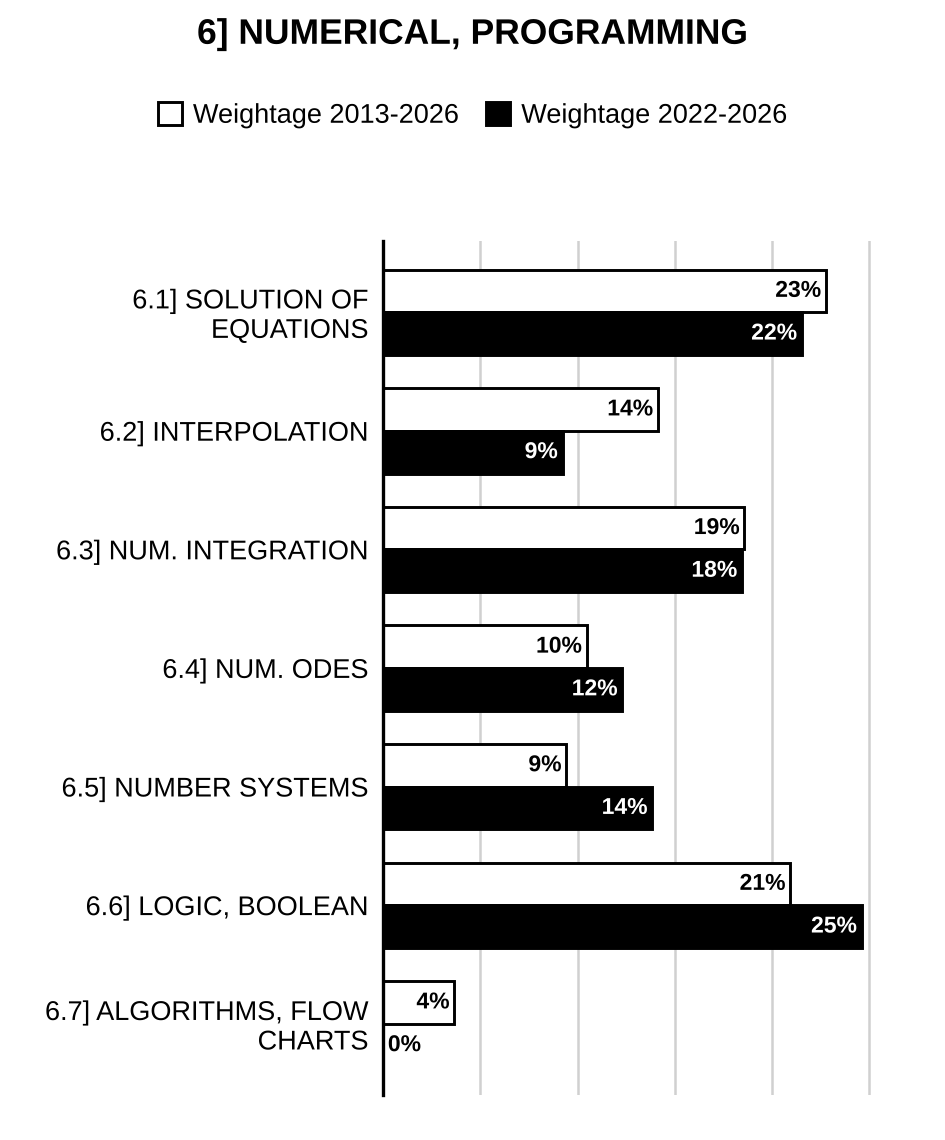
6.1] Solution of equations
28 questions
By using the Newton-Raphson iterative formula, establish the formula to find the cube root of . Use this formula, if established, to find the cube root of 63 correct to four decimal places with the initial approximation 3.9. [2026/10m/5b]
Solve the following system of linear equations by Gauss-Seidel method : [2025/10m/5b]
Solve the following system of linear equations by Gauss-Jordan method : [2024/10m/5b]
Solve the system of linear equations correct up to 4 significant figures by the Gauss-Seidel iterative method. Take initially guessed solution as . [2023/15m/6b]
Compute a root of the equation , in the interval , by Regula-Falsi method, correct to 6 decimal places. [2023/15m/8b]
Solve, by Gauss elimination method, the system of equations [2022/10m/5b]
Find a positive root of the equation by a numerical technique using initial values ; and further improve the result using Newton-Raphson method correct to 8 significant figures. [2021/10m/5b]
Solve the system of equations correct up to 4 significant figures by using Gauss-Seidel method after verifying whether the method is applicable in your transformed form of the system. [2021/15m/7b]
Show that the equation : has one root in the interval and one in . Calculate the negative root correct to four decimal places using Newton-Raphson method. [2020/10m/5b]
For the solution of the system of equations : set up the Gauss-Seidel iterative scheme and iterate three times starting with the initial vector . Also find the exact solutions and compare with the iterated solutions. [2020/15m/6b]
Apply Newton-Raphson method, to find a real root of transcendental equation , correct to three decimal places. [2019/10m/5b]
Apply Gauss-Seidel iteration method to solve the following system of equations : correct to three decimal places. [2019/15m/7b]
Write down the basic algorithm for solving the equation : by bisection method, correct to 4 decimal places. [2018/10m/5e]
Explain the main steps of the Gauss-Jordan method and apply this method to find the inverse of the matrix [2017/10m/5b]
Write an algorithm in the form of a flow chart for Newton-Raphson method. Describe the cases of failure of this method. [2017/15m/8b]
Find the solution of the system using Gauss-Seidel method (make four iterations). [2015/15m/8b]
Apply Newton-Raphson method to determine a root of the equation correct up to four decimal places. [2014/10m/5b]
Solve the system of equations using Gauss-Seidel iteration method (Perform three iterations). [2014/15m/6b]
Develop an algorithm for Newton — Raphson method to solve starting with initial iterate , be the number of iterations allowed, eps be the prescribed relative error and delta be the prescribed lower bound for . [2013/20m/7a]
Use Newton-Raphson method to find the real root of the equation correct to four decimal places. [2012/12m/5b]
Solve the following system of simultaneous equations, using Gauss-Seidel iterative method : [2012/20m/6c]
Find the positive root of the equation correct up to 6 decimal places by using Newton-Raphson method. Carry out computations only for three iterations. [2010/12m/5c]
Given the system of equations State the solvability and uniqueness conditions for the system. Give the solution when it exists. [2010/20m/7a]
The equation has two real roots and . Show that the iterative method given by : is convergent near , if . [2009/6m/5c(i)]
Develop an algorithm for Regula-Falsi method to find a root of starting with two initial iterates and to the root such that sign sign . Take as the maximum number of iterations allowed and eps be the prescribed error. [2009/30m/7a]
Find the smallest positive root of equation using regula-falsi method. Do three iterations. [2008/12m/5c]
Apply Gauss-Seidel method to calculate , , from the system: with initial values . Carry out computations for two iterations. [2008/15m/7a(ii)]
Draw a flow chart for solving equation correct to five decimal places by Newton-Raphson method. [2008/30m/7b]
6.2] Interpolation
13 questions
Find the unique polynomial of degree 2 or less which fits the following data : Also obtain the bound on the truncation error. [2025/15m/7b]
Using Newton’s forward difference formula for interpolation, estimate the value of from the following data : [2024/15m/8b]
Derive Newton’s backward difference interpolation formula and also do error analysis. [2021/15m/8b]
Write the three point Lagrangian interpolating polynomial relative to the points , and . Then by taking the limit , establish the relation where is the error function and [2020/15m/8b]
Using Newton’s forward difference formula find the lowest degree polynomial when it is given that , , , and . [2018/10m/5b]
For given equidistant values , , and , a value is interpolated by Lagrange’s formula. Show that it may be written in the form where . [2017/15m/6b]
Let , for . Estimate the value of using Lagrange interpolating polynomial of degree 3 over the nodes , , and . Also, compute the error bound over the interval and the actual error . [2016/20m/6c]
Find the Lagrange interpolating polynomial that fits the following data : Find . [2015/20m/6c]
In an examination, the number of students who obtained marks between certain limits were given in the following table : Using Newton forward interpolation formula, find the number of students whose marks lie between 45 and 50. [2013/10m/5c]
Find at from the following data : [2012/20m/7a]
Draw a flow chart for Lagrange’s interpolation formula. [2011/20m/7c]
Using Lagrange interpolation formula, calculate the value of from the following table of values of and : [2009/15m/7b]
The following values of the function are given: Construct the quadratic interpolating polynomial that fits the data. Hence calculate . Compare with exact value. [2008/15m/7a(i)]
6.3] Numerical integration
16 questions
Evaluate the integral , where by using single application of Simpson’s rule. [2026/15m/7b]
Find the constant and error term for the quadrature formula where , , and prime () represents derivative with respect to . Hence deduce the composite rule for integrating [2025/15m/8b]
Integrate from to using (i) Simpson’s rule with width , and (ii) Trapezoidal rule with width . [2024/15m/7b]
The velocity of a train which starts from rest is given by the following table, the time being reckoned in minutes from the start and the velocity in km/hour : Using Simpson’s rd rule, estimate approximately in km the total distance run in 20 minutes. [2022/15m/7b]
Find a quadrature formula which is exact for polynomials of highest possible degree. Then use the formula to evaluate (correct up to three decimal places). [2020/20m/7b]
Draw a flow chart and write a basic algorithm (in FORTRAN/C/C) for evaluating using Trapezoidal rule. [2019/10m/5e]
Starting from rest in the beginning, the speed (in Km/h) of a train at different times (in minutes) is given by the above table : Using Simpson’s rd rule, find the approximate distance travelled (in Km) in 20 minutes from the beginning. [2018/10m/5d]
Find the values of the constants , , such that the quadrature formula is exact for polynomials of as high degree as possible, and hence find the order of the truncation error. [2018/15m/7b]
Derive the formula Is there any restriction on ? State that condition. What is the error bound in the case of Simpson’s rule? [2017/20m/7b]
For an integral , show that the two-point Gauss quadrature rule is given by . Using this rule, estimate . [2016/15m/7c]
Use five subintervals to integrate using trapezoidal rule. [2014/10m/5c]
Draw a flowchart for Simpson’s one-third rule. [2014/15m/7b]
The velocity of a train which starts from rest is given in the following table. The time is in minutes and velocity is in km/hour. Estimate approximately the total distance run in 30 minutes by using composite Simpson’s rule. [2013/15m/7c]
Calculate (upto 3 places of decimal) by dividing the range into 8 equal parts by Simpson’s rd Rule. [2011/12m/5c]
A solid of revolution is formed by rotating about the -axis, the area between the -axis, the line and and a curve through the points with the following co-ordinates : Find the volume of the solid. [2011/20m/7a]
Find the value of the integral by using Simpson’s -rule correct up to 4 decimal places. Take 8 subintervals in your computation. [2010/20m/7b]

Preparing for Prelims too?
Our UPSC Prelims Topic-wise PYQ eBook covers every Prelims question with detailed explanations, so you can see exactly where UPSC asks from.
View the BookDownload Free Sample6.4] Numerical solution of ODEs
9 questions
Consider the initial value problem : , , (Step-size) (i) Apply the classical fourth order Runge-Kutta method to approximate the solution . (ii) Use Euler’s method to find and . [2026/15m/8b]
Given with initial condition at . Find the value of for by Euler’s method, correct to 4 decimal places, taking step length . [2023/10m/5b]
Using Runge-Kutta method of fourth order, solve the differential equation with , at . Use four decimal places for calculation and step length 0.1. [2022/15m/8b]
Using Runge-Kutta method of fourth order, solve with at . Use four decimal places for calculation and step length 0.2. [2019/10m/5d]
Solve the initial value problem , in the interval using the Runge-Kutta fourth-order method with step size . [2015/15m/7b]
Use Runge-Kutta formula of fourth order to find the value of at , where , . Take the step length . [2014/20m/6c]
Use Euler’s method with step size to compute the approximate value of , correct up to five decimal places from the initial value problem [2013/15m/7b]
Provide a computer algorithm to solve an ordinary differential equation in the interval for number of discrete points, where the initial value is , using Euler’s method. [2012/12m/5c]
Find the value of using Runge-Kutta fourth order method with step size from the initial value problem : [2009/15m/7c]
6.5] Number systems and representation
12 questions
Find the decimal equivalent of the following floating point 10-bit numbers with 5 bits as fractional part : 1010111011 and 0100101010. [2026/8m/6b(i)]
Evaluate and convert the final result in hexadecimal system. [2026/7m/6b(ii)]
(i) Convert the number into binary system and the number into decimal system. (ii) Determine the truth table for the Boolean function Also derive the full disjunctive normal form of from the truth table. [2025/10m/5c]
(i) Determine the decimal equivalent in sign magnitude form of and . (ii) Determine the decimal equivalent of . [2024/10m/5c]
Evaluate, using the binary arithmetic, the following numbers in their given system : (i) (ii) [2023/10m/5c]
(i) Convert the number into octal and the number into hexadecimal systems. (ii) Express the Boolean function in a product of maxterms form. [2022/10m/5c]
(i) Convert into octal and hexadecimal equivalents. (ii) Obtain the principal conjunctive normal form of . [2021/10m/5c]
Find the equivalent numbers given in a specified number to the system mentioned against them : (i) Integer 524 in binary system. (ii) to octal system. (iii) decimal number 5280 to hexadecimal system. (iv) Find the unknown number . [2019/15m/6b]
Find the equivalent of numbers given in a specified number system to the system mentioned against them. (i) to decimal system (ii) to hexadecimal system (iii) to decimal system (iv) to binary system. [2018/15m/6b]
Convert the following decimal numbers to equivalent binary and hexadecimal numbers : (i) (ii) (iii) [2016/10m/5d]
(i) Compute to the base 8. (ii) Let be an arbitrary but fixed Boolean algebra with operations , and and the zero and the unit element denoted by 0 and 1 respectively. Let be elements of . If be such that and then prove that . [2011/12m/5d]
Find the decimal equivalent of . [2009/6m/5d(ii)]
6.6] Computer systems, logic gates and Boolean algebra
25 questions
Consider the logic circuit : [Figure: logic circuit with inputs , , ; the first AND gate takes , , ; the second AND gate takes , (through a NOT gate) and ; the third AND gate takes (through a NOT gate) and ; the outputs of the three AND gates feed an OR gate whose output is ] (i) Express as a Boolean expression. (ii) Write 8-bit special sequences for , and . (iii) Find the truth table of using 8-bit special sequences. [2026/10m/5c]
(i) Convert the number into binary system and the number into decimal system. (ii) Determine the truth table for the Boolean function Also derive the full disjunctive normal form of from the truth table. [2025/10m/5c]
Simplify the Boolean function and draw the corresponding GATE network. [2025/15m/6b]
Draw the logical circuit for the Boolean expression . Also, obtain the output (truth table) for the three input bit sequences : , , [2024/15m/6b]
(i) Find the conjunctive normal form (CNF) of the following Boolean function : \(ii\) Express the Boolean function in disjunctive normal form (DNF) and construct the truth table for the function. [2023/15m/7a]
(i) Convert the number into octal and the number into hexadecimal systems. (ii) Express the Boolean function in a product of maxterms form. [2022/10m/5c]
Find a combinatorial circuit corresponding to the Boolean function and write the input/output table for the circuit. [2022/15m/6b]
(i) Convert into octal and hexadecimal equivalents. (ii) Obtain the principal conjunctive normal form of . [2021/10m/5c]
Obtain the Boolean function based on the table given below. Then simplify and draw the corresponding GATE network : [2021/15m/6b]
Let be a Boolean function. Obtain the conjunctive normal form for . Also express as a product of maxterms. [2020/10m/5c]
Given the Boolean expression (i) Draw the logical diagram for the expression. (ii) Minimize the expression. (iii) Draw the logical diagram for the reduced expression. [2019/15m/8a]
Simplify the boolean expression : by using the laws of boolean algebra. From its truth table write it in minterm normal form. [2018/15m/8a]
Write the Boolean expression in its simplest form using Boolean postulate rules. Mention the rules used during simplification. Verify your result by constructing the truth table for the given expression and for its simplest form. [2017/10m/5c]
Let , , be Boolean variables, denote complement of , is an expression for OR and is an expression for AND . Then simplify the following expression and draw a block diagram of the simplified expression, using AND and OR gates. [2016/15m/8c]
Find the principal (or canonical) disjunctive normal form in three variables , , for the Boolean expression . Is the given Boolean expression a contradiction or a tautology? [2015/10m/5c]
Use only AND and OR logic gates to construct a logic circuit for the Boolean expression . [2014/10m/5d]
For any Boolean variables and , show that . [2014/15m/8b]
(i) Compute to the base 8. (ii) Let be an arbitrary but fixed Boolean algebra with operations , and and the zero and the unit element denoted by 0 and 1 respectively. Let be elements of . If be such that and then prove that . [2011/12m/5d]
Find the logic circuit that represents the following Boolean function. Find also an equivalent simpler circuit : [2011/20m/7b]
(i) Suppose a computer spends 60 per cent of its time handling a particular type of computation when running a given program and its manufacturers make a change that improves its performance on that type of computation by a factor of 10. If the program takes 100 sec to execute, what will its execution time be after the change ? (ii) If , find the value of . [2010/12m/5d]
(i) Find the hexadecimal equivalent of the decimal number (ii) For the given set of data points write an algorithm to find the value of by using Lagrange’s interpolation formula. (iii) Using Boolean algebra, simplify the following expressions (i) (ii) where represents the complement of . [2010/20m/7c]
Find the values of two valued boolean variables , , , by solving the following simultaneous equations : where denotes the complement of . [2009/6m/5c(ii)]
Realize the following expression by using NAND gates only : where denotes the complement of . [2009/6m/5d(i)]
State the principle of duality in Boolean algebra and given the dual of the Boolean expressions and [2008/6m/5d(i)]
Represent in NOR to NOR logic network. [2008/6m/5d(ii)]
6.7] Algorithms and flow charts
11 questions
Draw a flow chart and write a basic algorithm (in FORTRAN/C/C) for evaluating using Trapezoidal rule. [2019/10m/5e]
Write down the basic algorithm for solving the equation : by bisection method, correct to 4 decimal places. [2018/10m/5e]
Write an algorithm in the form of a flow chart for Newton-Raphson method. Describe the cases of failure of this method. [2017/15m/8b]
Draw a flowchart for Simpson’s one-third rule. [2014/15m/7b]
Develop an algorithm for Newton — Raphson method to solve starting with initial iterate , be the number of iterations allowed, eps be the prescribed relative error and delta be the prescribed lower bound for . [2013/20m/7a]
Provide a computer algorithm to solve an ordinary differential equation in the interval for number of discrete points, where the initial value is , using Euler’s method. [2012/12m/5c]
In a certain examination, a candidate has to appear for one major and two minor subjects. The rules for declaration of results are : marks for major are denoted by and for minors by and . If the candidate obtains 75% and above marks in each of the three subjects, the candidate is declared to have passed the examination in first class with distinction. If the candidate obtains 60% and above marks in each of the three subjects, the candidate is declared to have passed the examination in first class. If the candidate obtains 50% or above in major, 40% or above in each of the two minors and an average of 50% or above in all the three subjects put together, the candidate is declared to have passed the examination in second class. All those candidates, who have obtained 50% and above in major and 40% or above in minor, are declared to have passed the examination. If the candidate obtains less than 50% in major or less than 40% in any one of the two minors, the candidate is declared to have failed in the examinations. Draw a flow chart to declare the results for the above. [2012/20m/7c]
Draw a flow chart for Lagrange’s interpolation formula. [2011/20m/7c]
(i) Find the hexadecimal equivalent of the decimal number (ii) For the given set of data points write an algorithm to find the value of by using Lagrange’s interpolation formula. (iii) Using Boolean algebra, simplify the following expressions (i) (ii) where represents the complement of . [2010/20m/7c]
Develop an algorithm for Regula-Falsi method to find a root of starting with two initial iterates and to the root such that sign sign . Take as the maximum number of iterations allowed and eps be the prescribed error. [2009/30m/7a]
Draw a flow chart for solving equation correct to five decimal places by Newton-Raphson method. [2008/30m/7b]

Strengthen your GS papers
Our UPSC Mains Topic-wise & Year-wise PYQ eBook (2013–2026) maps every GS question to the syllabus, so you know what UPSC asks and how often.
View the BookDownload Free Sample« Previous: Partial Differential Equations | Next: Mechanics and Fluid Dynamics »
Back to: Mathematics Optional PYQs – Topic-wise | Also see: Mathematics Optional year-wise question papers
Last updated: 30 October 2026