
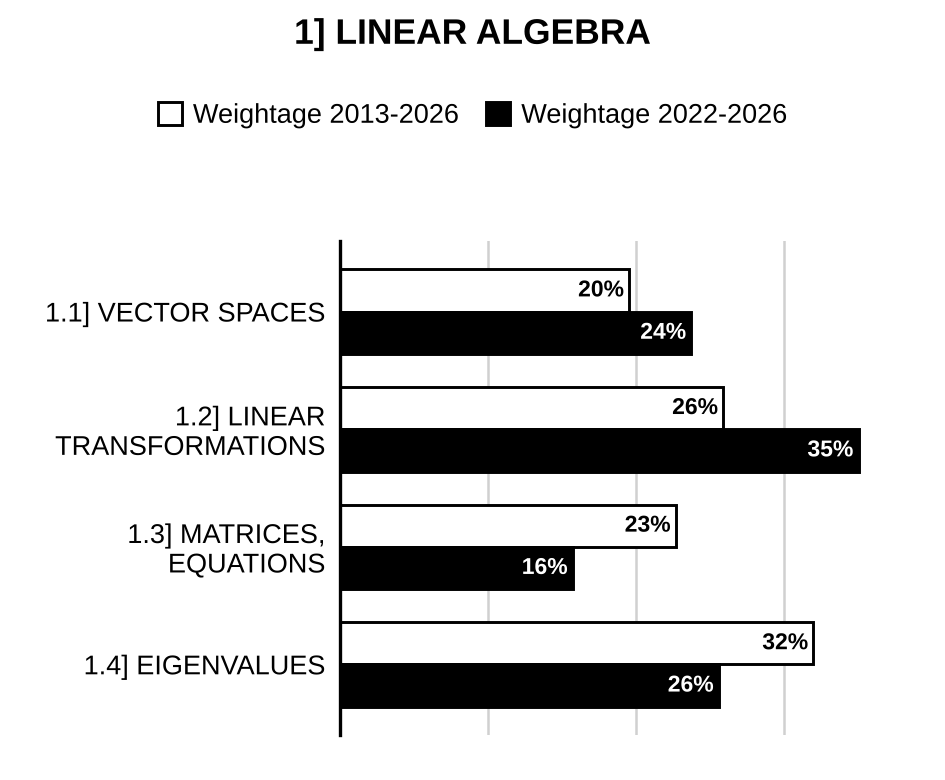
Here are all 118 Linear Algebra questions asked in UPSC Mathematics Optional Paper I from 2008 to 2026, arranged under the 4 topics of the official syllabus. Within each topic the latest questions come first.
Each question ends with a code such as [2024/10m/1a] – the year, the marks and the question number in the paper.
1.1] Vector spaces
26 questions
Given as a vector space over the field . (i) Let . Prove that is a subspace of and find a basis of . (ii) Find a subspace of such that . [2026/15m/3a]
Can the set be extended to form a basis of the vector space ? Justify your answer. [2025/10m/1a]
Let denote the vector space of all polynomials of degree over . Verify that [2025/8m/4c(ii)]
Let be a subspace of spanned by the vectors , , . Then find a basis and dimension of , and extend the basis of to a basis of . [2024/10m/1a]
Let , and be three vectors of the space . Does ? Justify your answer. [2023/10m/1a]
Prove that any set of linearly independent vectors in a vector space of dimension constitutes a basis for . [2022/10m/1a]
Let the set be the collection of vectors of a vector space . Then (i) prove that is a subspace of . (ii) find a basis and dimension of . [2022/20m/3a]
Show that is a subspace of . Find two bases of . Also find the dimension of . [2021/15m/2c]
Consider the set of all real magic squares. Show that is a vector space over . Give examples of two distinct magic squares. [2020/10m/1a]
Express basis vectors and as linear combinations of and . [2018/10m/1b]
Suppose and are distinct four dimensional subspaces of a vector space , where . Find the possible dimensions of subspace . [2017/10m/2d]
If then find and . [2016/3m/1b(ii)]
The vectors , , and are linearly independent. Is it true? Justify your answer. [2015/10m/1a]
Find the dimension of the subspace of , spanned by the set Hence find its basis. [2015/12m/4b]
Find one vector in which generates the intersection of and , where is the plane and is the space generated by the vectors and . [2014/10m/1a]
Let and be the following subspaces of : and Find a basis and the dimension of (i) , (ii) , (iii) . [2014/15m/2a]
Show that the vectors , and in are linearly independent over the field of real numbers but are linearly dependent over the field of complex numbers. [2013/8m/2c(ii)]
Prove or disprove the following statement : If is a basis for and is a two-dimensional subspace of , then has a basis made of just two members of . [2012/12m/1c]
Let be the vector space of all matrices over the field of real numbers. Let be the set consisting of all matrices with zero determinant. Is a subspace of ? Justify your answer. [2012/8m/2a(i)]
Show that the subspaces of spanned by two sets of vectors and are identical. Also find the dimension of this subspace. [2011/10m/2b(i)]
(i) In the -space , determine whether or not the set is linearly independent. (ii) Let be a linear transformation from a vector space over reals into such that . Show that is invertible. [2010/20m/4a]
Show that the set of solutions of the homogeneous linear differential equation on an interval forms a vector subspace of the real vector space of continuous functions on . What is the dimension of ? [2010/20m/7a]
Prove that the set of the vectors in which satisfy the equations and , is a subspace of . What is the dimension of this subspace? Find one of its bases. [2009/12m/1b]
Prove that the set of all real symmetric matrices forms a linear subspace of the space of all real matrices. What is the dimension of this subspace? Find at least one of the bases for . [2009/20m/4a]
Let be a non-empty set and let denote the set of all functions from into . Show that is a vector space with respect to the vector addition and scalar multiplication . [2008/12m/1b]
Find the dimension of the subspace of spanned by the set . Hence find a basis for the subspace. [2008/20m/4a]
1.2] Linear transformations
31 questions
Let be a subfield of complex numbers and let be the linear transformation from into , defined by If is a vector in , then answer the following : (i) Find the condition on , , such that the vector be in the null space of . What is the nullity of ? (ii) Find the condition on , , such that the vector be in the range of . What is the rank of ? [2026/15m/4a]
Find the range, rank, kernel and nullity of the linear transformation given by . [2025/10m/1b]
Let be a linear transformation such that , and . Find . [2025/15m/2a]
Let be a linear operator and be a basis of over . Suppose that , , . Find a basis for the range space and null space of . [2024/10m/1b]
Consider a linear operator on over defined by . Is invertible? If yes, justify your answer and find . [2024/15m/2a]
Let denote a vector space over the field of real numbers. Find the matrix of the linear mapping given by with respect to standard basis of , and hence find the rank of . Is invertible? Justify your answer. [2024/15m/3a]
Find the rank and nullity of the linear transformation: given by [2023/10m/1b]
If the matrix of a linear transformation relative to the basis is then find the matrix of relative to the basis . [2023/15m/2a]
Let be a linear transformation such that and . Find . [2022/10m/1b]
Find a linear map which rotates each vector of by an angle . Also, prove that for , has no eigenvalue in . [2022/15m/4a]
Find the matrix associated with the linear operator on defined by with respect to the ordered basis . [2021/10m/1b]
Let be the vector space of all real matrices. Let . Suppose is a linear transformation defined by . Find the rank and nullity of . Find a matrix which maps to the null matrix. [2020/10m/1b]
Let be a subfield of complex numbers and a function from defined by . What are the conditions on , , such that be in the null space of ? Find the nullity of . [2020/15m/3b]
Let be a linear map such that and . If is the matrix corresponding to with respect to the standard bases , , then find Rank . [2019/10m/1c]
Consider the matrix mapping , where . Find a basis and dimension of the image of and those of the kernel . [2017/15m/3a]
If is space of real matrices of order and is the space of real polynomials of degree at most 2, then find the matrix representation of , such that , with respect to the standard bases of and . Further find the null space of . [2016/10m/2a(i)]
If is such that , then choosing and as bases of and respectively, find the matrix of . [2016/6m/2a(ii)]
If is the matrix representation of a linear transformation with respect to the bases and , then find . [2016/18m/2c]
Let and , for all , be defined by What is the matrix relative to the basis [2015/12m/3a]
Let denote the vector space of all real polynomials of degree atmost and be a linear transformation given by Find the matrix of with respect to the bases and of and respectively. Also, find the null space of . [2013/10m/2a(i)]
Let be an -dimensional vector space and be an invertible linear operator. If is a basis of , show that is also a basis of . [2013/8m/2a(ii)]
Let be the linear transformation defined by Find a basis and the dimension of the image of and the kernel of . [2012/12m/1d]
Consider the linear mapping by Find the matrix relative to the basis and the matrix relative to the basis . [2012/12m/2b(i)]
Find the nullity and a basis of the null space of the linear transformation given by the matrix [2011/10m/2b(ii)]
Show that the vectors , and are linearly independent in . Let be a linear transformation defined by Show that the images of above vectors under are linearly dependent. Give the reason for the same. [2011/10m/2c(i)]
What is the null space of the differentiation transformation where is the space of all polynomials of degree over the real numbers? What is the null space of the second derivative as a transformation of ? What is the null space of the th derivative? [2010/12m/1b]
Let . Find the unique linear transformation so that is the matrix of with respect to the basis of and of . Also find . [2010/20m/2a]
(i) In the -space , determine whether or not the set is linearly independent. (ii) Let be a linear transformation from a vector space over reals into such that . Show that is invertible. [2010/20m/4a]
Let and be the two ordered bases of . Then find a matrix representing the linear transformation which transforms into . Use this matrix representation to find , where . [2009/20m/2a]
Let be a linear transformation defined by Then find the rank and nullity of . Also, determine null space and range space of . [2009/20m/3a]
Show that is a basis of . Let be a linear transformation such that , and . Find . [2008/20m/2a]

Preparing for Prelims too?
Our UPSC Prelims Topic-wise PYQ eBook covers every Prelims question with detailed explanations, so you can see exactly where UPSC asks from.
View the BookDownload Free Sample1.3] Algebra of matrices and linear equations
26 questions
Find all the values of for which the system of homogeneous equations has non-trivial solutions, and hence determine all the solutions for each value of . [2026/10m/1a]
Reduce the following matrix to echelon form : [2025/15m/3a]
Find the rank of the matrix by reducing it to row-reduced echelon form. [2023/15m/4a]
Find all solutions to the following system of equations by row-reduced method : [2022/15m/2a]
For two square matrices and of order 2, show that trace trace . Hence show that , where is an identity matrix of order 2. [2021/7m/3c(ii)]
Reduce the following matrix to a row-reduced echelon form and hence also, find its rank : [2021/10m/4a(i)]
Let \(i\) Find . (ii) Find and . (iii) Solve the following system of linear equations : [2020/15m/4a]
If then show that . Use this result to solve the following system of equations : [2019/10m/1d]
Let \(i\) Find the rank of matrix . (ii) Find the dimension of the subspace [2019/20m/3c]
Let be a matrix and a matrix. Show that is a singular matrix. [2018/10m/1a]
For the system of linear equations determine which of the following statements are true and which are false : (i) The system has no solution. (ii) The system has a unique solution. (iii) The system has infinitely many solutions. [2018/13m/3a]
Consider the following system of equations in , , : \(i\) For which values of does the system have a unique solution? (ii) For which pair of values does the system have more than one solution? [2017/15m/4b]
Using elementary row operations, find the inverse of . [2016/6m/1a(i)]
Using elementary row operations, find the condition that the linear equations have a solution. [2016/7m/1b(i)]
Reduce the following matrix to row echelon form and hence find its rank : [2015/10m/1b]
Using elementary row or column operations, find the rank of the matrix [2014/10m/1b]
Investigate the values of and so that the equations , , have (1) no solution, (2) a unique solution, (3) an infinite number of solutions. [2014/10m/2b(i)]
Find the inverse of the matrix : by using elementary row operations. Hence solve the system of linear equations [2013/10m/1a]
Find the rank of the matrix [2013/8m/2b(ii)]
Find the dimension and a basis for the space of all solutions of the following homogeneous system using matrix notation : [2012/12m/2a(ii)]
Let be a Hermitian matrix. Find a non-singular matrix such that is diagonal. [2012/20m/2c]
Let be a non-singular, square matrix. Show that . Hence show that . [2011/10m/1a]
Let Solve the system of equations given by Using the above, also solve the system of equations where denotes the transpose of matrix . [2011/10m/1b]
Let and be matrices over reals. Show that is invertible if is invertible. Deduce that and have the same eigenvalues. [2010/20m/3a]
Show that the matrix is invertible if and only if the is invertible. Hence find . [2008/12m/1a]
Let be a non-singular matrix. Show that if then . [2008/20m/3a]
1.4] Eigenvalues and special matrices
35 questions
If and are similar matrices, then show that and have the same rank, trace, characteristic polynomial and eigenvalues. [2026/10m/1b]
Let be a linear transformation defined by where denotes the set of all polynomials in of degree and . Find the eigenvalues and corresponding eigenvectors of using the matrix representation of with respect to the standard basis of . [2026/20m/2a]
Find the eigenvalues and the corresponding eigenvectors of the matrix [2025/12m/4c(i)]
Let be a matrix. Find the eigenvalues and the corresponding eigenvectors of . Hence find the eigenvalues and the corresponding eigenvectors of , where . [2024/20m/4a]
Let \(i\) Verify the Cayley-Hamilton theorem for the matrix . (ii) Show that for , where is the identity matrix of order 3. Hence, find . [2023/20m/3a]
Find a linear map which rotates each vector of by an angle . Also, prove that for , has no eigenvalue in . [2022/15m/4a]
If then show that (without finding ). [2021/10m/1a]
Prove that the eigen vectors, corresponding to two distinct eigen values of a real symmetric matrix, are orthogonal. [2021/8m/3c(i)]
Find the eigen values and the corresponding eigen vectors of the matrix , over the complex-number field. [2021/10m/4a(ii)]
Define an matrix as , where is a unit column vector. (i) Examine if is symmetric. (ii) Examine if is orthogonal. (iii) Show that trace . (iv) Find , when . [2020/20m/2b]
Let and be two orthogonal matrices of same order and . Show that is a singular matrix. [2019/15m/2b]
State the Cayley-Hamilton theorem. Use this theorem to find , where [2019/15m/4a]
Show that if and are similar matrices, then they have the same eigenvalues. [2018/12m/2a]
Let . Find a non-singular matrix such that is a diagonal matrix. [2017/10m/1a]
Show that similar matrices have the same characteristic polynomial. [2017/10m/1b]
Prove that distinct non-zero eigenvectors of a matrix are linearly independent. [2017/10m/3b]
If , then find . [2016/4m/1a(ii)]
If , then find the eigenvalues and eigenvectors of . [2016/8m/2b(i)]
Prove that eigenvalues of a Hermitian matrix are all real. [2016/8m/2b(ii)]
If matrix then find . [2015/12m/2a]
Find the eigen values and eigen vectors of the matrix : [2015/12m/2c]
Verify Cayley — Hamilton theorem for the matrix and hence find its inverse. Also, find the matrix represented by [2014/10m/2b(ii)]
Let . Find the eigen values of and the corresponding eigen vectors. [2014/8m/3c(i)]
Prove that the eigen values of a unitary matrix have absolute value 1. [2014/7m/3c(ii)]
Let be a square matrix and be its adjoint, show that the eigenvalues of matrices and are real. Further show that trace = trace . [2013/10m/1b]
Let where is a cube root of unity. If , , denote the eigenvalues of , show that . [2013/8m/2b(i)]
Let be a Hermetian matrix having all distinct eigenvalues . If are corresponding eigenvectors then show that the matrix whose column consists of the vector is non singular. [2013/8m/2c(i)]
If is a characteristic root of a non-singular matrix , then prove that is a characteristic root of . [2012/8m/2b(ii)]
Let be the eigen values of a square matrix with corresponding eigen vectors . If is a matrix similar to show that the eigen values of are same as that of . Also find the relation between the eigen vectors of and eigen vectors of . [2011/10m/2a(i)]
Verify the Cayley-Hamilton theorem for the matrix Using this, show that is non-singular and find . [2011/10m/2a(ii)]
Let and be a non-singular matrix of order . Find the eigen values of the matrix where . [2011/10m/2c(ii)]
If , , are the eigenvalues of the matrix show that [2010/12m/1a]
Let and be matrices over reals. Show that is invertible if is invertible. Deduce that and have the same eigenvalues. [2010/20m/3a]
Find a Hermitian and a skew-Hermitian matrix each whose sum is the matrix [2009/12m/1a]
Find a real matrix which is both orthogonal and skew-symmetric. Can there exist a real matrix which is both orthogonal and skew-symmetric? Justify your answer. [2009/20m/2c]

Strengthen your GS papers
Our UPSC Mains Topic-wise & Year-wise PYQ eBook (2013–2026) maps every GS question to the syllabus, so you know what UPSC asks and how often.
View the BookDownload Free SampleNext: Calculus »
Back to: Mathematics Optional PYQs – Topic-wise | Also see: Mathematics Optional year-wise question papers
Last updated: 30 October 2026