
Here are all 118 Ordinary Differential Equations questions asked in UPSC Mathematics Optional Paper I from 2008 to 2026, arranged under the 5 topics of the official syllabus. Within each topic the latest questions come first.
Each question ends with a code such as [2024/10m/1a] – the year, the marks and the question number in the paper.
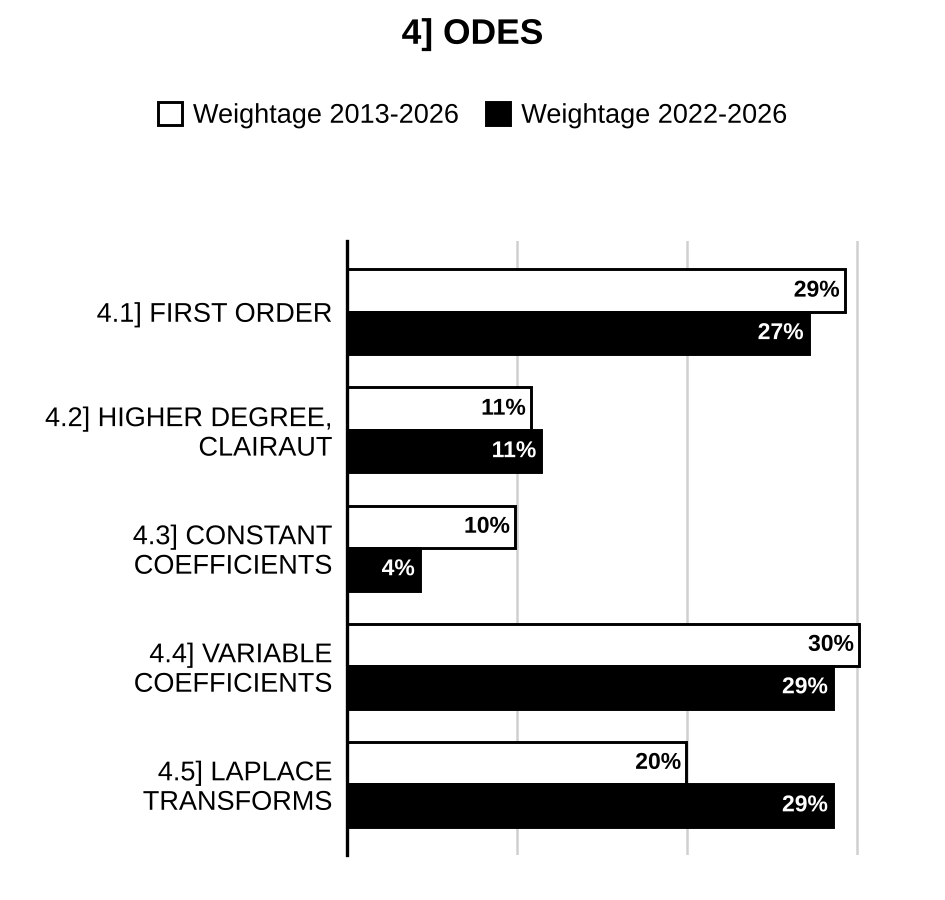
4.1] First order first degree equations
42 questions
If and are two solutions of , and , then show that , where is a non-zero constant. [2026/10m/5a]
Show that is an integrating factor of Hence solve it. [2026/10m/7c(i)]
Form the differential equation of all ellipses whose axes coincide with coordinate axes. [2025/10m/5b]
Find the orthogonal trajectories of the family of curves , where is a parameter. [2024/10m/5a]
State uniqueness theorem for the existence of unique solution of the initial value problem , in the rectangular region , . Test the existence and uniqueness of the solution of the initial value problem , , in a suitable rectangle . If more than one solution exist, then find all the solutions. [2024/15m/7a]
Obtain the solution of the initial-value problem in the form . [2023/10m/5a]
Find the solution of the differential equation : [2023/10m/7a(i)]
Show that the general solution of the differential equation can be written in the form , where , are non-zero functions of and , an arbitrary constant. [2022/10m/5a]
Show that the orthogonal trajectories of the system of parabolas : belong to the same system. [2022/10m/5b]
Find the orthogonal trajectories of the family of confocal conics ; are constants and is a parameter. Show that the given family of curves is self orthogonal. [2021/10m/8a(i)]
Solve the following differential equation : [2020/10m/5a]
Find the orthogonal trajectories of the family of circles passing through the points and . [2020/10m/5b]
Solve the differential equation [2019/10m/5a]
Find and such that is an integrating factor of and solve the equation. [2018/12m/7d]
Find such that is exact and hence solve. [2018/12m/8d]
Find the differential equation representing all the circles in the – plane. [2017/10m/5a]
Suppose that the streamlines of the fluid flow are given by a family of curves . Find the equipotential lines, that is, the orthogonal trajectories of the family of curves representing the streamlines. [2017/10m/5b]
If the growth rate of the population of bacteria at any time is proportional to the amount present at that time and population doubles in one week, then how much bacterias can be expected after 4 weeks? [2017/8m/6a(ii)]
Solve : [2016/10m/5c]
Show that the family of parabolas is self-orthogonal. [2016/10m/5d]
Solve : [2016/10m/6a]
Solve the differential equation : [2015/10m/5a]
Solve the differential equation : [2015/10m/5b]
Find the constant so that is the Integrating factor of and hence solve the differential equation. [2015/12m/6a]
Justify that a differential equation of the form : where is an arbitrary function of , is not an exact differential equation and is an integrating factor for it. Hence solve this differential equation for . [2014/10m/5a]
Find the curve for which the part of the tangent cut-off by the axes is bisected at the point of tangency. [2014/10m/5b]
Find the sufficient condition for the differential equation to have an integrating factor as a function of . What will be the integrating factor in that case ? Hence find the integrating factor for the differential equation and solve it. [2014/15m/8a]
is a function of , such that the differential coefficient is equal to . Find out a relation between and , which is free from any derivative/differential. [2013/10m/5a]
Obtain the equation of the orthogonal trajectory of the family of curves represented by , being the plane polar coordinates. [2013/10m/5b]
Solve the differential equation . [2013/10m/6a]
Solve [2012/12m/5a]
Find the orthogonal trajectories of the family of curves . [2012/12m/5b]
Show that the differential equation is not exact. Find an integrating factor and hence, the solution of the equation. [2012/20m/6a]
Obtain the solution of the ordinary differential equation , if . [2011/10m/5a]
Determine the orthogonal trajectory of a family of curves represented by the polar equation being the plane polar coordinates of any point. [2011/10m/5b]
Consider the differential equation where is a constant. Show that— (i) if is any solution and , then is a constant; (ii) if , then every solution tends to zero as . [2010/12m/5a]
Show that the differential equation admits an integrating factor which is a function of . Hence solve the equation. [2010/12m/5b]
Verify that Hence show that— (i) if the differential equation is homogeneous, then is an integrating factor unless ; (ii) if the differential equation is not exact but is of the form then is an integrating factor unless . [2010/20m/6a]
Show that the set of solutions of the homogeneous linear differential equation on an interval forms a vector subspace of the real vector space of continuous functions on . What is the dimension of ? [2010/20m/7a]
Find the differential equation of the family of circles in the -plane passing through and . [2009/20m/6a]
Solve : [2009/20m/6c]
Solve the differential equation [2008/12m/5a]
4.2] First order higher degree equations
12 questions
Solve . [2025/10m/5a]
Find the general solution and singular solution of the differential equation . [2025/10m/7c(i)]
Reduce the equation to Clairaut’s form by the substitution and . Hence solve the equation and show that is a singular solution of the differential equation. [2023/10m/7a(ii)]
Find the general and singular solutions of the differential equation : , where . Also give the geometric relation between the general and singular solutions. [2022/10m/8a(i)]
Find all possible solutions of the differential equation : [2021/15m/7b]
Find the general and singular solutions of the differential equation , where . [2020/10m/8a(ii)]
Obtain the singular solution of the differential equation Also find the complete primitive of the given differential equation. Give the geometrical interpretations of the complete primitive and singular solution. [2019/15m/8a]
Solve : [2018/13m/6a]
Consider the differential equation where . Substituting and reduce the equation to Clairaut’s form in terms of , and . Hence, or otherwise solve the equation. [2017/10m/6b(i)]
Solve the differential equation [2015/13m/7d]
Obtain Clairaut’s form of the differential equation Also find its general solution. [2011/15m/6a]
Solve the equation [2008/15m/6d]

Preparing for Prelims too?
Our UPSC Prelims Topic-wise PYQ eBook covers every Prelims question with detailed explanations, so you can see exactly where UPSC asks from.
View the BookDownload Free Sample4.3] Higher order linear equations with constant coefficients
13 questions
Solve the differential equation : [2023/15m/6a]
Solve the differential equation : [2021/10m/5a]
Determine the complete solution of the differential equation [2019/10m/5b]
Solve : [2018/10m/5a]
Solve : [2018/10m/5c]
Solve : [2018/13m/6c]
Solve the initial value problem [2018/13m/7c]
Solve the following simultaneous linear differential equations : and where and are functions of independent variable and . [2017/8m/6a(i)]
Solve the following initial value differential equations : , and . [2017/7m/6b(ii)]
Find a particular integral of . [2016/10m/5a]
Find the general solution of the equation . [2012/20m/6b]
Obtain the general solution of the second order ordinary differential equation where dashes denote derivatives w.r.t. . [2011/15m/6b]
Use the method of undetermined coefficients to find the particular solution of and hence find its general solution. [2010/20m/8a]
4.4] Second order equations with variable coefficients
30 questions
Solve [2026/15m/6a]
Solve by the method of variation of parameters. [2026/15m/8a]
Find the complete solution of . [2025/10m/7c(ii)]
Solve the differential equation by the method of variation of parameters. [2025/15m/8a]
Find the second solution of the differential equation using as one of the solutions. [2024/10m/6c(i)]
Find the general solution of the differential equation by the method of variation of parameters. [2024/10m/6c(ii)]
Solve the following differential equation by using the method of variation of parameters : , given that is one solution of the reduced equation. [2022/15m/6b]
Solve the following differential equation : [2022/10m/8a(ii)]
Solve the equation : completely by demonstrating all the steps involved. [2021/15m/6b]
Find the general solution of the differential equation : Hence, solve the differential equation : by the method of variation of parameters. [2021/10m/8a(ii)]
Using the method of variation of parameters, solve the differential equation , if is one solution of CF. [2020/20m/6a]
Solve the following differential equation : [2020/10m/8a(i)]
Solve the differential equation [2019/10m/6c(i)]
Find the linearly independent solutions of the corresponding homogeneous differential equation of the equation and then find the general solution of the given equation by the method of variation of parameters. [2019/15m/7a]
Solve : [2018/13m/7a]
Solve the differential equation : [2017/9m/7b(i)]
Solve the following differential equation using method of variation of parameters : [2017/8m/7b(ii)]
Using the method of variation of parameters, solve the differential equation [2016/15m/6b]
Find the general solution of the equation . [2016/15m/6c]
Solve : [2015/13m/8d]
Solve by the method of variation of parameters : [2014/10m/6a]
Solve the differential equation : [2014/20m/6b]
Solve the following differential equation : when is a solution to its corresponding homogeneous differential equation. [2014/15m/7a]
Using the method of variation of parameters, solve the differential equation [2013/10m/6b]
Find the general solution of the equation [2013/15m/6c]
Solve the ordinary differential equation [2012/20m/6c]
Using the method of variation of parameters, solve the second order differential equation [2011/15m/6c]
Find the Wronskian of the set of functions on the interval and determine whether the set is linearly dependent on . [2009/12m/5b]
Use the method of variation of parameters to find the general solution of [2008/12m/5b]
Solve the differential equation [2008/15m/6c]
4.5] Laplace transforms
21 questions
Apply Laplace transform to solve , , subject to the conditions , . [2026/10m/5b]
If , then show that . Hence evaluate . [2026/10m/7c(ii)]
If and are Laplace transforms of and respectively, then prove that . Using this result, solve the equation . [2025/15m/6a]
Solve the integral equation using Laplace transform. [2024/10m/5b]
Using Laplace transform, solve the initial value problem where denotes the Dirac delta function. [2024/15m/8a]
Given that . Show that . Hence evaluate the integral . [2023/10m/5b]
Solve the following initial value problem by using Laplace transform technique : , and is a given function of . [2023/15m/8a]
Solve the following initial value problem by using Laplace’s transformation , where [2022/15m/7b]
Solve the initial value problem : using Laplace transform method. [2021/10m/5b]
Using Laplace transform, solve the initial value problem ; and is arbitrary. Does this problem have a unique solution? [2020/10m/7b]
Find the Laplace transforms of and . Prove that the Laplace transform of , where , is [2019/10m/6c(ii)]
(i) Find the Laplace transform of . (ii) Find the inverse Laplace transform of . [2018/10m/5d]
Solve the following initial value problem using Laplace transform : where [2017/17m/8b]
Using Laplace transformation, solve the following : [2016/10m/6d]
(i) Obtain Laplace Inverse transform of \(ii\) Using Laplace transform, solve , , . [2015/12m/7a]
Solve the initial value problem by using Laplace-transform. [2014/20m/8c]
By using Laplace transform method, solve the differential equation , subject to the initial conditions and , at , in which , and are constants. [2013/15m/6d]
Using Laplace transforms, solve the initial value problem [2012/12m/5c]
Use Laplace transform method to solve the following initial value problem : [2011/15m/6d]
Find the inverse Laplace transform of [2009/20m/6b]
Using Laplace transform, solve the initial value problem with , . [2008/15m/6b]

Strengthen your GS papers
Our UPSC Mains Topic-wise & Year-wise PYQ eBook (2013–2026) maps every GS question to the syllabus, so you know what UPSC asks and how often.
View the BookDownload Free Sample« Previous: Analytic Geometry | Next: Dynamics and Statics »
Back to: Mathematics Optional PYQs – Topic-wise | Also see: Mathematics Optional year-wise question papers
Last updated: 30 October 2026