
Law Optional PYQs Topic-wise for UPSC Mains (1995–2026) are listed below unit by unit, in the order of the official syllabus – 1624 questions in all. Click any unit to open all its previous year questions, arranged topic-wise with the latest first.
Paper I
| Unit | Topic (click to open PYQs) | Sub-topics | Questions | Link |
|---|---|---|---|---|
| 1 | Constitutional and Administrative Law | 16 | 404 | Click here → |
| 2 | International Law | 15 | 404 | Click here → |
Trend: Paper 1 is split evenly: Section A (Constitutional and Administrative Law) and Section B (International Law) each carry half the marks every year. In constitutional law, fundamental rights (with PIL) are the largest topic, followed by Centre–State relations and the services, PSCs and Election Commission; amendment and basic structure have gained in recent years. In international law, marks are spread widely, with law of the sea, the WTO and international economic law, jurisdiction and extradition, and the sources of international law asked most often, and the United Nations and human rights rising in the last five years.

Preparing for Prelims too?
Our UPSC Prelims Topic-wise PYQ eBook covers every Prelims question with detailed explanations, so you can see exactly where UPSC asks from.
View the BookDownload Free SamplePaper II
| Unit | Topic (click to open PYQs) | Sub-topics | Questions | Link |
|---|---|---|---|---|
| 1 | Law of Crimes | 16 | 243 | Click here → |
| 2 | Law of Torts | 13 | 182 | Click here → |
| 3 | Law of Contracts and Mercantile Law | 13 | 287 | Click here → |
| 4 | Contemporary Legal Developments | 8 | 104 | Click here → |
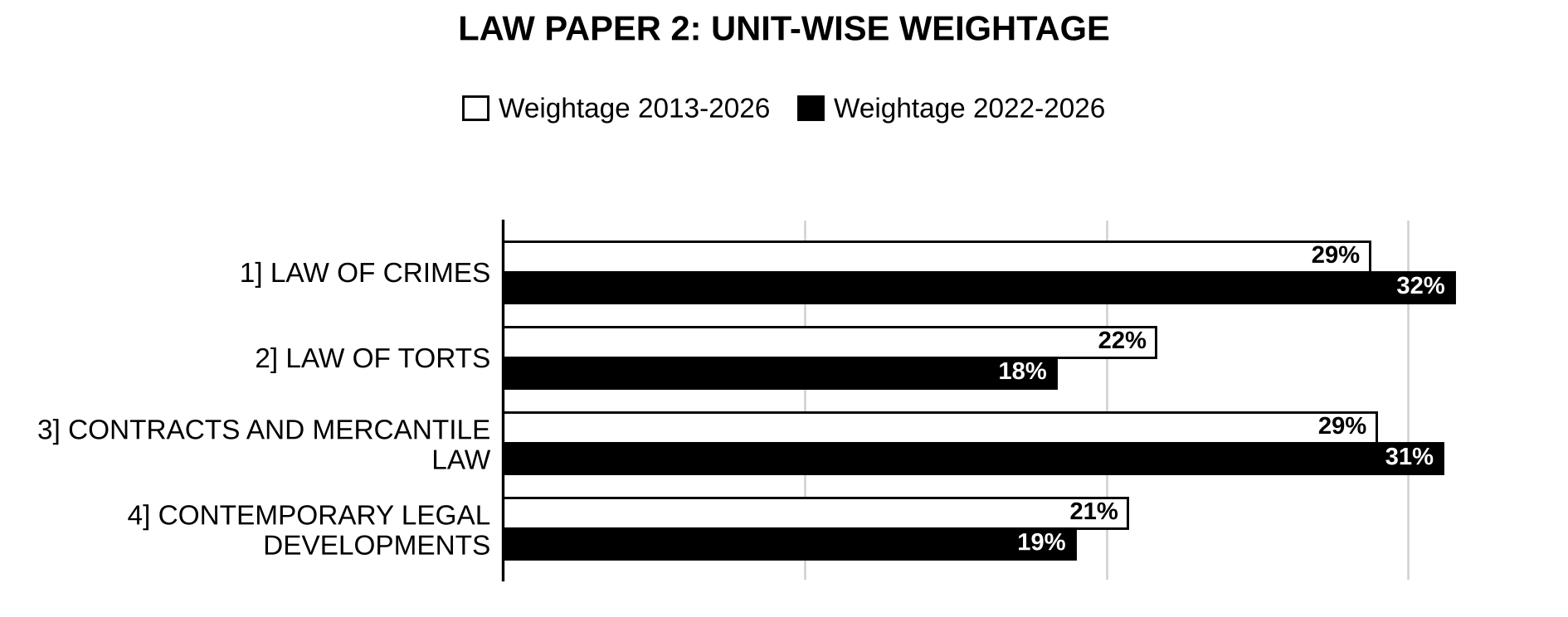
Trend: Law of Crimes and Contracts and Mercantile Law each take a little under a third of Paper 2, and both have grown slightly in the last five years; Law of Torts and Contemporary Legal Developments share the rest. Offences against the human body, general exceptions, and offences against property and against women dominate criminal law. In torts, vicarious and State liability, consumer protection and nuisance lead recent papers. In contracts, formation, sale of goods, arbitration and agency are asked most. Among contemporary developments, intellectual property rights take the largest share, followed by IT and cyber law, environmental statutes, PIL and the RTI Act.
More questions
Other questions (outside the present syllabus) – 1 question
How this collection is organised
Considering the changing exam pattern over three decades, we felt it necessary to declare some practices we’ve adopted in this collection.
Units and topics follow the official syllabus. Paper 1 has two units (Constitutional and Administrative Law; International Law) and Paper 2 four (Law of Crimes; Law of Torts; Law of Contracts and Mercantile Law; Contemporary Legal Developments). Topic numbers follow the numbering of the items in the notification, so Paper 1 – 2.4 is item 4 of International Law (Law of the sea). Within each unit, questions are divided by these topics.
UPSC often asks around a syllabus item rather than on its exact words. Such questions are placed under the nearest topic: for example, rule of law and judicial activism under separation of powers (Paper 1 – 1.14); writs and compensation for violation of fundamental rights under fundamental rights (1.2); state responsibility and self-determination under nature and sources of international law (2.1); diplomatic immunity under jurisdiction (2.6); murder, hurt and kidnapping under offences against the human body (Paper 2 – 1.10); bailment and pledge under indemnity and guarantee (3.7). Questions on the Bharatiya Nyaya Sanhita go under the same topic as the corresponding IPC provision.
Some questions cover more than one topic. We’ve kept such questions in each topic of relevance. A few questions fit no topic of their paper’s present syllabus; they are kept under “Other Questions (Outside the Present Syllabus)” at the end of the paper concerned.
Graphs at the start of each paper show the weightage of every unit in that paper, and graphs for each unit show the weightage of its topics. Weightage is the share of marks asked from a unit or topic, compared for 2013–2026 (white bars) and the last five years, 2022–2026 (black bars). A question placed under two topics has its marks split equally between them.
Each of the topicwise question is suffixed by a question code like this [2024/10m/150w/5e]. This code indicates a) year in which the question was asked, b) maximum marks the question carried, c) prescribed word limit and, d) the question number in actual paper, in given order. Where UPSC prescribed no word limit, that field is skipped.
Until 2012, each paper carried 300 marks (60 per question); since 2013 each paper carries 250 marks (50 per question). Where a question offered more parts than were to be answered (for example “answer any three” of four parts, up to 2010), every part is included with its own marks.
2016–2026 papers are transcribed from the official UPSC question papers and 2009–2015 from scans of the printed papers. No scan of the 1995–2008 papers is available; they are taken from typed copies checked against each other, and the marks of a few of those years come from a topic-wise compilation that records each question’s marks.
The wording of the questions is as printed, including the papers’ own grammar and the names of statutes current at the time (e.g. the Indian Penal Code).
Spotted an error? Use the “Report an Error” box at the end of any page – we review every report and update the page.

Strengthen your GS papers
Our UPSC Mains Topic-wise & Year-wise PYQ eBook (2013–2026) maps every GS question to the syllabus, so you know what UPSC asks and how often.
View the BookDownload Free SampleLast updated: 30 October 2026