
Here are all 287 Law of Contracts and Mercantile Law questions asked in UPSC Law Optional Paper II from 1995 to 2026, arranged under the 13 topics of the official syllabus. Within each topic the latest questions come first.
Each question ends with a code such as [2024/15m/3b] – the year, the marks, the word limit (where UPSC set one) and the question number in the paper.
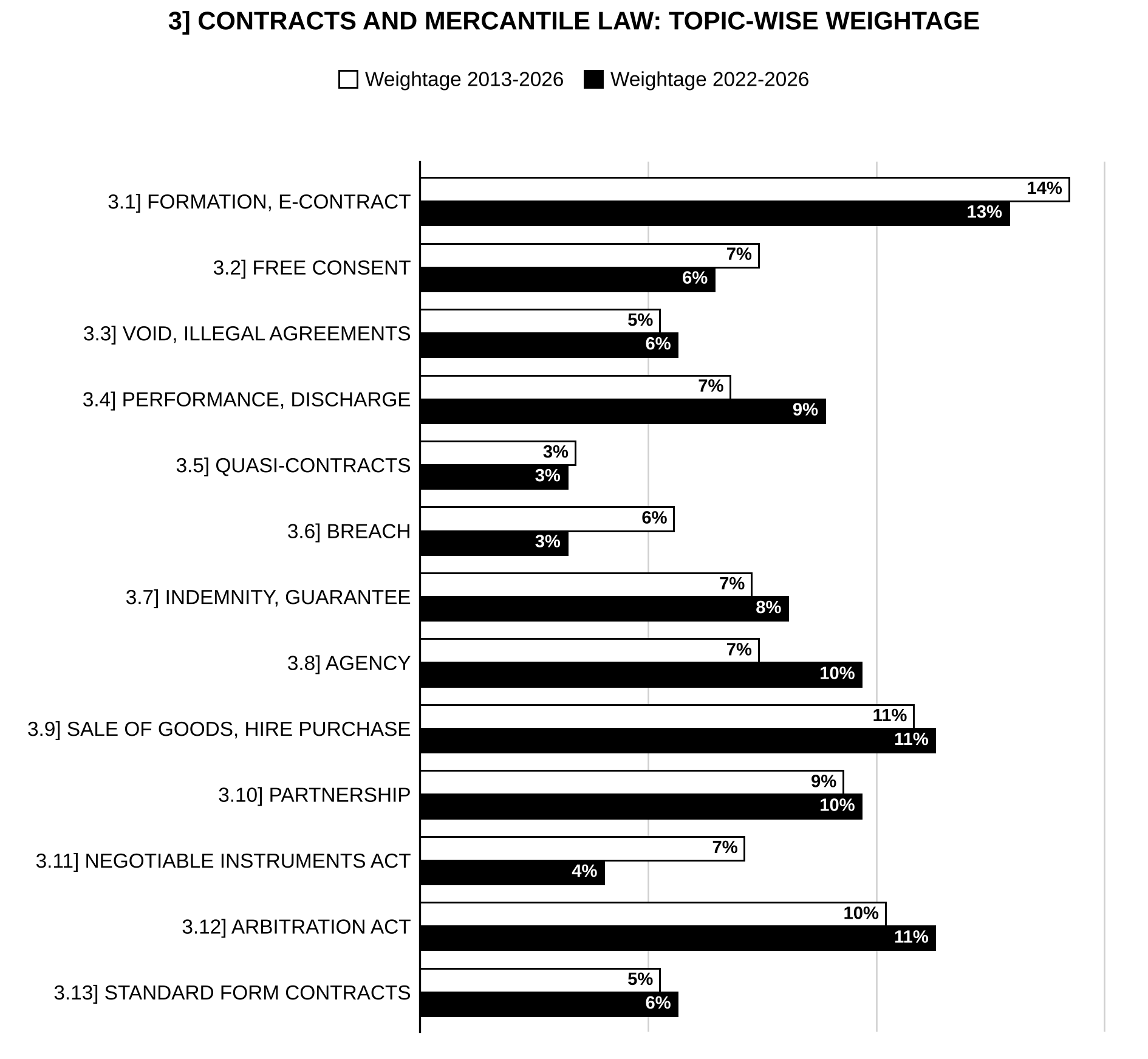
3.1] Nature and formation of contract; e-contract
39 questions
Explain the applicability of the rule of ‘privity of contract’ in India. Also discuss the circumstances in which the rule does not prevent a person from enforcing a contract without his being a party to it. [2026/15m/6b]
“Any departure from the terms of the offer or the addition of any qualification while accepting the offer vitiates the acceptance unless it is agreed to by the offeror.” Elucidate the statement in the light of the provisions of the Indian Contract Act, 1872 and established principles. [2025/15m/6b]
“The law of contract is not the whole law of agreements, nor is it the whole law of obligations. It is the law of those agreements which create obligations, and those obligations which have their source in agreement” – Salmond. Critically examine this statement. [2023/10m/150w/5a]
“A minor’s contract being void, ordinarily it should be wholly devoid of all effects. If there is no contract, there should, indeed, be no contractual obligation on either side.” Explain with case laws. [2023/15m/6b]
“All the contracts are agreements, but all the agreements are not contracts.” Elucidate the statement. [2022/10m/150w/5a]
“An agreement without consideration is void.” Is there any exception to it? Discuss by giving suitable illustrations. [2022/15m/7c]
Minor’s contract is ‘void ab initio’. Comment. [2021/10m/150w/5a]
“Like an ordinary paper contract, an electronic contract is also primarily governed by the codified provisions of the Indian Contract Act, 1872 as applicable to contracts in general.” Explain the statement highlighting the legal provisions relating to conclusion of electronic contract. [2020/10m/150w/5a]
“In the course of time, the courts have introduced a number of exceptions in which the rule of privity of contract does not prevent a person from enforcing a contract which has been made for his benefit but without his being a party to it.” Explain the statement with the help of leading case law. [2020/20m/8a]
“The law of contracts is not the whole law of agreements, nor it is the whole law of obligations, but it also deals with the rights and obligations of both.” Elucidate. [2019/10m/150w/5a]
If certain goods are displayed either in a show window or inside the shop and such goods bear price tags, discuss whether such display amounts to an offer to sell. Explain the distinction between offer and invitation to offer with the help of decided cases. [2018/10m/150w/5a]
“Minority can only be claimed as a shield but not as a sword.” Explain the statement and mention the situations when a minor is liable under the law of contract. [2017/10m/150w/5a]
“Revocation of proposal is death of the proposal.” Explain the statement and mention the manners of revocation. [2017/15m/6b]
Under the Indian Contract Act, 1872, when is a contract deemed to be entered into by the parties? Discuss. [2017/20m/8a]
“An offer is to an acceptance what a lighted match-stick is to a train of gunpowder. It produces something which cannot be recalled or undone” – Anson. Explain. [2016/10m/150w/5a]
A owed B ₹ 1,000, but the debt is barred by the Limitation Act, 1963. Subsequently A signs a written promise to pay ₹ 1,000 on account of the previous debt. Decide the validity of this agreement. [2016/10m/150w/5d]
Explain the law relating to minor’s agreements. [2015/15m/7c]
“Privity of contract is no longer a rule but only an exception.” Explain in the context of modern transactions. [2013/10m/125w/5b]
A television was displayed on a Web site owned by XYZ Distributors for sale at a price of ₹ 79.99. Hundreds of customers ordered the television but the retailer refused to fill the orders on the ground that they had been incorrectly priced by mistake. The correct price was ₹ 7,999. Explain the liability, if any, arising out of the above-mentioned communications. Give reasons. [2012/20m/8b]
‘An invitation to treat is not an offer’. Explain. [2009/20m/200w/5a]
Distinguish between ‘Specific offer’ and ‘General offer’. [2009/20m/200w/8b]
“For giving rise to a valid contract, there must be consensus ad-idem among the contracting parties.” Explain this statement. [2008/20m/200w/5a]
“A contract can not be enforced by a person who is not a party to it though it is made for his benefit. He is a stranger to the contract and can claim no rights under it.” Examine the above statement in the light of judicial pronouncements stating the exceptions thereto. [2007/20m/200w/5b]
“Insufficiency of consideration is immaterial but an agreement without consideration is void.” Comment. [2006/20m/200w/5a]
Distinguish an offer from a quotation or an invitation to an offer with the help of illustrations. [2006/20m/200w/5b]
“All contracts are agreements but all agreements are not contracts.” Explain. [2005/20m/200w/5a]
“A contract without consideration is void but there are some contracts, which even though made without consideration, are valid.” Discuss. [2005/20m/200w/5b]
Whether an agreement without consideration is void? Discuss the rule with exceptions, if any. [2004/20m/200w/5a]
Discuss in detail the principle of promissory estoppel and its application in respect of contractual obligations. Explain the position of this principle as against the Government and its agencies. [2003/30m/6a]
‘A’ offers to sell his machinery to ‘B’ for a fixed price. ‘B’ agrees to buy the same subject to the condition that ‘A’ should get it repaired in order to put it into its running condition. ‘A’ replies that ‘B’ should himself get the machinery repaired and pay him the agreed price less the actual cost of repairs. While being repaired, the machinery is destroyed without any fault of the mechanic. ‘A’ sues ‘B’ for the price of the machinery. Will he succeed? [2003/30m/7b]
Legal framework of offer and acceptance does not favour protection of consumers interests. Critically examine with illustrations. [2002/20m/200w/5b]
“The test of contractual intention is objective, not subjective.” Discuss. [2001/20m/200w/5a]
“An act done at the promisor’s desire furnishes a good consideration for his promise even though it is of no significance or personal benefit to him.” Discuss. [2001/20m/200w/5b]
What are the exceptions to the principle that the contractual benefits or obligations are confined to the parties to the contract? [2000/30m/6a]
“The general rule undoubtedly is that no third person can sue or be sued on a contract to which he is not a party, but at bottom that is only a rule of procedure. It goes to the form of remedy, not to the underlying right.” Critically comment on the principle of privity of contract in the light of the above statement and state whether you agree with the statement. [1999/20m/200w/5a]
A owes B Rs. 1,000, but the debt is time barred, C signs a written promise to pay B Rs. 500 on account of the above barred debt. Is B entitled to enforce the promise against C? [1999/10m/200w/5b(ii)]
“Under the law of contract the intention of the parties must be manifested clearly so that their obligations may be demarcated with certainty.” Examine. [1997/20m/200w/5a]
“A contract consists of the actionable promise or promises.” Examine. [1996/20m/200w/5a]
The tenant and the sub-tenant of a certain premises agree between themselves that the sub-tenant would pay the tenant’s rent directly to the landlord. After paying the said rent for a certain period, the sub-tenant refuses to make further payments. The land-lord sues the sub-tenant. The sub-tenant argues that there was no contract between him and the landlord. Decide. [1996/30m/6b]
3.2] Factors vitiating free consent
17 questions
In an action to void a contract on the ground of ‘undue influence’, what is to be proved by the plaintiff? Under what circumstances can ‘undue influence’ be presumed? [2026/10m/150w/5e]
“The law draws a distinction between coercion and undue influence. Coercion in the execution of a contract occurs when there is a physical compulsion of the person. In contrast, undue influence may exist without violence or threats of violence against the victim.” In the light of this statement, distinguish between coercion and undue influence referring to relevant provisions and presumptions raised under the Indian Contract Act, 1872. [2025/15m/6c]
‘Mistake does not defeat consent, but only misleads the parties.’ Explain citing the relevant legal provisions and cases decided by the courts. [2024/15m/7c]
How does any factor vitiating ‘free consent’, affect a contract? Explain. [2021/15m/8c]
In an action to avoid a contract on the ground of undue influence, the plaintiff has to prove two points. Explain those points and different kinds of relations leading to presumption of undue influence which vitiates free consent. [2018/10m/150w/5b]
“There can be a mistake of identity only when a person bearing a particular identity exists within the knowledge of the plaintiff, and the plaintiff intends to deal with him only. If the name assumed by the swindler is fictitious, there will be no mistake of identity.” Examine the statement with leading case law. [2016/20m/6c]
X and Co. in its prospectus represented that A, B and C would be the directors of the company. This was true and on the basis of this P and Q applied for shares. However, before the allotment took place, there were changes in directors. Is the allotment of P and Q subject to their choice or it stands cancelled due to change in directors? Discuss. [2014/10m/6a]
“It has been a common statement of the law that while relief is available for certain kinds of mutual mistake, it is unavailable for unilateral mistake unless the other party knew or had reason to know of the mistake.” Critically examine the statement with leading case law. [2013/25m/6a]
“Undue influence is said to be a subtle species of fraud whereby mastery is obtained over the mind of the victim by insidious approaches and seductive artifices.” Explain. [2012/12m/150w/5a]
‘An attempt at deceit which does not deceive is not fraud’. Do you agree? [2009/20m/200w/5b]
Explain the meaning of ‘free consent’ as an essential element of a valid contract and enumerate the factors vitiating ‘free-consent’. [2007/20m/200w/5c]
“The strict adherence to the theoretical consideration that a contract made under mistake as to the identity of parties or identity of the subject matter is void, would lead to absurd result.” Do you agree with this statement? Give reasons. [2004/20m/200w/5b]
“A deceit which does not deceive is no fraud.” Discuss. [2003/20m/200w/5b]
Law relating to coercion and undue influence has a feature in each which is uncommon to the legal system as a whole. Explain with illustrations. [2002/20m/200w/5a]
Even where the party seeking recession is not in a position to restore to the defendant his status quo ante, the courts may allow by doing what is practically just in the circumstances. [2002/20m/200w/5d]
One of the requirements for formation of a valid contract is free consent. Why then, in some cases of absence of free consent, does it make the contract voidable, not a void agreement? Explain with illustrations. [1998/30m/7a]
Explain the effect of ‘mistake of fact’ on agreements with illustrations and decided cases. [1995/30m/7a]
3.3] Void, voidable, illegal and unenforceable agreements
15 questions
“Every agreement by which anyone is restrained from exercising a lawful profession, trade or business of any kind is to that extent void.” Discuss the statement along with the circumstances in which such agreements have been considered valid by the courts. [2025/20m/6a]
‘An illegal contract is always void but a void contract is not always illegal.’ Examine while illustrating both the types of contract. [2024/15m/6b]
According to Anson, “Contract of insurance bears a certain superficial resemblance to wagering agreement but they are really transactions of different nature”. Elucidate. [2020/10m/150w/5e]
“No court will lend its aid to a man who found his cause of action upon an immoral or illegal act.” Are there any exceptions to the above-said rule? Explain. [2020/15m/6b]
Section 28 of the Indian Contract Act, 1872 makes agreements in restraint of legal proceedings void. Are there any exceptions to this rule? Discuss with the help of relevant provisions and decided cases. [2018/10m/150w/5c]
“Public policy is like an ‘unruly horse’ which cannot be controlled easily.” Explain the statement and mention the agreements which are against public policy. [2017/10m/150w/5b]
“Every agreement by which any party thereto is restricted absolutely from enforcing his rights under or in respect of any contract, by the usual legal proceedings in the ordinary Tribunals, or which limits the time within which he may thus enforce his right is void to that extent.” Explain the exceptions, if any, of this principle. [2015/10m/150w/5c]
“All illegal agreements are void but all void agreements are not illegal.” Discuss. [2007/20m/200w/5a]
“Jurisdiction of a court to decide disputes arising out of contractual relations cannot be ousted by an agreement between the parties.” Discuss. [2003/20m/200w/5a]
There is a very limited application of law relating to agreement in restraint of trade in India. Critically examine the statement and suggest the area of limitations. [2002/20m/200w/5c]
Maintenance and Champerty. [2000/15m/3b(ii)]
“Public policy was a very unruly horse and when once you get astride it you never know where it will carry you.” (Burrough, J.) Examine relevancy of this statement under the Indian Law. [2000/20m/200w/5b]
How do you distinguish void agreement and void contract? Does void contract have similar legal implications to voidable contract? [1998/20m/200w/5b]
“Liberty to trade is not an aspect which the law would permit a person to barter.” Examine. [1996/20m/200w/5b]
“A contract shall not be enforced if the agreement is opposed to public policy.” Examine. [1995/20m/200w/5a]
3.4] Performance and discharge of contracts
13 questions
“The parties to a contract must either perform or offer to perform their respective promises unless the performance is dispensed with or excused under the provisions of the Contract Act or of any other law.” Explain the statement in reference to relevant provisions of the Indian Contract Act, 1872. [2025/20m/7a]
State the circumstances of supervening impossibility and frustration of contract in the light of the decided cases. [2022/20m/7a]
“Time is an essence of the contract.” What are the remedies available to the aggrieved party in case of non-fulfilment of obligation within the stipulated time? [2022/15m/8b]
What are the various modes in which a contract may be discharged? Explain in the light of decided cases. [2021/20m/6a]
“Discharge of a contract includes breach of contract, but breach of a contract does not necessarily include discharge of contract.” Examine the statement with suitable illustrations. [2019/15m/6a]
“It is well-settled that if and when there is frustration, the dissolution of the contract occurs automatically …. It does not depend on the choice or election of either party. It depends on the effect of what has actually happened on the possibility of performing the contract.” Discuss the effects of frustration of contract. [2018/20m/6a]
Briefly explain the meaning, scope and applicability of the doctrine of frustration under the law of contract. [2012/30m/6b]
What is meant by the doctrine of “supervening impossibility”? Under what circumstances the “supervening impossibility” may arise? [2007/20m/200w/5d]
What are the circumstances under which a party to a contract can plead impossibility as an excuse from performing his contractual obligation? [2006/30m/7a]
Examine the principle of ‘time is the essence of contract’. [2000/10m/200w/5d(ii)]
“The doctrine of frustration is really an aspect of or part of law of discharge of contract by reason of supervening impossibility or illegality of the act agreed to be done.” Elucidate with suitable illustrations. [1999/30m/7a]
What do you mean by ‘force majeure’ clause in a contract? What implications does the clause have in view of the provision for supervening impossibility? [1998/20m/200w/5c]
“In India the impossibility of performance covers both the agreement to do impossible act as well as the contract to do act afterwards becoming impossible or unlawful.” Examine. [1997/30m/6a]
3.5] Quasi-contracts
15 questions
“Law as well as justice should try to prevent unjust enrichment.” Elucidate the statement in reference to relevant provisions of the Indian Contract Act, 1872. [2025/10m/150w/5a]
A “‘Quasi-Contract’ arises out of judicial principles and not out of contractual agreement between two parties.” Explain. [2024/10m/150w/5a]
Discuss the concept and classification of ‘Quasi contracts’ under Indian Contract Act, 1872. [2021/20m/8a]
“The principle of unjust enrichment finds place indirectly under the law of contract.” Explain its various dimensions. [2019/15m/7a]
“Quasi-contract consists of the contractual obligation which is entered upon not because the parties have consented to it, but because law does not allow a person to have unjustified benefit at the cost of other party.” Explain the real basis of quasi-contracts with legal provisions and illustrations. [2012/12m/150w/5b]
‘A quantum meruit, although a quasi contract, arises out of a contract’. Comment. [2009/20m/200w/5d]
“Law as well as justice should try to prevent unjust enrichment.” Critically examine this statement in relation to quasi-contracts. [2008/20m/200w/5b]
Enumerate and explain briefly those relations in the Indian Contract Act which resemble those created by a contract. [2005/20m/200w/5c]
Discuss the scope of Section 70 of the Indian Contract Act, 1872. Can a State recover cost of training on failure of the defendant to join the service? [2004/30m/8a]
A minor is liable to pay out of his property for necessaries supplied to him. Discuss with the help of decided cases. [2000/20m/200w/5a]
A transport company refuses to deliver certain goods to the consignee except upon the payment of illegal charge of carriage. The consignee pays the sum charged in order to obtain the goods. Discuss the rights of the consignee as against the transport company. [2000/20m/200w/5c]
Examine the obligation under the Indian Contract Act of a person to whom money has been paid by mistake. In this connection is there a distinction required to be drawn between a mistake of fact and mistake of law? [1999/15m/6b(i)]
The plaintiff bank paid cash over the counter on a crossed cheque on which the defendant had forged the payee’s endorsement. Can they claim return of the money by contending that it was paid by mistake? [1999/15m/6b(ii)]
The plaintiff bank made payment of certain crossed cheques to the defendant bank. The latter informed their customer-payee of the cheques that the payment had been received for the cheques. It then turned out that the cheques were forged. The plaintiff sued the defendant bank and his customer to recover back the amount contending that the payment had been made under the mistaken belief that the cheques were genuine. Decide. [1997/30m/6b]
“A quasi-contract arises out of judicial principles and not out of a contractual agreement between two persons.” Examine. [1996/30m/6a]
3.6] Consequences of breach of contract
13 questions
Discuss the rules which are taken into account by the courts while awarding damages for the breach of contract. Refer to the relevant statutory provisions and case law. [2024/20m/6a]
“Section 74 of the Indian Contract Act, 1872 has cut down the most troublesome knot of Common Law doctrine of awarding damages.” Discuss the statement. [2017/20m/7a]
“Every contract contains a ‘core’ or ‘fundamental obligation’ which must be performed. If one party fails to perform this fundamental obligation, he will be guilty of a breach of contract whether or not any exempting clause has been inserted which purports to protect him.” Critically examine the statement with case law. [2016/10m/150w/5b]
“The object of awarding damages for a breach of contract is to put the injured party in the same position, so far as money can do it, as if he had not been injured.” In the light of the above statement, explain the various kinds of damages that the court can award. Also explain the rules relating to assessment of damages. [2016/20m/8a]
A, a singer, contracts with B, the manager of a restaurant, to sing at his restaurant for two nights every week during next two months; and B engages to pay to her 5,000/- rupees for each night’s performance. On the sixth night, A wilfully absents herself from the restaurant and B, in consequence, rescinds the contract. Decide. [2015/10m/150w/5a]
If a contract is broken, the law will endeavour so far as money can do it, to place the injured party in the same position as if the contract had been performed. Explain the above statement and discuss the principle court follows for assessment of damages. [2014/10m/150w/5a]
In a contract between A and B, security deposit was taken by A from B to ensure due performance of the contract. B committed default in performance though no actual loss had arisen. A forfeited the deposit for fault of B. B claimed that forfeiture of deposit is not valid in law. How would you decide? Give reasons. [2012/20m/8c]
On breach of contract only such loss can be recovered as was in the contemplation of both the parties at the time of entering into the contract. Discuss. [2010/15m/5a]
What are liquidated damages and when are they awarded? [2006/20m/200w/1c]
Is a party rightfully rescinding the contract entitled to compensation? Explain with the help of examples. [2006/20m/200w/5c]
A government building contract is allotted through tenders. It falls to the share of a Karnataka based contractor who transports his mobile workshop from there to the work site at Jammu. He had done only a part of the work when the government unjustifiably repudiates the contract. The contractor sues for the loss of profits. Decide. [1997/30m/7b]
With the help of decided cases discuss in detail the market rate theory of assessment of damages in cases of breach of contract. [1995/30m/6a]
The plaintiff booked a hotel for his son’s wedding reception in which two hundred guests were invited. The contract included provision for a dinner in a big hall by the hotel management who would also provide a band to play music. The hotel management cancelled the contract just a day before the wedding. As a result the plaintiff was forced to organise only a simple function at a small place with a simple dinner. The plaintiff sues the hotel management and claims general damages for inconvenience and mental torture and special damages for cancellation of the band music and telephone expenses to inform the guests about the change of venue. Decide. [1995/30m/6b]

Preparing for Prelims too?
Our UPSC Prelims Topic-wise PYQ eBook covers every Prelims question with detailed explanations, so you can see exactly where UPSC asks from.
View the BookDownload Free Sample3.7] Contracts of indemnity, guarantee and insurance
15 questions
‘The liability of a surety is secondary, but it is co-extensive with that of Principal debtor.’ In this backdrop, discuss the nature and extent of liability of surety. [2024/15m/6c]
‘Sections 124 and 125 of the Indian Contract Act, 1872 are not exhaustive of the law of indemnity.’ Comment in the context of Indemnity and Indemnity-holder’s rights. [2024/15m/7b]
“The liability of a surety is coextensive with principal debtor, unless it is otherwise provided by the contract.” Elucidate the statement by narrating the circumstances under which a surety is discharged from his liability. [2022/20m/6a]
Write short notes on the following: (i) Caveat Emptor (ii) Uberrima fides (iii) Nemo dat quod non habet. [2021/15m/6c]
“A surety is said to be discharged from liability when his liability comes to an end.” Throw light on the statement with relevant legal provision under the Indian Contract Act, 1872. [2020/10m/150w/5d]
According to Anson, “Contract of insurance bears a certain superficial resemblance to wagering agreement but they are really transactions of different nature”. Elucidate. [2020/10m/150w/5e]
“A contract by which one party promises to save the other from loss caused to him by the conduct of the promisor himself or by the conduct of any other person, is called, a contract of indemnity”. Explain. [2015/15m/6b]
A, stands as a surety for the good conduct of B, who is employed in a Bank on a monthly salary of Rs. 1,600. Three months after when the financial position of the bank deteriorated B, agreed to accept a monthly salary of Rs. 1,500. Two months after, it is discovered that B has been misappropriating cash all through. What is the liability of A as surety under the Indian Law? [2014/20m/6b]
“‘Indemnity’ has relation to the conduct either of the indemnifier himself or of a third party. A ‘Guarantee’ is always related to the conduct of a third party.” Elucidate. [2013/10m/125w/5a]
The plaintiff was insured with the defendant against loss by theft. The plaintiff advertised a watch and a ring for sale and in response, he received a telephone call from someone who expressed interest. He called, agreed to pay the asked price and made payment by a building society cheque and took delivery of the items. The cheque was dishonoured. For the articles so lost, a claim was presented to the insurer under the theft policy. The insurer refused to pay anything. Explain the rights, if any, available to the plaintiff under the circumstances. [2012/20m/3c]
“There can be no contract of guarantee unless there is someone primarily liable.” Comment. [2011/15m/150w/5b]
The very object of taking a surety is defeated, if the creditor is required to postpone his remedies against the surety. Explain the liability of the surety. [2010/15m/5b]
Distinguish between ‘Contract of indemnity’ and ‘Contract of guarantee’. [2009/20m/200w/8a]
“Liability of the surety is secondary.” Comment. [2008/20m/200w/5c]
“Every contract of guarantee is a contract of indemnity but every contract of indemnity is not a contract of guarantee.” Elaborate. ‘A’ and ‘B’ go to a shop. ‘A’ says to the shopkeeper, “let B take goods from your shop and if he does not pay, I will pay”. What kind of contract is this? Give reasons. [2008/30m/6b]
3.8] Contract of agency
25 questions
“Every person who acts for another is not an agent. Representative character and derivative authority may briefly be said to be the distinguishing features of an agent.” In view of the above, discuss the nature of agency. [2026/15m/8c]
Mutual rights and duties of the Principal and agent may be wholly provided for in their contract. Discuss the general duties of the agent with special reference to the duty of reasonable care and skill. [2024/10m/150w/5d]
“The doctrine of ‘Undisclosed Principal’ comes into play when the agent neither disclosed the existence of his principal nor his representative character.” In such cases discuss the rights and liabilities of the Principals, the agent and the third parties. [2023/15m/7c]
What are the essentials of an agency? How is an agency created and terminated under the Indian Contract Act, 1872? [2022/20m/8a]
In legal phraseology “every person who acts for another is not an agent”. Comment. [2021/10m/150w/5c]
“Contract of agency is revocable like an ordinary contract, but sometimes it is impossible to repudiate it.” Analyze with the help of decided cases and relevant provisions. [2019/10m/150w/5d]
“If a person falsely represents that he is an agent of another, the principal may ratify the act even though the same was done without his authority.” Discuss, in the light of the above statement, the essentials of valid ratification and its effect. [2018/15m/6b]
“The revocation of agent’s authority can be made by the principal subject to certain rules.” Examine these rules in the light of protection to agent. [2016/15m/7b]
“The liability of sub-agent towards principal is not direct, except in case of fraud and wilful wrong.” Explain giving reasons. [2014/10m/150w/5e]
Explain with illustrations when may a principal unilaterally cancel an agency relation without incurring liability for breach of contract. [2012/12m/150w/5c]
“Ratification is a kind of affirmation of unauthorised acts.” Critically examine. Is there any difference between ‘agency by estoppel’ and ‘agency by ratification’? Discuss. [2011/30m/6a]
‘The essential characteristic of an agent is that he is invested with a legal power to alter his principal’s legal relations with third parties; the principal is under a co-relative liability to have his legal relations altered’. Discuss. A enters into a contract with B to sell him 500 bales of cotton and afterwards discovers that B was acting as agent for C. Who is liable to A for the price of the cotton? [2009/30m/6b]
“Agency in law connotes an authority or capacity in one person to create legal relations between a person occupying the position of principal and third parties.” Critically discuss the concept of ‘agency’. Explain the duties of an agent to principal. [2006/30m/6a]
X, a wholesale cloth dealer, appoints Y as his agent for the sale of cloth on the basis of 5% commission on the sale made by him. Y had an agreement with his principal X that he could retain part of the same amount of goods to adjust the commission due to him. X terminates the agency of Y. Y refuses to hand over the cloth in his possession to X, and claims that he is vested with authority coupled with interest and that agency cannot be terminated. Decide. [2006/30m/6b]
“The authority of an agent means his capacity to bind the principal.” Discuss. [2005/20m/200w/5d]
‘A’ makes an offer to purchase goods in possession of ‘B’ who is the agent of ‘C’ but who has no authority to make any contract of sale. The offer is accepted by ‘B’ on behalf of ‘C’. ‘B’ writes to ‘C’ for ratification of the contract. Before the ratification ‘A’ withdraws the offer, ‘C’ ratifies the contract made by ‘B’. Has the contract come into existence in this case? If ‘B’ repudiates the contract before ‘C’ comes to know of it, and subsequently ‘C’ ratifies the contract and sues to enforce it, what will be the consequences? [2003/30m/6b]
To know whether a person occupies the position of an agent or not, the law has to go by his functions and the substance of the transaction and not the parties terminology. [2002/30m/4b]
Discuss the rights and obligations of undisclosed principal and his agent vis-a-vis the other party to the contract. [2002/30m/8a]
“An agency coupled with interest cannot be terminated in the absence of an express contract.” Discuss. Also discuss as to when is an agency irrevocable. [2001/30m/6a]
The defendant husband and his wife lived in a suite of a hotel where he was the manager and the wife acted as manageress. They had no domestic establishment of their own. The wife incurrent with a tradesman a debt for clothes, payment of which was demanded from the husband. Discuss the liability of the husband to pay off the debt. [2001/30m/7b]
No consideration is necessary to create an agency. Explain, giving reasons. [1999/10m/200w/5b(i)]
Critically examine the legal basis, scope and extent of the liability of a principal for the misrepresentations made or frauds committed by his agent. Would it be correct to say that the said liability is an extension of the principle of vicarious liability? [1999/30m/6a]
“An agent cannot personally enforce a contract entered into by him on behalf of the principal, nor is he personally bound by them.” Examine. [1997/20m/200w/5c]
“An agent is person employed to do any act for another in dealing with third parties.” Examine. [1996/20m/200w/5c]
“An agency coupled with interest cannot, in the absence of an express contract, be terminated.” Examine. [1995/20m/200w/5b]
3.9] Sale of goods and hire purchase
38 questions
What are the ingredients of ‘hire-purchase’? How is it different from an ‘agreement to buy’? [2026/10m/150w/5d]
“Sellers can no longer abuse their freedom by selling sub-standard goods and relying on exclusion clauses. Now there is a duty to deliver appropriate goods.” Explain the above statement with the help of statutory provisions and decided cases. [2026/15m/6c]
“In breach of a sale contract, both the buyer and the seller have remedies against each other.” Discuss the statement in reference to relevant provisions of the Sale of Goods Act, 1930. [2025/10m/150w/5b]
‘The rights of an unpaid seller do not depend upon any agreement, express or implied, between the parties. They arise by implication of law.’ Explain. [2024/10m/150w/5c]
“Though risk and property generally go together, the two are not inseparable. Sometimes risk may be in one party and property in another.” Discuss the law relating to ‘passing off risk’ under the Sale of Goods Act, 1930. [2023/15m/8c]
Elaborate the conditions and warranties provided under the Sale of Goods Act, 1930. [2022/10m/150w/5d]
Write short notes on the following: (i) Caveat Emptor (ii) Uberrima fides (iii) Nemo dat quod non habet. [2021/15m/6c]
“Parties to the contract of sale may reduce or enhance the risk relating to passing of property.” Elucidate its various dimensions under the law of sale of goods. [2019/20m/7c]
“Right to stoppage of goods in transit starts when right to lien ends.” Discuss. [2017/10m/150w/5c]
“The rights of unpaid seller do not depend upon any agreement, express or implied, between the parties. They arise by implication of law.” Elucidate. [2016/20m/7c]
“A hire purchase agreement is a bailment plus an agreement to sell.” Explain. [2015/20m/6a]
“In a contract of sale of goods property or ownership in the goods will pass from seller to the buyer which the parties intend to pass.” Explain the statement with necessary legal provisions and case law. [2015/20m/8a]
Explain the scope of rule of “Caveat Emptor” in the expanding law of consumer protection. [2014/15m/7c]
Under what circumstances ‘breach of condition’ may be treated as ‘breach of warranty’ under the Sale of Goods Act? Discuss. [2012/30m/7a]
“Passing of property and delivery of goods are two different concepts.” Explain with the help of provisions of The Sale of Goods Act and case law. [2011/30m/8a]
Distinguish between ‘Sale’ and ‘hire purchase’ agreement. [2009/20m/200w/8c]
“The rule of Caveat Emptor does not mean that the buyer must take a chance, it means that the buyer must take care.” Explain with exceptions, if any. [2008/20m/200w/5d]
The general rules as regards to transfer of title is “nemo dat quod non habet” (No one can give or transfer what he does not himself possess). Critically examine the rule highlighting its exceptions in the light of statutory provisions. [2007/30m/6a]
Discuss the rights of ‘unpaid seller’ against the goods as described under the Sale of Goods Act, 1930. [2007/30m/7b]
“If you contract to sell peas, you cannot oblige a party to take beans. If the description of the article tendered is different in any respect it is not the article bargained for, and the other party is not bound to take it.” Comment. [2006/30m/8a]
Discuss the essentials of hire-purchase agreement. [2006/15m/8b(ii)]
Define and distinguish between a ‘Condition’ and a ‘Warranty’. Under what circumstances can a breach of condition be treated as a breach of warranty? [2005/30m/7a]
A sells his motor car to B, one cylinder of which is slightly cracked to A’s knowledge. B examined the car but failed to detect the defect at the time of purchasing the car. Later on, the defect comes to the knowledge of B. Can he rescind the sale and get back the price paid by him? [2005/30m/7b]
“The contract of sale is consensual and bilateral.” Discuss. How does Sale differ from Hire Purchase Agreement? [2004/20m/200w/5c]
Critically examine the principle of Caveat Emptor, highlighting its exceptions in the light of statutory provisions and judicial pronouncements. [2004/30m/7a]
“The right of stoppage of goods in transit is the rule of natural justice and is recognised in sale of goods”. Discuss. [2003/20m/200w/5d]
How do you distinguish the nature and features of the following transactions? (i) A agrees to buy a motor-cycle from M/s Eastern Traders on terms that on delivery of the motor-cycle to A, A will pay the price in instalments along with interest for the motor-cycle in 24 monthly instalments. (ii) M/s Eastern Traders agrees to give possession of a motorcycle to A on terms that A would pay down Rs. 5,000 and thereafter Rupees Three Thousand every month for 12 months. After the payment of all instalments only the vehicle would be registered in the name of A. [2002/30m/6a]
“There are definite rules for ascertaining the intention of the parties as to time when the property in the specific goods is to pass to the buyer.” Discuss. [2001/20m/200w/5c]
‘A’ sold 100 bales of cotton to ‘B’ for a sum of Rs. 50,000. ‘A’ had not received the payment of the price but he sent the railway receipt to ‘B’ without reserving his right of disposal. ‘B’ immediately endorsed the railway receipt to ‘C’, a bonafide purchaser for value. ‘B’ became insolvent before the goods could reach their destination. ‘A’ exercised his rights of stoppage of goods in transit. Discuss the title of ‘C’ over the goods. [2001/30m/6b]
Explain how far the rule of Caveat Emptor has undergone changes especially after passing the Consumer Protection Act. [2000/10m/200w/5d(i)]
What is passing of the property where the goods are unascertainable? [2000/15m/8a(ii)]
What is the rule of caveat emptor? Explain the exceptions to this rule. [1999/20m/200w/5c]
“Hire purchase does not have any legal regulation in India.” Critically examine the statement. [1998/20m/200w/5a]
Do you find any areas of conflict between the Indian Sale of Good Act and the Consumer Protection Act? Critically review the areas and suggest how you would like to resolve the conflict. [1998/60m/8]
“The cost, insurance and freight (C.I.F.) contract is not a contract of sale of goods but a contract of sale of documents relating to goods.” Examine. [1997/20m/200w/5b]
“‘Risk follows the owner’ is an established rule in sale of goods.” Examine. [1996/20m/200w/5d]
A sold a television by auction. It was knocked down in favour of B, who was allowed to take it on the condition that he would give a cheque for the price and the ownership would pass only when the cheque was cleared. The cheque given by B was not cleared, but in the meanwhile B sold the television to C. Discuss the validity of the title to C. [1996/30m/7b]
Examine the correctness of the following statements: (i) “In the absence of express agreement the seller of goods is bound to answer for his title.” (ii) “A person cannot make a contract to purchase his own goods.” [1995/30m/8a]
3.10] Formation and dissolution of partnership
32 questions
Write a note on ‘non-partners’ who can share the profits in a partnership. [2026/10m/150w/5c]
“Sharing of profits is only prima facie evidence of the existence of a partnership. The conclusive test is that of ‘mutual-agency’.” In view of the above statement, discuss the essential features of a partnership. [2026/20m/6a]
“An outgoing partner shares subsequent profits but not the liability for acts of the firm after his retirement.” Elucidate the statement referring to relevant provisions of the Indian Partnership Act, 1932. [2025/10m/150w/5c]
Every partner of a Limited Liability Partnership (LLP) for the purposes of its business is its agent but not that of other partners. Analyse the extent of liability of LLP and its partners. [2024/10m/150w/5b]
“At the suit of a partner, the court may dissolve a firm on certain grounds specified in the Indian Partnership Act, 1932. The right of a partner to ask for dissolution on any of the grounds mentioned in the Act cannot be excluded by any agreement to the contrary.” Explain. [2023/10m/150w/5b]
“Limited Liability Partnership is an alternative corporate form that gives the benefit of limited liability of a company and flexibility of a partnership”. In the light of the above discuss the chief characteristics of Limited Liability Partnership Act, 2008. [2021/15m/8b]
“The dissolution of partnership is the dissolution of a partnership firm, but the dissolution of a partnership firm is not the dissolution of partnership.” Elucidate with the help of legal provisions and cases. [2019/10m/150w/5b]
“In determining whether a group of persons is or is not a firm, or whether a person is or is not a partner in the firm, regard shall be had to the real relations between the parties, as shown by all relevant facts taken together.” Comment. [2016/10m/150w/5c]
Explain the various circumstances in which a firm may be dissolved. What are the rights and obligations of partners after dissolution of firm? [2015/15m/8c]
The actual concept of partnership from ‘people sharing the profit’ to ‘mutual responsibility’ was the outcome of the decision in Cox V. Hickman case. Elaborate. [2014/10m/150w/5d]
“Right not to compete” is a right meant for promoting business through small groups called firms. Explain. [2014/20m/8a]
“The principle of ‘holding out’ is based on the principle of estoppel.” Elucidate. [2013/10m/125w/5d]
Mere cessation of trading does not result in dissolution of a partnership. Rights and liabilities need to be settled between the partners. Explain. [2010/15m/5d]
‘As an agreement is an essential ingredient in a Partnership, it follows that a minor cannot enter into an agreement of Partnership’. Critically examine this statement and discuss the circumstances under which the Indian Partnership Act permits a minor to participate in the benefit of partnership. [2009/30m/7a]
“The effects of non-registration of partnership firm are so fatal that ordinarily the firms are registered.” Explain with the help of legal provisions and decided cases. [2008/30m/6a]
Under what circumstances a partnership firm may be dissolved by the intervention of the court? [2007/30m/6b]
“Sharing of profits is not a conclusive evidence of the existence of partnership firm.” Discuss and describe the essential elements to constitute a partnership firm. [2007/30m/7a]
“Though a minor cannot be a partner in a firm, but he may be admitted to the benefits of the partnership.” Explain the rights and liabilities of a minor in the light of this statement. [2006/15m/7b(i)]
There are two partners in a firm. One of them dies. Will it result in dissolution of the firm? [2006/15m/7b(ii)]
“The Indian Partnership Act has effectively ensured the registration of firms without making it compulsory.” Comment. [2005/30m/6a]
A, B, C and D are partners in a firm which has not been registered. A is wrongfully expelled from the firm by the other partners. Can he successfully bring a suit against the other partners for damages for wrongful expulsion and declaration that he continues to be a member of the firm? What remedies if any are open to A? [2005/30m/6b]
“In determining whether a group of persons is or is not a firm, or whether a person is or is not a partner in a firm, regard shall be had to the real relations between the parties as shown by all the relevant facts taken together.” Do you agree with this statement? Give reasons. [2004/20m/200w/5d]
Discuss the consequences of non-registration of partnership firm. [2004/30m/7b]
What is meant by “Reconstitution of a firm”? In what circumstances can a partnership firm be reconstituted? Refer to the relevant statutory provisions and the decided cases in your answer. [2003/30m/8a]
There is a possibility that a minor admitted to the benefit of partnership may not know long after his attaining majority that he is admitted to the benefits of partnership. Hence the principle of equity may adversely affect the interest of the minor. Critically examine the statements and justify with reasons. [2002/30m/6b]
Distinguish between partnership by estoppel and partnership by holding out. Discuss the chief ingredients of Section 28 of the Indian Partnership Act. [2001/30m/7a]
Explain the circumstances under which a partnership firm is said to be reconstituted. [2000/30m/7a]
A managing partner of a partnership firm asks for your legal advice on why or why not the firm be registered. Give your opinion with reasons. [1998/30m/6a]
What forms the acid test for a partnership firm? Explain with illustrations. [1998/30m/6b]
Discuss the law relating to contribution and indemnity between partners. Also discuss as to what happens in case one of the partners is unable to contribute. [1997/30m/7a]
Examine the circumstances under which a firm may be dissolved on just and equitable grounds. Refer to various judicial pronouncements in this regard. [1996/30m/7a]
“Any change in the relations of the partners will result in the reconstitution of the firm.” Examine. [1995/20m/200w/5c]
3.11] Negotiable Instruments Act, 1881
38 questions
“A ‘bearer instrument’ is transferable by simple delivery. An ‘instrument payable to order’ can be transferred by endorsement and delivery.” Explain. [2023/15m/6c]
Discuss the quasi-criminal nature of Section 138 of the Negotiable Instruments Act, 1881. [2022/10m/150w/5b]
“The objective of Section 138 of the Negotiable Instruments Act, 1881 is to promote the efficiency of banking operations and to ensure credibility in transacting business through cheques.” Explain the statement with recent amendments. [2020/20m/7a]
If an officer with an intelligence agency of the Government receives a cheque for consideration on the basis of an agreement to pass on intelligence inputs, can such cheque be enforceable under Section 138 of the Negotiable Instruments Act, 1881? Discuss the scope of the legally enforceable liability of the drawer under Sections 138 and 139 of the Act. [2018/20m/7a]
Explain ‘holder’ and ‘holder in due course’, and distinguish between the two. Also discuss their rights. [2017/15m/6c]
“Every sole maker, drawer, payee or endorsee, or all of joint makers, drawers, payees, or endorsees, of a negotiable instrument may endorse and negotiate it.” In the light of the above statement, distinguish between endorsement and negotiation and also explain different kinds of ‘endorsements’. [2016/10m/150w/5e]
Explain clearly what is meant by ‘negotiation and endorsement’. How does negotiation differ from ordinary assignment? [2015/15m/8b]
“Once an instrument passes through the hands of a holder in due course, it is purged of all defects, it is true like a current coin.” Explain. [2013/10m/125w/5e]
Discuss the law regarding dishonour of cheque for insufficiency, etc., of funds in the account. [2012/12m/150w/5d]
“The great element of negotiability is the acquisition of property by your own conduct, not by another’s, that if you take it bonafide and for value nobody can deprive you of it.” Explain. [2011/15m/150w/5c]
What do you understand by a Promissory Note? Discuss. [2010/15m/5c]
“A cheque marked ‘not negotiable’ is nevertheless negotiable”. Comment. [2009/20m/200w/5c]
Explain the concept of ‘Holder’ and ‘Holder in due course’ as envisaged in the Negotiable Instruments Act and also examine the privileges and protections to which they are entitled under the Act. Illustrate your answer with decided cases. [2009/30m/7b]
“The object of Sec. 138 of the Negotiable Instruments Act, 1881 is to inculcate faith in the efficacy of banking operations and credibility in transacting business on negotiable instruments.” Elucidate with the help of the latest Supreme Court cases. [2008/30m/7a]
Who can make negotiable instrument? Whether a promissory note duly executed in favour of minor is void? Give reasons. [2007/30m/8a]
What is meant by ‘material alteration’ in the negotiable instrument? Under what circumstances an alteration in the negotiable instrument may be treated as material alteration under the Negotiable Instruments Act, 1881? State the effect of such alteration. [2007/30m/8b]
“Any material alteration of a negotiable instrument renders the same void.” Discuss. [2006/20m/200w/5d]
Distinguish between Holder and Holder in due Course. Support your answer with decided cases. [2004/30m/6a]
What are various kinds of Indorsement recognised by law? Discuss the effect of forged indorsement. Give reasons. [2004/30m/6b]
“A cheque marked ‘not negotiable’ is nevertheless negotiable.” Discuss. [2003/20m/200w/5c]
Examine the reasons which make it necessary that there should be a concept like “holder in due course” in the law of negotiable instruments. State the characteristics of a “holder in due course” and his privileges and protections under the Negotiable Instruments Act, 1881. [2003/30m/7a]
Explain whether any offence is committed, and under what circumstances (give reasons): A cheque issued by X on his Bank having knowledge about insufficient funds in his account. [2002/10m/100w/2b]
What conditions an instrument must possess to become negotiable? How do you distinguish negotiability from endorsement? Explain with illustrations. [2002/30m/7a]
“Once a bearer instrument is always a bearer instrument.” Discuss. [2001/20m/200w/5d]
Discuss the circumstances in which a bill of exchange is said to be dishonoured. What are the consequences of such dishonour? [2001/30m/8a]
What is meant by material alteration of a negotiable instrument? What is the legal effect of such material alteration? [2000/15m/6b(i)]
A dismissed his servant B from service and for his wages gave him a draft in the following words “Mr. X will much oblige Mr. A by paying to Mr. B or order Rs. 200 on his account – A”. Is this draft a bill of exchange? [2000/15m/6b(ii)]
What is forgery? What are the effect of forged indorsement on a negotiable instrument? [2000/15m/8a(i)]
Explain, citing relevant case law, whether the penal provisions of Section 138 of the Negotiable Instruments Act cover a case where a cheque is dishonoured by a bank on the ground that the drawer of the cheque has closed the particular account on which he has drawn the cheque. [1999/20m/200w/5d]
The plaintiff bank paid cash over the counter on a crossed cheque on which the defendant had forged the payee’s endorsement. Can they claim return of the money by contending that it was paid by mistake? [1999/15m/6b(ii)]
A banker’s cheque is a peculiar sort of instrument in many respects resembling a bill of exchange, but in some entirely different. Explain, highlighting the distinctive features of these two instruments. [1999/15m/8a(i)]
A cheque is drawn payable to “B or order” and delivered to B. It is stolen and B’s endorsement is forged. The Bank pays the cheque and debits the drawer’s account. B sues the Bank and the drawer. Decide. [1999/15m/8a(ii)]
What is the legal validity of a negotiable instrument where the promisor of the note simply signs a stamp paper for a promissory note of Rs. 5,000 but he did not write anything excepting merely signing on a blank stamp paper? [1998/20m/200w/5d]
Critically explain the evolution of Banker-Customer relations in the common law countries. What type of relations would you suggest to suit the modern banking transactions? [1998/30m/7b]
“A cheque is a bill of exchange drawn on a specific banker and is not expressed to be payable otherwise than on demand.” Examine. [1997/20m/200w/5d]
The plaintiff bank made payment of certain crossed cheques to the defendant bank. The latter informed their customer-payee of the cheques that the payment had been received for the cheques. It then turned out that the cheques were forged. The plaintiff sued the defendant bank and his customer to recover back the amount contending that the payment had been made under the mistaken belief that the cheques were genuine. Decide. [1997/30m/6b]
“The greatest element of negotiability is the acquisition of property by your own conduct, not by another’s, that if you can take it bonafide and for value, nobody can deprive you of it.” Examine. [1996/30m/8a]
A draws a cheque payable to bearer and hands it over to B. B crosses it and endorses it in favour of C and delivers it to him. D steals the cheque from C and presents it for payment before the bank which makes the payment over the counter. C sues the bank. Decide. [1995/30m/8b]
3.12] Arbitration and Conciliation Act, 1996
19 questions
Can ‘Alternative Dispute Resolution’ (ADR) mechanisms effectively adjudicate disputes involving public law elements, constitutional rights, or matters of significant public interest? Critically discuss the role of ADR mechanisms in light of limitations under the Arbitration and Conciliation Act, 1996. [2026/20m/7a]
“To enforce the arbitration agreement, the terms of the agreement must be clear and certain.” Explain. [2025/15m/8b]
“The principle of arbitral autonomy is an integral element of the ever evolving domain of arbitration law …. The basis of arbitral autonomy is to give effect to the true intention of the parties to distance themselves from the ‘risk of domestic judicial parochialism.’” Comment with reference to the theory and practice. [2024/20m/7a]
“The parties cannot appeal against an arbitral award as to its merits. But, this does not mean that there is no check on the Arbitrator’s conduct. Awards may also be challenged.” Critically examine the above statement. [2023/10m/150w/5c]
Dwell on the concept of emergency arbitration in providing expeditious relief in India. [2022/15m/6c]
Section 8 of the Arbitration and Conciliation Act, 1996 denotes a provision which limits judicial intervention in the process of arbitration? Elucidate the statement with support of case law development on the point. [2021/20m/7a]
“The parties cannot appeal against an arbitral award as to its merits and the court cannot interfere on its merits.” Critically examine the statement and also explain the highlights of the Arbitration and Conciliation (Amendment) Act, 2019. [2020/15m/6c]
“Approximate justice with finality by the way of arbitration is against the basic principle of administration of justice in the courts.” Examine the statement in the light of latest developments of alternative dispute resolution system in India. [2019/15m/8b]
Highlight the important amendments made in the Arbitration and Conciliation Act, 1996 by the Arbitration and Conciliation (Amendment) Act, 2015. [2016/15m/7a]
“An ‘Arbitration Agreement’ with respect to existing disputes, may or may not be in the form of an Arbitration clause in the main contract.” Explain. [2015/20m/7a]
Arbitration, as an alternate method of adjudication is acceptable to parties largely irrespective of the fact that access to court by the parties has been curbed drastically under the Arbitration and Conciliation Act, 1996. Explain. [2014/10m/150w/5c]
An impartial and independent conciliator assists the parties in resolving their dispute amicably. Discuss the provisions of law relating to conciliation. [2010/30m/7a]
Distinguish between ‘Foreign Award’ and ‘Conventional Award’. Discuss the procedure for the enforcement of ‘Foreign Award’ with the help of case law. [2010/30m/7b]
State the procedure laid down in the Arbitration and Conciliation Act, 1996 for conciliation in the family disputes. [2006/15m/8b(i)]
“In most cases reference to arbitration shuts out the jurisdiction of the courts, except as provided in the Act, and since criminal courts cannot be deprived of their jurisdiction to try criminals, no criminal matter can be referred to arbitration.” Comment. [2005/30m/8a]
“In any event, adaptability and access to expertise are hallmarks of arbitration.” Discuss the advantages of arbitration over litigation. [2005/30m/8b]
How is an Arbitral Tribunal constituted? On what grounds and under what procedure can an appointment of an arbitrator be challenged? [2003/30m/8b]
‘The Arbitration and Conciliation Act, 1996 contains provisions for effective use of Arbitration as an alternate model of justice.’ – Do you agree? Explain your answer with suitable illustrations. [2002/30m/8b]
Define and explain “international commercial agreement” and “arbitration agreement” under the Arbitration and Conciliation Act, 1996. [2001/30m/8b]
3.13] Standard form contracts
8 questions
How can courts protect individuals against the possibility of exploitation inherent in ‘standard form contracts’? Discuss and refer to decided cases. [2026/15m/8b]
“‘Standard-contracts’ contain a large number of terms and conditions in ‘fine print’ which restrict or often exclude liability under the contracts. The individuals can hardly bargain with the massive organisation.” Explain the modes of protection which have been evolved by the courts. [2023/20m/7a]
‘No customer in a thousand ever read the conditions. If he had stopped to do so, he would have missed the boat’. Critically examine the contractuality of a standard form of contract in view of the above statement. [2021/15m/7b]
The courts have found it very difficult to come to the rescue of the weaker party to a standard form contract, and thus evolved certain modes to protect such weaker party against the possibility of exploitation inherent in such contracts. Explain the modes of protection available to weaker party in a standard form contract. [2018/20m/8a]
“The individual deserves to be protected against the possibility of exploitation inherent in ‘Standard Form of Contract’.” Explain. [2015/15m/7b]
“An irrational distrust of all standard form contracts would be as dangerous as a facile acceptance and enforcement of these contracts.” Discuss. [2012/30m/6a]
“Standard form contracts exist in complete disregard to the established principles of freedom of contract and equality of bargaining power of the parties.” Elucidate. [2011/15m/150w/5a]
“In a ‘standard form contract’, it is likely that the party having stronger bargaining power may insert such exemption clauses in the contract that his duty to perform the main contractual obligation is thereby negatived.” Explain, and discuss the various rules which have been evolved to protect the weaker party. [2004/30m/8b]

Strengthen your GS papers
Our UPSC Mains Topic-wise & Year-wise PYQ eBook (2013–2026) maps every GS question to the syllabus, so you know what UPSC asks and how often.
View the BookDownload Free Sample« Previous: Law of Torts | Next: Contemporary Legal Developments »
Back to: Law Optional PYQs – Topic-wise
Last updated: 30 October 2026