
Here are all 104 Contemporary Legal Developments questions asked in UPSC Law Optional Paper II from 1995 to 2026, arranged under the 8 topics of the official syllabus. Within each topic the latest questions come first.
Each question ends with a code such as [2024/15m/3b] – the year, the marks, the word limit (where UPSC set one) and the question number in the paper.
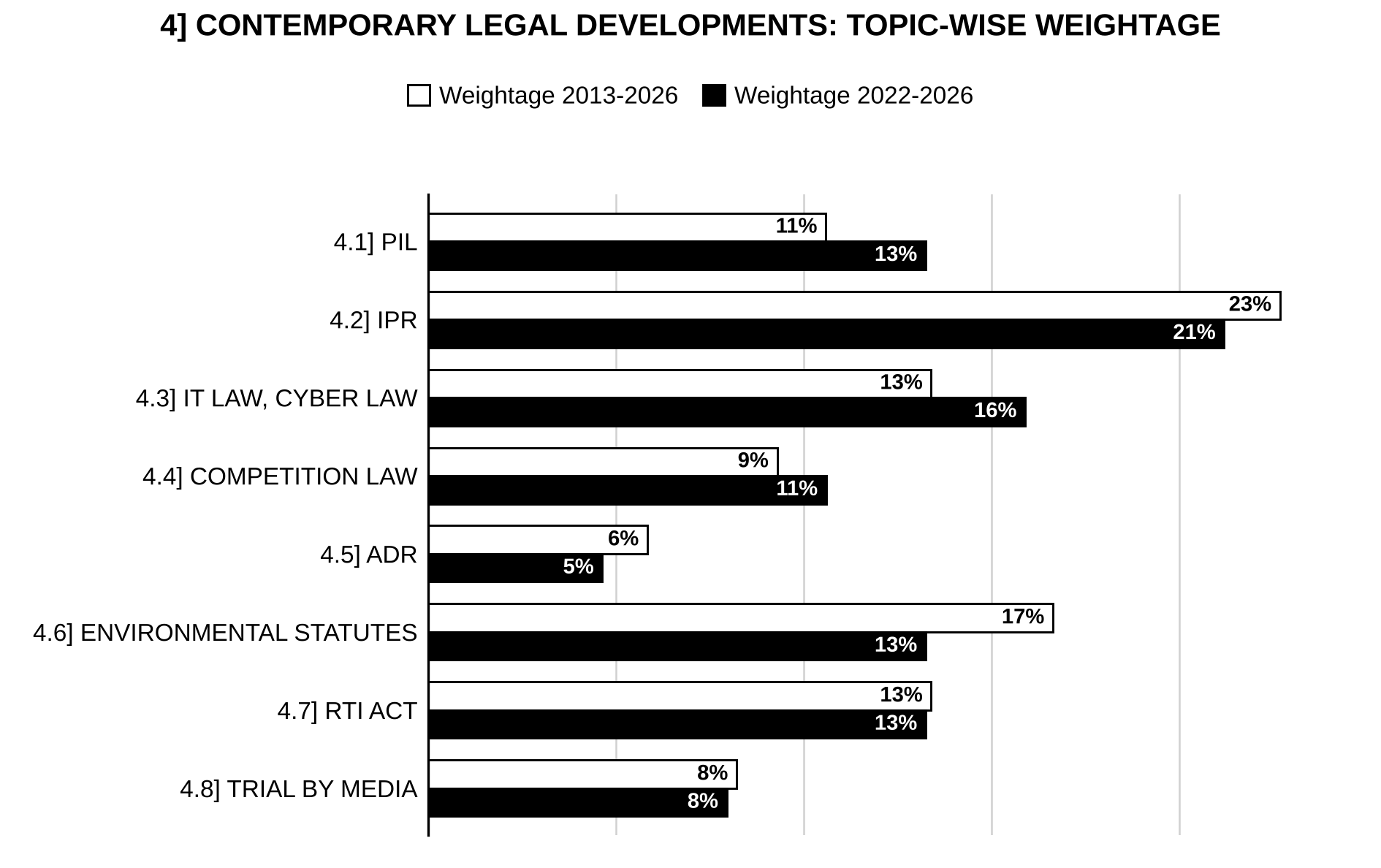
4.1] Public interest litigation
11 questions
“Public interest litigation is a tool to protect fundamental rights of persons or group of persons who are unable to approach the court due to poverty or social and economic conditions.” Critically analyze this statement. [2025/10m/150w/5e]
“There is, in recent years, a feeling which is not without any foundation that ‘public interest litigation’ is now tending to become ‘publicity interest litigation’ or ‘private interest litigation’, and has a tendency to be counter-productive.” Examine the statement critically. [2024/20m/8a]
“The Constitutional courts through their judicial activism have made substantial contribution in protecting women against exploitation, using Public Interest Litigation as a tool for securing their Constitutional rights.” Explain with leading case laws. [2023/20m/6a]
“The Supreme Court of India in public interest litigation cases relating to COVID-19 pandemic adopted a judicial policy of non-interference into the policies of the Government.” Elucidate with the help of decided cases. [2020/10m/150w/5c]
“Public interest litigation is not the pill of all ills, it is the boon of the courts. However it is also the duty of the court to prevent its misuse.” Elucidate. [2019/10m/150w/5c]
Public Interest Litigation (PIL) in India, of late, has been used not only to represent the unrepresented and weak but also to advance the interest of others. Comment on the recent trends relating to the application, use and misuse of PIL in India. [2018/10m/150w/5d]
“Public interest litigation has played a very crucial role in protection of environment in India.” Elucidate and illustrate with the help of decided cases. [2017/15m/7b]
“PIL writ petition cannot be filed in the Supreme Court under Article 32 of Indian Constitution only if a question concerning the enforcement of ‘Fundamental Rights’ is involved.” Comment. [2015/10m/150w/5b]
In matters such as enforcement of social, economic, cultural or political rights or civil liberties or gender concerns, courts in India have been inclined to apply relaxed rules of standing or litigational competence rather than strict rules of locus. Discuss. [2013/25m/7b]
“Public interest litigation is not in the nature of adversary litigation but it is a challenge and opportunity to the Government and its officers to make basic human rights meaningful to the deprived and vulnerable sections of community to assure them social and economic justice which is the signature tune of our Constitution.” Discuss. [2012/30m/7b]
Public Interest Litigation has been a significant tool in protecting the environment. Discuss with the help of cases. [2010/30m/6b]
4.2] Intellectual property rights
21 questions
“Intellectual property laws confer exclusive rights on creators; however, such rights are not absolute.” Critically examine this statement in view of copyright vis-à-vis public interest. [2026/20m/8a]
Discuss the remedies for infringement of trademark and passing off available to the trademark owner. [2025/15m/8c]
What is the commercial significance of the Geographical Indications of Goods? Explain the benefits that accrue to the registered proprietors and authorised users by registration of Geographical Indications of Goods. [2024/10m/150w/5e]
“In India, there are different types of Intellectual Property rights, which are protected under different laws.” Explain. [2023/10m/150w/5d]
“The quotation from a work which has already been lawfully made available to the public does not constitute infringement of copyright.” Comment. [2022/10m/150w/5e]
Discuss the ambit and scope of Section 3(d) of the Patent Act, 1970 in the context of the Novartis Case, 2013. [2022/15m/8c]
‘With the globalisation of trade, brand names, trade names and trade marks have attained an immense value and therefore it requires an effective trade mark law’. Discuss. [2021/10m/150w/5e]
“The grant of patent implies that patentee has a right to exclude others from using the invention.” Examine the implication of the above statement with relevant provisions of the Patent Act, 1970 and leading judgements. [2020/20m/6a]
“Laws are geared to protect the right to equitable remuneration but life is beyond the material.” In the light of the above statement, dwell on the dichotomy of economic rights and moral rights under the Copyright Act, 1957 and case law on the point. [2020/15m/7b]
“The intellectual property right and competition law generally work in tandem but often become friends in disagreement.” Elucidate the above statement by referring to the mandate of the TRIPS Agreement, 1995 and its compliance under the Competition Act, 2002. [2020/15m/8b]
“In the present time, there is a conflict between the right to access to knowledge and the copyright law.” Explain the statement in the light of doctrine of fair dealing under the copyright law. [2019/15m/8a]
In spite of introduction and recognition of Technological Protection Measures (TPMs), the digital copyright continues to be unsafe and unsecured. Explain the impact of the 2012 Amendments to the Copyright Act, 1957 on the protection of digital copyright in India. [2018/10m/150w/5e]
Discuss the various defences which can be pleaded by the defendant in an action for infringement of copyright under the Copyright Act, 1957. [2017/10m/150w/5d]
When does the infringement of trademark occur? Discuss the essentials of infringement of trademark. Write down the acts not constituting infringement of registered trademark. [2017/10m/150w/5e]
“An invention has to satisfy certain conditions in order to get a patent.” Examine critically the statement. [2017/15m/8b]
Discuss various provisions of Compulsory Licencing under Patents Act, 1970. [2015/15m/6c]
“Copyright is the right of the artist, author, producer of a film who have created a work by use of their artistic skills.” Examine infringement of copyright particularly relating to video piracy and the remedies available under the law. [2014/20m/7a]
“The copyright exists in expression but not in idea.” Discuss with the help of the provisions of Copyright Act and case law. [2013/10m/125w/5c]
Critically analyse the term ‘inventive steps’ as incorporated under the Patent (Amendment) Act, 2005. Do you agree with the present definition? Refer to recent case law. [2013/25m/6b]
The principle of ‘passing off’ in an action has been extended to the use of ‘false trade description’. Explain the conditions for a successful passing off action and the defences available to the opposite party. [2010/30m/8b]
“Intellectual property of whatever species is in the nature of intangible incorporal property.” In the light of this statement discuss the scope of intellectual property rights in India. [2008/30m/8a]
4.3] Information technology law including cyber laws
14 questions
“There is a jurisprudential difference between ‘cyber contraventions’ and ‘cyber offences’ as provided under the Information Technology Act, 2000.” Discuss. [2026/10m/150w/5b]
Discuss the relevance of the ‘safe harbour’ clause under the Information Technology Act 2000. Comment on the need to make the intermediaries liable for transmitting the posts and communications of third parties. [2024/15m/8b]
Under what circumstances, can an intermediary be held liable for third party-content hosted by them? Explain the liability of intermediaries in the light of the relevant legal provisions in IT Act and other contemporary developments. [2023/20m/8a]
“The Information Technology Act, 2000 aimed at e-commerce development, but failed to satisfy growth-building traders and consumer confidence.” Comment. [2022/15m/7b]
Dwell on the legality and constitutionality of Section 66A, Information Technology Act, 2000. [2021/15m/6b]
Ascertainment of jurisdiction is a big challenge under the cyber law. Elaborate the relevant legal provisions of the Information Technology Act along with various tests applied by the Indian courts. [2019/20m/6c]
“E-governance represents a new form of governance which needs dynamic laws, keeping pace with the technological advancement.” Comment on the adequacy of the Information Technology Act, 2000 in ensuring effective E-governance in India. [2018/15m/7b]
Explain the salient features and your views on the Information Technology Act, 2000 as amended in 2008 by the Information Technology (Amendment) Act, 2008. [2016/15m/8b]
“The procedure and qualifications for appointment of chairperson and members of Cyber Appellate Tribunal have been introduced to keep up the standards of Justice.” Comment. [2014/10m/150w/5b]
Cyber-terrorism is a well organised transborder criminal act, hence a combined domestic law supported by a Global law may help to address the problem. Discuss. [2014/20m/8c]
What is securing of digital signature under the Information Technology Act, 2000? State the duty of disclosure of the Certifying Authority. [2011/30m/8b]
Examine the legal recognition of ‘Digital Signature’ and explain the procedure for its registration under the Information Technology Act. [2010/30m/8a]
‘Information Technology – brought about by Computers, Internet and Cyberspace – has posed new problems in jurisprudence’. In the context of this statement, critically examine how far our existing laws are deficient in meeting these challenges. [2009/30m/6a]
“Cyber crime is a collective term encompassing both ‘cyber contraventions’ and ‘cyber offences’.” Explain this statement and discuss the various offences enumerated in the Information Technology Act, 2000. [2008/30m/8b]
4.4] Competition law
14 questions
How does the Indian Competition Act, 2002, reflect a shift from regulating monopoly to protecting the interests of consumers? Discuss. [2026/10m/150w/5a]
“Both horizontal and vertical agreements are included in Section 3 of the Competition Act, 2002 even when horizontal agreements are considered more harmful in comparison to vertical agreements.” Discuss. [2025/15m/7b]
What do you mean by ‘abuse of dominance’ and ‘abusive conduct’ prohibited under the Competition Act, 2002? [2022/15m/6b]
“The intellectual property right and competition law generally work in tandem but often become friends in disagreement.” Elucidate the above statement by referring to the mandate of the TRIPS Agreement, 1995 and its compliance under the Competition Act, 2002. [2020/15m/8b]
“The basic purpose of competition policy and the law is to preserve and promote competition as a means of ensuring efficient allocation of resources in an economy.” Elucidate the statement in the light of new economic scenario in India. [2019/20m/8c]
How far is the Competition Act, 2002 an improvement over the Monopolies and Restrictive Trade Practices Act, 1969 (MRTP Act, 1969) with respect to ‘abuse of dominant position’? Discuss and explain the relevant statutory provisions. [2017/15m/8c]
Competition Law in India has not achieved the result as was expected. Discuss the bottlenecks with which it suffers and suggest the remedies necessary to make it fruitful. [2013/25m/8a]
“Competition Law needs to have necessary provisions and teeth to examine and adjudicate upon anti-competitive practices.” Examine and evaluate this statement in the context of the Competition Act, 2002. [2011/30m/7a]
The Competition Act is designed to prevent monopolies and unfair trade practices against smaller competitors and consuming public. Elucidate. [2010/30m/6a]
Critically examine the utility of the Monopolies and Restrictive Trade Practices Act, 1969 in the days of liberalisation, globalisation and privatisation. [2000/30m/8b]
What are interconnected undertakings as determined in Section 2(g) [?] of the MRTP Act? Explain briefly how and when the Central Government may direct severance of interconnection between undertakings. [1999/30m/8b]
Recent amendment to the Monopolies and Restrictive Trade Practices Act, 1969 has left the Act with only regulating restrictive trade practices. Justify the statement. Critically explain the provisions amended. [1998/30m/4b]
Examine the mechanism envisaged by the Monopolies and Restrictive Trade Practices Act, 1969 to have surveillance over restrictive trade practices. [1997/30m/8a]
What is the nature of an unfair trade practice under the Monopolies and Restrictive Trade Practices Act, 1969? How does the Act protect a consumer? [1995/30m/7b]

Preparing for Prelims too?
Our UPSC Prelims Topic-wise PYQ eBook covers every Prelims question with detailed explanations, so you can see exactly where UPSC asks from.
View the BookDownload Free Sample4.5] Alternate dispute resolution
8 questions
Can ‘Alternative Dispute Resolution’ (ADR) mechanisms effectively adjudicate disputes involving public law elements, constitutional rights, or matters of significant public interest? Critically discuss the role of ADR mechanisms in light of limitations under the Arbitration and Conciliation Act, 1996. [2026/20m/7a]
“The establishment of ‘Consumer Mediation Cell’ and procedure for mediation in the Consumer Protection Act, 2019 is a step towards alternative dispute resolution in consumer cases.” Discuss. [2025/15m/4c]
“Alternative dispute resolution mechanism as provided under the Legal Services Authorities Act, 1987 has played a pivotal role in dispensation of justice to the needy persons.” Explain with the help of legal provisions and case law. [2019/15m/7b]
Even though Section 89 of the Code of Civil Procedure, 1908 provides for out of court settlement of civil disputes filed in a civil court, the impact of such settlement through Alternative Dispute Resolution (ADR) appears to be poor. Analyse the reasons for failure to settle the disputes through ADR modes. [2018/15m/7c]
Discuss the various principles of ‘mediation’. [2015/10m/150w/5e]
“By and large Lok-Adalats have failed in achieving the objects for which they were created.” Comment. And also suggest some measures to make this institution more effective. [2014/10m/8b]
What are the advantages and disadvantages of Alternative Dispute Resolution System? [2012/12m/150w/5e]
“Lok-Adalats in India manifest the purpose and objectives laid down in Alternate Dispute Resolution Schemes.” Discuss. [2011/15m/150w/5d]
4.6] Major statutes concerning environmental law
18 questions
In international environmental jurisprudence, the emergence of the ‘precautionary principle’ marks a shift from the assimilative capacity principle to the precautionary principle. Elucidate this statement in light of the concept of ‘sustainable development’. [2026/15m/7b]
“The ‘precautionary principle’ and the ‘polluter pays principle’ are essential principles of the sustainable development.” Explain both the principles and also their contribution in sustainable development referring to relevant case-laws. [2025/15m/7c]
What kind of cases are heard by the ‘National-Green Tribunal’? How is it different from the Central Pollution Control Board (CPCB)? [2023/10m/150w/5e]
Discuss the implications of the High Level Committee (known as T. S. R. Subramanian Committee) Report, 2014 for review of environment-related laws in India. [2022/10m/150w/5c]
India’s 40 years old ‘Air Act’, 1981, languishes in the present circumstances of Air pollution emergency in Delhi – National Capital Region. Comment on the effectiveness of law in the light of judicial and administrative mechanism. [2021/10m/150w/5d]
Discuss the access and benefit sharing (ABS) law provided under the Biodiversity Conservation Act, 2002 with special reference to adjudication of biodiversity disputes and jurisdiction of the National Green Tribunal. [2020/10m/150w/5b]
“The Environment (Protection) Act, 1986 is an umbrella legislation to not only protect and improve the environment but to prevent and control of pollution.” Comment and analyze. [2020/15m/8c]
“The National Green Tribunal, which was established for effective and expeditious disposal of cases relating to environmental protection and conservation of forests and other natural resources, has played a pivotal role in the recent past in this regard.” Examine the statement with reference to pronouncements given by the National Green Tribunal. [2019/15m/6b]
‘Sustainable development’ has been accepted as a balancing concept between ecology and development. Discuss the recognition and application of this principle under the laws relating to environmental protection in India. [2018/15m/6c]
Discuss the constitution, jurisdiction, powers and authority of National Green Tribunal. How far has it been successful in achieving its objectives? Explain with the help of recent cases. [2017/20m/6a]
“Public interest litigation has played a very crucial role in protection of environment in India.” Elucidate and illustrate with the help of decided cases. [2017/15m/7b]
Write a note on ‘Impact of noise pollution on the health of the people.’ [2015/10m/150w/5d]
The doctrine of “Public Trust” as propounded by Supreme Court has worked as an instrument for protection of Environment in India. Discuss. [2014/15m/7b]
Corporates causing havoc to the wildlife existing on seashores is an extreme type of environmental crime and laws are almost non-existent to deal with them directly. Discuss. [2013/25m/8b]
“The rise of Environmental Crimes in spite of Environmental Legislations is due to absence of adequate punitive methods of sentencing.” Discuss. [2011/30m/7b]
Public Interest Litigation has been a significant tool in protecting the environment. Discuss with the help of cases. [2010/30m/6b]
The “precautionary principle” and the “polluter pays principle” are the parts of the environment law of this country. Explain in the light of decided cases. [2008/30m/7b]
Explain the nature, scope and extent of the liability of the polluter for environmental torts in the light of the “Polluter pays principle” as developed in recent Supreme Court decisions. [1999/30m/4b]
4.7] Right to Information Act
11 questions
“Right to Information, for citizens to secure access to information under the control of public authorities, is an important enactment.” Discuss. Also describe the obligations of public authorities as mentioned in the Act. [2025/20m/8a]
An information shall ordinarily be provided in the form in which it is sought. Are there any exceptions to this rule? Explain with suitable illustrations. [2024/15m/8c]
Describe the constitutional roots of ‘Right to Information’ in India. Refer to decided case laws. [2023/15m/7b]
Discuss the constitutionality of Right to Information Act, 2019 in the light of recent judgment by the Supreme Court of India. [2021/10m/150w/5b]
Discuss the rationale of exemption to disclosure of information endangering life and the information regarding criminal trial and criminal investigation provided under the Right to Information Act, 2005 in the light of decided cases. [2020/15m/7c]
“Pragmatic regime of right to information for citizens is the key to good governance in India, but it is not being implemented in its original spirit.” Examine it in the light of decision of the Supreme Court of India in Anjali Bhardwaj vs. Union of India, February 2019. [2019/10m/150w/5e]
“Mahatma Gandhi, the Father of Nation, observed that the meaning of real freedom is not to acquire authority by few but to acquire the capacity to question the abuse of such authority.” Examine, in the light of the above statement, the obligations of the public authorities and explain whether they have discharged it effectively during the last about seven decades. [2018/15m/8c]
“Notwithstanding transparency of governance, certain informations have been exempted from disclosure under the Right to Information Act, 2005.” Discuss the relevant provisions and limitations on disclosure of information. [2017/15m/7c]
“The Right to Information Act, 2005 was enacted in order to promote transparency and accountability in the working of every public authority.” How far has this goal been achieved by the Right to Information Act, 2005 in the last ten years? Critically analyse your answer with the support of exceptions and case law. [2016/15m/6a]
“An attempt by all political parties to bring amendments to the RTI Act, 2005 is to sabotage the steps towards transparency of governance in this country.” Critically evaluate the statement. [2013/25m/7a]
A Central Government Medical Research Institute in collaboration with an MNC used a drug on experimental basis on humans for curing cancer. Some of the patients died due to this drug. In order to sue for compensation for such victims and violation of right to privacy, Mr. X, a relative of a deceased patient sought information through the instrumentality of Right to Information Act. The information was refused on the ground that it affects the contracting power of the Central Government with foreign companies and violates trade secrets too. Decide. [2011/30m/6b]
4.8] Trial by media
7 questions
“‘Trial by media’ is a complex phenomenon which poses a conflict between two fundamental principles of democracy, viz. ‘the right to a fair trial’ and ‘freedom of the press’.” How can a balance be maintained between these two? Explain. [2026/15m/7c]
‘Media trials entail the possibility of subverting administration of justice.’ In the light of this statement, analyse the report of Law Commission of India on Media Trial. [2023/15m/8b]
Discuss the symbiotic relationship between Media Trial and Fair Trial with reference to judicial approach. [2021/15m/7c]
Trial by media appears to be an affront to the concept of free and fair trial in criminal cases, apart from being a kind of contempt of court in certain cases. Analyse the impact of trial by media on the administration of criminal justice in general and on the stakeholders in particular. [2018/15m/8b]
“Though there is no law for media trial, however, in freedom of expression and speech under fundamental rights, media has the freedom to express its views based on evidence. This trial has no authority before the court of law.” Critically examine the statement with case law. [2016/15m/6b]
Judiciary in India is impartial, hence can not be influenced by internal or external factors. In the light of this discuss how far media transgresses its limit and attempts to influence the judicial process. [2014/20m/6c]
“During high publicity court cases, the media are often accused of provoking an atmosphere of public hysteria akin to a lynch mob which not only makes a fair trial nearly impossible but means that regardless of the result of the trial the accused will not be able to live the rest of his life without intense public scrutiny.” How would you reconcile the “freedom of the press” and the “individual’s right to privacy and right to a fair trial”? Do you think that trial by media amounts to “contempt of court” and needs to be punished? [2012/20m/8a]

Strengthen your GS papers
Our UPSC Mains Topic-wise & Year-wise PYQ eBook (2013–2026) maps every GS question to the syllabus, so you know what UPSC asks and how often.
View the BookDownload Free Sample« Previous: Law of Contracts and Mercantile Law | Next: Other Questions »
Back to: Law Optional PYQs – Topic-wise
Last updated: 30 October 2026