
Here are all 404 Constitutional and Administrative Law questions asked in UPSC Law Optional Paper I from 1995 to 2026, arranged under the 16 topics of the official syllabus. Within each topic the latest questions come first.
Each question ends with a code such as [2024/15m/3b] – the year, the marks, the word limit (where UPSC set one) and the question number in the paper.
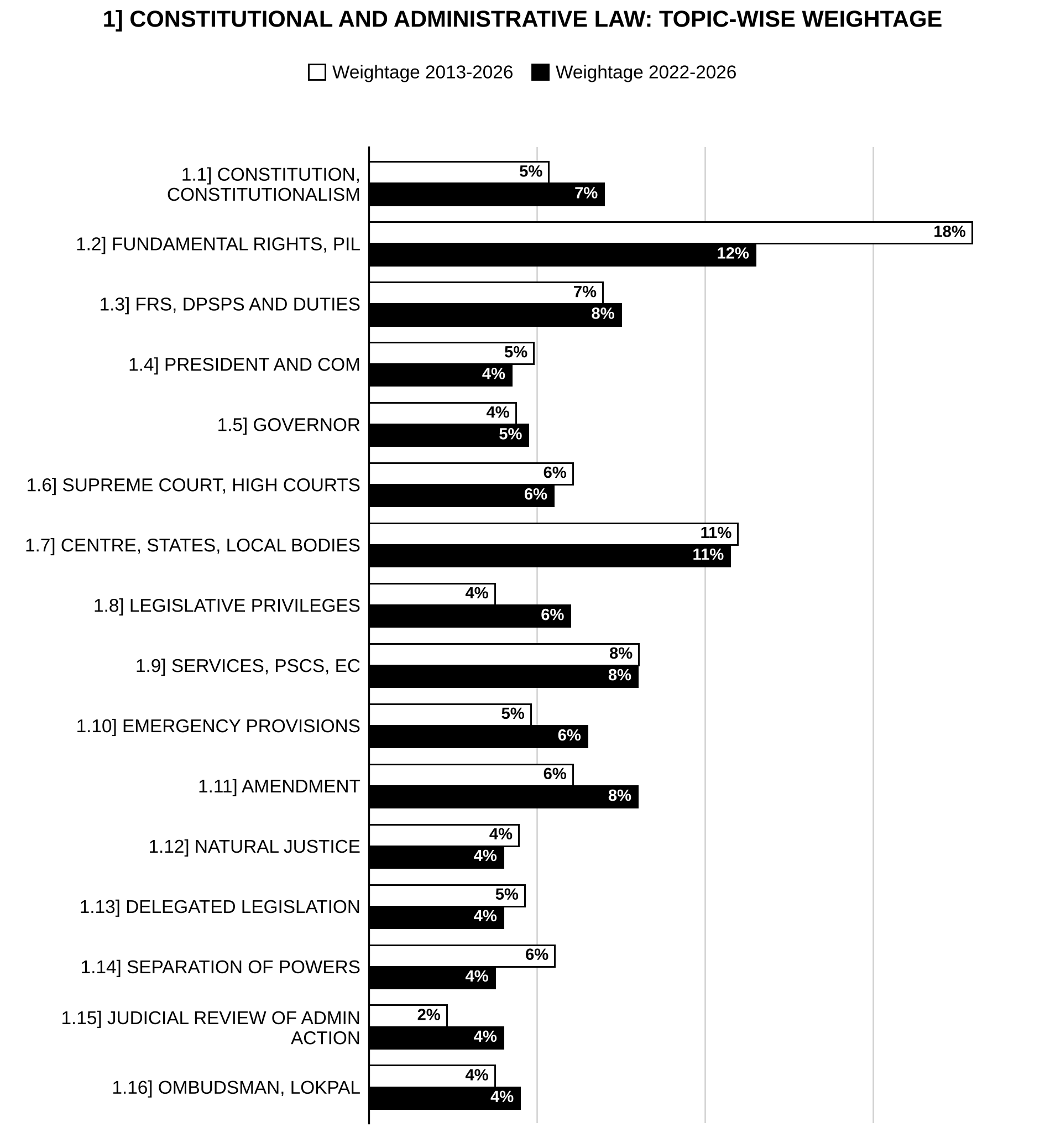
1.1] Constitution and constitutionalism
24 questions
“‘Constitutionalism’ connotes in essence–‘limited government’ or ‘a limitation on government’. It is the antithesis of arbitrary powers.” Discuss. [2026/15m/2b]
“Constitutionalism is the concept of limited government under a Fundamental Law.” In the light of this, differentiate between distinctive features of Constitution and Constitutionalism. [2024/15m/2b]
In recent years, the concept of ‘Cooperative Federalism’ has played a pivotal role in constitutional governance of the nation but at the same time it comes across various challenges as well. Elaborate. [2024/20m/4a]
“Preamble of the Indian Constitution is indicative of basic values that the political system is expected to pursue.” How far do you agree with the statement? Explain with the reference to values that have been enshrined in the Preamble of the Constitution. [2023/10m/150w/1a]
‘To preserve basic freedoms and dignity of individuals, a Constitution should be permeated with Constitutionalism.’ Discuss. [2022/10m/150w/1b]
With the help of illustrations, discuss and differentiate, co-operative federalism and competitive federalism. [2020/15m/2c]
“India that is ‘Bharat’, shall be a Union of States.” Explain. Do you think that the Indian Constitution is a Federal Constitution? Discuss with the help of decided cases. [2019/15m/3c]
What do you understand by the terms ‘cooperative federalism’ and ‘competitive federalism’? Do you agree with the view that the Indian Constitution is based on the concept of ‘competitive federalism’ and not on the concept of ‘cooperative federalism’? [2018/10m/150w/1a]
Is ‘Secularism’ an essential feature of the Constitution of India? Explain in the light of decided case laws. [2017/10m/150w/1b]
Explain the concept of ‘Federalism’ as incorporated in the Indian Constitution. [2016/10m/1a]
What do you think is the form/nature of our Constitution – Federal, Unitary or Quasi-federal? The Members of the Drafting Committee call it federal, but many others would dispute this title. Critically examine the statement. [2014/10m/150w/1a]
What is ‘Constitutionalism’? Explain the said concept both in its negative and positive aspects in the context of India’s tryst with ‘Constitutionalism’ and ‘Constitutional Governance’. [2014/10m/150w/1b]
What do you understand by the term ‘Constitutional Conventions’? Are they are relevant in a country like India having a lengthy written constitution with preamble? [2012/20m/2a]
Secularism. [2011/20m/4c]
Differentiate between ‘Federal Constitution’ and ‘Federal Government’. Based on judicial pronouncements and your perception of the working of our Constitution, comment on whether India has a Federal Government or a Federal Constitution. [2009/20m/200w/1a]
“The Constitution of India is not true to any traditional pattern of federation.” Comment. [2007/20m/200w/1c]
“The Indian federal structure has brought in some novel provisions which are not to be found in other federations.” Critically discuss. [2005/20m/200w/1d]
“Federalism has in recent years, witnessed a change – from the dogmatic to dynamic – approach.” Discuss the changing approach and point out the main deviations in the working of the Constitution of India. [2004/20m/200w/1a]
What is the nature of the Indian Constitution? Do you think it is a Federal Constitution? Discuss. [2002/20m/200w/1d]
“The Indian Constitution is essentially federal in character, though it tends to be unitary at times.” Comment. [2000/20m/200w/1a]
“Constitution of India is first and foremost a social document.” Granville Austin. Explain. [1998/20m/200w/1a]
“Indian secularism is neither anti-religious nor is it based on total neutrality towards religion but is based on equal respect for all religions.” Explain and illustrate. [1997/20m/200w/1d]
“Constitution of India is neither purely federal nor purely unitary but is a combination of both.” Discuss. [1995/20m/200w/1a]
Discuss the characteristics of secularism and examine how far the Indian Constitution is secular. [1995/30m/2b]
1.2] Fundamental rights
93 questions
“While interpreting Article 21 of the Constitution, the Supreme Court introduced the concept of ‘due process of law’ indirectly into the Constitution of India, and thereby expanded its scope considerably.” Support your answer with the help of leading case laws. [2026/20m/2a]
If Article 21 confers on a person the right to live a dignified life, does it also include a right not to live? Examine the Constitutional Provisions with the help of decided case laws. [2025/10m/150w/1d]
“It is significant that the State shall secure the operation of legal system to promote justice on the basis of equal opportunity.” Examine the provisions under the Constitution and Legal Services Authorities Act, 1987. [2025/15m/3c]
“A law is void only to the extent of inconsistency or contravention with the relevant Fundamental Right.” Explain with the help of decided cases. [2024/10m/150w/1e]
The concept of Public Interest Litigation is an exception to the rule of ‘locus standi’. Elaborate in the light of its evolution, aims and objects in India with the help of leading cases. Also discuss its drawbacks. [2024/20m/2a]
Who are ‘minorities’? The Constitution of India protects the rights and interests of minorities to the extent that the rights conferred to them to establish and administer educational institutions of their choice are not absolute and are subject to reasonable restrictions. Discuss with the help of decided case laws. [2024/15m/3b]
“‘Legal-Aid’ provides a basic tool for access to justice for poor and marginalized sections of society.” Discuss and elucidate the Constitutional provisions and the provisions of the Legal Services Authorities Act, 1987. [2023/15m/3b]
‘Absolute equality may itself be a cause of inequality.’ In the light of this statement, discuss substantive equality. [2022/10m/150w/1a]
“The Fundamental Rights may be said to constitutionalise social values of existing society.” Explain and illustrate. [2021/10m/150w/1a]
“Public Interest Litigation in India is judge-led and even to some extent judge-induced.” Explain with the help of relevant case law. [2021/10m/150w/1b]
“Right to Education is the base for the Fundamental Rights and Human Rights.” Discuss the efforts made by the Government with regard to Right to Education of the children. [2021/10m/150w/1c]
“Pluralism is the keystone of Indian culture and religious tolerance is the bedrock of Indian Secularism. It is based on the belief that all religions are equally good and efficacious pathways to perfection of God-realisation. Thus, all persons are equally entitled to freedom of religion which is not absolute.” Critically examine the above statement with the help of constitutional provisions and relevant case laws. [2021/20m/2a]
Examine the role of State Legal Services Authority in promoting legal literacy and right of women and children in the State. [2021/15m/4b]
Examine the scope of protective discrimination offered to persons belonging to Scheduled Castes, Scheduled Tribes and Other Backward Classes under Articles 15 and 16 of the Constitution of India. Explain with the help of decided cases. [2020/20m/3a]
“Right to Privacy is protected as an intrinsic part of life and personal liberty enshrined under Article 21 of the Constitution of India.” Elucidate this statement in the light of the decision of Justice K.S. Puttaswamy (Retd.) v. Union of India. [2019/10m/150w/1e]
Examine and explain the following statements: (i) Public Interest Litigation is a tool to promote politics of the Judiciary. (ii) Judicial Activism has both positive and negative impact on the Judiciary. [2019/15m/4c]
Critically evaluate the changing dimensions of the concept of ‘State’ under Article 12 of the Constitution of India. [2018/10m/150w/1c]
Examine the concept of social justice as envisaged in the Constitution, more particularly in Chapter IV of the Constitution and under Article 14 of the Constitution. [2018/20m/2a]
“The liberty of the press implicit in the freedom of speech stands on no higher footing than the freedom of speech and expression of a citizen, and no privilege is attached to the press as such distinct from the ordinary citizen.” Explain this statement and also distinguish the term ‘freedom of speech and expression’ and ‘speech and expression’. [2018/20m/4a]
Under what circumstances, does a third party, apart from concerned parties, have locus standi to move writ petitions before the High Court or the Supreme Court in India? Also point out the limitations of such petitions. [2018/15m/4c]
Discuss the importance of ‘Right to life and personal liberty’ with reference to recent case laws. [2017/10m/150w/1a]
Given the contemporary economic, political and social realities, critically evaluate the judicial framework developed to determine whether an agency/body is ‘State’ for the purposes of Article 12. Is the test currently too narrow? Justify your answer. [2015/10m/150w/1a]
“Article 14 of the Constitution of India forbids class legislation not reasonable classification.” Examine and also discuss how far equality of status and opportunity are achieved by this Constitutional provision. [2015/10m/150w/1c]
“Right to life means something more than mere animal existence.” Discuss with reference to case law. Is there any difference between the expression ‘right to life’ and ‘personal liberty’? Explain critically. [2015/20m/2a]
The horizon of ‘Legal aid’ has been widened best, still the impact is totally missing. How would you resolve this crisis which is ruining the life of millions of poor people of our country over the years? Suggest some concrete measures to make it more effective and implementative. [2015/15m/2c]
What is ‘Protected discrimination’? Examine how far it is constitutional under Article 15 and 16. Give reference of decided cases. Also mention the limitations of these articles as per its application. [2015/15m/3b]
Under what circumstances, apart from concerned parties, a third party has locus standi to move writ petition before the High Court or Supreme Court? How has this procedure helped in developing and promoting democratic principles in the country? [2015/20m/4a]
Article 13 makes the judiciary, and especially the Apex Court, as a guardian, protector and the interpreter of the Fundamental Rights. It confers a power as well as imposes an obligation on the Courts to declare a law void if it is inconsistent with a Fundamental Right. Discuss. [2014/10m/150w/1c]
Explain and elucidate the meaning of the ‘Right to personal liberty’ as interpreted by the Supreme Court in Papanasam Labour Union v. Madura Coat Ltd. AIR 1995 S.C. 2200. Analyse critically the guidelines prescribed by the Hon’ble Supreme Court in this respect. [2014/15m/2b]
A backward class cannot be identified only and exclusively with reference to economic criterion. A backward class may, however, be identified on the basis of occupation-cum-income without any reference to caste. There is no constitutional bar in the State categorising the backward classes as ‘backward’ and ‘more backward’. Do you agree with the statement? Give reasons. [2014/15m/3b]
What is ‘Public Interest Litigation’? What are the major facets of this form of litigation? Also discuss the limitations of this type of litigation. [2014/15m/3c]
Do you agree with the statement that “all human rights are fundamental rights protected and recognised by the Constitution of India”. Discuss with reference to statutory provisions and case laws. [2014/15m/4b]
Is ‘Commercial advertisement’ covered within the ambit of ‘freedom of speech and expression’? Discuss with reference to leading cases. [2013/10m/150w/1c]
Doctrine of equality under the Constitution cannot be applied to legitimise an illegal act. Can equality be invoked to justify another wrong? Critically examine with reference to cases. [2013/10m/150w/1e]
Do you agree with the view that “Equality is antithesis of arbitrariness. In fact equality and arbitrariness are sworn enemies”? Comment critically. [2013/25m/2a]
Whether law relating to preventive detention can be challenged for violation of Article 19? [2013/15m/4b]
Are personal laws ‘law’ for the purposes of Part III of the Constitution? Discuss with reference to leading case law. [2012/12m/150w/1b]
In what circumstances and for violation of which rights can monetary compensation be awarded to the victims? What is your view for adopting such an approach by judiciary? Analyse critically. [2012/20m/2c]
Is there any difference between ‘Right to information’ and ‘Right to be informed’? Do we have any provision in the Constitution in this regard? Discuss with reference to case law. [2012/20m/3c]
‘Equality is a dynamic concept with many aspects and dimensions, and it cannot be cribbed, cabined or confined within traditional and doctrinaire limits.’ Explain, how the judiciary has widened the scope of the right to equality by various decisions. [2011/30m/2a]
Right to life has been extended to a clean human environment by the Courts in India. Discuss the development of law in this regard. [2011/30m/2b]
New frontiers of criminal justice have been spelled out from Article 21 of the Constitution, which provides that no person shall be deprived of his right to life and personal liberty except according to procedure established by law. Discuss and refer to decided cases. [2010/30m/2a]
Locus standi is necessary for challenging an administrative action, through a writ petition. How has it been liberalised in case of public interest litigation? Comment on the statement that “PIL is not a PILL against all the ILLS.” [2010/30m/2b]
“It is the religious teaching, not the teaching of religion which is prohibited under the Constitution of India.” [2010/20m/4b]
Define and distinguish between ‘formal equality’ and ‘substantive equality’ as interpreted by the Apex Court of the country. [2009/20m/200w/1c]
“The term ‘freedom of speech and expression’ in Article 19(1)(a) has been held to include the right to acquire information and disseminate the same.” Elucidate the import of this statement in the context of media industry. Is the right to paint or sing or dance covered by Article 19(1)(a) of the Indian Constitution or not? [2009/30m/2b]
Scope of the Right with regard to self-incrimination. [2009/20m/4a]
“Equality is the basic feature of the Constitution of India and any treatment of equals unequally or unequals as equals will be violation of basic structure of the Constitution of India.” Explain. [2008/30m/3b]
Rights of the Press and the problem of Pre-censorship. [2008/20m/4b]
What is the meaning of ‘Freedom of Press’ under the Indian Constitution? Can the freedom of press be restricted by a law requiring the press owners to pay minimum wages to the employees of the press? Decide. [2007/20m/200w/1d]
Examine and elucidate the scope and significance of Article 32 of the Constitution in the context of Public Interest Litigation as expounded by the Supreme Court in M. C. Mehta Vs. Union of India, AIR 1987 SC. 1086. [2007/30m/2a]
Meaning of the term ‘Other Authorities’ under Article 12 of the Constitution. [2007/20m/4b]
“In fact, equality and arbitrariness are sworn enemies; one belongs to the rule of law in a republic while the other, to the whim and caprice of an absolute monarch.” Elucidate with the help of constitutional provisions & judicial decisions. [2006/20m/200w/1a]
“Article 16 (4) is by itself a rule of equality rather than an exception to the rule.” What is your view? Discuss with the help of case-law. [2005/20m/200w/1a]
“The fundamental right to freedom of speech and expression has in recent times seen expanding horizons.” Discuss and point out the judicial approach in this regard. [2005/20m/200w/1b]
“Secularism is neither anti-God nor pro-God. It eliminates God from the matters of State and ensures that no one shall be discriminated on the grounds of religion.” In the light of the above observation discuss the true import of freedom of religion guaranteed under the Indian Constitution. [2005/30m/3a]
“Liberty of Press consists in laying no prior restraints upon publications and not in freedom from censure for matters when published.” Explain and indicate how far this liberty of Press is protected under the Indian Constitution. [2004/20m/200w/1b]
“The extensive use of the device of ‘reasonable classification’ by State and its approval by the Supreme Court has rendered the guarantee of ‘fair and equitable treatment’ under Article 14 largely illusory.” Discuss making clear the constitutional and popular concepts of ‘right to equality’ in India. [2004/20m/200w/1c]
“Preventive Detention is the only exception carved out to the generally accepted proposition that no person shall be deprived of his personal liberty except in accordance with the procedure established by law”. Discuss the safeguards evolved by the Judiciary for the protection of personal liberty of a person detained under the law of Preventive Detention. [2003/20m/200w/1a]
Critically examine the decisions of the Supreme Court from A.K. Gopalan to Maneka Gandhi cases with special reference to “procedure established by law”. [2003/30m/4a]
If the words “All minorities” in Article 30 of the Constitution of India are replaced by the words, “All sections of citizens having distinct language or religion”, what fundamental rights of the minorities would be affected? [2002/20m/200w/1a]
Discuss any one theory developed by the Supreme Court of India under Article 21 of the Constitution of India for compensation to the victims. [2002/30m/2a]
What fundamental right, if any, of a person is violated if the State acts in pursuance of either Article 15(4) or 16(4) of the Constitution of India? [2001/20m/200w/1a]
Discuss the relationship between Article 29 and Article 30 of the Constitution. [2001/20m/200w/1c]
In order to make the best use of the limited resources in the country and to meet certain demands of the journalists and other workers in the newspaper industry; the government plans to enact a law which (i) fixes the minimum wages for all the journalists and workers, (ii) declares Sunday and all other national holidays as compulsory holidays for the newspaper industry; (iii) requires the newspapers to allocate certain percentage of news space to pressing socio-economic issues facing the country; and (iv) prohibits certain kinds of advertisements, particularly those which make indecent depiction of women. Your advice is sought by the government on the constitutionality of such legislation vis-a-vis Article 19(1)(a). Give your advice with reference to decided cases. [2001/30m/2a]
Critically examine the statement that though Maneka Gandhi V. Union of India has made a great advancement towards the understanding and application of the Fundamental Rights in our Constitution it has not been able to make much difference either to the preventive detentions or towards ensuring the due process of law. [2001/30m/3a]
In order to cure the heavy under-representation of the Schedules Castes and the Schedules Tribes in the State services even after fifty years of the Constitution, a State wants to make a scheme, which may remove this imbalance within a period of five years. Advise the State about the steps that it may take under the Constitution for this purpose. [2001/30m/3b]
Discuss the nature and the scope of the following writs: (i) Certiorari (ii) Mandamus. [2001/30m/4b]
Explain the provisions relating to protection and improvement of environment in our Constitution with special reference to the role of judiciary in this regard. [2000/20m/200w/1c]
“The Supreme Court in Maneka Gandhi’s case has revolutionised the law relating to ‘personal-liberty’ under Article 21 of the Constitution.” Explain with illustration. [2000/30m/2a]
The Civil Surgeon had issued an advertisement for a training course in midwifery at the District Hospital. The advertisement had a clause “Married women candidates must enclose along with their application their husband’s written permission for pursuing the course.” The wife got the letter of consent from her husband and joined the course. The husband, however, had second thoughts and wrote to her and the authority saying she should return immediately as her not being there would disturb the family life and hence she would not be permitted to join. Thereafter the authority asked her to produce another letter of “no objection” from the husband. Examine with reference to the relevant provisions of the Constitution the validity of the order of the authority. [2000/30m/4b]
What is prohibited is hostile discrimination, and not reasonable classification. [1999/20m/200w/1a]
What is included within the right to freedom of speech and expression? Are commercial advertisements covered by the protection? Discuss referring to decided cases. [1999/30m/2a]
The term ‘procedure established by law’ in Article 21 of the Constitution has been interpreted by the Supreme Court to entitle an accused person to a right to fair trial. Discuss and referring to decided cases spell out the ingredients of a fair trial. [1999/30m/3a]
A law prohibits religious conversions brought about by use of fraud, force, or allurement and makes it a punishable offence. In a writ petition it is alleged that the law is violative of right to propagate religion guaranteed under Article 25 of the Constitution. Decide giving reasons. [1999/20m/4a]
The Service Rules of a Statutory Corporation allow the Corporation to terminate the services of a confirmed employee by giving three months notice or by paying three month’s salary in lieu of notice. The validity of the rule is challenged for violation of Articles 14 and 21 of the Constitution. Decide giving reasons. [1999/20m/4b]
A minority educational institution, which is completely unaided by the Government, is required by the Education Code framed by the Government to pay to its teachers salary at the prescribed rate. The institution shows its inability and contends that the enforcement of the code amounts to interference with its constitutionally guaranteed right of administration. Decide giving reasons. [1999/20m/4c]
“Right to equality and protection to personal liberty are no longer mutually exclusive.” Discuss. [1998/20m/200w/1b]
Right not to be discriminated on the ground of sex and the need for empowerment of women by making special provision for them requires the State to ensure that women have adequate representation in Parliament. Argue for and against the proposed constitutional amendment for the purpose. [1998/30m/3a]
A boy aged 16 was convicted and punished in 1957 to undergo rigorous punishment for six months. After his conviction the Probation of Offenders Act, 1958 was passed. In appeal he claims the protection of the Probation of Offenders Act, 1958. Decide. [1998/30m/4a]
The Government of India by an office memorandum reserved 27% of posts for appointment under the State in favour of socially and educationally backward classes. A petition is filed in the Supreme Court challenging its validity on the ground that it could only be done by an Act of Parliament and not by an executive order. Decide. [1998/30m/4c]
“Reservations should be made only in respect of direct recruitment at any level but not in respect of promotions.” Discuss. [1997/20m/200w/1b]
“The concept of instrumentality or agency of the government is not limited to a corporation by a statute but it is equally applicable to a created company or society.” Discuss and state whether Article 12 also includes private persons. [1997/30m/3a]
“True our Constitution has no ‘due process’ clause but after Maneka Gandhi’s case the consequence is the same.” Discuss. [1997/30m/3b]
X was sentenced to death but his death sentence was not executed for ten years, X contends that to take away his life after keeping him in jail for ten years entitles him to demand the quashing of his death sentence under Article 21 of the Constitution. Examine X’s contention. [1997/30m/4a]
Clause 3 of the Constitution 44th Amendment Act which provides for several vital safeguards in favour of persons under preventive detention has not yet come into force as the Central Government has not issued the necessary notification under Clause 2 of the Amendment. A detenue aggrieved by the Central Government’s apathy and inaction moves the Supreme Court in proceedings under Art. 32 for a writ of mandamus to compel the Government to appoint and notify the date of commencement of Clause 3 forthwith. Is he entitled to seek such a direction from the court? Discuss in the background of connected case law. [1997/30m/4c]
Does the right to life and personal liberty in Article 21 of the Constitution embrace a right to clean, healthy and livable environment, using the expression “environment” in its broadest meaning as understood in contemporary jurisprudence? Examine the question in the background of cognate constitutional provisions and case-law. [1996/20m/200w/1a]
“The right to receive compensation in proceedings under Article 32 of the Constitution for violation of the fundamental right to life and personal liberty by public officials cannot be defeated by raising a plea of sovereign immunity.” Discuss with the help of case-law. [1996/30m/2b]
X has been sentenced to death for having committed several murders. He writes his autobiography in jail and hands over the same to his wife for publication. The autobiography depicts a close nexus between X and some top government officials, some of whom had been partners in these murders. Z, a publisher accepts the autobiography for publication. The Inspector-General Prisons asks Z to stop publication of X’s autobiography as it contains defamatory material against State officials and is false. Z contends that the Inspector-General Prisons has no authority to impose a prior-restraint upon the publication of the autobiography. Decide. [1996/30m/4b]
“Right to life includes the right to commit suicide.” Examine. [1995/20m/200w/1c]
Critically examine the widening dimensions of the concept “the State” in Article 12 of the Constitution of India. [1995/30m/2a]
Consequent on a dispute between two rival groups, the police arrested A, the leader of the group and lodged him in sub-jail. A warned the authorities that the other group may attack him in jail. But the authorities did not take any precautionary measures. At night the rival group attacked and killed A in jail. The heirs of A filed writ petition before the High Court asking for compensation for the violation of the right to life of A. The State pleads sovereign immunity. Decide. [1995/30m/4b]
Doordarshan invited X, a lady journalist, for an interview to be telecast subsequently. The theme of the interview was “Laws relating to women”. In the course of the interview X referred to a bill on women’s rights pending in Parliament and criticized that some of its provisions are unjustified and unconstitutional. This portion of the interview was arbitrarily deleted when the interview was telecast. X wants to challenge with deletion. Discuss the questions involved. [1995/30m/4c]
1.3] Fundamental rights, directive principles and fundamental duties
26 questions
The word ‘State’ used in the ‘Directive Principles’ has the same meaning as has been given to it by Article 12, for the purposes of enforcement of the Fundamental Rights. Examine in the light of exceptions, if any. [2026/10m/150w/1d]
“The Directive Principles of State Policy are fundamental in the governance of the country, and it shall be the duty of the State to apply these Principles in making laws.” Illustrate the legislations, which have been enacted for the implementation of Directive Principles. [2025/15m/2b]
“The Fundamental Rights are not an end in themselves but are the means to an end. The end is specified in the Directive Principles.” Analyze the statement. [2024/15m/4b]
“The Constitution of India has provided for a clear-cut distinction between civil and political rights on the one hand and economic and cultural rights on the other, with a distinct primacy given to civil and political rights.” Explain. [2023/20m/2a]
Do you think that all the ‘Directive Principles of State Policy’ are equally fundamental for the governance of the country? Describe with the help of decided case laws. [2022/15m/2c]
“The provisions of the Directive Principles of State Policy are not enforceable by any court, but they are fundamental in the governance of the country.” Critically examine the role of the Government to fulfil the desired objectives enshrined in Part IV of the Constitution. [2021/20m/4a]
Enumerate the list of Fundamental Duties as provided in the Constitution of India. What is the rationale of incorporation of Fundamental Duties under the Indian Constitution through the Constitutional (Forty-second Amendment) Act, 1976? [2020/10m/150w/1d]
Examine the concept of social justice as envisaged in the Constitution, more particularly in Chapter IV of the Constitution and under Article 14 of the Constitution. [2018/20m/2a]
Discuss the relationship between ‘Fundamental Rights’ and ‘Directive Principles of State Policy’ in the light of the constitutional amendments and decided cases. [2016/10m/1e]
Explain the opinion of the Supreme Court of India regarding the relation between the Fundamental Rights and Directive Principles of State Policy in the light of its decided cases. Do you agree with the view that giving primacy to one over the other is to disturb the harmony of the Constitution? Comment with reference to the present day scenario relating to education, health, religion, etc. [2015/15m/4c]
Enumerate the fundamental duties as provided in the Constitution of India. Also discuss the rationale behind the incorporation of fundamental duties in the Constitution of India later on. [2014/15m/4c]
Has judiciary been a hindrance or a facilitator in the interpretation of Directive Principles? Examine in the light of various judgements of the Supreme Court. [2013/10m/150w/1a]
“Fundamental duties are only ethical or moral duties and should not form a part of the fundamental law.” Comment. [2013/10m/150w/1b]
Introduction of Uniform Civil Code. [2013/20m/4c]
“The Directive Principles which have been declared to be ‘fundamental’ in the governance of the country cannot be isolated from Fundamental Rights.” Explain critically. Also throw light with reference to recent judgments on the Supreme Court’s view as regards the interplay of Directive Principles and Fundamental Rights. [2009/30m/3a]
Spell out the object and reasons of Part IV A of the Constitution of India. Do you support this addition to the Constitution of India? Give reasons and also suggest some effective measures to make these provisions more realistic and operational. [2009/30m/3b]
Explain and elucidate the significance of the various strategies adopted for the implementation of the ‘Directive Principles’ of State Policy enshrined in Part – IV of the Indian Constitution. [2008/20m/1d]
The scope of the constitutional harmony and balance between ‘Fundamental Rights’ and ‘Directive Principles’ of State Policy. [2008/20m/4c]
“Fundamental duties are only ethical and moral duties and should not form a part of the fundamental law.” Comment. [2006/20m/200w/1b]
“Directive principles of state policy are not enforceable in the Court of Law but, nevertheless, they are fundamental in the governance of the country.” Discuss this statement with the help of decided cases. [2006/30m/2a]
“While the implementation of the Directive Principles of the State Policy is a pre-condition for the enjoyment of Fundamental Rights, the destruction of the Fundamental Rights will frustrate the realisation of the Directive Principles.” Discuss. [2003/20m/200w/1b]
Justify the contemporary economic liberalisation reforms on the basis of constitutional provisions. [2002/30m/2b]
Explain the provisions relating to protection and improvement of environment in our Constitution with special reference to the role of judiciary in this regard. [2000/20m/200w/1c]
Examine critically the relationship between the Fundamental Rights and the Directive Principles of State Policy in the light of decided cases and the constitutional amendments. [2000/30m/2b]
Directive Principles of state Policy have played a significant role in the interpretation of the Constitution. Explain and illustrate your answer. [1998/30m/2a]
“In recent times certain directive principles have been judicially enforced and made enforceable by imaginative and creative interpretation of fundamental rights.” Do you agree? Give reasons. [1997/30m/2a]
1.4] President and the Council of Ministers
26 questions
The President in India is elected not directly by the people, but by the method of indirect election. Explain. Who will decide in case any dispute arises in connection with the election of the President? Discuss. [2026/10m/150w/1e]
Discuss the relationship between the President and the Council of Ministers under the parliamentary form of government in India. Explain with the help of relevant constitutional provisions. [2024/15m/2c]
“The ordinance making power of the President and the Governors is a unique feature of the Indian Constitution but it balances on a razor-sharp edge between pragmatic governance and potential over-reach.” Critically examine with the help of decided case laws. [2024/15m/4c]
“The office of the President under the Indian Constitution has been designed to be largely that of a ‘figurehead’.” Explain, with reference to the cases decided on the subject. [2023/10m/150w/1b]
Explain the relationship between the President and the Council of Ministers. Is the President bound to accept the advice of the Council of Ministers? Discuss. [2021/10m/150w/1d]
(i) Discuss the powers and functions of the Lokpal and the Lokayukta under the Lokpal and Lokayuktas Act, 2013. How do you think the office of Lokpal is better than other anti-corruption mechanisms? (ii) Explain the Pardoning Powers of the President. Examine how far the Judicial Review can be exercised over such powers. [2020/20m/2a]
Discuss the Ordinance making power of the President. Can the validity of an Ordinance be challenged in the Court of Law? Cite relevant case-law. [2019/15m/4b]
“With the adoption of Parliamentary form of government, the vesting clause under Article 53(1) remains to a great extent meaningless, as real executive power lies in the Ministry.” Critically examine the above statement in the context of the status and position of the President of India under the Indian Constitution. Also answer, if the President of India does not accept the advice of the Prime Minister, what consequences would follow. [2018/10m/150w/1e]
Briefly enumerate the executive powers of the President, especially when two or more States are involved in non-observance of an inter-State agreement. [2016/15m/3a]
What would be your opinion regarding the view that the exercise of powers by the President and Governors under Article 72 and 161 to grant mercy should also be open to Constitutional Challenge? Discuss with reference to recent cases of the Apex Court of the country. [2015/10m/150w/1b]
“The Prime Minister is the keystone of the Cabinet arch because he is responsible for its formation, life and death.” Critically examine the above statement in the light of various provisions of the Constitution and determine the position of the Prime Minister of India in the Cabinet. [2015/15m/2b]
Examine and elucidate the constitutional scope of the Ordinance making power of the President and the Governors in India. [2014/20m/3a]
What is meant by ‘individual responsibility’ and ‘collective responsibility’ of the Council of Ministers? What would be the consequences of ‘individual responsibility’ in case a Minister of the Government is found guilty of tort of misfeasance by the Supreme Court of India? Comment. [2012/12m/150w/1c]
What is the justification behind the Pardoning power of the President of India under Article 72 of the Constitution? Discuss with reference to Supreme Court cases the extent to which the exercise of this power can be subjected to judicial review. [2012/12m/150w/1d]
Duties of the Prime Minister regarding furnishing of information to the President. [2011/20m/4b]
The distinction between ‘Executive Power’ of the President and his ‘Constitutional Power’. [2008/20m/4a]
Power of President of India to grant pardons, reprieves, etc. under Article 72 of the Constitution. [2007/20m/4c]
“Collective responsibility is the very basis of the Parliamentary system of government.” Do you agree with this statement? What has been the impact of coalition politics on the doctrine of collective responsibility? [2006/30m/2b]
Is the President of India a mere constitutional head? Is he bound to accept the advice of the Council of Ministers? Discuss fully stating constitutional provisions. [2005/30m/3b]
Explain the form of the Government that the Constitution of India has adopted and which has been subject of criticism. What reforms, if any, will you suggest in this regard? [2004/30m/4b]
Elucidate the constitutional procedure for electing President of India. [2002/20m/200w/1c]
Schedule-III provides for an oath of Secrecy by a Minister. Can a Chief Minister administer such an oath to a non-minister in order to facilitate him with access to all government documents? Give reasons. [2002/30m/3b]
What are the discretionary powers of the President, if any? How much discretion does he have in the appointment of the Prime Minister, dismissal of the Government and dissolution of the Lok Sabha? Discuss. [1999/30m/2b]
“The question whether any and if so what advice was tendered by Ministers to the President shall not be inquired into in any court” – Art. 74 (2) of the Constitution. Examine the scope and ambit of the exclusion of judicial review mandated by this provision in the background of decided cases. [1997/30m/2b]
Discuss the constitutional position of President of India. On the eve of general elections to the Lok Sabha and just after the last session of Parliament, the government sends an Ordinance to the President extending the benefit of job reservations to Dalit Christians. The President returns the Ordinance and asks the Cabinet to reconsider its advice. Is the action of President sustainable under the Constitution? Discuss. [1996/30m/3b]
“The Central Executive exercises not only executive functions but also, in a limited way, judicial and legislative functions.” Comment on the various powers of the Executive at the Centre. [1995/30m/3a]
1.5] Governor and his powers
14 questions
Examine the power of the Governor to grant pardons, reprieves, respites or remissions of punishment, or to suspend, remit or commute the sentence of any person convicted of any offence against any law relating to a matter to which the executive power of the State extends. [2025/20m/4a]
“The ordinance making power of the President and the Governors is a unique feature of the Indian Constitution but it balances on a razor-sharp edge between pragmatic governance and potential over-reach.” Critically examine with the help of decided case laws. [2024/15m/4c]
Can the constitutional head of the State be truly described as the nerve-centre of the federal system? Explain in the light of powers and duties of the Governor. [2022/20m/3a]
“Governor’s office is sui generis. The Governor in our system does not function as constitutional head for the whole gamut of his responsibilities. There is an important area, though limited and subject to constitutional constraints, within which he acts in the exercise of his discretion.” Examine this statement in the light of Sarkaria Commission Report. [2020/15m/3c]
Is the Governor’s post dependent on the pleasure of the President? Discuss. What exactly constitutes the ‘discretion’ of the Governor while exercising numerous powers? Explain with reference to statutory provisions and relevant case law. [2018/15m/3b]
What is the position of the Governor in a State? Examine the Pardoning Powers of the Governor under the Constitution. Is Pardoning Power, subject to judicial review? [2017/20m/2a]
Critically evaluate the powers of the Governor of a State as provided under the Constitution of India. How would you interpret the following observation that “the role of a Lieutenant Governor is no more than that of a facilitator of administration under the President’s control”? [2015/15m/4b]
Examine and elucidate the constitutional scope of the Ordinance making power of the President and the Governors in India. [2014/20m/3a]
The Governor of a State holds office during the ‘pleasure’ of the President of India. Can he be removed by the President any time without any reason? Examine in the context of the position of the Governor under the Indian Constitution. [2011/15m/150w/1d]
In recent times the role of Governor in the appointment and dismissal of Chief Minister has been impugned and it is said that the Court has assumed the role of the Governor and the Speaker. Comment. Refer to recent cases where the Supreme Court has directed to take composite floor test and report to the Court. [2010/30m/3b]
How far the Governor of a State is bound to act with the advice of his Ministers? What functions are required by the Constitution to be exercised in his discretion? [2006/30m/4b]
“The pardoning power of the Governor is not immuned from Judicial review” Examine this statement in the light of the case of Satpal Vs. State of Hariyana (2000). [2004/30m/2a]
What are the discretionary powers of the Governors of States? Why is there no provision in the Constitution for impeachment of a Governor? Explain. [2000/20m/200w/1b]
“Repromulgation of ordinances without placing them before the Legislative Assembly is a fraud on the Constitution.” Discuss with reference to D.C. Wadhwa’s case. [1998/20m/200w/1c]
1.6] Supreme Court and the High Courts
29 questions
“The Supreme Court of India is a multi-jurisdictional Court and may be regarded as the most powerful Apex Court in the world.” Justify this statement supported by relevant constitutional provisions. [2026/20m/4a]
Critically examine, with the help of decided cases, the power of the President to consult the Supreme Court. [2025/10m/150w/1c]
Examine the appellate jurisdiction of the Supreme Court in appeals from High Courts in regard to criminal matters. [2024/10m/150w/1a]
If at any time, it appears to the President that a critical question of law and fact has arisen, the President can obtain the opinion of the Supreme Court. Discuss the role of the Supreme Court in this matter, by giving suitable examples. [2023/15m/4c]
Discuss the procedure for the appointment of judges of the Supreme Court and High Courts and transfer of judges of the High Courts in the light of the decisions of the Supreme Court of India. Also refer to the constitutional provisions. [2021/15m/2b]
Make a distinction between judicial review and judicial power. Explain the scope of judicial review with reference to the cases arising under the Xth Schedule of the Constitution. [2020/10m/150w/1b]
“While certainly law is important in India, it can’t be at the cost of justice.” Critically examine this statement in the context of “Curative Writ Petition” in India. Refer to relevant case law. [2020/15m/4c]
Examine the nature of the powers of the High Courts under Article 226 of the Constitution of India and distinguish it from the powers of the Supreme Court under Article 32. [2019/15m/2c]
What would be the best way or method for the appointment of judges in High Courts and the Supreme Court in India? Give your views and support your views with reasons. [2018/15m/2c]
Elucidate the scope of the appellate jurisdiction of the Supreme Court of India under the constitution with regard to Criminal matters. [2017/10m/150w/1c]
While discussing the underlying principle of the 99th Amendment Act, 2014, comment on the present system of appointment of judges to the Higher Judiciary in the country. [2016/20m/3b]
What do you understand by the expression ‘independence of judiciary’? Why is it being discussed/debated/questioned too much nowadays? What reasons would you give for this development? [2015/10m/150w/1e]
Explain the scope of the ‘Special Leave Jurisdiction’ of the Supreme Court as expounded by it. [2014/10m/150w/1d]
“Contempt of Court is a power inherent to a court of record.” In this regard discuss the sweep of power of the Supreme Court and the High Courts to punish their contempt. Also examine the defences of ‘fair criticism’ and ‘truth’ in the light of Contempt of Courts Act, 1971. [2012/20m/2b]
“The fragrance and colour which is enshrined in Article 141 of the Constitution of India is destined to uphold the Rule of Law in the interest of justice and people of India.” Do you agree? Give reasons. [2010/20m/200w/1a]
“While certainty of law is important in India, it cannot be at the cost of justice.” Critically examine this statement in the context of ‘curative petition’ in India and also refer to relevant case-law. [2010/20m/200w/1c]
How would you judge the constitutional validity of an Amendment giving primacy to the executive in the matter of appointment of the judges of the Supreme Court and High Courts? [2009/20m/200w/1d]
Examine the scope of the ‘Special Leave Jurisdiction’ of the Supreme Court as expounded by the Supreme Court of India. [2008/20m/1c]
Discuss in detail the advisory jurisdiction of the Supreme Court of India. Is the Supreme Court opinion binding on all courts? [2007/30m/3b]
Discuss the scope of the Original and Advisory Jurisdictions of the Supreme Court of India. Also give in brief your response to the view that the Advisory Jurisdiction to be abolished. [2005/30m/2b]
Examine in detail the provisions of the Constitution regarding appointment of Judges of the Supreme Court of India. Is it necessary to constitute a Commission to review and reform the prevailing provisions of the Constitution in this regard? Give reasons. [2004/30m/2b]
Article 136 does not confer a right of appeal on a party as such but it confers a wide discretionary power on the Supreme Court to grant Special Leave to Appeal in suitable cases. Discuss. [2003/30m/2b]
The powers under Article 226 confer a discretion of the most extensive nature on the High Courts. But the very vastness of the powers conferred on the High Court imposes on it the responsibility to use them with circumspection. Discuss briefly the principles which would regulate the exercise of the jurisdiction under Article 226. [2003/30m/4b]
“The recent judicial pronouncement on the question of the appointment of the judges of the Supreme Court and the High Courts is dominated by the emphasis on integrated participatory consultative process for selecting the best and most suitable persons available for the appointment.” Elucidate the above statement highlighting the norms laid down by the Supreme Court for appointment of the judges of the Supreme Court and the High Courts and for transfer of the judges of the High Courts. [2001/30m/4a]
Independence of judiciary being a basic feature of the Constitution, appointment of judges should not be influenced by political considerations. [1999/20m/200w/1d]
“The High Court’s power of superintendence under Article 227 is of an administrative as well as of judicial nature.” Discuss. [1996/20m/200w/1d]
Examine whether the opinion of the Chief-Justice of India in regard to the appointment of Judges to the Supreme Court and High Courts is entitled to primacy. Can the President of India disregard the said opinion when it is in conflict with the advice tendered by the Council of Ministers? Refer to the constitutional issues and the case-law on the point. [1996/30m/4a]
Do you agree with the view that it is not possible to define limitations on the exercise of discretionary jurisdiction vested in the Supreme Court by Article 136? Give reasons for your answer. [1995/30m/3b]
D, a judge of a High Court was transferred by the Presidential order to another High Court. D challenges the transfer on the ground that the order was issued without his consent and without the concurrence of the Chief Justices of the two State High Courts concerned and of the Chief Justice of India. Examine the legal issues involved. [1995/30m/4a]
1.7] Centre, States and local bodies
42 questions
What do you understand by legislative process? Under the Constitution, the Parliament has been empowered to make law on any matter, in any list, for any territory not included in a State. Explain. [2026/10m/150w/1c]
‘Constitutional governance’ is a system where government authority is limited, defined and structured by a supreme written or unwritten constitution. Analyze with special reference to the Sixth Schedule of the Indian Constitution. [2026/15m/3b]
Where does the Constitution of India vest executive power with respect to subject-matters in the Concurrent List over which both the Union and States have legislative powers? Explain. [2025/10m/150w/1a]
Examine the provisions under the Indian Constitution that authorize the Parliament to legislate on the subject-matters of the State List of the Seventh Schedule. [2025/15m/3b]
The Parliament or any State Legislature should keep within the domain assigned to it and not encroach upon the other’s subject. Critically examine. [2024/10m/150w/1b]
“There is an obvious slant in favour of the Centre, in distribution of powers between Centre and States.” Do you agree with the statement? Explain. [2023/10m/150w/1c]
“Panchayati Raj Institutions and Urban Local Bodies have been accorded constitutional status.” Explain the ambit and structure of the authority of Panchayati Raj Institutions and Urban Local Bodies under the Indian Constitution. [2023/15m/2b]
“The strength of the ‘eminent domain’ is inversely proportional to the strength of democratic structure of any system.” Do you agree with this statement? Explain. [2023/15m/3c]
Explain the legal position in case of repugnancy between Union and State laws with the help of decided case laws. Which law shall prevail in case of repugnancy? [2022/10m/150w/1c]
What are the tests laid down by the Supreme Court in a recent decision for quantifying and providing quota for Other Backward Classes in local body elections? [2022/10m/150w/1d]
Discuss the purpose, function and use of Articles 256 and 257 of the Constitution of India. Should these provisions be restructured? What are the consequences of State’s defiance of the directives issued under these Articles by the Union? [2021/15m/2c]
Analyse the relevance of doctrine of eminent domain under the Constitution of India. Explain the limitations of this doctrine with the help of case law. [2020/10m/150w/1c]
“An amendment of the Constitution of India for better Union and State relations is due.” Comment on this statement and substantiate your recommendations for amendment of specific provisions of the Constitution, if any, on this matter. [2020/15m/3b]
(i) Do local bodies enjoy autonomy in performing their role in the field of economic development and social justice? Explain in the light of relevant constitutional provisions. (ii) Describe the powers and functions of the Union Public Service Commission. [2020/20m/4a]
Discuss the doctrine of ‘Pith and Substance’ relating to the distribution of legislative powers between the Centre and the States with the help of the landmark judicial decisions. [2019/10m/150w/1a]
(i) Give an overview of the growth of the Tribunals in India with special reference to Administrative Tribunals established under the Administrative Tribunal Act. (ii) “Revival of the Panchayati Raj system in India is an aid to reduce the workload on the Judiciary.” Comment. [2019/20m/2a]
What are the major challenges in the functioning of local bodies in India? Does it talk about success story or something else? [2018/20m/3a]
In view of the importance of Panchayat Raj institution in local governance, do you think the idea of prescribing educational qualification to contest local body election is undemocratic and incoherent? [2017/15m/2b]
Evaluate the constitutional provisions relating to administrative relation between the Union and the State with special emphasis on inter-governmental delegation of administrative power. [2017/20m/3a]
What do you understand by the term ‘Eminent Domain’? Discuss its relevance in the present-day context. [2016/10m/1d]
Discuss the legislative powers of the Union and States as provided in the Constitution on the basis of subjects and territory. [2016/20m/2a]
Discuss ‘Residuary Powers’ of the Parliament to legislate. [2016/15m/2b]
“The non-obstante clause in Article 246 ought to be regarded as last resource in case of an inevitable and irreconcilable conflict between the lists.” Examine critically. Also discuss the abuse/abuses related to this clause. Is there any connection between the doctrine of ‘pith and substance’ and ‘non-obstante clause’? [2015/15m/3c]
Residuary Powers. [2013/15m/4a]
“The entries in the legislative lists are not the source of powers for the legislative constituents, but they merely demarcate the fields of legislation. It is now well settled law that these entries are to be construed liberally and widely so as to attain the purpose for which they have been enacted. Narrow interpretation of the entries is likely to defeat their object as it is not always possible to write these entries with such precision that they cover all possible topics and without any overlapping.” Critically evaluate the above statement with reference to interpretation of legislative entries contained in Seventh Schedule to the Constitution. [2012/12m/150w/1a]
With special reference to the landmark judgments of the Supreme Court of India, discuss the effect of relegation of the right to property from being a fundamental right to a constitutional right. Also suggest the changes required to be made in the Land Acquisition Act, 1894. [2012/20m/3a]
Institution of Local Self Government. [2012/20m/4b]
Do local bodies enjoy autonomy in performing their role in the field of economic development and social justice? Explain. [2011/15m/150w/1c]
“The doctrine of pith and substance introduces a degree of flexibility into the otherwise rigid scheme of distribution of legislative power under the Indian Constitution.” Justify this statement with the help of case law. [2007/20m/200w/1b]
The doctrine of territorial nexus. [2007/20m/4a]
“The constitutional scheme of the distribution of legislative powers weights heavily in favour of the Union Parliament.” Elucidate with the help of constitutional provisions and judicial decisions. [2005/20m/200w/1c]
Explain the provisions made in the constitution of India for smooth administrative relationship between the Union and the States. [2003/30m/2a]
Briefly explain the principles of interpretation which have been upheld in ascertaining the respective jurisdictions of Parliament and the State Legislatures set out in Article 246 of the Constitution of India. [2003/30m/3a]
Can Parliament of India make laws on the entries in the State List? If so, in what circumstances? [2002/20m/200w/1b]
Outline any three constitutional provisions that ensure non-discrimination against any State by the Centre. [2002/30m/3a]
“The doctrine of pith and substance introduces a great degree of flexibility into the otherwise rigid scheme of distribution of legislative powers in the Indian Constitution.” Elucidate. [2001/20m/200w/1b]
What you cannot do directly, you cannot do indirectly. Discuss and comment on the theory of colourable legislation. [1998/20m/200w/1d]
State the scope of the Freedom of Trade and Commerce in India. When and in which circumstances may preference to one State be given over others? [1998/30m/2b]
Critically examine the existing scheme of Union and State relations in India. Comment upon the Sarkaria Commission Report in this connection and examine the propriety of the power of the Union Government to impose President’s Rule in the States. [1998/30m/3b]
Examine the contention that the Constitution 44th Amendment which has radically altered the character and content of the right to property violates the basic structure of the Constitution. [1996/20m/200w/1b]
“The doctrine of pith and substance introduces a great deal of flexibility into otherwise rigid scheme of the distribution of legislative powers.” Explain. [1996/20m/200w/1c]
In order to ensure availability of timber to the common man at a reasonable price, the State of UP declared timber as an essential commodity and imposed a total ban on the movement of timber from Uttar Pradesh to any other area outside the State. The law imposing a total ban is challenged as violative of Article 301. Decide. [1996/30m/4c]
1.8] Legislative powers, privileges and immunities
12 questions
What do you understand by legislative process? Under the Constitution, the Parliament has been empowered to make law on any matter, in any list, for any territory not included in a State. Explain. [2026/10m/150w/1c]
What are the powers, privileges and immunities of Houses of Parliament in India? Do they have the power to expel any of their members for breach of privileges? If so, are such expulsions subject to judicial review? Discuss. [2025/20m/2a]
“Article 194, which is an exact reproduction of Article 105, deals with the State Legislatures and their members and committees.” On this background, comment that both the Articles are complementary to each other and should be read together. [2024/20m/3a]
Discuss the application of fundamental rights to parliamentary privilege cases. [2022/15m/2b]
Make a distinction between judicial review and judicial power. Explain the scope of judicial review with reference to the cases arising under the Xth Schedule of the Constitution. [2020/10m/150w/1b]
“Parliamentary privilege is an essential incident to the high and multifarious functions which the legislature performs.” Discuss. What reforms will you suggest, if any, in the existing position? [2020/15m/4b]
“The issue of Parliamentary-privileges has been a bone of contention and conflict between the Parliament and the Judiciary.” Analyse this statement in the backdrop of decided cases. [2019/10m/150w/1d]
Discuss the law relating to the powers of Parliament and State Legislatures to punish a person for breach of their privileges. [2017/15m/3b]
“With a view to enabling Parliament to act and discharge its high functions effectively, without any interference or obstruction from any quarter, without fear or favour certain privileges and immunities are attached to each House collectively, and to the Member thereof individually.” Critically examine the statement. [2008/20m/1b]
“The issue of parliamentary privileges has been bone of contention and conflict between the Parliament and Judiciary.” Critically examine in the light of the decided cases. [2006/20m/200w/1c]
“Parliamentary privileges is an essential incident to the high and multifarious functions which the legislature is called upon to perform.” Discuss the position under the Constitution of India. Will you suggest reforms, if any, in the existing position? [2004/30m/4a]
“One has to turn to the privileges of the House of Commons to ascertain the Parliamentary privileges in India”. How far is this statement still correct? Discuss. [2003/20m/200w/1c]

Preparing for Prelims too?
Our UPSC Prelims Topic-wise PYQ eBook covers every Prelims question with detailed explanations, so you can see exactly where UPSC asks from.
View the BookDownload Free Sample1.9] Services under the Union and the States
24 questions
“The ‘Doctrine of Pleasure’ in its absolute unrestricted application does not exist in India.” Elucidate with regard to service jurisprudence. [2026/10m/150w/1a]
“It is often said that the decision of the Supreme Court in L. Chandra Kumar Vs. Union of India (1997) has defeated the very raison d’etre of establishing administrative tribunals in India.” Discuss. [2025/10m/150w/1b]
“Every person who is a member of civil service of the Union holds office during the pleasure of the President.” Is there any exception to this rule? Describe. [2024/10m/150w/1c]
“The Constitution of India provides constitutional status and protection to civil servants.” What protections have been secured for civil servants in India? Explain. [2023/15m/2c]
“Superintendence, direction and control of elections is vested in the office of the Election Commission and therefore, the appointment of Election Commissioner is of crucial importance in conducting free and fair elections.” Critically examine the above statement with reference to recent judicial decisions. [2023/20m/3a]
Are administrative tribunals competent to examine the constitutional validity of primary legislations? Discuss in the light of case law. [2022/15m/4b]
“Free and fair election is the ‘basic structure’ of our Constitution and it is the ‘heartbeat’ of democracy.” But widespread corruption and increasing criminalisation in the election process have made our democracy weak. Discuss the various efforts undertaken by the Election Commission to ensure free and fair election. [2021/20m/3a]
(i) Do local bodies enjoy autonomy in performing their role in the field of economic development and social justice? Explain in the light of relevant constitutional provisions. (ii) Describe the powers and functions of the Union Public Service Commission. [2020/20m/4a]
(i) Give an overview of the growth of the Tribunals in India with special reference to Administrative Tribunals established under the Administrative Tribunal Act. (ii) “Revival of the Panchayati Raj system in India is an aid to reduce the workload on the Judiciary.” Comment. [2019/20m/2a]
“The Election Commission of India is an autonomous constitutional authority responsible for administering the election process in India.” Comment by explaining the powers and functions of the Election Commission of India. [2019/15m/3b]
What are the constitutional safeguards available to a civil servant against dismissal, removal or reduction in rank of services? Are these rights also available to an employee of a public corporation? Discuss with reference to statutory provisions and case law. [2018/15m/2b]
Explain the phenomenon of tribunalisation of justice in India. [2017/10m/150w/1d]
Examine the powers and role of Election Commission of India in conducting free and fair election. [2017/15m/4b]
Discuss the powers and functions of the Union Public Service Commission. Also explain how it has maintained its impartiality. [2016/15m/3c]
The concept of ‘Reasonable Opportunity’ being a constitutional limitation on the doctrine of ‘Tenure Pleasure’, Parliament or State Legislature can make a law defining the content of ‘Reasonable Opportunity’ and prescribing procedure for affording the said opportunity to the accused government servant. Explain the concept with reference to leading cases. [2014/20m/2a]
Define the term ‘public servant’. Also discuss the recruitment procedure of public servants in India. [2014/15m/2c]
Examine whether the Election Commission of India has succeeded in performing the two responsibilities entrusted to it under Art. 324 of the Constitution of India? What steps would you suggest to ensure the preparation of correct electoral rolls? [2011/30m/3b]
Whether right to vote is a fundamental or a statutory right? Justify your statement with the help of relevant case-law on this subject. [2010/20m/200w/1b]
“Powers of Election Commission are not sufficient.” Comment. [2009/20m/4c]
What Constitutional safeguards are available to civil servants under the Constitution of India? Explain the circumstances under which a civil servant can be dismissed from service without holding a regular inquiry against him. [2006/30m/3b]
Discuss the constitutional safeguards in respect of dismissal, removal or reduction in rank of persons employed in civil capacities under the Union or the State. Do these safeguards override the “Doctrine of Pleasure” embodied in the Constitution? [2003/30m/3b]
“Article 311(2) lays down that a civil servant cannot be dismissed or removed or reduced in rank unless he has been given a reasonable opportunity to show cause against the action proposed to be taken against him.” Critically examine the statement with reference to the Constitution (Forty-Second Amendment) Act, 1976. [2000/30m/3b]
X on probation in Delhi Police force was served with a notice to show cause why he should not be discharged from service for “gross neglect of duties and unsatisfactory work.” X gave an explanation to appropriate authority which was not considered satisfactory. Thereafter the said authority passed an order discharging X from service for “unsatisfactory work and conduct”. X contends that the order is invalid as he has not been given a reasonable opportunity to be heard as required by Article 311 (2) of the Constitution. Discuss X’s contention and decide. [1997/30m/4b]
What is the scope and content of the phrase “reasonable opportunity of being heard in respect of those charges” in Article 311 (2) of the Constitution of India? Does it embrace a right to receive a copy of the inquiry officer’s report? Refer to the case-law on the subject. [1996/30m/3a]
1.10] Emergency provisions
18 questions
“It is the satisfaction of the President and not of the Central Cabinet, for proclamation of emergency in India.” Do you agree with it? Critically examine and also, discuss about the consequences of such proclamation. [2026/15m/4b]
What are the significant changes introduced by the Constitution (Forty-fourth Amendment) Act, 1978 to emergency provisions contained in Part XVIII of the Constitution of India? Are they efficacious enough to prevent the possible abuse of power under Article 352 of the Constitution? Elaborate. [2025/15m/4b]
What do you understand by breakdown of constitutional machinery in a State? Critically examine the powers of the President in imposing President’s Rule under Article 356 of the Constitution, by citing decided cases on the point. [2023/20m/4a]
Briefly discuss the impact of Proclamation of Emergency under Article 352 of the Constitution. [2022/15m/3c]
“Article 356 of the Constitution contains provisions relating to the justification of imposition of ‘President’s Rule’ in the State.” Explain the consequences of proclamation of Emergency in a State. [2021/15m/3b]
“Imposition of Emergency in a State under Article 356 has always been a matter of controversy.” In this backdrop, explain the consequences of proclamation of Emergency in a State. [2018/15m/4b]
Discuss the circumstances under which ‘Financial Emergency’ can be proclaimed by the President of India and effects thereof. [2017/15m/3c]
What restrictions have been imposed by the Constitutional Amendment (44th) to check misuse of proclamation of emergency? Discuss. [2013/25m/3b]
The decision of the Supreme Court of India in ADM, Jabalpur v. S. Shukla, according to Dr. Upendra Baxi, “made the darkness of emergency completely dark”. Do you think that the Constitution (44th Amendment) Act 1978 removed this darkness and provided for better protection of the Fundamental Rights? Explain. [2011/30m/3a]
The framers of the Constitution felt that, in an emergency, the centre should have overriding powers to control and direct all aspects of administration and legislation throughout the country. Elucidate. [2008/30m/2a]
When can the President’s Rule be imposed under Article 356 of the Constitution? Is there any need to amend Article 356? What will be your suggestion in this regard? [2007/30m/2b]
“The Constitution has imposed an obligation on the Union to ensure that the Government of every State is carried on in accordance with the provisions of the Constitution. In order to enable the Union to carry out this obligation the Constitution has conferred adequate powers on it.” Elucidate. Also discuss the safeguards against misuse of Article 356. [2006/30m/3a]
Examine the scope of Proclamation of Emergency by the President of India and enumerate the safeguards introduced by constitutional amendments to present abuse of these powers. [2005/30m/4a]
What are the grounds, duration and consequences of the Proclamation issued by the President of India pertaining to the failure of constitutional machinery in States? Is such a Proclamation justiciable? [2004/30m/3b]
What is the meaning of ‘failure of constitutional machinery in a State’? To what extent is the satisfaction of the President in this regard subject to review by the courts? Discuss. [1999/30m/3b]
Critically examine the existing scheme of Union and State relations in India. Comment upon the Sarkaria Commission Report in this connection and examine the propriety of the power of the Union Government to impose President’s Rule in the States. [1998/30m/3b]
“The Writ of Habeas Corpus cannot be suspended even in an emergency.” Discuss in the background of connected case law and constitutional provisions. [1997/20m/200w/1c]
To what extent the Supreme Court has put a check on motivated and arbitrary dismissal of State governments by the Centre under Article 356? Refer to case-law. [1996/30m/2a]
1.11] Amendment of the Constitution
26 questions
“If the power of judicial review of legislation and administrative actions is abrogated or taken away, the Constitution will cease to be what it is.” Critically evaluate. [2026/10m/150w/1b]
Keshavananda illustrates judicial creativity and the policy-making role of the Supreme Court of a very high order and could be regarded to be an improvement over the formulation in Golaknath. Examine with the help of relevant arguments. [2026/20m/3a]
“It was claimed in the Constituent Assembly that the Constitution of India has in fact, laid down a very ‘facile’ procedure for the amendment of the Constitution.” Do you think the Doctrine of Basic Structure significantly limits the amending power under Article 368? Elucidate. [2025/15m/2c]
Discuss the procedure of amending the Constitution. Are there any restrictions also in this regard? Support your answer with the help of relevant Supreme Court judgments. [2024/15m/3c]
“Amending power does not extend to damaging or destroying the basic structure or framework of our Constitution.” Discuss. [2022/20m/2a]
The goals specified in the Preamble contain the basic structure of the Constitution, which cannot be amended under Article 368 of the Constitution. Analyse this statement in the light of leading decided cases. [2020/10m/150w/1a]
“Power of the Parliament to amend the Constitution is wide, but not unlimited.” Do you agree with this statement? Discuss whether the doctrine of basic structure has reinforced the power of judicial review under the Constitution. [2019/15m/2b]
“The procedure adopted for amending the Constitution is unique; it is not rigid yet difficult.” Elaborate. [2016/10m/1b]
Define and distinguish between ‘Constituent power’, ‘Amending power’ and ‘Legislative power’. Give illustrations. [2014/20m/4a]
Critically examine the constitutional validity of an amendment deleting Article 16(4) and authorising the State to make job reservation in favour of the backward classes of citizens. [2013/10m/150w/1d]
The goals specified in the Preamble contain basic structure of our Constitution, which cannot be amended under Article 368. Elaborate in context of leading cases. [2013/25m/3a]
Constituent power to frame the constitution and the constituent power to amend the constitution have different connotation and scope. Explain. [2011/15m/150w/1a]
Doctrine of Prospective Overruling. [2011/20m/4a]
“The power to destroy the Constitution is not included in the power to amend the Constitution.” [2010/20m/4a]
How would you judge the constitutional validity of an Amendment giving primacy to the executive in the matter of appointment of the judges of the Supreme Court and High Courts? [2009/20m/200w/1d]
‘Judicial review is one of the basic features of the Constitution.’ Do you agree with the view? Cite relevant case laws. [2008/30m/2b]
“Equality is the basic feature of the Constitution of India and any treatment of equals unequally or unequals as equals will be violation of basic structure of the Constitution of India.” Explain. [2008/30m/3b]
What procedure would you suggest to the Government of India where under an agreement between the Government of India and a neighbouring foreign country a small portion of Indian territory comprised in State Y has to be ceded to the above foreign neighbouring country? [2007/20m/200w/1a]
Are these features in the Constitution of India that are basic or fundamental to it? Would you subscribe to the proposition that the Parliament’s competence to amend the Constitution is subject to the basic or fundamental features of the Constitution? Elucidate. [2007/30m/3a]
“All these years Article 368 has seen a tug of war between the constituent power and power of judicial review.” Comment on and narrate this development in detail. [2005/30m/2a]
“The Supreme Court of India has extended theory of basic structure of the Constitution to the constitutional morality in the case of B.R. Kapur Vs. State of Tamil Nadu, (2001).” Explain. [2004/30m/3a]
Assuming that the Parliament, under Article 368 of the Constitution, passes the following constitutional amendments: (i) Religion is a matter of personal faith. Its propagation in any form is strictly prohibited. (ii) Article 16(4) of the Constitution empowering the state to make reservation in services under the state in favour of backward class of citizens is completely deleted. Discuss whether these amendments are likely to be held valid. [2000/30m/3a]
Parliament’s power to amend the Constitution cannot be equated with the power of the Constituent Assembly to frame a Constitution. [1999/20m/200w/1b]
“The amending power of Parliament should not be subjected to the vague and uncertain doctrine of basic structure.” Comment. [1997/20m/200w/1a]
Examine the contention that the Constitution 44th Amendment which has radically altered the character and content of the right to property violates the basic structure of the Constitution. [1996/20m/200w/1b]
“The doctrine of basic structure has established judicial supremacy in the area of constitutional amendment.” Examine. [1995/20m/200w/1d]
1.12] Principles of natural justice
19 questions
“The concept of ‘natural justice’ is of variable content and imposes variable procedural norms from case to case.” Explain. [2026/15m/3c]
“The principles of natural justice are not cast in stone and there is always a possibility of deviation from stated principles of law in view of overall demands of justice.” Explain citing decided cases on the subject. [2023/10m/150w/1d]
Explain the significance of ‘Audi Alteram Partem’. What are the cases or circumstances in which the aforesaid principle of natural justice can be excluded? [2022/15m/4c]
Explain the various principles of natural justice with the help of relevant decided cases. [2021/15m/3c]
“Distinction between quasi-judicial and administrative functions is no longer the exclusive criteria for deciding whether or not the rules of Natural justice apply.” Critically examine this statement. [2020/15m/2b]
“‘Audi alteram partem’, rule is a very flexible, malleable and adaptable concept of natural justice to adjust the need for speed and obligation to act fairly.” Examine the statement with the help of decided case-law. [2019/10m/150w/1c]
“Natural justice is not a made to order formula which has to be fitted to all situations with an iron-bound uniformity.” Comment. Refer to case laws. [2018/10m/150w/1d]
Explain the significance of the rule of ‘AUDI ALTERAM PARTEM’ in administrative decision making and state the circumstances under which ‘post decisional hearing’ can effectively satisfy the mandate of natural justice. [2017/15m/2c]
The rule against bias strikes at such factors which may improperly influence in arriving at a decision. Comment. [2016/10m/1c]
“The ‘Rule of Law’ is based on the principle of legality and is opposed to exercise of arbitrary powers.” Discuss. Explain whether failure to give reasons amounts to exercising power arbitrarily. [2016/20m/4a]
Modern progressive approach of the principles of natural justice. [2012/20m/4c]
“There is still a controversy whether ‘Reasoned Decisions’ comprise a third pillar of natural justice.” Do you agree with this statement? Discuss with reference to recent case laws. [2009/20m/200w/1b]
“The concept of natural justice is elastic and is not susceptible to precise definition.” Do you agree with this statement? Explain the concept of natural justice with the help of case-law. [2006/20m/200w/1d]
“Bias vitiates all judicial and quasi-judicial proceedings.” Comment on this statement and give two examples to illustrate the principle. [2005/30m/4b]
Illustrate the doctrine of ‘Nemo judex in causa sua’ (no one should be a judge in his own cause) as an effective rule of natural justice. [2002/30m/4b]
Except in cases where the requirement has been dispensed with expressly or by necessary implication an administrative authority exercising judicial or quasi-judicial functions is required to record the reasons for its decisions. Examine and discuss whether administrative authority must record reasons for its decision when performing administrative function. [2001/30m/2b]
The Transport Commissioner is the Director, ex-officio of the Karnataka State Road Transport Corporation (KSRTC) which is responsible for the operation and management of the transport undertakings of the Corporation. The Transport Commissioner is simultaneously Chairman of the KSRTC Authority which has power to grant/refuse stage carriage permits. In this case, private bus operators had applied for renewal of their stage carriage permits in respect of various routes. At the same time, KSRTC also applied for fresh stage carriage permits in respect of the same routes. Examine with reference to the relevant provisions of the Administrative Law, whether the Commission can be restrained from exercising his power. Give reasons for your answer. [2000/30m/4a]
Justice should not only be done, but should manifestly and undoubtedly be seem to be done. [1999/20m/200w/1c]
“A quasi-judicial authority cannot make any decision adverse to any party without giving him an effective opportunity of meeting any relevant allegations against him.” Examine. [1995/20m/200w/1b]
1.13] Delegated legislation and its constitutionality
18 questions
“The Legislature itself must set the essential policy, or lay down standards or policy in the Delegating Act and the delegate would then legislate to advance the legislative policy.” Elaborate the statement with the help of relevant case laws. [2026/15m/2c]
The Indian Constitution permits delegation but imposes specific restrictions to ensure alignment with the Parent Act and protect legislative intent. Examine with illustrations. [2024/10m/150w/1d]
What are the grounds to declare a delegated legislation as substantive ultravires? Refer case laws. [2022/15m/3b]
Delegation of ‘Legislative Powers’ has neither been permitted nor prohibited under the Indian Constitution. Discuss the constitutionality of delegated legislation with the help of decided cases. [2021/10m/150w/1e]
What are the various modes of judicial control of delegated legislation? [2020/10m/150w/1e]
While conferring the power of delegated legislation on the administration, the enabling Act may specify the procedural safeguards to be followed in the exercise of the power. What are the consequences of non-compliance with the requirements as laid down in the Act? Discuss with the help of decided cases. [2019/20m/3a]
Discuss the constitutionality of delegated legislation. What are the limits of delegated legislation? Explain. [2018/15m/3c]
“The need for administrative rule making entails delegated legislation.” Comment. [2016/15m/2c]
In light of the fact that the Constitution of India has no express prohibition on delegated legislation, critically evaluate the basis for different judicial positions either prohibiting excessive delegation or permitting delegation without Constitutional limitations. [2015/20m/3a]
Do you agree with the statement that ‘re-looking of the process of delegated legislation is necessary particularly in context to substantial amount of public participation?’ Comment critically. [2012/12m/150w/1e]
“The doctrine of excessive delegation is a judicially tailored principle.” [2010/20m/4c]
“The legislature cannot delegate its powers to make a law; but it can make a law to delegate a power to determine some fact or state of things upon which the law intends to make its own action depend.” Critically comment on the above statement and discuss with the aid of relevant legal provisions and case laws. [2008/30m/3a]
“Essential legislative functions cannot be delegated.” Explain with the help of case-law. Also discuss the technique and utility of legislative control of delegated legislation. [2006/30m/4a]
“One of the methods of control over the exercise of power of delegated legislation is legislative overseeing of delegated legislation”. Discuss. Highlight the legislative control over delegated legislation. [2003/20m/200w/1d]
Outline the methods of Parliamentary control over delegated legislation. [2002/30m/4a]
“There is no abdication, surrender of legislative function so long as the legislature has expressed its will on a particular subject matter, indicated its policy and left effectuation of policy to subordinate agency.” Discuss. [2001/20m/200w/1d]
“The question today is not whether there should be delegated legislation, but subject to what safeguards it should be resorted to.” Critically examine the statement. [2000/20m/200w/1d]
Section 7 of the Delhi Laws Act, 1912 empowered the Provincial Government to extend with such restrictions and modifications as it thinks fit to the province of Delhi or any part thereof, any enactment which is in force in any part of India on the date of such notification. A petition is filed in the Supreme Court contending that delegation of such legislative power is not constitutional. Decide. [1998/30m/4b]
1.14] Separation of powers and constitutional governance
17 questions
‘Constitutional governance’ is a system where government authority is limited, defined and structured by a supreme written or unwritten constitution. Analyze with special reference to the Sixth Schedule of the Indian Constitution. [2026/15m/3b]
“The doctrine of Separation of Powers in its classical structural form is not followed in any country.” Critically evaluate this statement with reasons. [2025/10m/150w/1e]
In the Parliamentary system, though there is no separation between the legislature and the executive in terms of personnel, there is separation of functions between the two. Explain in the light of relevant judicial decisions. [2022/20m/4a]
What is meant by the ‘Doctrine of Separation of Powers’? Is strict adherence of the doctrine possible under a parliamentary form of government? Discuss with the help of relevant case laws. [2021/15m/4c]
What do you mean by the term ‘Rule of Law’? The basic element of Dicey’s doctrine of the rule of law is, ‘be you ever so high, the law is above you’. Discuss with the help of decided cases. [2019/20m/4a]
Examine and explain the following statements: (i) Public Interest Litigation is a tool to promote politics of the Judiciary. (ii) Judicial Activism has both positive and negative impact on the Judiciary. [2019/15m/4c]
Administrative powers/actions are not always in conflict with the ‘rule of law’ principle. Discuss with illustration. [2018/10m/150w/1b]
Do you think the current trends in judicial activism in India are inconsistent with the Principles of Separation of Powers, which is considered to be one of the basic features of the Constitution? [2017/20m/4a]
“The ‘Rule of Law’ is based on the principle of legality and is opposed to exercise of arbitrary powers.” Discuss. Explain whether failure to give reasons amounts to exercising power arbitrarily. [2016/20m/4a]
Examine the doctrine of separation of powers. Also mention the relevance of this doctrine in India. [2014/10m/150w/1e]
“The Constitution of India merely subscribes to three-fold division of gubernatorial functions and not to the doctrine of separation of powers in its absolute rigidity.” Comment. [2013/25m/2b]
In the presence of institutions like Competition Commission of India and Telecom Regulatory Authority of India, where policy making and adjudicatory functions are fused, comment on the significance of the doctrine of separation of powers in the contemporary Indian scenario. [2012/20m/3b]
“The Judiciary by usurping the powers of the other two organs of the Government in certain matters has diluted the theory of separation of powers.” Do you agree? Examine critically. [2011/15m/150w/1b]
The doctrine of separation of powers in its classical sense, which is functional rather than structural, cannot be applied in any modern government. Discuss. [2010/20m/200w/1d]
Critically examine the role of the Supreme Court of India in the maintenance of minimum standards in public life and polity. Opine on how much of it is enforcement of the rule of law and how much of it is judicial activism. [2010/30m/3a]
‘Rule of Law’ does not mean rule according to statutory law, pure and simple, because such a law may itself be harsh, inequitable, discriminatory or unjust. ‘Rule of Law’ connotes some higher kind of law which is reasonable, just and non-discriminatory. Explain. [2008/20m/1a]
What is Judicial activism? In this context evaluate the contribution of the Supreme Court of India, which is empowered to act as the guardian of the constitutional provisions. [2004/20m/200w/1d]
1.15] Judicial review of administrative action
7 questions
“In any democratic society, judicial review of administrative action is the soul of the system. Without it, democracy, and rule of law cannot be maintained.” Explain with example. [2025/20m/3a]
Explain and elucidate the grounds of judicial review for administrative action, by quoting decided cases on the subject. [2023/10m/150w/1e]
Elucidate ‘Wednesbury’s Principles of Unreasonableness’. Do these principles provide in any way, scope for ‘merits review’ of administrative decisions? [2022/10m/150w/1e]
Briefly explain the grounds on which administrative actions can be subjected to judicial review. [2017/10m/150w/1e]
“‘The Policy and Guideline Theory’ presupposes delivery of justice by quasi-judicial authority.” Elaborate it. [2016/15m/4c]
Doctrine of Legitimate Expectation. [2012/20m/4a]
“By evolving the concept of jurisdictional facts, the Courts have broadened the power of judicial review of administrative action.” Discuss this statement and compare the extent of judicial review of administrative action over jurisdictional facts and ordinary facts. [2009/30m/2a]
1.16] Ombudsman
9 questions
“An ‘Ombudsman’ is the projection of the legislative function of supervising the administration.” Elucidate this statement in Indian perspectives with the help of examples. [2026/15m/4c]
“Lokpal and Lokayukta have roots in Indian governance culture.” Explain, how the Lokpal and Lokayuktas Act, 2013 ensures transparency and accountability in public governance, both within and outside India. [2025/15m/4c]
Discuss the objectives of the establishment of Lokpal and Lok Ayukta, and their powers and functions under the Lokpal and Lok Ayuktas Act, 2013. Examine the effectiveness of the said Act. [2023/15m/4b]
(i) Discuss the powers and functions of the Lokpal and the Lokayukta under the Lokpal and Lokayuktas Act, 2013. How do you think the office of Lokpal is better than other anti-corruption mechanisms? (ii) Explain the Pardoning Powers of the President. Examine how far the Judicial Review can be exercised over such powers. [2020/20m/2a]
“The purpose of the office of the ‘Lokpal’ is not to adjudicate, but to provide regular machinery for investigating grievances against the administration in a discrete and informal manner.” Critically examine this statement by providing proper justification of the office of the ‘Lokpal’ in India. [2019/10m/150w/1b]
Do you think the institution of Lokpal, as envisaged under the Lokpal and Lokayukta Act, 2013, is efficacious enough to curb corruption in India? State the inadequacies in the legislative framework, if any. [2017/15m/4c]
The role of ‘Ombudsman’ is to correct the administrative faults which are troubling the rights of a person in view of proliferation of trading entities. Discuss. [2016/15m/4b]
Define and distinguish between the terms ‘Lokayukta’ and ‘Lokpal’ in the Indian context. Also mention about its relevance. [2015/10m/150w/1d]
Indian ombudsman–unfulfilled dream. [2009/20m/4b]

Strengthen your GS papers
Our UPSC Mains Topic-wise & Year-wise PYQ eBook (2013–2026) maps every GS question to the syllabus, so you know what UPSC asks and how often.
View the BookDownload Free SampleNext: International Law »
Back to: Law Optional PYQs – Topic-wise
Last updated: 30 October 2026