
Every question in this collection of the Thirteenth Century History Optional PYQs (1995–2026) is given below with its year, marks and question number. It is unit 15 of Paper 1, Section B – Medieval India, with 25 questions, the latest from 2023.
The Thirteenth Century – History Optional PYQs (1995–2026)
15.1] The Ghurian invasions – factors behind Ghurian success
1. Assess the causes of the defeat of Northern Indian States against the Turkish invasion. [2020/15m/6a]
2. Internal strife and conflict beset with personal ambitions was enough of an invitation for the Ghurids to invade India. Discuss. [2019/15m/7b]
3. “The battles of Tarain and Chandawar laid the foundations of Turkish rule in India.” Elaborate. [2018/10m/150w/5a]
4. “The inferior cavalry of the Rajputs was not the only cause of their defeat at the hands of Turko-Afghans and Mughals.” Comment. [2001/60m/4]
15.3] Foundation of Delhi Sultanate and early Turkish Sultans
1. Do you consider Sultan Iltutmish to be the real founder of the Delhi Sultanate? Discuss. [2021/10m/150w/5b]
2. Discuss the importance of Iqta system. How did it help in centralization of administration of the Delhi Sultanate? [2021/15m/7a]
3. To what extent was the Caliphate the source and sanction to the legal authority of the Sultans of Delhi? [2017/15m/6a]
4. What measures were initiated by the Sultans for the consolidation of the Delhi Sultanate? Discuss. [2016/15m/6b]
5. Bring out the main features of the administrative system under Delhi Sultanate during Turko-Afghan period. [2006/60m/6]
15.4] Consolidation: the rule of Iltutmish and Balban
1. Why did Balban prefer ‘consolidation’ over ‘expansion’ of the Delhi Sultanate? [2023/15m/6b]
2. Much of the political instability after the death of Iltutmish was the doing of the Chahalgan. Elucidate. [2022/10m/150w/5c]
3. Do you consider Sultan Iltutmish to be the real founder of the Delhi Sultanate? Discuss. [2021/10m/150w/5b]
4. Critically examine the ‘blood and iron’ policy of Balban. [2017/10m/150w/5c]
5. What measures were initiated by the Sultans for the consolidation of the Delhi Sultanate? Discuss. [2016/15m/6b]
6. What measures did Balban adopt to combat the Mongol menace? [2015/10m/150w/5d]
7. Evaluating the theory of kingship of the Sultanate, discuss the deviations seen in the reigns of different Sultans. [2014/20m/7b]

Preparing for Prelims too?
Our UPSC Prelims Topic-wise PYQ eBook covers every Prelims question with detailed explanations, so you can see exactly where UPSC asks from.
View the BookDownload Free Sample8. Analyze the steps taken by Razia Sultan to strengthen her position as an independent ruler despite the various obstacles. [2013/10m/150w/5d]
9. Analyse the racial composition and the role of nobility under the successors of Iltutmish. How did it affect the contemporary politics? [2012/30m/6b]
10. How did the Mongol invasions affect the Delhi Sultanate and the north-western frontier policy of the Delhi Sultans? [2012/30m/7b]
11. Assess the contribution of Iltutmish for the expansion and consolidation of the Delhi Sultanate. [2011/20m/200w/5a]
12. Write a short essay on: The ‘Corps of Forty’ and its relations with the Sultan. [2008/20m/200w/5c]
13. Write a short essay on: The ‘Corps of Forty’ and its relations with the Sultans. [2004/20m/200w/5a]
14. Discuss Balban’s concept of kingship. How was it modified by Alauddin Khalji? [2002/60m/6]
15. Give an estimate of Ghiasuddin Balban. [1996/60m/6]
16. Comment on: Balban’s theory of kingship. [1995/20m/200w/6b]
Summary of The Thirteenth Century PYQs (1995–2026)
| Total questions (1995–2026) | 25 (23 unique – a few questions are listed under more than one sub-topic) |
| Total marks asked | 550 (unique questions) |
| Questions in last 5 years (2022–2026) | 2 |
| Most recent year asked | 2023 |
| Sub-topics | 3 (15.1 to 15.4) |
The earliest question here dates from 1995 and the latest from 2023; UPSC has drawn on this unit in 20 of the 32 years. In the last five years (2022–2026), 2 questions were set from it.
Official Syllabus
15. The Thirteenth Century
- Establishment of the Delhi Sultanate: The Ghurian invasions – factors behind Ghurian success.
- Economic, Social and cultural consequences.
- Foundation of Delhi Sultanate and early Turkish Sultans.
- Consolidation: The rule of Iltutmish and Balban.
Source: UPSC Civil Services Examination 2026 notification.
Where this unit stands in Medieval India
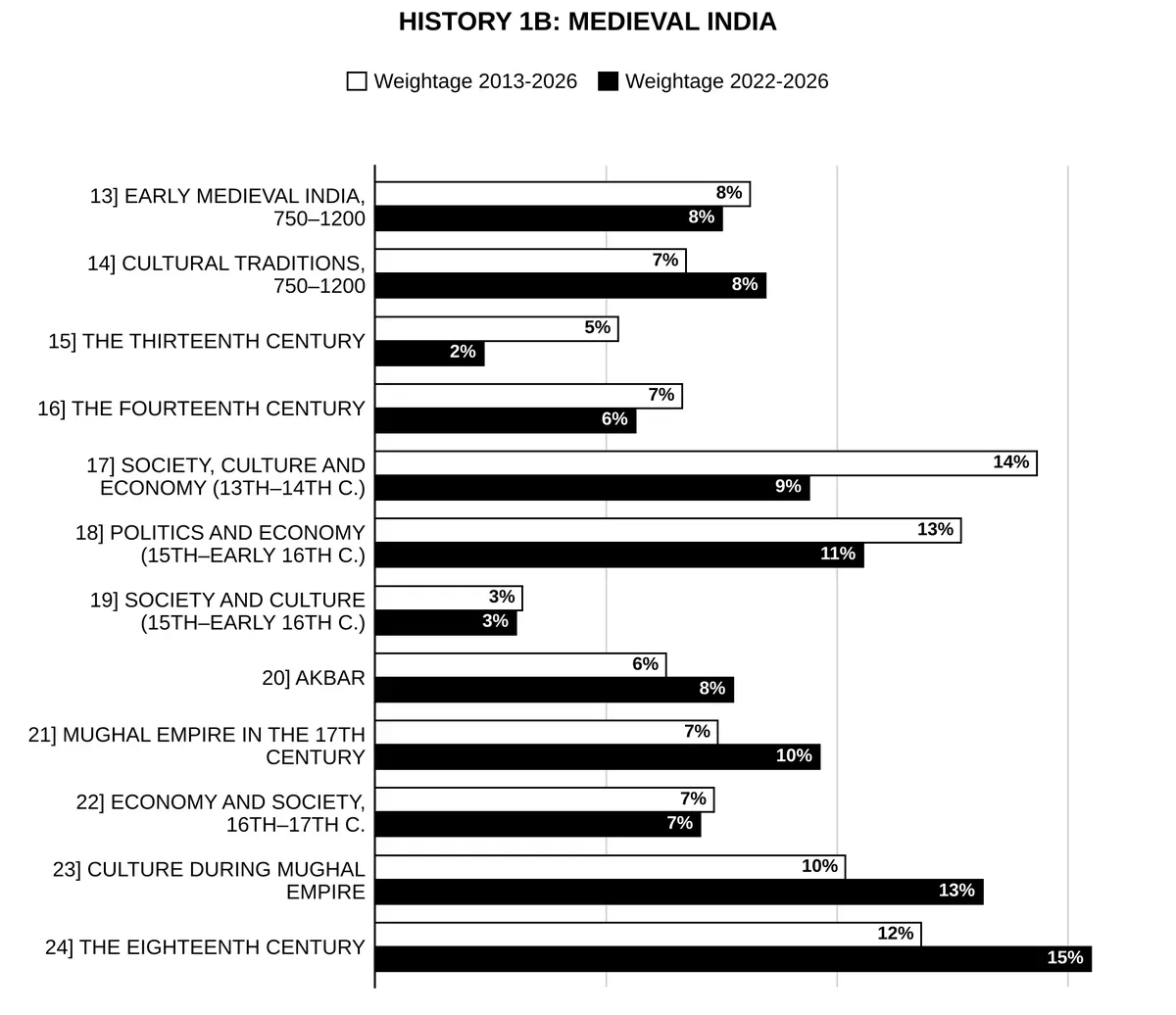
The Thirteenth Century accounted for about 2% of the marks asked in Medieval India in 2022–2026, down from 5% over 2013–2026, ranking 12th of the 12 units in the section by recent weightage.
How to use these PYQs
- Map every question to a phrase of the official syllabus shown above; recurring phrases show where UPSC’s interest lies.
- Start with the latest questions at the top of each list to see how UPSC frames this unit today; the older 60-mark questions are still useful for depth and content.
- Write timed answers to a few questions every week, keeping to the marks and word limit in each code, and revisit questions you found difficult.
Frequently Asked Questions
How many History Optional questions have been asked from The Thirteenth Century?
This collection lists 25 question entries from The Thirteenth Century (unit 15 of Paper 1) between 1995 and 2023, of which 23 are unique questions; the rest are listed under more than one sub-topic. They were asked in 20 of the 32 years and 2 came in 2022–2026.
When was The Thirteenth Century last asked in History Optional?
Most recently in 2023, with 1 question (2023/15m/6b). Before that, it was asked in 2022.
Where can I find all History Optional PYQs topic-wise?
All units of Paper 1 and Paper 2, the map question and the earlier-syllabus questions are linked from History Optional PYQs Topic-wise (1995–2026).
« Previous: Cultural Traditions in India (750-1200) – History Optional PYQs (1995–2026)
Next: The Fourteenth Century – History Optional PYQs (1995–2026) »
Back to: History Optional PYQs Topic-wise (1995–2026) | Also see: History Optional year-wise question papers (1995–2026)