
This page brings together all the Fourteenth Century History Optional PYQs asked in UPSC Civil Services Mains from 1995 to 2026, arranged topic-wise. It is unit 16 of Paper 1, Section B – Medieval India, with 32 questions, the latest from 2026.
The Fourteenth Century – History Optional PYQs (1995–2026)
16.1] “The Khalji Revolution”
1. Why is the reign of the Khaljis known as the ‘Khalji Revolution’? [2021/15m/7b]
2. Write a short essay on: The Khilji Revolution. [2006/20m/200w/5a]
16.2] Alauddin Khalji
1. “Alauddin Khilji’s economic measures aimed at centralising political authority in the Delhi Sultanate.” Elucidate. [2025/10m/150w/5b]
2. The motive of Alauddin Khalji’s agrarian policy was to curb the powers of the intermediaries. Examine the measures which he adopted to achieve his objective. [2023/10m/150w/5e]
3. The market regulations of Ala-ud-din Khilji were useful for the Sultan’s military might but harmful for the economy of the Sultanate. Comment. [2022/15m/6a]
4. Elaborate upon the agrarian reforms of Alauddin Khilji. [2020/20m/6c]
5. The economic measures of Alauddin Khalji were aimed at greater political control. Discuss. [2019/10m/150w/5d]
6. Do you think that the economic measures introduced by the Sultanate rulers were beneficial to the common people as well? Illustrate with examples. [2016/20m/7b]
7. Discuss in brief the land-revenue system and judicial administration of the Delhi Sultanate. [2015/15m/6b]
8. Analyse the ordinances mentioned by Barani which Alauddin Khalji promulgated for market control. [2014/10m/150w/5c]
9. Evaluating the theory of kingship of the Sultanate, discuss the deviations seen in the reigns of different Sultans. [2014/20m/7b]
10. How did the Mongol invasions affect the Delhi Sultanate and the north-western frontier policy of the Delhi Sultans? [2012/30m/7b]
11. Examine critically the agrarian and economic reforms of Alauddin Khalji. How did it strengthen the Sultanate? [2011/20m/200w/5b]
12. Bring out the main features of the administrative system under Delhi Sultanate during Turko-Afghan period. [2006/60m/6]
13. Discuss Balban’s concept of kingship. How was it modified by Alauddin Khalji? [2002/60m/6]
14. Assess the impact of the market reforms of Alauddin Khilji on contemporary economy and society. [2001/60m/6]
15. Write a short essay on: Alauddin Khilji was a typical despot. [1999/20m/200w/5a]
16. Discuss the implications of Khilji imperialism with reference to administration and economic regulations on the State and people of India. [1997/60m/7]
17. Make a comparative review of the agrarian reforms of Alauddin Khalji and Sher Shah Suri. [1995/60m/7]

Preparing for Prelims too?
Our UPSC Prelims Topic-wise PYQ eBook covers every Prelims question with detailed explanations, so you can see exactly where UPSC asks from.
View the BookDownload Free Sample16.3] Muhammad Tughluq
1. “Muhammad-bin-Tughlaq’s token currency scheme was an innovative economic experiment in medieval India, but its failure exposed the limitations of State control over the medieval economy.” Evaluate. [2026/10m/150w/5e]
2. Critically evaluate the Muslim Nobility during the period of Tughlaq dynasty. [2020/10m/150w/5a]
3. “The policy of creating heterogeneous nobility by Muhammad Tughlaq started the process of disintegration of Delhi Sultanate.” Explain. [2018/20m/6c]
4. Do you agree that the schemes of Muhammad bin Tughluq were correctly conceived, badly executed and disastrously abandoned? Discuss. [2017/15m/7a]
5. Write a short essay on: Muhammad Tughluq as an agrarian innovator. [2009/20m/200w/5b]
6. Write a short essay on: The Token Currency System introduced by Muhammad Tughlaq. [2004/20m/200w/5b]
7. Write a short essay on: Experiments of Mohammad Tughluq. [2003/20m/200w/5b]
16.4] Firuz Tughluq
1. Evaluate Firuz Shah Tughluq’s economic policies. [2024/10m/150w/5b]
2. What factors do you attribute for the decline of the Delhi Sultanate? [2023/10m/150w/5d]
3. Critically evaluate the Muslim Nobility during the period of Tughlaq dynasty. [2020/10m/150w/5a]
4. Form an estimate of the personality of Firoz Shah Tughlaq with special reference to his religious policy and public works. [2000/60m/7]
16.5] Foreign contacts and Ibn Battuta’s account
1. Discuss evidence on slavery provided by Ibn Batuta with special reference to female slaves. [2018/10m/150w/5b]
2. What is your assessment of Ibn Batutah’s Rehla as an important source of Indian history. [2011/20m/200w/5c]
Summary of The Fourteenth Century PYQs (1995–2026)
| Total questions (1995–2026) | 32 (31 unique – a few questions are listed under more than one sub-topic) |
| Total marks asked | 760 (unique questions) |
| Questions in last 5 years (2022–2026) | 6 |
| Most recent year asked | 2026 |
| Sub-topics | 5 (16.1 to 16.5) |
The earliest question here dates from 1995 and the latest from 2026; UPSC has drawn on this unit in 25 of the 32 years. In the last five years (2022–2026), 6 questions were set from it.
Official Syllabus
16. The Fourteenth Century
- “The Khalji Revolution”.
- Alauddin Khalji: Conquests and territorial expansion, agrarian and economic measure.
- Muhammad Tughluq: Major projects, agrarian measures, bureaucracy of Muhammad Tughluq.
- Firuz Tughluq: Agrarian measures, achievements in civil engineering and public works, decline of the Sultanate, foreign contacts and Ibn Battuta’s account.
Source: UPSC Civil Services Examination 2026 notification.
Where this unit stands in Medieval India
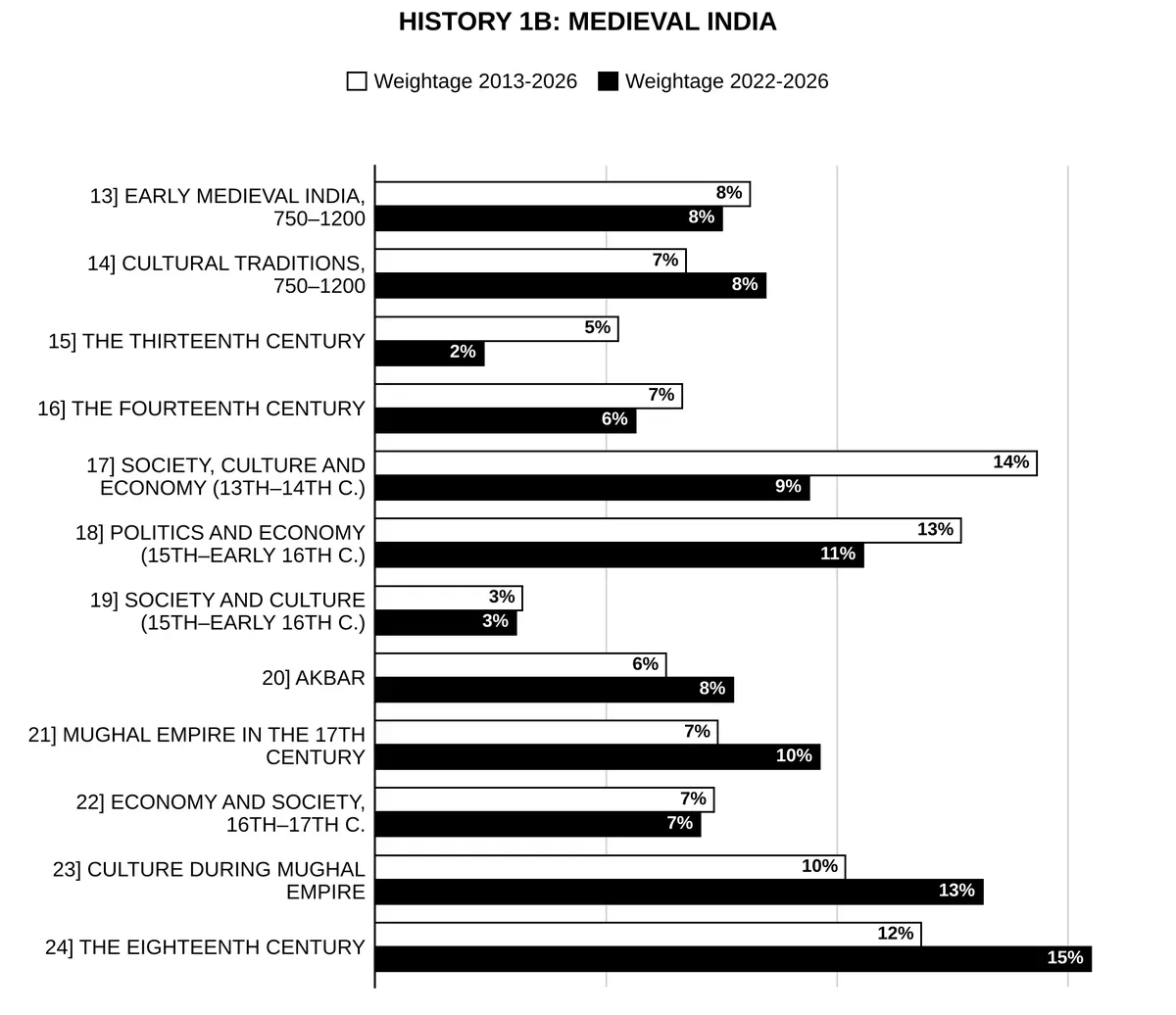
The Fourteenth Century accounted for about 6% of the marks asked in Medieval India in 2022–2026, down from 7% over 2013–2026, ranking 10th of the 12 units in the section by recent weightage.
How to use these PYQs
- Read the syllabus line in the box above alongside the questions and mark which phrases UPSC keeps returning to; those are the areas to prepare first.
- Questions run from the latest year to the oldest, so read the top of each list first for the current pattern, then use older ones for practice of content.
- Use the question code to set the length of your practice answer – marks and word limit tell you how much depth UPSC expected.
Frequently Asked Questions
How many History Optional questions have been asked from The Fourteenth Century?
This collection lists 32 question entries from The Fourteenth Century (unit 16 of Paper 1) between 1995 and 2026, of which 31 are unique questions; the rest are listed under more than one sub-topic. They were asked in 25 of the 32 years and 6 came in 2022–2026.
When was The Fourteenth Century last asked in History Optional?
Most recently in 2026, with 1 question (2026/10m/150w/5e). Before that, it was asked in 2025.
Where can I find all History Optional PYQs topic-wise?
All units of Paper 1 and Paper 2, the map question and the earlier-syllabus questions are linked from History Optional PYQs Topic-wise (1995–2026).
« Previous: The Thirteenth Century – History Optional PYQs (1995–2026)
Next: Society, Culture and Economy in the 13th and 14th Centuries – History Optional PYQs (1995–2026) »
Back to: History Optional PYQs Topic-wise (1995–2026) | Also see: History Optional year-wise question papers (1995–2026)