
Use this list of Cultural Traditions in India (750-1200) History Optional PYQs to see how UPSC has examined this part of the syllabus between 1995 and 2026.
Cultural Traditions in India (750-1200) – History Optional PYQs (1995–2026)
14.1] Philosophy
1. Analyze the contributions of Acharya Triumvirate to Indian Vedanta. [2024/20m/6a]
2. Assess the statement that ‘the philosophy of Shankaracharya revolutionised religious thoughts in India’. [2019/20m/6a]
3. “The Advaita doctrine of Shankara cut at the very root of Bhaktivada.” Do you agree? [2016/15m/7a]
4. Assess the contribution of the Acharyas in the development of the ideological basis of bhakti. [2012/12m/150w/5c]
5. Write a short essay on: The Vedanta of Sankaracharya. [2001/20m/200w/5a]
14.2] Religion
1. Throw light on the chief characteristics of Tamil bhakti Movement during the early medieval period. [2022/15m/4b]
2. The Virashaiva Movement of Southern Deccan in the twelfth century was essentially an attempt at social reform. Discuss. [2022/15m/7a]
3. Trace and identify the changing pattern of Tantrism in Ancient India with examples. [2020/15m/4b]
4. “Utpanna dravide bhaktih, Karnate vriddhimagata / Sthita kinchit maharashtre gurjare jirnatam gata” — Padmapurana. Account for the emergence of bhakti in Dravida desa. [2018/15m/4b]
5. The 11th–12th centuries C.E. saw eventful progression in the cultural history of India. Discuss. [2017/10m/150w/5a]
6. “Tantrism, if not in practice, at least on conceptual level challenged patriarchy.” Examine Tantrism specially keeping in mind the above context. [2015/15m/7c]
7. What are the manifestations of Tamil devotional cults? How do you account for their growth between c. 750 and c. 1200 CE? [2008/60m/6]
8. Trace influence of Islam on Indian culture and civilization. [1999/60m/8]
14.3] Literature
1. Critically evaluate the major stages in the development of art and literature in early medieval India and explain how these stages reflected the broader changes in society and patterns of patronage during the period. [2025/20m/4c]
2. Examine the defects in Alberuni’s assessment of the Indian society. [2023/10m/150w/5b]
3. Kalhana’s Rajatarangini is the best example of history writing tradition in early India. Discuss. [2022/15m/4c]
4. Discuss the relationship between emergence of literature in vernacular languages and formation of regional identities in early medieval India. [2021/15m/4c]

Preparing for Prelims too?
Our UPSC Prelims Topic-wise PYQ eBook covers every Prelims question with detailed explanations, so you can see exactly where UPSC asks from.
View the BookDownload Free Sample5. Do you consider the Rajatarangini of Kalhana to be a reliable source of the political history of Kashmir? Why? [2017/10m/150w/5d]
6. Comment on the veracity of Alberuni’s account of the Indian society. [2016/10m/5d]
7. Evaluate the ‘Kitab al-Hind’ of Alberuni as a source of history of India. [2014/15m/7a]
8. Evaluate Rajtarangini as a source of history. [2012/12m/150w/5a]
9. Assess Kalhana’s views on history. [2009/30m/6b]
10. Write a short essay on: Kalhan as a historian. [2003/20m/200w/5a]
11. Attempt a critical essay on the Indian Science and Civilization in the light of Alberuni’s writings. What merits and drawbacks, do you find in his account? [2003/60m/6]
12. Write a short essay on: Al-Biruni’s India. [1998/20m/200w/5b]
13. “Ancient Indians had no taste for historiography; their scholars cared more for religious, spiritual and philosophical studies. Indian historiography is essentially an Islamic heritage.” Comment upon this statement with special reference to the contemporary writers and their works which help us in the reconstruction of history of the early medieval period of Indian history. [1996/60m/3]
14.4] Art and architecture
1. Critically evaluate the major stages in the development of art and literature in early medieval India and explain how these stages reflected the broader changes in society and patterns of patronage during the period. [2025/20m/4c]
2. How far temple architecture under the Cholas became more refined and grandiose as compared to the early South Indian temple architecture style? [2023/15m/4b]
3. The 11th–12th centuries C.E. saw eventful progression in the cultural history of India. Discuss. [2017/10m/150w/5a]
4. Give a brief account of the early medieval temple architecture of Kashmir. [2015/10m/150w/5a]
Summary of Cultural Traditions in India (750-1200) PYQs (1995–2026)
| Total questions (1995–2026) | 30 (28 unique – a few questions are listed under more than one sub-topic) |
| Total marks asked | 614 (unique questions) |
| Questions in last 5 years (2022–2026) | 8 (7 unique) |
| Most recent year asked | 2025 |
| Sub-topics | 4 (14.1 to 14.4) |
The earliest question here dates from 1996 and the latest from 2025; UPSC has drawn on this unit in 20 of the 32 years. In the last five years (2022–2026), 8 questions were set from it.
Official Syllabus
14. Cultural Traditions in India, 750–1200
- Philosophy: Shankaracharya and Vedanta, Ramanuja and Vishishtadvaita, Madhva and Brahma-Mimansa.
- Religion: Forms and features of religion, Tamil devotional cult, growth of Bhakti, Islam and its arrival in India, Sufism.
- Literature: Literature in Sanskrit, growth of Tamil literature, literature in the newly developing languages, Kalhan’s Rajtarangini, Alberuni’s India.
- Art and Architecture: Temple architecture, sculpture, painting.
Source: UPSC Civil Services Examination 2026 notification.
Where this unit stands in Medieval India
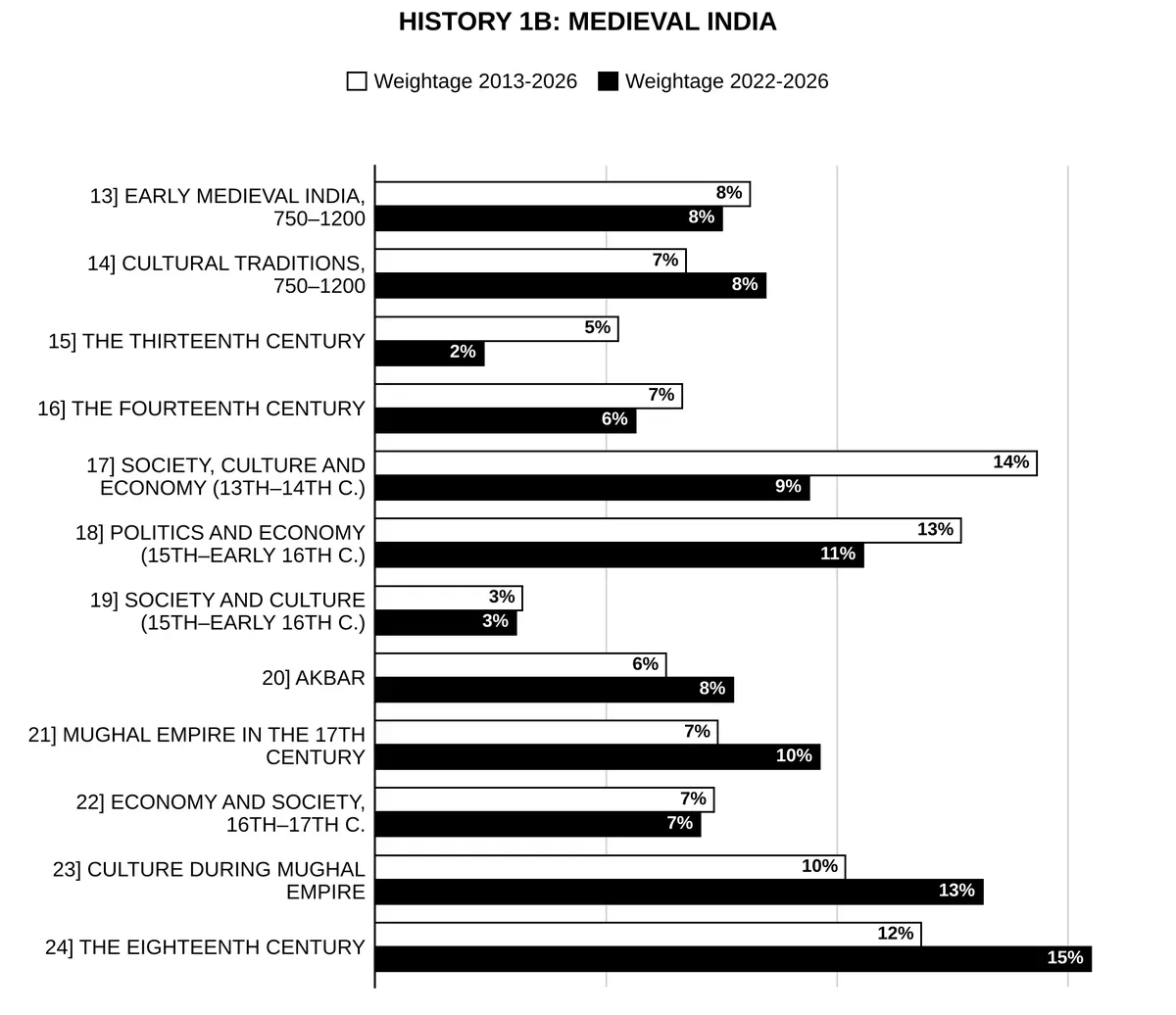
Cultural Traditions in India (750-1200) accounted for about 8% of the marks asked in Medieval India in 2022–2026, up from 7% over 2013–2026, ranking 6th of the 12 units in the section by recent weightage.
How to use these PYQs
- Compare the questions with the official syllabus wording above – themes that recur across years deserve the deepest notes.
- Give priority to the recent questions (2013 onwards follow the present 250-mark paper pattern); use the pre-2013 questions to test your depth of content.
- Practise answers within the word limit shown in the question code (for example 150w or 250w) and under timed conditions, then revise them after a week.
Frequently Asked Questions
How many History Optional questions have been asked from Cultural Traditions in India (750-1200)?
This collection lists 30 question entries from Cultural Traditions in India (750-1200) (unit 14 of Paper 1) between 1996 and 2025, of which 28 are unique questions; the rest are listed under more than one sub-topic. They were asked in 20 of the 32 years and 8 came in 2022–2026.
When was Cultural Traditions in India (750-1200) last asked in History Optional?
Most recently in 2025, with 1 question (2025/20m/4c). Before that, it was asked in 2024.
Where can I find all History Optional PYQs topic-wise?
All units of Paper 1 and Paper 2, the map question and the earlier-syllabus questions are linked from History Optional PYQs Topic-wise (1995–2026).
« Previous: Early Medieval India (750-1200) – History Optional PYQs (1995–2026)
Next: The Thirteenth Century – History Optional PYQs (1995–2026) »
Back to: History Optional PYQs Topic-wise (1995–2026) | Also see: History Optional year-wise question papers (1995–2026)