
Society, Culture and Economy in the 13th and 14th Centuries History Optional PYQs from 1995 to 2026 are compiled here exactly as UPSC set them in the Mains examination, sorted by syllabus topic.
Society, Culture and Economy in the 13th and 14th Centuries – History Optional PYQs (1995–2026)
17.1] Society
1. Compare and contrast the position of Hindu and Muslim women in 13th and 14th century India. [2024/15m/6b]
2. Describe village polity and economy of medieval Deccan. [2020/15m/7a]
3. Discuss evidence on slavery provided by Ibn Batuta with special reference to female slaves. [2018/10m/150w/5b]
4. Assess the condition of peasantry during 13th to 17th centuries C.E. [2017/15m/8b]
5. Critically evaluate the educational development during the Sultanate period. [2013/15m/6c]
6. Evaluate critically the conditions of labour from 1200–1500 CE on the basis of historical sources. [2013/15m/7b]
7. State the structure of medieval village society in Northern India. What were the passive forms of resistance of the peasants in the medieval period? [2012/30m/8a]
17.2] Bhakti movement and Sufi movement
1. “The Sufis created a climate in which people belonging to different sects and religions could live in peace and harmony.” Discuss. [2026/10m/150w/5d]
2. Evaluate the contribution of Qalandariyyah to medieval Indian culture. [2024/10m/150w/5c]
3. Analyze the tenets, spread and impact of the Bhakti Movement. [2023/20m/4a]
4. Discuss the importance of Sufic literature as an important source of history. [2023/10m/150w/5c]
5. Discuss the attitude of Chishti saints towards the state. How were the Suhrawardi saints different in their attitude towards the government? [2021/10m/150w/5e]
6. Sufi and Bhakti thoughts ennobled Indian psyche amidst the vagaries of time. Elucidate. [2019/15m/6c]
7. What was the role of Sufi Folk literature in the diffusion of Islam in India in general and in Deccan in particular? [2018/15m/7c]
8. “Bhakti and Sufi movements served the same social purpose.” Discuss. [2017/15m/6b]
9. “Sufis and medieval mystic saints failed to modify either the religious ideas and practices or the outward structure of Islamic/Hindu societies to any appreciable extent.” Comment for/against. [2015/20m/6c]
10. Evaluate the contribution of Vaishnava saints to the growth of medieval Bhakti literature. [2014/10m/150w/5b]
11. Evaluate the Malfuzat texts as sources of medieval history. [2013/10m/150w/5a]

Preparing for Prelims too?
Our UPSC Prelims Topic-wise PYQ eBook covers every Prelims question with detailed explanations, so you can see exactly where UPSC asks from.
View the BookDownload Free Sample12. Discuss and evaluate critically various trends in the historiography of bhakti. [2013/15m/7c]
13. “The tenets of Hindu and Muslim mystics were similar enough that the ground was ripe for syncretic movements involving adherents of both the religions.” Elucidate. [2007/60m/7]
14. Write a short essay on: Sufism in North India. [2006/20m/200w/5b]
15. “The tenets of Hindu and Muslim mystics were similar enough that the ground was ripe for syncretic movements involving adherents of both religions.” Elucidate. [2005/60m/7]
16. Write a short essay on: Sufi Movements. [2003/20m/200w/5c]
17. What impact did Kabir and Nanak leave on Indian Society and Culture? [2003/60m/7]
18. Write a short essay on: Origin of the Bhakti Movement. [2002/20m/200w/5a]
19. Evaluate the impact of the Sufi and Bhakti Movements on vernacular languages and life and thought of the common people. [2001/60m/7]
20. Write a short essay on: The Sufi Movement and its role in promoting communal harmony. [2000/20m/200w/5d]
17.3] Culture: literature
1. Critically analyze Barani’s Tarikh-i-Firoz Shahi and identify the shortcomings in his account. [2026/15m/6c]
2. Barani’s “Fatwa-i-Jahandari” was not a proper account of the Delhi Sultanate, rather a lament. Elucidate. [2025/15m/6b]
3. Discuss the importance of Sufic literature as an important source of history. [2023/10m/150w/5c]
4. Identify the different categories of Persian literature which emerged during the Delhi Sultanate. [2021/10m/150w/5c]
5. Evaluate the contents of the Tabaqat-i-Nasiri as a source of medieval history. [2016/10m/5a]
6. Evaluate the contribution of Vaishnava saints to the growth of medieval Bhakti literature. [2014/10m/150w/5b]
7. Evaluate the Malfuzat texts as sources of medieval history. [2013/10m/150w/5a]
8. Assess the Lekhapaddhati as an important source for evaluating the society and economy of the thirteenth century CE with special reference to Gujarat. [2013/15m/8b]
9. Write a short note on: Provide a comparative analysis of the development of Arabic and Persian historiography. [2010/20m/200w/5a]
10. Give a critical assessment of the contributions of Amir Khusrau and Barani to Indo-Persian literature. [2009/30m/8a]
11. Evaluate the impact of the Sufi and Bhakti Movements on vernacular languages and life and thought of the common people. [2001/60m/7]
12. Write a short essay on: Amir Khusro was an eminent poet not a historian. [2000/20m/200w/5b]
13. Comment on: Growth of regional languages and literature during the medieval period. [1995/20m/200w/6c]
17.4] Culture: Sultanate architecture and new structural forms, painting
1. How far can the Qutub Complex at Mehrauli be considered as an ideal specimen for the study on the development of architecture under the Delhi Sultanate? Analyze. [2026/10m/150w/5a]
2. Describe the new architectural features added by successive Sultans in the construction of Tombs in India. [2018/20m/7b]
3. Trace the technological and stylistic development in the architecture of the Sultanate period. [2014/15m/6b]
17.5] Evolution of a composite culture
1. “Sufis and medieval mystic saints failed to modify either the religious ideas and practices or the outward structure of Islamic/Hindu societies to any appreciable extent.” Comment for/against. [2015/20m/6c]
2. “The tenets of Hindu and Muslim mystics were similar enough that the ground was ripe for syncretic movements involving adherents of both the religions.” Elucidate. [2007/60m/7]
3. “The tenets of Hindu and Muslim mystics were similar enough that the ground was ripe for syncretic movements involving adherents of both religions.” Elucidate. [2005/60m/7]
4. Trace influence of Islam on Indian culture and civilization. [1999/60m/8]
17.6] Economy
1. The establishment of large number of urban settlements in North India in the thirteenth century was principally owing to the deployment of Turkish garrisons across the lands. Comment. [2022/10m/150w/5b]
2. Discuss the importance of Iqta system. How did it help in centralization of administration of the Delhi Sultanate? [2021/15m/7a]
3. How did international trade support urbanisation in North India during the 13–14th century CE. [2020/10m/150w/5c]
4. Some new crafts production were introduced by the Turks. Comment. [2020/15m/7b]
5. Delineate the state of agriculture during the Sultanate period. [2019/15m/6b]
6. Discuss the advancement made in Textile Technology under the Delhi Sultans. [2018/10m/150w/5c]
7. Delineate non-agricultural production and urban economy in the 13th and 14th centuries C.E. [2017/20m/6c]
8. Do you think that the economic measures introduced by the Sultanate rulers were beneficial to the common people as well? Illustrate with examples. [2016/20m/7b]
9. Discuss in brief the land-revenue system and judicial administration of the Delhi Sultanate. [2015/15m/6b]
10. How was Iqta system of the Sultans different from the Jagir system under the Mughals? [2014/15m/8b]
11. Evaluate the conditions of industries in India from 1200–1500 CE. [2013/20m/6a]
12. Evaluate critically the conditions of labour from 1200–1500 CE on the basis of historical sources. [2013/15m/7b]
13. Medieval Indian towns were merely an extension of villages. Comment. [2012/12m/150w/5b]
14. Critically evaluate various approaches to study medieval Indian towns. [2010/20m/200w/5d]
15. Examine the increasing importance of maritime trade of India during thirteenth to fifteenth centuries. [2010/30m/6a]
16. Identify the main factors that sustained the expansion of urban economy in the Delhi Sultanate. [2009/30m/7a]
17. Throw light on the Land Revenue System of Sultanate period. [1998/60m/7]
18. Do you agree with the view that the advent of the Turks and the Mughals in India heralded many changes in the means of production? Give reasons in support of your answer. [1995/60m/8]
Summary of Society, Culture and Economy in the 13th and 14th Centuries PYQs (1995–2026)
| Total questions (1995–2026) | 65 (57 unique – a few questions are listed under more than one sub-topic) |
| Total marks asked | 1232 (unique questions) |
| Questions in last 5 years (2022–2026) | 10 (9 unique) |
| Most recent year asked | 2026 |
| Sub-topics | 6 (17.1 to 17.6) |
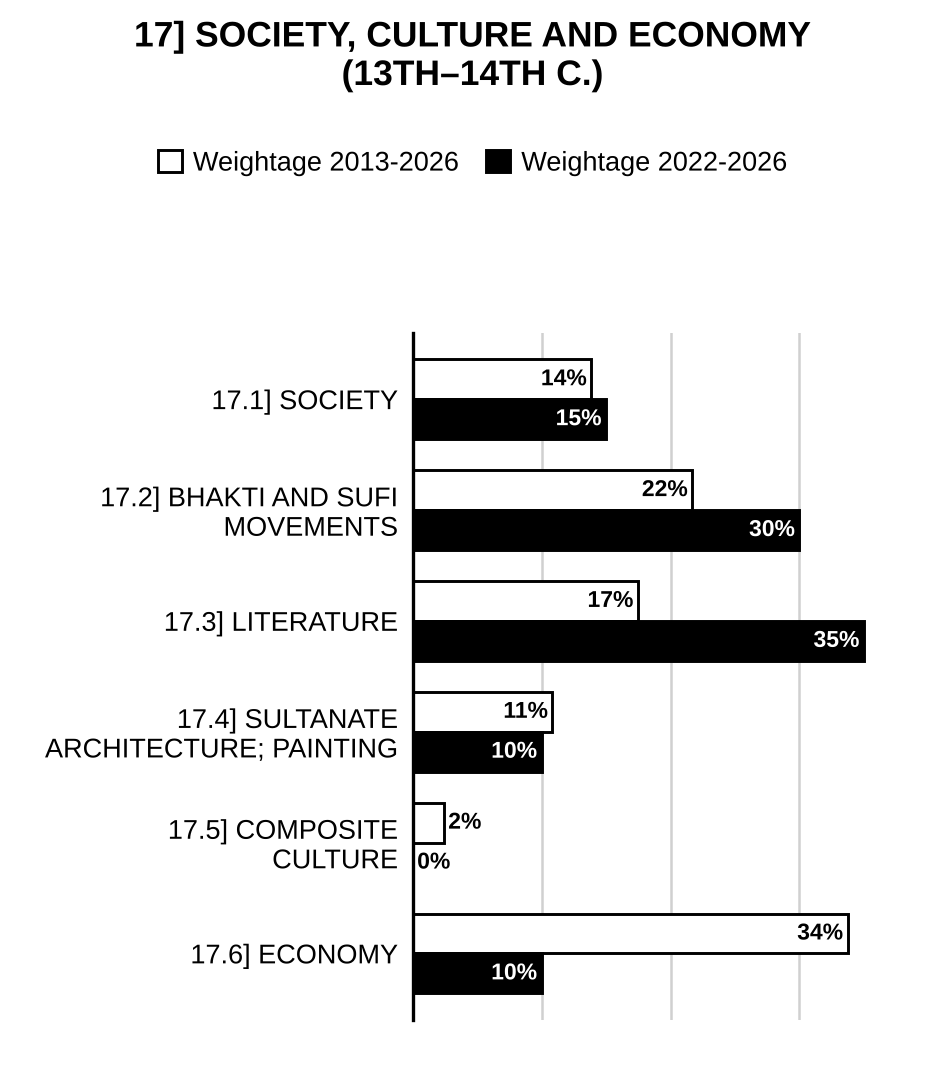
The earliest question here dates from 1995 and the latest from 2026; UPSC has drawn on this unit in 27 of the 32 years. In the last five years (2022–2026), 10 questions were set from it.
Official Syllabus
17. Society, Culture and Economy in the Thirteenth and Fourteenth Centuries
- Society: composition of rural society, ruling classes, town dwellers, women, religious classes, caste and slavery under the Sultanate, Bhakti movement, Sufi movement.
- Culture: Persian literature, literature in the regional languages of North India, literature in the languages of South India, Sultanate architecture and new structural forms, painting, evolution of a composite culture.
- Economy: Agricultural Production, rise of urban economy and non-agricultural production, trade and commerce.
Source: UPSC Civil Services Examination 2026 notification.
Where this unit stands in Medieval India
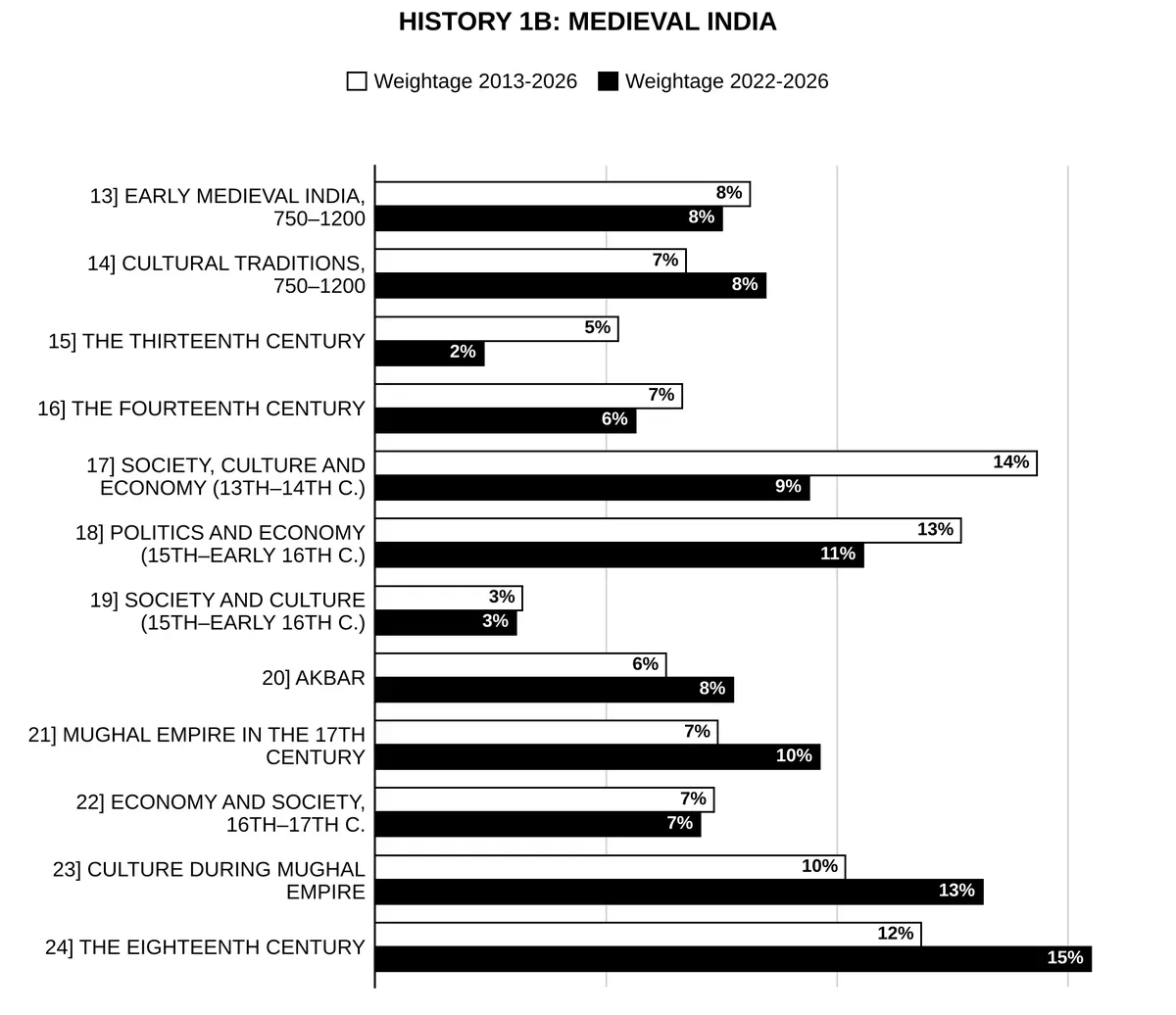
Society, Culture and Economy in the 13th and 14th Centuries accounted for about 9% of the marks asked in Medieval India in 2022–2026, down from 14% over 2013–2026, ranking 5th of the 12 units in the section by recent weightage.
How to use these PYQs
- Compare the questions with the official syllabus wording above – themes that recur across years deserve the deepest notes.
- Give priority to the recent questions (2013 onwards follow the present 250-mark paper pattern); use the pre-2013 questions to test your depth of content.
- Practise answers within the word limit shown in the question code (for example 150w or 250w) and under timed conditions, then revise them after a week.
Frequently Asked Questions
How many History Optional questions have been asked from Society, Culture and Economy in the 13th and 14th Centuries?
This collection lists 65 question entries from Society, Culture and Economy in the 13th and 14th Centuries (unit 17 of Paper 1) between 1995 and 2026, of which 57 are unique questions; the rest are listed under more than one sub-topic. They were asked in 27 of the 32 years and 10 came in 2022–2026.
When was Society, Culture and Economy in the 13th and 14th Centuries last asked in History Optional?
Most recently in 2026, with 3 questions (2026/10m/150w/5d, 2026/15m/6c, 2026/10m/150w/5a). Before that, it was asked in 2025.
Where can I find all History Optional PYQs topic-wise?
All units of Paper 1 and Paper 2, the map question and the earlier-syllabus questions are linked from History Optional PYQs Topic-wise (1995–2026).
« Previous: The Fourteenth Century – History Optional PYQs (1995–2026)
Back to: History Optional PYQs Topic-wise (1995–2026) | Also see: History Optional year-wise question papers (1995–2026)