
Every question in this collection of Guptas, Vakatakas and Vardhanas History Optional PYQs (1995–2026) is given below with its year, marks and question number. It is unit 10 of Paper 1, Section A – Ancient India, with 40 questions, the latest from 2026.
Guptas, Vakatakas and Vardhanas – History Optional PYQs (1995–2026)
10.1] Polity and administration
1. Discuss the provincial and district administrative units of the Gupta Empire with the designations and functions of the officers. [2014/15m/4b]
2. Describe the expansion of the Gupta empire under Samudragupta. [2006/60m/3]
3. What are the salient features of the administrative system of the Guptas? [2005/60m/4]
4. Examine the information of Fahien about the political, religious, social and economic conditions of India. Make a comparative study of his account with that of Yuan Chwang. [2003/60m/4]
5. Who were the Maukharis? Discuss their political relations with the Later Guptas of Magadha. [2000/60m/3]
6. ‘Harshvardhan was himself great, but he has been made greater by Ban and Yuan Chiang.’ Critically examine the statement. [1999/60m/3]
7. Write a short essay on: Skandagupta’s war with the Hunas. [1997/20m/200w/1c]
8. Write a short essay on: Factors that led to the rise and fall of the Gupta Empire. [1996/20m/200w/1d]
9. “Of all the events that had a singular bearing on the history of India, Harsha’s death in 647 A.D. is significant.” Why? Explain. [1996/60m/2]
10.2] Economic conditions, coinage of the Guptas, land grants
1. The economic achievements of the Guptas were the culmination of a process which began during the Kushanas. Comment. [2022/20m/3a]
2. Large number of land grants in hitherto non-arable tracts invariably meant expansion of agriculture in early medieval India. How did the management of hydraulic resources (different types of irrigation works) facilitate expansion of agriculture in this period? [2021/15m/4b]
3. Do you agree that the system of land grants from the Gupta-Vakataka period was connected with the decentralisation of state in any way? [2019/20m/4b]
4. The second urbanization gave rise to the organized corporate activities that reached their zenith during the Gupta period. Discuss. [2017/20m/2b]
5. Critically evaluate the theory and practice of land revenue system in ancient India. [2016/20m/4a]

Preparing for Prelims too?
Our UPSC Prelims Topic-wise PYQ eBook covers every Prelims question with detailed explanations, so you can see exactly where UPSC asks from.
View the BookDownload Free Sample6. What were the privileges granted to the donees in land-grant charters of early India? How far were these charters responsible for integration or disintegration of socio-political milieu? [2014/20m/4c]
7. Evaluate the ownership of land in ancient India on the basis of literary and epigraphic sources. [2013/15m/4b]
8. Discuss the types of lands and the science of agriculture mentioned in the literature and epigraphs of ancient India. [2011/20m/4b]
9. Evaluate the socio-economic conditions from the Gupta Period to 1200 C.E. as gleaned from the various types of grants or dana shasana. [2011/60m/6]
10. Give an account of the use of gold coins by commoners in the Gupta period. [2009/30m/3b]
11. Throw light on the condition of common man in the Gupta period. [2007/60m/4]
10.3] Decline of urban centres
1. To what extent “monetary anaemia” afflicted the erstwhile commercial economy during the early medieval period? [2010/30m/6b]
10.4] Indian feudalism
1. Do you agree that the system of land grants from the Gupta-Vakataka period was connected with the decentralisation of state in any way? [2019/20m/4b]
2. What were the privileges granted to the donees in land-grant charters of early India? How far were these charters responsible for integration or disintegration of socio-political milieu? [2014/20m/4c]
3. Write a short essay on: Applicability of the term ‘Indian Feudalism’ to early Medieval society. [2009/20m/200w/5a]
4. Comment on: Land charters of north India (c. A.D. 750–1200) [1995/20m/200w/6a]
10.5] Caste system and position of women
1. Evaluate the status of women in the Gupta period as compared to the pre-Gupta era. [2023/15m/3c]
2. How did the Varnashrama Dharma manifest the increasing social complexities in the Gupta and post-Gupta period arising from social and economic developments? [2021/15m/3c]
3. “The copious references to the preservation of Varnashrama system by the kings eulogized in inscriptions are mere reflection of the Smriti tradition.” Discuss. [2016/15m/4b]
4. Social norms for women in the Dharmasastra and Arthasastra tradition were framed in accordance with the Varnashrama tradition. Evaluate critically. [2013/20m/3b]
5. “The varna concept may always have been largely a theoretical model and never an actual description of society.” Comment in the context of Ancient India. [2013/15m/3c]
6. What light do early inscriptions and literature throw on the status of women in politico-socio-economic spheres? [2010/60m/4]
7. Throw light on the condition of common man in the Gupta period. [2007/60m/4]
8. Assess the status of women in India from c. 4th century BC to AD 6th century. [2005/60m/3]
10.6] Education and educational institutions: Nalanda, Vikramshila and Vallabhi
1. “Royal patronage and religious institutions significantly contributed to the development of Nalanda, Vikramashila and Vallabhi into prominent centres of learning.” Elucidate. [2026/20m/3c]
2. Assess the educational system in early India and identify important educational institutions of the period. [2012/30m/3b]
3. Write a short essay on: Nalanda Mahavihara. [1997/20m/200w/1d]
10.7] Literature, scientific literature, art and architecture
1. ‘Sanskrit literature of classical Gupta Age set standards for the early medieval India’. Evaluate the statement with representative examples. [2020/15m/4a]
2. Discuss the experimentations with art and architecture during the Gupta-Vakataka period. [2018/15m/4c]
3. Highlight the achievements of the Gupta period in the field of literature, science and technology. [1998/60m/4]
4. How did Indian culture spread in the South-east Asiatic countries during the Gupta Age? [1997/60m/4]
Summary of Guptas, Vakatakas and Vardhanas PYQs (1995–2026)
| Total questions (1995–2026) | 40 (37 unique – a few questions are listed under more than one sub-topic) |
| Total marks asked | 1205 (unique questions) |
| Questions in last 5 years (2022–2026) | 3 |
| Most recent year asked | 2026 |
| Sub-topics | 7 (10.1 to 10.7) |
The earliest question here dates from 1995 and the latest from 2026; UPSC has drawn on this unit in 25 of the 32 years. In the last five years (2022–2026), 3 questions were set from it.
Official Syllabus
10. Guptas, Vakatakas and Vardhanas: Polity and administration, Economic conditions, Coinage of the Guptas, Land grants, Decline of urban centres, Indian feudalism, Caste system, Position of women, Education and educational institutions; Nalanda, Vikramshila and Vallabhi, Literature, scientific literature, art and architecture.
Source: UPSC Civil Services Examination 2026 notification.
Where this unit stands in Ancient India
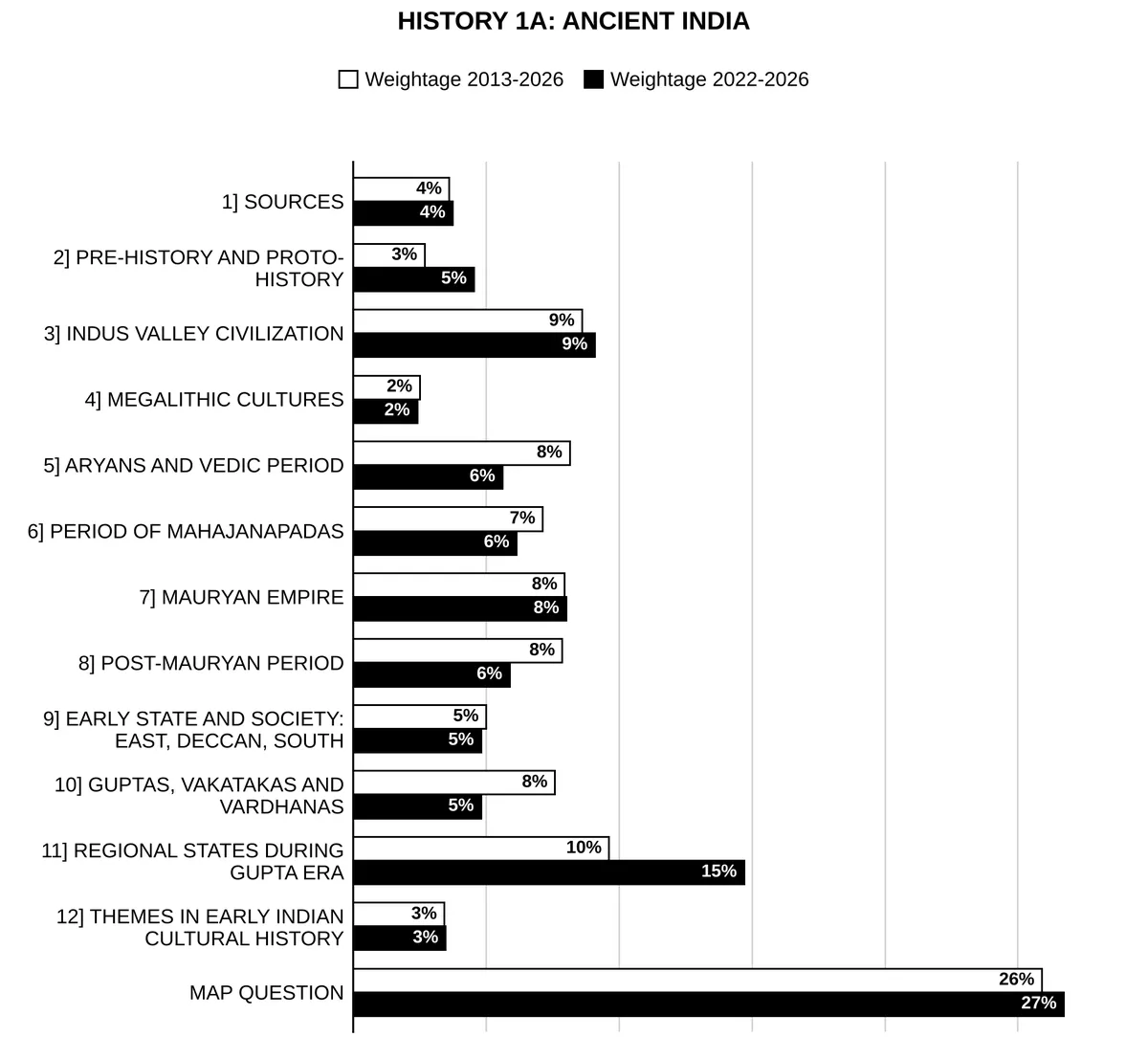
Guptas, Vakatakas and Vardhanas accounted for about 5% of the marks asked in Ancient India (the map question included) in 2022–2026, down from 8% over 2013–2026, ranking 7th of the 12 units in the section by recent weightage.
How to use these PYQs
- Read the syllabus line in the box above alongside the questions and mark which phrases UPSC keeps returning to; those are the areas to prepare first.
- Questions run from the latest year to the oldest, so read the top of each list first for the current pattern, then use older ones for practice of content.
- Use the question code to set the length of your practice answer – marks and word limit tell you how much depth UPSC expected.
Frequently Asked Questions
How many History Optional questions have been asked from Guptas, Vakatakas and Vardhanas?
This collection lists 40 question entries from Guptas, Vakatakas and Vardhanas (unit 10 of Paper 1) between 1995 and 2026, of which 37 are unique questions; the rest are listed under more than one sub-topic. They were asked in 25 of the 32 years and 3 came in 2022–2026.
When was Guptas, Vakatakas and Vardhanas last asked in History Optional?
Most recently in 2026, with 1 question (2026/20m/3c). Before that, it was asked in 2023.
Where can I find all History Optional PYQs topic-wise?
All units of Paper 1 and Paper 2, the map question and the earlier-syllabus questions are linked from History Optional PYQs Topic-wise (1995–2026).
« Previous: Early State and Society in Eastern India, Deccan and South India – History Optional PYQs (1995–2026)
Next: Regional States during Gupta Era – History Optional PYQs (1995–2026) »
Back to: History Optional PYQs Topic-wise (1995–2026) | Also see: History Optional year-wise question papers (1995–2026)