
Use this list of Early State and Society in Eastern India, Deccan and South India History Optional PYQs to see how UPSC has examined this part of the syllabus between 1995 and 2026.
Early State and Society in Eastern India, Deccan and South India – History Optional PYQs (1995–2026)
9.2] The Satavahanas
1. “The Satavahanas not only served as a vital link between Northern and Southern India in the Deccan region, but also strengthened the process of trade, urbanization and cultural integration.” Review. [2026/15m/4c]
9.3] Tamil States of the Sangam Age
1. How do recent archaeological findings and Sangam literary texts enlighten us about the early state and society in South India? [2008/60m/4]
9.4] Administration, economy, land grants, coinage, trade guilds and urban centres
1. Symbiotic relationships between Buddhist establishments, traders, artisan guilds, and royal support led to a close proximity of religion, economy and polity in the Mauryan and post-Mauryan periods. Examine the statement. [2024/20m/3a]
2. The discovery of monsoons by Hippalus gave a new direction to Indo-Roman trade during the Satavahana period. Comment. [2019/15m/4c]
3. The second urbanization gave rise to the organized corporate activities that reached their zenith during the Gupta period. Discuss. [2017/20m/2b]
4. How does the numismatic evidence of the period reflect the political and economic outlook of the Kushanas and the Satavahanas? [2016/15m/3b]
5. Trace the role of guilds and trade organisations in the development of early Indian economy. [2015/15m/4a]

Preparing for Prelims too?
Our UPSC Prelims Topic-wise PYQ eBook covers every Prelims question with detailed explanations, so you can see exactly where UPSC asks from.
View the BookDownload Free Sample6. On the basis of contemporary sources assess the nature of banking and usuary in ancient India. [2013/15m/3a]
7. Assess the role of guilds and trade organizations in the development of early Indian economy. [2010/30m/3b]
9.6] Sangam literature and culture
1. How far the Sangam literature acts as a window into the social and cultural traditions of ancient South India? [2023/20m/3a]
2. Discuss the salient features of cultural traditions of South India as reflected in Sangam Literature. [2020/20m/3c]
3. The accurate picture of the complex socio-cultural milieu of Peninsular India is presented in the early Sangam literature. Delineate. [2017/15m/4c]
4. “Not only does ancient Tamil literature furnish an accurate picture of widely disparate classes; it also describes the social condition of Tamil country as it was.” Discuss. [2015/15m/3c]
5. How do recent archaeological findings and Sangam literary texts enlighten us about the early state and society in South India? [2008/60m/4]
Summary of Early State and Society in Eastern India, Deccan and South India PYQs (1995–2026)
| Total questions (1995–2026) | 14 (13 unique – a few questions are listed under more than one sub-topic) |
| Total marks asked | 275 (unique questions) |
| Questions in last 5 years (2022–2026) | 3 |
| Most recent year asked | 2026 |
| Sub-topics | 4 (9.2 to 9.6) |
The earliest question here dates from 2008 and the latest from 2026; UPSC has drawn on this unit in 11 of the 32 years. In the last five years (2022–2026), 3 questions were set from it.
Official Syllabus
9. Early State and Society in Eastern India, Deccan and South India: Kharavela, The Satavahanas, Tamil States of the Sangam Age; Administration, Economy, land grants, coinage, trade guilds and urban centres; Buddhist centres; Sangam literature and culture; Art and architecture.
Source: UPSC Civil Services Examination 2026 notification.
Where this unit stands in Ancient India
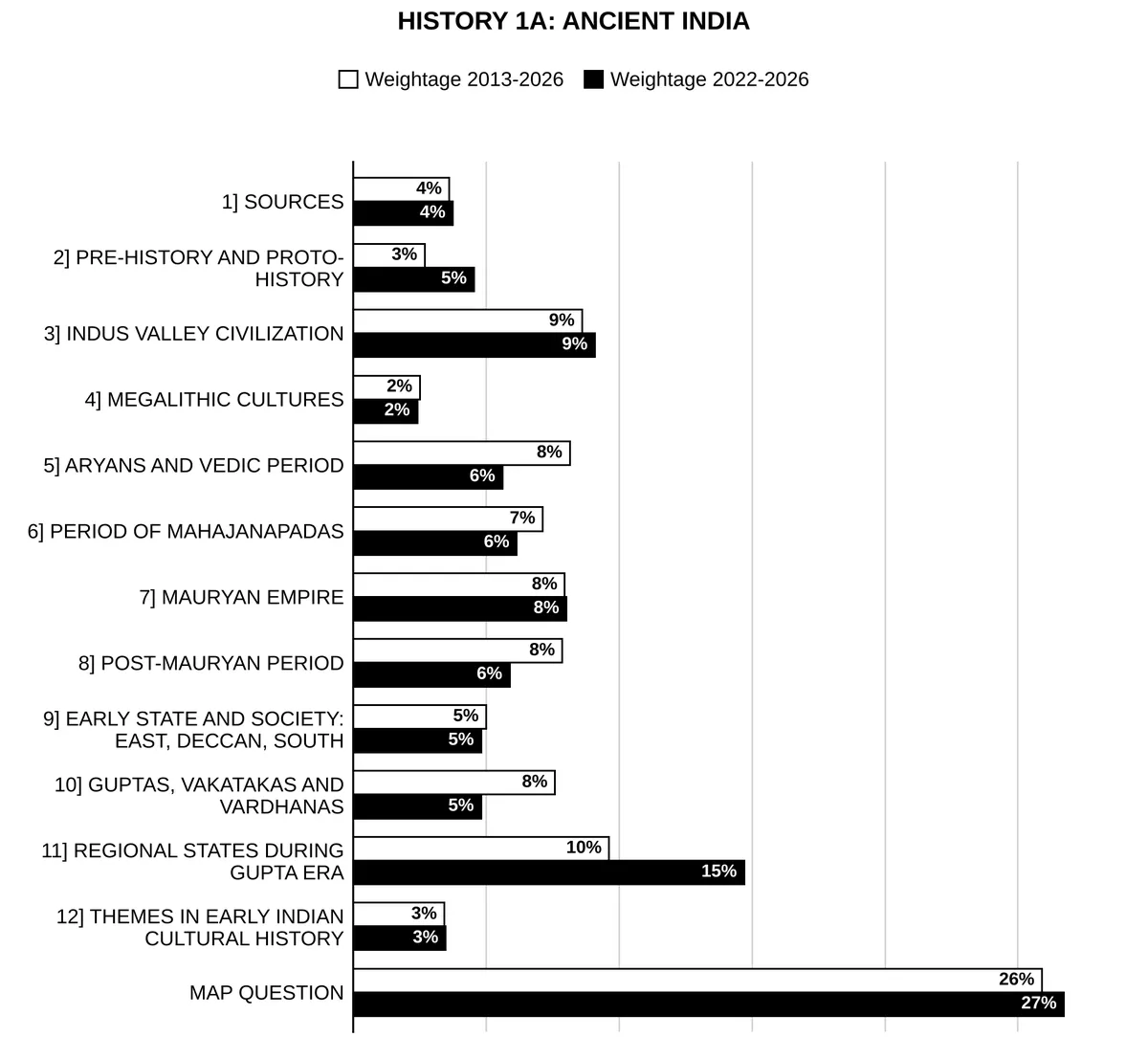
Early State and Society in Eastern India, Deccan and South India accounted for about 5% of the marks asked in Ancient India (the map question included) in 2022–2026, the same as 5% over 2013–2026, ranking 8th of the 12 units in the section by recent weightage.
How to use these PYQs
- Map every question to a phrase of the official syllabus shown above; recurring phrases show where UPSC’s interest lies.
- Start with the latest questions at the top of each list to see how UPSC frames this unit today; the older 60-mark questions are still useful for depth and content.
- Write timed answers to a few questions every week, keeping to the marks and word limit in each code, and revisit questions you found difficult.
Frequently Asked Questions
How many History Optional questions have been asked from Early State and Society in Eastern India, Deccan and South India?
This collection lists 14 question entries from Early State and Society in Eastern India, Deccan and South India (unit 9 of Paper 1) between 2008 and 2026, of which 13 are unique questions; the rest are listed under more than one sub-topic. They were asked in 11 of the 32 years and 3 came in 2022–2026.
When was Early State and Society in Eastern India, Deccan and South India last asked in History Optional?
Most recently in 2026, with 1 question (2026/15m/4c). Before that, it was asked in 2024.
Where can I find all History Optional PYQs topic-wise?
All units of Paper 1 and Paper 2, the map question and the earlier-syllabus questions are linked from History Optional PYQs Topic-wise (1995–2026).
« Previous: Post-Mauryan Period – History Optional PYQs (1995–2026)
Next: Guptas, Vakatakas and Vardhanas – History Optional PYQs (1995–2026) »
Back to: History Optional PYQs Topic-wise (1995–2026) | Also see: History Optional year-wise question papers (1995–2026)