
This page brings together all Regional States during Gupta Era History Optional PYQs asked in UPSC Civil Services Mains from 1995 to 2026, arranged topic-wise. It is unit 11 of Paper 1, Section A – Ancient India, with 58 questions, the latest from 2026.
Regional States during Gupta Era – History Optional PYQs (1995–2026)
11.1] The Kadambas, Pallavas, Chalukyas of Badami: polity and administration, trade guilds, literature
1. Discuss the circumstances which led to the conflict between the Pallavas and the Chalukyas and mention how this rivalry shaped the power dynamics in South India. [2025/15m/4b]
2. Examine the course of Pallava-Chalukya conflicts between sixth and eighth century CE. [2024/15m/4b]
3. Describe the evolution and development of regional temple architecture of South India with special reference to Pallavas. [2020/20m/4c]
4. Why is Mamallapuram famous? [2015/10m/150w/5b]
5. Analyse the vibrant cultural activities in peninsular India during 550–750 CE. Compare and contrast it with the situation in contemporary North India. [2012/30m/4b]
6. Give an account of the rise of the Chalukyas of Vatapi and their struggle with other rulers. Write a note on their patronage of arts. [2004/60m/4]
7. Give an account of the struggle for supremacy in South India between the Chalukyas of Badami and the Pallavas. [2000/60m/4]
8. Assess the achievements of the Pallavas in administration and art. [1997/60m/3]
9. How far is it true to say that the strength and vigour of Indian history during c. A.D. 500–750 lay in the south of the Vindhyas? [1995/60m/4]
11.2] Growth of Vaishnava and Saiva religions
1. Is it correct to say that the post-Gupta period was remarkable for the expansion of religious cults in India? [2023/15m/4c]
2. Puranas were the innovative genre of literature to popularise and revive Vedic religion. Elaborate with examples. [2020/15m/2a]
11.3] Tamil Bhakti movement
1. Throw light on the chief characteristics of Tamil bhakti Movement during the early medieval period. [2022/15m/4b]
2. “Utpanna dravide bhaktih, Karnate vriddhimagata / Sthita kinchit maharashtre gurjare jirnatam gata” — Padmapurana. Account for the emergence of bhakti in Dravida desa. [2018/15m/4b]
3. What are the manifestations of Tamil devotional cults? How do you account for their growth between c. 750 and c. 1200 CE? [2008/60m/6]
4. Write a short essay on: Origin of the Bhakti Movement. [2002/20m/200w/5a]

Preparing for Prelims too?
Our UPSC Prelims Topic-wise PYQ eBook covers every Prelims question with detailed explanations, so you can see exactly where UPSC asks from.
View the BookDownload Free Sample11.4] Shankaracharya; Vedanta
1. Assess the statement that ‘the philosophy of Shankaracharya revolutionised religious thoughts in India’. [2019/20m/6a]
2. “The Advaita doctrine of Shankara cut at the very root of Bhaktivada.” Do you agree? [2016/15m/7a]
3. Assess the contribution of the Acharyas in the development of the ideological basis of bhakti. [2012/12m/150w/5c]
4. Write a short essay on: The Vedanta of Sankaracharya. [2001/20m/200w/5a]
11.5] Institutions of temple and temple architecture
1. Illustrate the main features of Vesara style temple architecture. [2024/10m/150w/5a]
2. With the help of representative examples, delineate the main differences between the Nagara and Dravida styles of temple architecture. [2022/15m/3c]
3. Describe the evolution and development of regional temple architecture of South India with special reference to Pallavas. [2020/20m/4c]
4. Trace the origin and development of temple architecture in India with reference to regional styles and variations. [2017/20m/4a]
5. Kailasa temple built at Ellora marks the culmination of rock-cut architecture in India. Elucidate. [2015/15m/4b]
6. Why is Mamallapuram famous? [2015/10m/150w/5b]
7. Assess Ellora as a unique art centre of the different cultural streams. [2011/20m/4c]
8. Bring out the regional variations in the early South Indian temples’ architectural styles. [2009/60m/4]
9. Assess the achievements of the Pallavas in administration and art. [1997/60m/3]
11.6] Palas, Senas, Rashtrakutas, Paramaras: polity and administration; cultural aspects
1. Evaluate the importance of tripartite struggle for the domination over North India during the eighth and ninth centuries. [2022/20m/4a]
2. Kailasa temple built at Ellora marks the culmination of rock-cut architecture in India. Elucidate. [2015/15m/4b]
3. Critically evaluate the contribution of Rashtrakutas to art and culture. [1999/60m/6]
4. “Achieving dominance in the south of the Vindhyas did not satisfy the ambitions of the Rashtrakutas; they also wanted to achieve dominance over the Gangetic Plains.” Elaborate and comment. [1997/60m/6]
5. How far is it true to say that the strength and vigour of Indian history during c. A.D. 500–750 lay in the south of the Vindhyas? [1995/60m/4]
11.7] Arab conquest of Sind; Alberuni
1. Examine the defects in Alberuni’s assessment of the Indian society. [2023/10m/150w/5b]
2. Comment on the veracity of Alberuni’s account of the Indian society. [2016/10m/5d]
3. Evaluate the ‘Kitab al-Hind’ of Alberuni as a source of history of India. [2014/15m/7a]
4. Write a short essay on: Alberuni on science in India. [2007/20m/200w/5a]
5. Attempt a critical essay on the Indian Science and Civilization in the light of Alberuni’s writings. What merits and drawbacks, do you find in his account? [2003/60m/6]
6. Write a short essay on: Al-Biruni’s India. [1998/20m/200w/5b]
7. Write a short essay on: Historical significance of the advent of the Arabs in India. [1995/20m/200w/1d]
11.8] The Chalukyas of Kalyana, Cholas, Hoysalas, Pandyas: polity and administration; local government
1. “The success of the Cholas as an imperial power rested not only on the administrative efficiency, but also on a well-organized army and a formidable navy.” Evaluate. [2026/10m/150w/5b]
2. “The Chola rulers were not only mighty conquerors, efficient administrators but also builders of fine temples.” Comment. [2021/15m/8a]
3. “Doubtless it was not a free state; it was any rate a state” (K A N Sastri). Reflect upon the nature of local self government institutions in the Chola country. [2018/15m/3c]
4. Assess the contribution of the Cholas in the expansion of Indian culture outside India. [2011/30m/8b]
5. Show that the administrative system in India reached a very high level during the Chola period. [2007/60m/6]
6. The Cholas are said to have established a strong and well organized administration with an element of self-government at the local level. Do you agree? Give reasons. [2004/60m/6]
7. Were the Chola village assemblies democratic in nature? Give reasons for your answer. [2000/60m/6]
8. Critically evaluate the achievements of the Cholas. [1998/60m/6]
9. Assess the importance of the Cholas in the history of South India. [1996/60m/7]

Strengthen your GS papers
Our UPSC Mains Topic-wise & Year-wise PYQ eBook (2013–2026) maps every GS question to the syllabus, so you know what UPSC asks and how often.
View the BookDownload Free Sample11.9] Growth of art and architecture, religious sects, institution of temple and Mathas, Agraharas
1. “Hoysala temple architecture marks a distinctive and innovative phase in the evolution of South Indian art and architecture.” Illustrate with examples. [2026/20m/4a]
2. Examine the role played by the Agraharas in the promotion of education in the early medieval India. [2024/15m/4c]
3. How far temple architecture under the Cholas became more refined and grandiose as compared to the early South Indian temple architecture style? [2023/15m/4b]
4. What were ‘Brahmadeya’ grants? How do you account for the large number of such grants in the early medieval period? [2022/10m/150w/5a]
5. How did the temples of South India, as financial institutions, have deep impact on the social institutions of early medieval period? Critically examine. [2016/15m/4c]
6. How far do you agree with the view that the temples in the early medieval period were catalysts in spreading education? [2010/30m/8b]
11.10] Education and literature, economy and society
1. Examine the role played by the Agraharas in the promotion of education in the early medieval India. [2024/15m/4c]
2. Analyse the vibrant cultural activities in peninsular India during 550–750 CE. Compare and contrast it with the situation in contemporary North India. [2012/30m/4b]
3. How far do you agree with the view that the temples in the early medieval period were catalysts in spreading education? [2010/30m/8b]
Summary of Regional States during Gupta Era PYQs (1995–2026)
| Total questions (1995–2026) | 58 (50 unique – a few questions are listed under more than one sub-topic) |
| Total marks asked | 1447 (unique questions) |
| Questions in last 5 years (2022–2026) | 14 (13 unique) |
| Most recent year asked | 2026 |
| Sub-topics | 10 (11.1 to 11.10) |
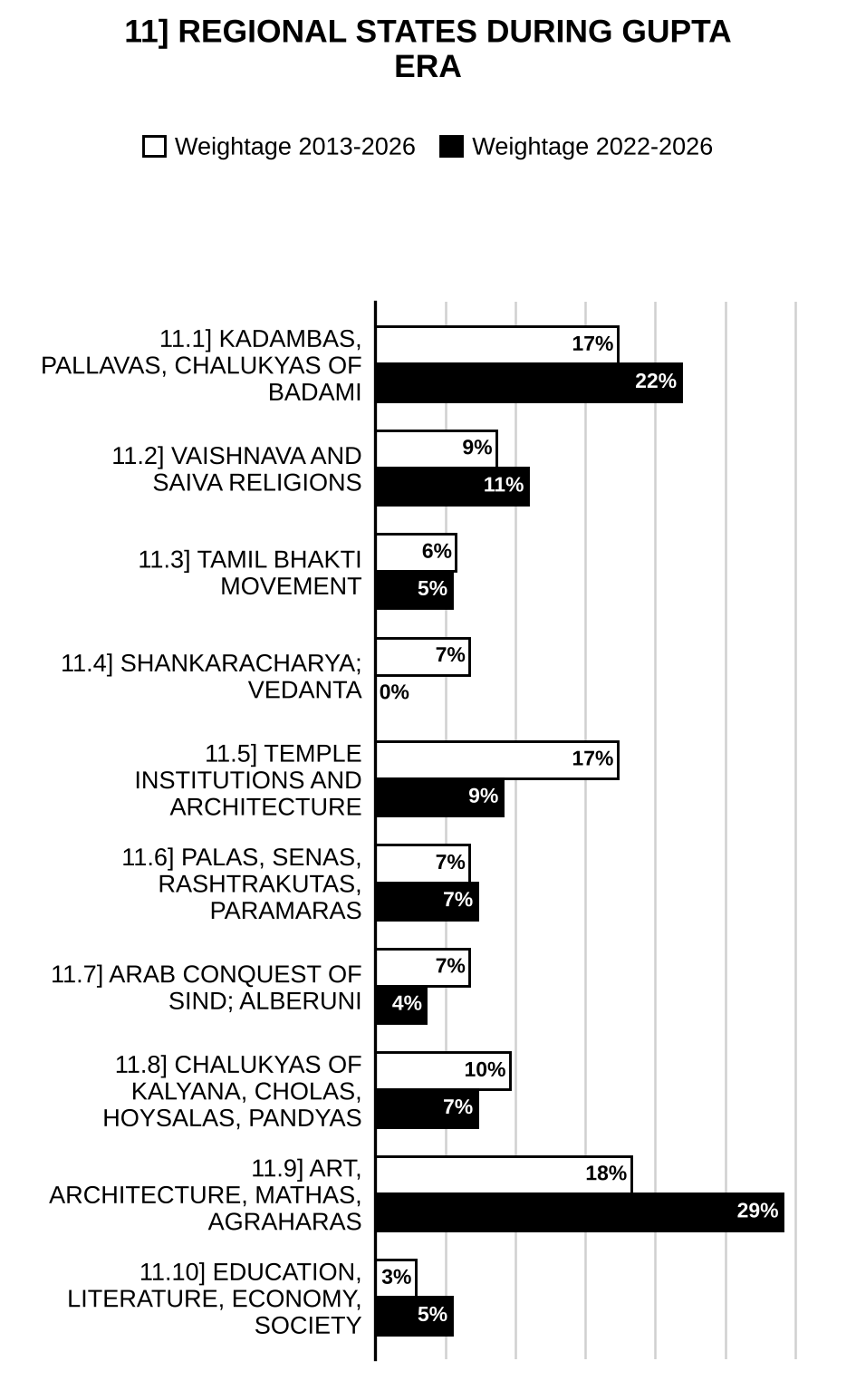
The earliest question here dates from 1995 and the latest from 2026; UPSC has drawn on this unit in 29 of the 32 years. In the last five years (2022–2026), 14 questions were set from it.
Official Syllabus
11. Regional States during Gupta Era: The Kadambas, Pallavas, Chalukyas of Badami; Polity and Administration, Trade guilds, Literature; growth of Vaishnava and Saiva religions. Tamil Bhakti movement, Shankaracharya; Vedanta; Institutions of temple and temple architecture; Palas, Senas, Rashtrakutas, Paramaras, Polity and administration; Cultural aspects. Arab conquest of Sind; Alberuni, The Chalukyas of Kalyana, Cholas, Hoysalas, Pandyas; Polity and Administration; Local Government; Growth of art and architecture, religious sects, Institution of temple and Mathas, Agraharas, education and literature, economy and society.
Source: UPSC Civil Services Examination 2026 notification.
Where this unit stands in Ancient India
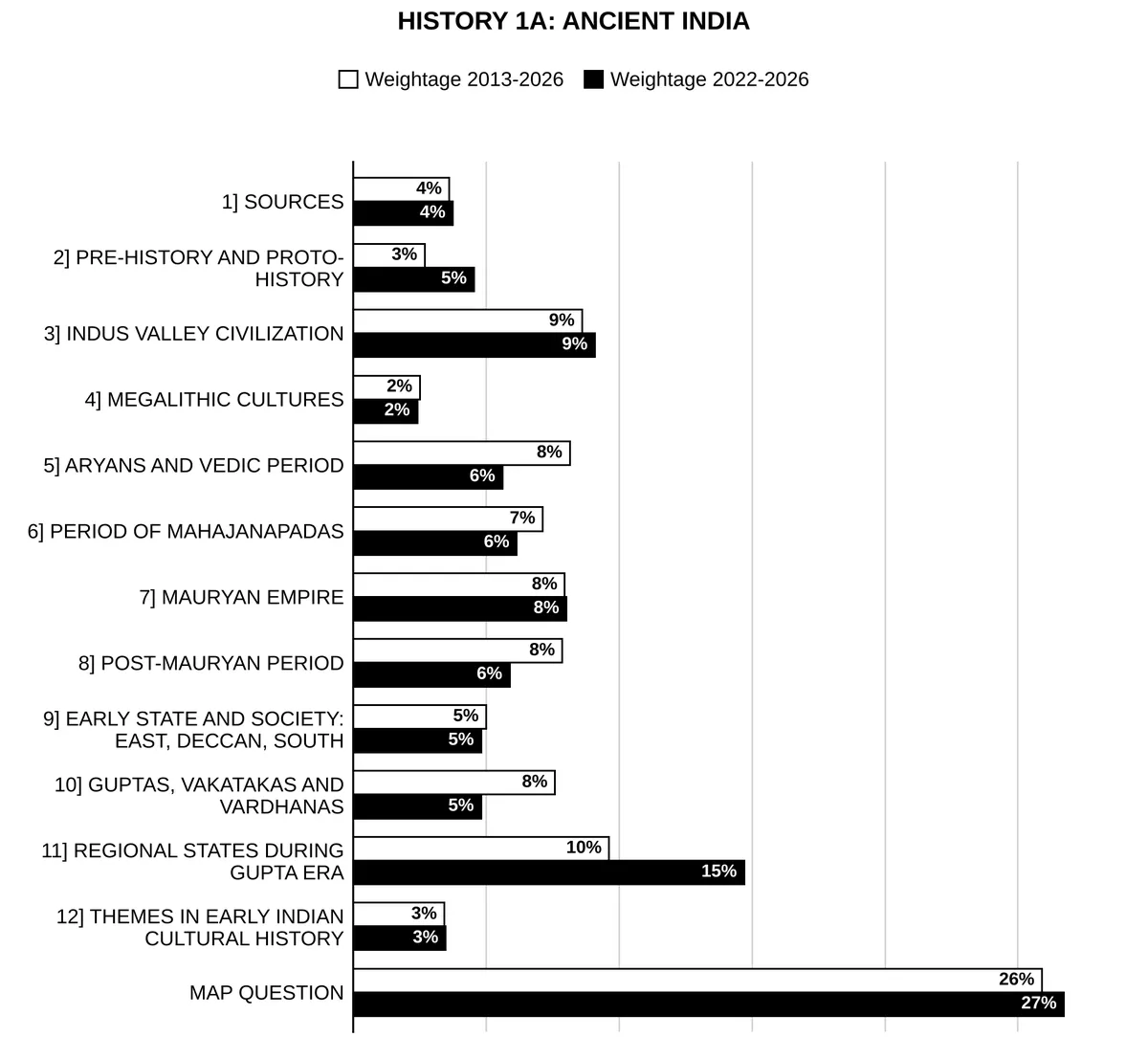
Regional States during Gupta Era accounted for about 15% of the marks asked in Ancient India (the map question included) in 2022–2026, up from 10% over 2013–2026, ranking 1st of the 12 units in the section by recent weightage.
How to use these PYQs
- Compare the questions with the official syllabus wording above – themes that recur across years deserve the deepest notes.
- Give priority to the recent questions (2013 onwards follow the present 250-mark paper pattern); use the pre-2013 questions to test your depth of content.
- Practise answers within the word limit shown in the question code (for example 150w or 250w) and under timed conditions, then revise them after a week.
Frequently Asked Questions
How many History Optional questions have been asked from Regional States during Gupta Era?
This collection lists 58 question entries from Regional States during Gupta Era (unit 11 of Paper 1) between 1995 and 2026, of which 50 are unique questions; the rest are listed under more than one sub-topic. They were asked in 29 of the 32 years and 14 came in 2022–2026.
When was Regional States during Gupta Era last asked in History Optional?
Most recently in 2026, with 2 questions (2026/10m/150w/5b, 2026/20m/4a). Before that, it was asked in 2025.
Where can I find all History Optional PYQs topic-wise?
All units of Paper 1 and Paper 2, the map question and the earlier-syllabus questions are linked from History Optional PYQs Topic-wise (1995–2026).
« Previous: Guptas, Vakatakas and Vardhanas – History Optional PYQs (1995–2026)
Next: Themes in Early Indian Cultural History – History Optional PYQs (1995–2026) »
Back to: History Optional PYQs Topic-wise (1995–2026) | Also see: History Optional year-wise question papers (1995–2026)