
Use this list of Economic Development and Political Change History Optional PYQs to see how UPSC has examined this part of the syllabus between 1995 and 2026.
Economic Development and Political Change – History Optional PYQs (1995–2026)
15.1] Economic development and political change
1. India’s developmental strategy after independence was influenced by economic imperatives, not ideological considerations. — Comment. [2024/10m/4c]
2. Critically examine: “Not until independence, when economic development became a conscious and pursued policy, did the Railways begin to realize their potential for assisting in the transformation of the Indian economy.” [2019/10m/150w/1b]
3. “Jawaharlal Nehru, though a declared socialist, was pragmatist enough to focus on providing building blocks to the making of a new India.” Examine. [2015/20m/4b]
4. “Notwithstanding the quest for modernity and the antagonism that guided Nehru’s attitude towards the inequalities inherent in the social structure in rural India, the Congress Party did not carry out a concerted campaign against discrimination based on caste. Nehru’s own perception was that industrial growth was bound to break the stranglehold of this feudal remnant. This, however, did not happen in India.” Examine. [2013/25m/4a]
5. Comment on: “Having won political freedom, India had to win economic and cultural freedom.” [1995/20m/200w/1d]
15.2] Land reforms
1. Why did the demand for land reform never become an agenda in national politics after 1947? Elucidate. [2024/10m/2c]
2. Trace the development of land reforms in India between 1947 and early 1960’s. [2018/20m/3b]
15.3] The politics of planning and rural reconstruction
1. How did the introduction of Community Development Programme and Panchayat Raj Programme promote welfare of rural India? Explain. [2026/10m/4c]
2. Planning was seen as a powerful instrument that could be used to remove regional inequality. Examine. [2020/10m/3c]
3. How did the introduction of Community Development Programme and Panchayati Raj promote welfare of rural India? [2019/10m/4c]
4. “Jawaharlal Nehru, though a declared socialist, was pragmatist enough to focus on providing building blocks to the making of a new India.” Examine. [2015/20m/4b]
5. “Nehru’s ‘temple of Modern India’ consisted not only of steel and power plants, irrigation dams, but included institutions of higher learning, particularly in the scientific field.” Elaborate. [2011/30m/4a]

Preparing for Prelims too?
Our UPSC Prelims Topic-wise PYQ eBook covers every Prelims question with detailed explanations, so you can see exactly where UPSC asks from.
View the BookDownload Free Sample15.4] Ecology and environmental policy in post-colonial India
1. How did the popular movements help us to understand the nature of environmental crisis in post-colonial India? [2022/10m/4c]
2. Critically examine the nature and scope of environmental movements in independent India. [2016/10m/4c]
3. “The Chipko became famous as the first major environmental movement in post-colonial India and gave rise to the understanding that environmental issues are often women’s issues because they suffer most from its deterioration.” — Explain. [2012/30m/4b]
15.5] Progress of Science
1. How far the developments in science and technology in post-Independence period put India on the path of modernity. [2017/20m/4b]
2. “Nehru’s ‘temple of Modern India’ consisted not only of steel and power plants, irrigation dams, but included institutions of higher learning, particularly in the scientific field.” Elaborate. [2011/30m/4a]
Summary of Economic Development and Political Change PYQs (1995–2026)
| Total questions (1995–2026) | 17 (15 unique – a few questions are listed under more than one sub-topic) |
| Total marks asked | 245 (unique questions) |
| Questions in last 5 years (2022–2026) | 4 |
| Most recent year asked | 2026 |
| Sub-topics | 5 (15.1 to 15.5) |
The earliest question here dates from 1995 and the latest from 2026; UPSC has drawn on this unit in 13 of the 32 years. In the last five years (2022–2026), 4 questions were set from it.
Official Syllabus
15. Economic Development and Political Change: Economic development and political change; Land reforms; the politics of planning and rural reconstruction; Ecology and environmental policy in post-colonial India; Progress of Science.
Source: UPSC Civil Services Examination 2026 notification. The notification gives no title for this unit; the short title used here is editorial.
Where this unit stands in Modern India
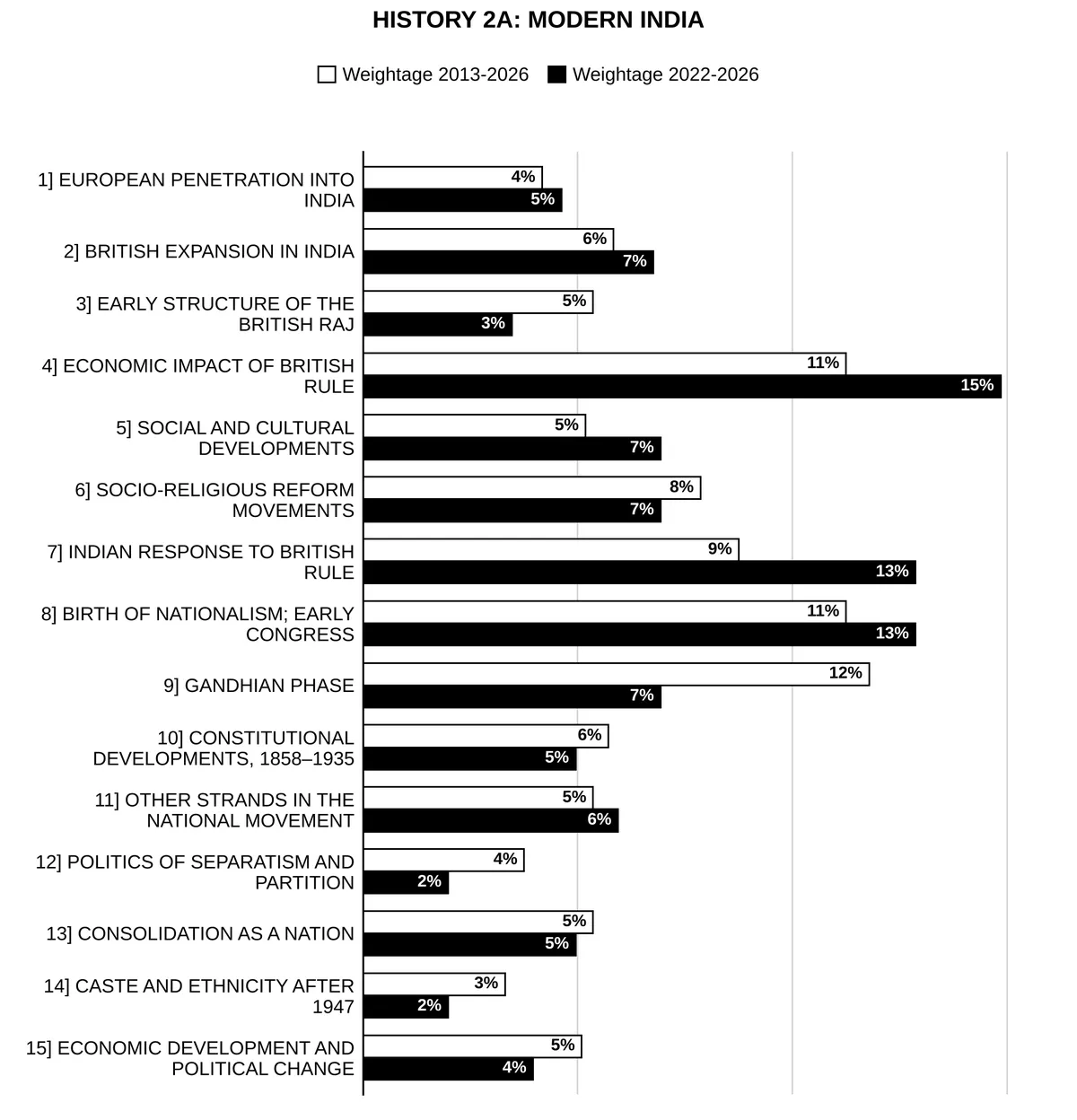
Economic Development and Political Change accounted for about 4% of the marks asked in Modern India in 2022–2026, down from 5% over 2013–2026, ranking 12th of the 15 units in the section by recent weightage.
How to use these PYQs
- Map every question to a phrase of the official syllabus shown above; recurring phrases show where UPSC’s interest lies.
- Start with the latest questions at the top of each list to see how UPSC frames this unit today; the older 60-mark questions are still useful for depth and content.
- Write timed answers to a few questions every week, keeping to the marks and word limit in each code, and revisit questions you found difficult.
Frequently Asked Questions
How many History Optional questions have been asked from Economic Development and Political Change?
This collection lists 17 question entries from Economic Development and Political Change (unit 15 of Paper 2) between 1995 and 2026, of which 15 are unique questions; the rest are listed under more than one sub-topic. They were asked in 13 of the 32 years and 4 came in 2022–2026.
When was Economic Development and Political Change last asked in History Optional?
Most recently in 2026, with 1 question (2026/10m/4c). Before that, it was asked in 2024.
Where can I find all History Optional PYQs topic-wise?
All units of Paper 1 and Paper 2, the map question and the earlier-syllabus questions are linked from History Optional PYQs Topic-wise (1995–2026).
« Previous: Caste and Ethnicity after 1947 – History Optional PYQs (1995–2026)
Next: Enlightenment and Modern Ideas – History Optional PYQs (1995–2026) »
Back to: History Optional PYQs Topic-wise (1995–2026) | Also see: History Optional year-wise question papers (1995–2026)