
Every question in this collection of Enlightenment and Modern Ideas History Optional PYQs (1995–2026) is given below with its year, marks and question number. It is unit 16 of Paper 2, Section B – World History, with 35 questions, the latest from 2026.
Enlightenment and Modern Ideas – History Optional PYQs (1995–2026)
16.1] Major ideas of Enlightenment: Kant, Rousseau
1. Critically examine: “Immanuel Kant was an advocate of liberalism and nationalism.” [2026/10m/150w/5a]
2. “Anti-clericalism of the Enlightenment echoed the sentiments of the Renaissance and the Reformation. Yet it neither endorsed the paganism of the Renaissance nor did it share the faith of Reformation.” Discuss. [2025/10m/7c]
3. Critically examine: The ideas raised by Enlightenment thinkers were profoundly unsettling and challenging to old regime society and political order. [2024/10m/150w/5a]
4. Enlightenment was not confined to scientific revolution alone, but humanism and ideas of progress too were its inseparable constituents. Examine. [2023/10m/6c]
5. Critically examine: ‘Rousseau kindled a hope which became the spirit of the Enlightenment’. [2022/10m/150w/5a]
6. What was “enlightened” about the Age of Enlightenment? [2021/20m/6a]
7. Critically examine: “The principles of Enlightenment were in some ways a continuation of the discoveries and theories of the Scientific Revolution.” [2020/10m/150w/5a]
8. Explain the major ideas of Enlightenment. Discuss the contribution of Rousseau in Enlightenment. [2018/20m/6a]
9. Critically examine: “Kant’s redefinition of reason and his rehabilitation of conscience marked a high point in the intellectual reaction against dominant rationalism of the Enlightenment.” [2017/10m/150w/5a]
10. Critically examine the statement that the French Revolution was not caused by the French philosophers but by the conditions of national life and by the mistakes of the government. [2016/20m/6a]
11. Critically examine: “Rousseau strove to reconcile the liberty of the individual and the institution of Government through a new vision of the Contract-Theory of Government.” [2014/10m/150w/5a]
12. Critically examine: “Enlightened despots (Europe) were not necessarily politically liberal.” [2014/10m/150w/5c]
13. Critically examine: “For Kant, Enlightenment is mankind’s final coming of age, the emancipation of the human consciousness from an immature state of ignorance and error.” [2013/10m/150w/5a]
14. Critically examine: “The despotic rulers of Europe were influenced by the philosophy of Enlightenment and began to follow a benevolent policy towards their subjects.” [2012/12m/150w/5a]

Preparing for Prelims too?
Our UPSC Prelims Topic-wise PYQ eBook covers every Prelims question with detailed explanations, so you can see exactly where UPSC asks from.
View the BookDownload Free Sample15. Critically examine: “The connection between the philosophers’ ideas and the outbreak of the French Revolution (1789) is somewhat remote and indirect.” [2012/12m/150w/5c]
16. Critically evaluate: “The promptings of the heart are more to be trusted than the logic of the mind.” — Rousseau. [2011/20m/200w/5a]
17. Critically evaluate: “… he (Voltaire) was living in the Age of Enlightenment … . The age itself was not enlightened.” — E. Kant. [2010/20m/200w/5a]
18. “The Enlightenment represented alternative approaches to modernity, alternative habits of mind and heart, of conscience and sensibility.” Discuss. [2008/60m/6]
19. Comment on: “No event as encompassing as the French Revolution occurs in an intellectual vacuum.” [2007/20m/200w/5a]
20. Comment on: ‘The writings of the philosophers had a tremendous influence on the minds of the people and created a revolutionary awakening in their minds and formed the intellectual creed of the French Revolution.’ [2005/20m/200w/5b]
21. Comment on: ‘Rousseau’s political philosophy contains the seeds of Socialism, Absolutism and Democracy.’ [2004/20m/200w/5a]
22. Comment on: If monarchical misrule ignited the French Revolution, lofty ideas both inspired and sustained it. [2002/20m/200w/5b]
23. Comment on: “If monarchical misrule ignited the French revolution, lofty ideas both inspired and sustained it.” [1997/20m/200w/5b]
16.2] Spread of Enlightenment in the colonies
1. “The American Revolution was, in many respects, a manifestation of the Enlightenment in political, civil and ecclesiastical spheres.” Explain. [2025/20m/6b]
2. Critically examine: “Enlightened despots (Europe) were not necessarily politically liberal.” [2014/10m/150w/5c]
16.3] Rise of socialist ideas (up to Marx); spread of Marxian Socialism
1. Critically examine: “The pre-Marxian socialist thinkers envisioned socialist societies without fully considering the practical mechanisms for achieving or maintaining them.” [2025/10m/150w/5e]
2. Marxian socialism claims itself to be a scientific socialist theory capable of explaining the history of humankind. Discuss. [2023/20m/6b]
3. Critically examine: Engels did much more than Marx himself to popularise the ideas of Marxism. [2022/10m/150w/5c]
4. How would you explain the nature of pre-Marxian Socialism? [2019/10m/150w/5e]
5. Critically examine: “With the writings of Karl Marx, Socialism assumed the form of Scientific Socialism.” [2018/10m/150w/5a]
6. “Karl Marx applied his critical intelligence to Wealth of Nations … Where Smith had seen only the sunlight, Marx saw only the shadows thrown upon the human scene by the unimpeded exercise of individual liberty …” Elucidate. [2016/10m/150w/5a]
7. Critically examine: “France was even more fertile than Britain in producing new socialist theories and movements, though bore less concrete results in France than Britain.” [2015/10m/150w/5a]
8. “If we were to define our conception of the State, our answer would be that the State is the banker of the poor. The government would finance and supervise the purchase of productive equipments and the formation of social workshops.” In light of the above statement of Louis Blanc, throw light on the Pre-Marxist Socialist Thought in Europe. [2014/20m/6b]
9. Comment on: “France was more fertile than Britain in producing new Socialist theories and movements, though they bore less concrete results in France than in Britain.” [2008/20m/200w/5a]
10. Comment on: ‘Marxian Communism is primarily the offspring of German Hegelianism and French Socialism.’ [2001/20m/200w/5a]
Summary of Enlightenment and Modern Ideas PYQs (1995–2026)
| Total questions (1995–2026) | 35 (34 unique – a few questions are listed under more than one sub-topic) |
| Total marks asked | 544 (unique questions) |
| Questions in last 5 years (2022–2026) | 9 |
| Most recent year asked | 2026 |
| Sub-topics | 3 (16.1 to 16.3) |
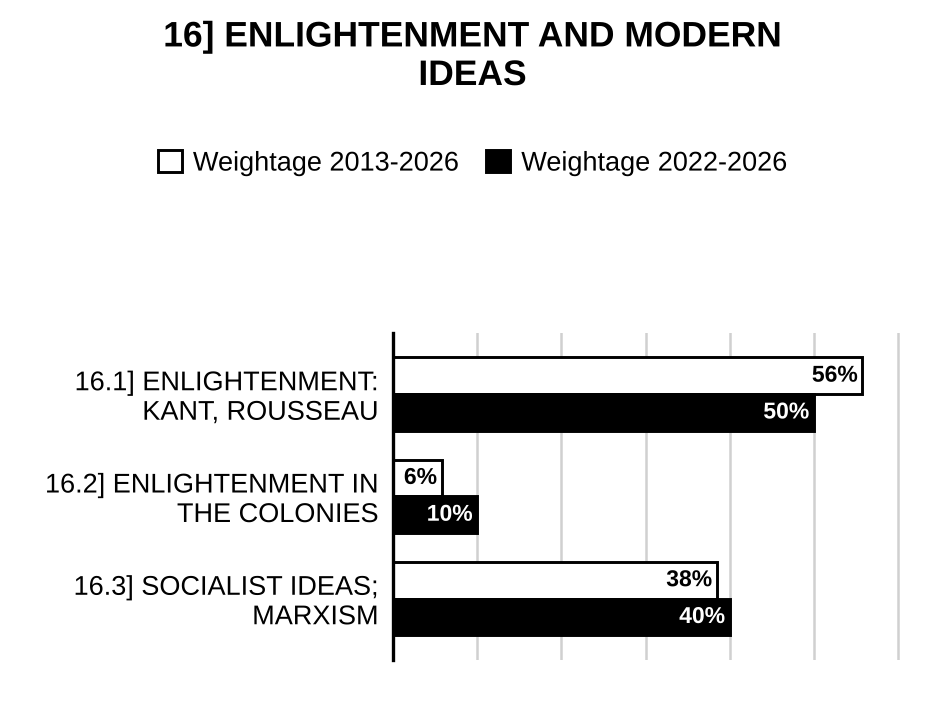
The earliest question here dates from 1997 and the latest from 2026; UPSC has drawn on this unit in 24 of the 32 years. In the last five years (2022–2026), 9 questions were set from it.
Official Syllabus
16. Enlightenment and Modern Ideas
- (i) Major Ideas of Enlightenment: Kant, Rousseau.
- (ii) Spread of Enlightenment in the colonies.
- (iii) Rise of socialist ideas (up to Marx); spread of Marxian Socialism.
Source: UPSC Civil Services Examination 2026 notification.
Where this unit stands in World History
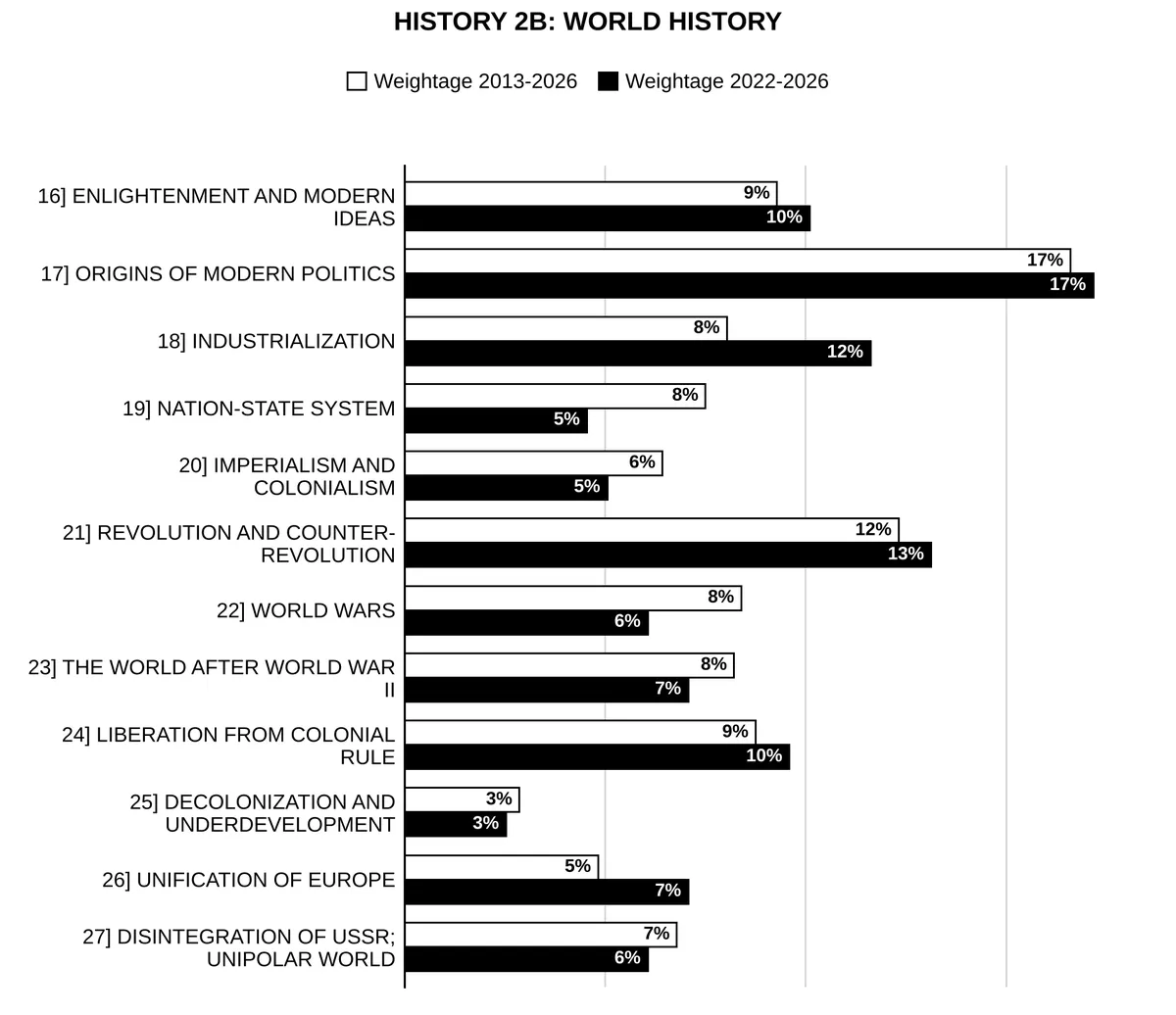
Enlightenment and Modern Ideas accounted for about 10% of the marks asked in World History in 2022–2026, up from 9% over 2013–2026, ranking 4th of the 12 units in the section by recent weightage.
How to use these PYQs
- Read the syllabus line in the box above alongside the questions and mark which phrases UPSC keeps returning to; those are the areas to prepare first.
- Questions run from the latest year to the oldest, so read the top of each list first for the current pattern, then use older ones for practice of content.
- Use the question code to set the length of your practice answer – marks and word limit tell you how much depth UPSC expected.
Frequently Asked Questions
How many History Optional questions have been asked from Enlightenment and Modern Ideas?
This collection lists 35 question entries from Enlightenment and Modern Ideas (unit 16 of Paper 2) between 1997 and 2026, of which 34 are unique questions; the rest are listed under more than one sub-topic. They were asked in 24 of the 32 years and 9 came in 2022–2026.
When was Enlightenment and Modern Ideas last asked in History Optional?
Most recently in 2026, with 1 question (2026/10m/150w/5a). Before that, it was asked in 2025.
Where can I find all History Optional PYQs topic-wise?
All units of Paper 1 and Paper 2, the map question and the earlier-syllabus questions are linked from History Optional PYQs Topic-wise (1995–2026).
« Previous: Economic Development and Political Change – History Optional PYQs (1995–2026)
Next: Origins of Modern Politics – History Optional PYQs (1995–2026) »
Back to: History Optional PYQs Topic-wise (1995–2026) | Also see: History Optional year-wise question papers (1995–2026)