
Here is the complete set of Caste and Ethnicity after 1947 History Optional PYQs from UPSC Mains 1995–2026, taken from our topic-wise question bank. It is unit 14 of Paper 2, Section A – Modern India, with 13 questions, the latest from 2025.
Caste and Ethnicity after 1947 – History Optional PYQs (1995–2026)
14.1] Caste and ethnicity after 1947
1. Discuss the major initiatives taken by the Government of India for the removal of caste injustice and inequality after 1947. [2025/10m/4c]
2. “Notwithstanding the quest for modernity and the antagonism that guided Nehru’s attitude towards the inequalities inherent in the social structure in rural India, the Congress Party did not carry out a concerted campaign against discrimination based on caste. Nehru’s own perception was that industrial growth was bound to break the stranglehold of this feudal remnant. This, however, did not happen in India.” Examine. [2013/25m/4a]
3. Comment on: “In exercising its exclusive power the Parliament additionally enacted the Untouchability (Offences) Act in 1955.” [2008/20m/200w/1d]
14.2] Backward Castes and Tribes in post-colonial electoral politics
1. “Nehru favoured the policy of integrating the tribal people in Indian society, of making them an integral part of the Indian nation even while maintaining their distinct identity and culture.” — Elaborate with special reference to Northeastern India. [2012/30m/4a]
14.3] Dalit movements
1. How did the factionalised Dalit leadership in Hyderabad undergo a period of intense re-organization between 1948 and 1953? [2023/10m/4c]
2. Discuss the changing nature of Dalit assertion in India in the twentieth century. [2021/20m/4b]
3. Analyse various trends in Dalit Movements in various parts of post-independent India. [2018/20m/2b]

Preparing for Prelims too?
Our UPSC Prelims Topic-wise PYQ eBook covers every Prelims question with detailed explanations, so you can see exactly where UPSC asks from.
View the BookDownload Free Sample4. Critically examine: “Sri Narayana guru’s was a major intervention in the social reform movement from a subaltern perspective.” [2017/10m/150w/1e]
5. How did Dr. B.R. Ambedkar try to seek a political solution to the problem of caste in India? [2016/10m/3c]
6. “Dalit Movements for empowerment in independent India have essentially been for carving out political space through electoral politics.” Discuss. [2014/10m/2c]
7. Discuss the factors that led to the growth of Dalit consciousness and mention the major movements aimed at their empowerment. [2010/30m/4b]
8. Comment on: “In exercising its exclusive power the Parliament additionally enacted the Untouchability (Offences) Act in 1955.” [2008/20m/200w/1d]
9. Trace the course and comment on the character of caste movements in south India in the 20th century. How far was their object achieved? [1995/60m/4]
Summary of Caste and Ethnicity after 1947 PYQs (1995–2026)
| Total questions (1995–2026) | 13 (12 unique – a few questions are listed under more than one sub-topic) |
| Total marks asked | 255 (unique questions) |
| Questions in last 5 years (2022–2026) | 2 |
| Most recent year asked | 2025 |
| Sub-topics | 3 (14.1 to 14.3) |
The earliest question here dates from 1995 and the latest from 2025; UPSC has drawn on this unit in 12 of the 32 years. In the last five years (2022–2026), 2 questions were set from it.
Official Syllabus
14. Caste and Ethnicity after 1947: Caste and Ethnicity after 1947; Backward Castes and Tribes in post-colonial electoral politics; Dalit movements.
Source: UPSC Civil Services Examination 2026 notification. The notification gives no title for this unit; the short title used here is editorial.
Where this unit stands in Modern India
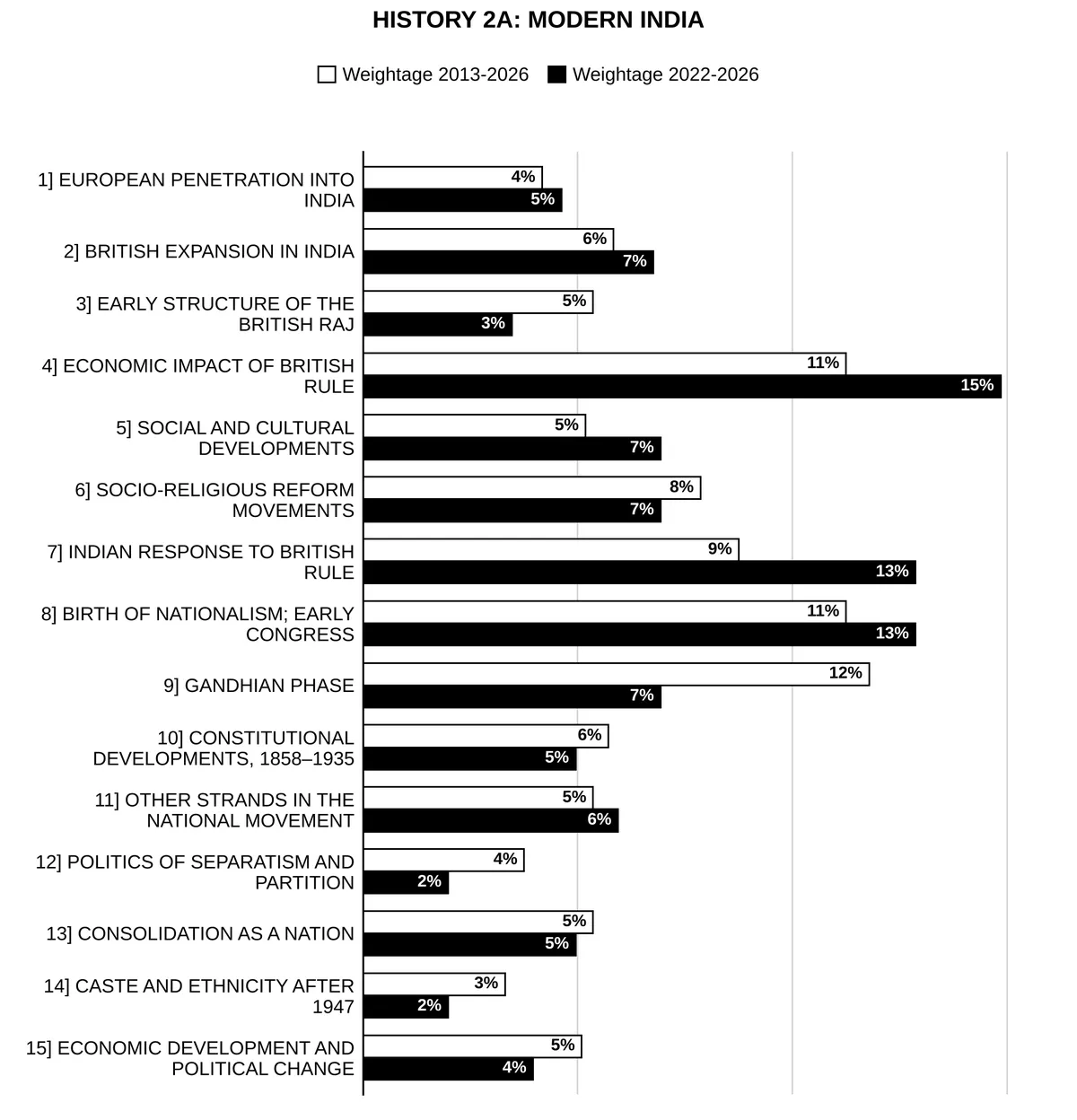
Caste and Ethnicity after 1947 accounted for about 2% of the marks asked in Modern India in 2022–2026, down from 3% over 2013–2026, ranking 14th of the 15 units in the section by recent weightage.
How to use these PYQs
- Compare the questions with the official syllabus wording above – themes that recur across years deserve the deepest notes.
- Give priority to the recent questions (2013 onwards follow the present 250-mark paper pattern); use the pre-2013 questions to test your depth of content.
- Practise answers within the word limit shown in the question code (for example 150w or 250w) and under timed conditions, then revise them after a week.
Frequently Asked Questions
How many History Optional questions have been asked from Caste and Ethnicity after 1947?
This collection lists 13 question entries from Caste and Ethnicity after 1947 (unit 14 of Paper 2) between 1995 and 2025, of which 12 are unique questions; the rest are listed under more than one sub-topic. They were asked in 12 of the 32 years and 2 came in 2022–2026.
When was Caste and Ethnicity after 1947 last asked in History Optional?
Most recently in 2025, with 1 question (2025/10m/4c). Before that, it was asked in 2023.
Where can I find all History Optional PYQs topic-wise?
All units of Paper 1 and Paper 2, the map question and the earlier-syllabus questions are linked from History Optional PYQs Topic-wise (1995–2026).
« Previous: Consolidation as a Nation – History Optional PYQs (1995–2026)
Next: Economic Development and Political Change – History Optional PYQs (1995–2026) »
Back to: History Optional PYQs Topic-wise (1995–2026) | Also see: History Optional year-wise question papers (1995–2026)