
Early Structure of the British Raj History Optional PYQs from 1995 to 2026 are compiled here exactly as UPSC set them in the Mains examination, sorted by syllabus topic.
Early Structure of the British Raj – History Optional PYQs (1995–2026)
3.1] The early administrative structure; from diarchy to direct control
1. Why did the British Crown assume direct control over the Indian Government in 1858? Mention the new administrative arrangements. [2026/20m/4a]
2. Can you explain how, after acquiring Diwani, the government of the East India Company functioned like ‘an Indian ruler’? [2022/10m/2c]
3. How far is it correct to say that if Clive was the founder of the British Empire in India, Warren Hastings was its administrative organiser? [2016/20m/2a]
4. “The Dual System of Government was a complete failure from the outset. In the first place, the abuse of the private trade reached a greater height than ever. In the second place, the demands of the Company for the increase led to gross oppression of the peasantry.” [2014/20m/2a]
5. “In terms of the administrative structure, the Government of India Act of 1858, … meant more continuation than change.” Do you agree? Substantiate. [2010/20m/2a]
6. Comment on: ‘Dalhousie changed the map of India with speed and thoroughness no campaign could equal.’ [2001/20m/200w/1a]
7. Comment on: Towards the Princes, Canning adopted a policy of “punishing resistance and rewarding obedience.” [2000/20m/200w/1b]
3.2] Regulating Act (1773), Pitt’s India Act (1784), Charter Act (1833)
1. “The need to impose greater parliamentary control over the Company’s affairs increased during the decades (1773–1853) after Plassey.” Elucidate. [2016/20m/4a]
2. Critically examine: “The Regulating Act (1773), the Pitt’s India Act (1784) and eventually the Charter Act of 1833 left the East India Company as a mere shadow of its earlier political and economic power in India.” [2015/10m/150w/1b]
3. “The Charter Act of 1833 rung down the curtain on the Company’s trade and introduced a new concept of government in India.” Substantiate. [2011/20m/2a]
4. Comment on: ‘The object of the Act (Regulating) was good, but system that it established was imperfect.’ [2004/20m/200w/1b]

Preparing for Prelims too?
Our UPSC Prelims Topic-wise PYQ eBook covers every Prelims question with detailed explanations, so you can see exactly where UPSC asks from.
View the BookDownload Free Sample3.3] The voice of free trade and the changing character of British colonial rule
1. Do you agree that the idea of permanent fixation of land revenue of 1793 in Bengal was highly influenced by the Physiocratic school of thinking? Discuss. [2025/20m/2a]
2. Critically examine: “An ideology of paternalistic benevolence, occasionally combined with talk of trusteeship and training towards self-government, thinly veiled the realities of a Raj uncompromisingly white and despotic.” [2018/10m/150w/1d]
3. “The forces of free trade and the British determination to create a political and administrative environment conducive to trade and investment had shaped the British policy towards India in the first half of the nineteenth century.” — Elucidate. [2012/30m/2a]
4. Comment on: The British policy towards Indian States in 1818–1858 was one of “isolation and non-interference tempered by annexation.” [1996/20m/200w/1b]
5. Comment on: The Government of India from Canning to Curzon was regarded “as a white man’s burden rather than as a call to creative effort or the preparation for a new era.” [1995/20m/200w/1b]
3.4] The English utilitarian and India
1. Critically examine: The values of utilitarianism prompted the Company administration to attempt reform of Indian society. [2024/10m/150w/1b]
2. How did English utilitarian thinking impact India in the British era? [2021/20m/3a]
3. “Peace hath her victories no less renowned than war.” Examine this statement with reference to Lord William Bentinck. [2016/20m/2b]
4. “James Mill, the apostle of utilitarian philosophy, proposed a revolution of Indian society through the ‘weapon of law’ solely. But in actual policy framing, other influences and considerations weighed much more than the colonial State.” Elucidate. [2015/20m/3b]
5. What role did the economic ideas play in the early phase of the British rule in the shaping of land tenure policy? [2010/30m/3a]
6. Comment on: “Sprung from paternalism, the English Utilitarian philosophy as introduced in India rejected its human warmth between rulers and the ruled.” [2008/20m/200w/1a]
7. Comment on: The British Indian State experienced the ‘wind of change’ with the arrival of Lord William Bentinck. [1999/20m/200w/1b]
Summary of Early Structure of the British Raj PYQs (1995–2026)
| Total questions (1995–2026) | 23 |
| Total marks asked | 440 |
| Questions in last 5 years (2022–2026) | 4 |
| Most recent year asked | 2026 |
| Sub-topics | 4 (3.1 to 3.4) |
The earliest question here dates from 1995 and the latest from 2026; UPSC has drawn on this unit in 19 of the 32 years. In the last five years (2022–2026), 4 questions were set from it.
Official Syllabus
3. Early Structure of the British Raj: The Early administrative structure; From diarchy to direct control; The Regulating Act (1773); The Pitt’s India Act (1784); The Charter Act (1833); The Voice of free trade and the changing character of British colonial rule; The English utilitarian and India.
Source: UPSC Civil Services Examination 2026 notification.
Where this unit stands in Modern India
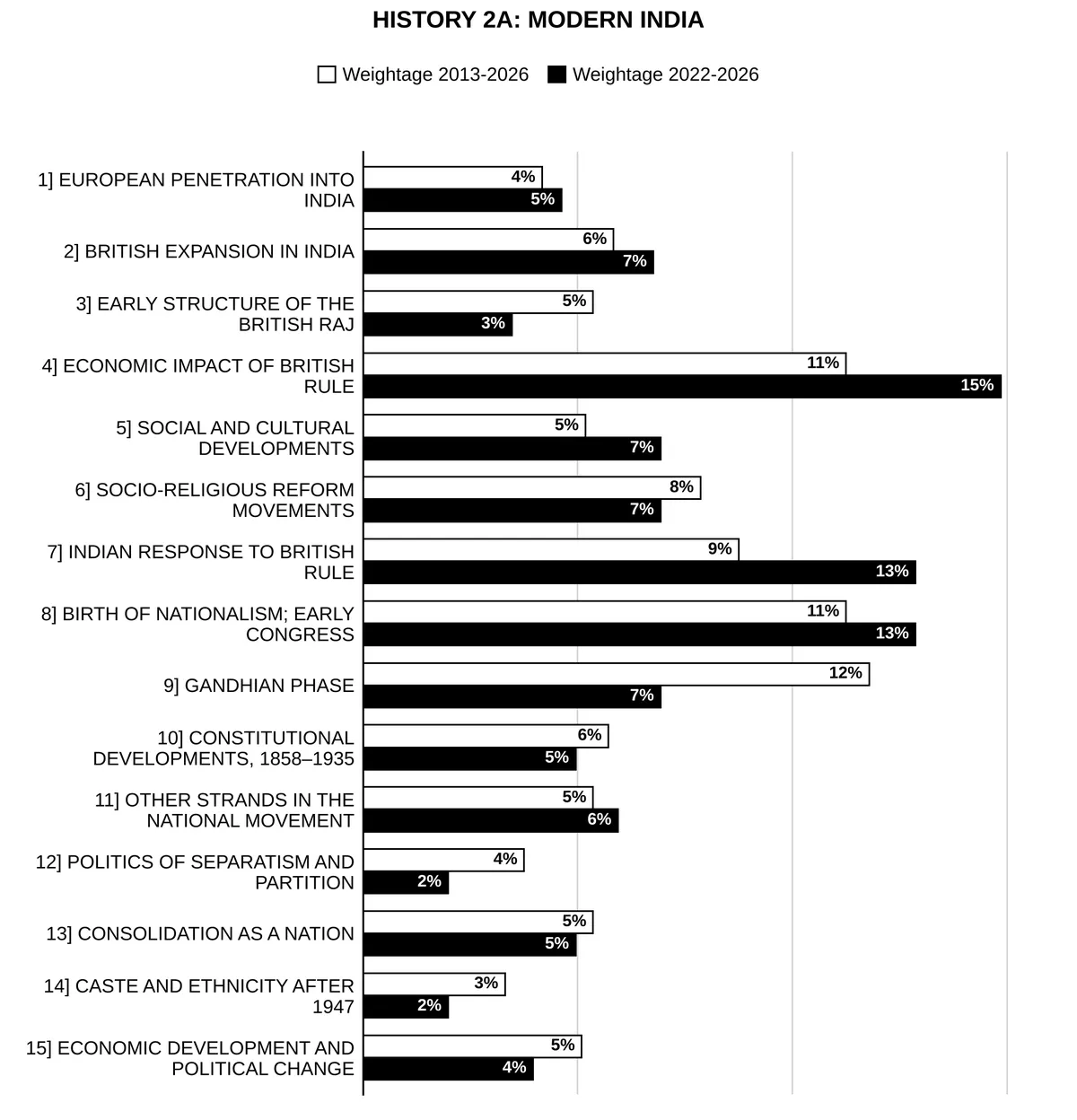
Early Structure of the British Raj accounted for about 3% of the marks asked in Modern India in 2022–2026, down from 5% over 2013–2026, ranking 13th of the 15 units in the section by recent weightage.
How to use these PYQs
- Map every question to a phrase of the official syllabus shown above; recurring phrases show where UPSC’s interest lies.
- Start with the latest questions at the top of each list to see how UPSC frames this unit today; the older 60-mark questions are still useful for depth and content.
- Write timed answers to a few questions every week, keeping to the marks and word limit in each code, and revisit questions you found difficult.
Frequently Asked Questions
How many History Optional questions have been asked from Early Structure of the British Raj?
This collection lists 23 question entries from Early Structure of the British Raj (unit 3 of Paper 2) between 1995 and 2026. They were asked in 19 of the 32 years and 4 came in 2022–2026.
When was Early Structure of the British Raj last asked in History Optional?
Most recently in 2026, with 1 question (2026/20m/4a). Before that, it was asked in 2025.
Where can I find all History Optional PYQs topic-wise?
All units of Paper 1 and Paper 2, the map question and the earlier-syllabus questions are linked from History Optional PYQs Topic-wise (1995–2026).
« Previous: British Expansion in India – History Optional PYQs (1995–2026)
Next: Economic Impact of British Colonial Rule – History Optional PYQs (1995–2026) »
Back to: History Optional PYQs Topic-wise (1995–2026) | Also see: History Optional year-wise question papers (1995–2026)