
This page brings together all British Expansion in India History Optional PYQs asked in UPSC Civil Services Mains from 1995 to 2026, arranged topic-wise. It is unit 2 of Paper 2, Section A – Modern India, with 38 questions, the latest from 2025.
British Expansion in India – History Optional PYQs (1995–2026)
2.1] Bengal – Mir Jafar and Mir Kasim; the Battle of Buxar
1. Critically examine: After the battle of Plassey, the mercenary became the Kingmaker. [2024/10m/150w/1a]
2. Critically examine: ‘The Battle of Plassey (1757) was a skirmish while the Battle of Buxar (1764) was a real war’. [2022/10m/150w/1a]
3. Can you explain how, after acquiring Diwani, the government of the East India Company functioned like ‘an Indian ruler’? [2022/10m/2c]
4. The East India Company had thought that they had found an ideal puppet in Mir Kasim. Mir Kasim, however, belied the expectation of the company. Examine critically. [2021/10m/2c]
5. How far is it correct to say that if Clive was the founder of the British Empire in India, Warren Hastings was its administrative organiser? [2016/20m/2a]
6. Critically examine: “Plassey did not complete the British conquest of India. Had the English been convincingly defeated in any subsequent battle in India, then (the battle of) Plassey would have remained as a minor episode in the history of India.” [2014/10m/150w/1a]
7. How did the East India Company become the dejure power in India? [2009/30m/2b]
8. Examine the essential principles of the Subsidiary Alliance system. How far did it contribute in making the British Company the supreme sovereign authority in India? [2005/60m/2]
9. Comment on: “The verdict at Plassey was confirmed by the English victory at Buxar”. [2002/20m/200w/1a]
10. “The rise and expansion of British empire was an accident rather than the result of a deliberate policy and design.” Critically examine this statement. [2002/60m/2]
11. Comment on: After 1757 there grew up a State of Bengal which was a “sponsored state” as well as a “plundered state”. [1999/20m/200w/1a]
12. How did the British conquer Bengal in the 18th century? What circumstances helped them? [1998/60m/2]
13. Comment on: The British conquered India “in a fit of absent-mindedness”. [1997/20m/200w/1a]
14. Comment on: “The verdict of Plassey was confirmed by the English victory at Buxar.” [1996/20m/200w/1a]
15. Comment on: “By certain of his actions Clive has marred both the glory and usefulness of his work.” [1995/20m/200w/1a]

Preparing for Prelims too?
Our UPSC Prelims Topic-wise PYQ eBook covers every Prelims question with detailed explanations, so you can see exactly where UPSC asks from.
View the BookDownload Free Sample2.2] Mysore
1. The Carnatic Wars, the Anglo-Mysore Wars and the Anglo-Maratha Wars had virtually eliminated the French from the contest of supremacy in South India. Discuss. [2023/20m/2a]
2. Critically examine: Tipu Sultan had little success in setting forth a course of change significantly different from the general experience of 18th century crisis of Indian politics and society where public life tended over and over to become a system of plundering. [2021/10m/150w/1b]
3. Critically examine: “Tipu Sultan was trying to build in Mysore a strong centralised and militarised state, with ambitious territorial designs.” [2019/10m/150w/1a]
4. Why was Mysore considered a threat by the British to their possessions and mercantile interests in the south. Do you think that Tipu Sultan’s posturing became his undoing? [2009/30m/2a]
5. Examine the circumstances which led to the Third Mysore War. Could Cornwallis have avoided it? [2006/60m/2]
6. Examine the essential principles of the Subsidiary Alliance system. How far did it contribute in making the British Company the supreme sovereign authority in India? [2005/60m/2]
2.3] The Marathas: the three Anglo-Maratha Wars
1. Critically examine: “The seeds of domestic dissensions were thickly and deeply sown in the Maratha system under the Peshwas.” [2025/10m/150w/1b]
2. Twenty years of peace secured by the treaty of Salbai proved very costly to the Marathas in strategic terms. — Elucidate. [2024/10m/3c]
3. The Carnatic Wars, the Anglo-Mysore Wars and the Anglo-Maratha Wars had virtually eliminated the French from the contest of supremacy in South India. Discuss. [2023/20m/2a]
4. While individually the Marathas were clever and brave, they lacked the corporate spirit so essential for national independence. Discuss with reasons. [2021/10m/3c]
5. Critically examine: “The Maratha polity disintegrated through internal stress.” [2017/10m/150w/1a]
6. Comment on: ‘Upon the whole, then, I conclude that the treaty of Bassein was wise, just and a politic measure.’ [2005/20m/200w/1a]
7. Comment on: “The Treaty of Salbai (1782) was neither honorable to the English nor advantageous to their interests.” [2004/20m/200w/1a]
8. Comment on: The British “fought the First Maratha War in a period when their fortunes were at the lowest ebb”. [1998/20m/200w/1a]
2.4] The Punjab
1. Critically examine: “The Sikh monarchy was Napoleonic in the suddenness of its rise, the brilliancy of its success and the completeness of its overthrow.” [2025/10m/150w/1a]
2. Critically examine: ‘The Treaty of Amritsar (1809) was significant for its immediate as well as potential effects’. [2022/10m/150w/1b]
3. Critically examine: “Maharaja Ranjit Singh died in 1839. His death was the signal for an outburst of anarchy all over the Punjab.” [2020/10m/150w/1a]
4. Underline the major considerations of the British imperial power that led to the annexation of Punjab. [2017/10m/2c]
5. Critically examine: “Annexation of Punjab was part of a broad north-west frontier policy set in motion after the exit of Maharaja Ranjit Singh.” [2015/10m/150w/1a]
6. “Punjab’s fate after Ranjit Singh was foredoomed as the impulse of neo-Victorian Imperialism was bound to overwhelm it.” Elucidate. [2010/20m/2b]
7. Comment on: ‘Dalhousie changed the map of India with speed and thoroughness no campaign could equal.’ [2001/20m/200w/1a]
8. Comment on: Sir Charles Napier said, “We have no right to seize Sind, yet we shall do so, and a very advantageous, useful, humane piece of rascality it will be.” [2000/20m/200w/1c]
9. The British conquest of Sind was both a political and moral sequel to the first Afghan war. Comment. [1995/60m/2]
Summary of British Expansion in India PYQs (1995–2026)
| Total questions (1995–2026) | 38 (36 unique – a few questions are listed under more than one sub-topic) |
| Total marks asked | 780 (unique questions) |
| Questions in last 5 years (2022–2026) | 9 (8 unique) |
| Most recent year asked | 2025 |
| Sub-topics | 4 (2.1 to 2.4) |
The earliest question here dates from 1995 and the latest from 2025; UPSC has drawn on this unit in 24 of the 32 years. In the last five years (2022–2026), 9 questions were set from it.
Official Syllabus
2. British Expansion in India: Bengal – Mir Jafar and Mir Kasim; The Battle of Buxar; Mysore; The Marathas; The three Anglo-Maratha Wars; The Punjab.
Source: UPSC Civil Services Examination 2026 notification.
Where this unit stands in Modern India
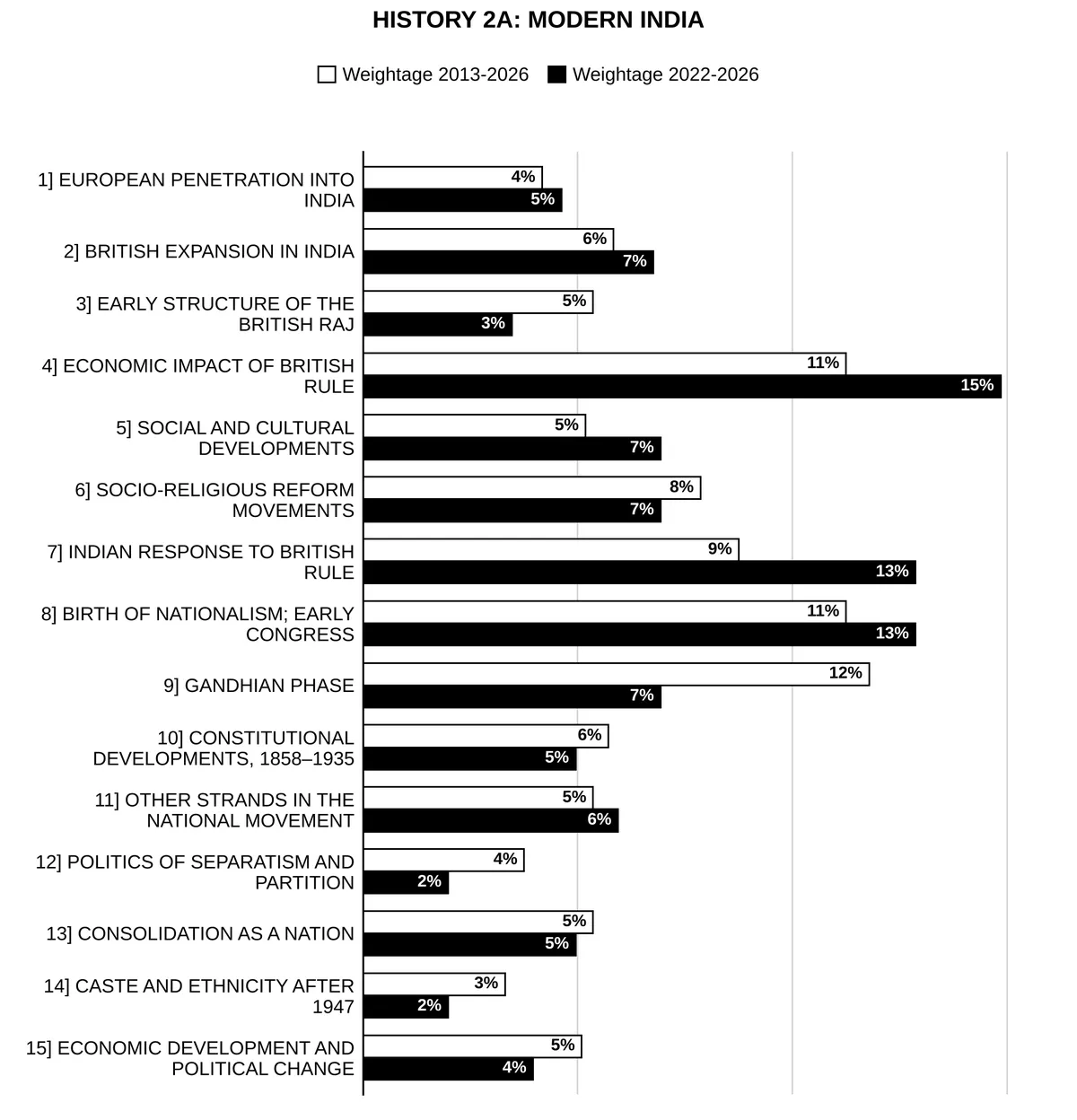
British Expansion in India accounted for about 6% of the marks asked in Modern India in 2022–2026, the same as 6% over 2013–2026, ranking 7th of the 15 units in the section by recent weightage.
How to use these PYQs
- Compare the questions with the official syllabus wording above – themes that recur across years deserve the deepest notes.
- Give priority to the recent questions (2013 onwards follow the present 250-mark paper pattern); use the pre-2013 questions to test your depth of content.
- Practise answers within the word limit shown in the question code (for example 150w or 250w) and under timed conditions, then revise them after a week.
Frequently Asked Questions
How many History Optional questions have been asked from British Expansion in India?
This collection lists 38 question entries from British Expansion in India (unit 2 of Paper 2) between 1995 and 2025, of which 36 are unique questions; the rest are listed under more than one sub-topic. They were asked in 24 of the 32 years and 9 came in 2022–2026.
When was British Expansion in India last asked in History Optional?
Most recently in 2025, with 2 questions (2025/10m/150w/1b, 2025/10m/150w/1a). Before that, it was asked in 2024.
Where can I find all History Optional PYQs topic-wise?
All units of Paper 1 and Paper 2, the map question and the earlier-syllabus questions are linked from History Optional PYQs Topic-wise (1995–2026).
« Previous: European Penetration into India – History Optional PYQs (1995–2026)
Next: Early Structure of the British Raj – History Optional PYQs (1995–2026) »
Back to: History Optional PYQs Topic-wise (1995–2026) | Also see: History Optional year-wise question papers (1995–2026)