
Here is the complete set of Economic Impact of British Colonial Rule History Optional PYQs from UPSC Mains 1995–2026, taken from our topic-wise question bank. It is unit 4 of Paper 2, Section A – Modern India, with 60 questions, the latest from 2026.
Economic Impact of British Colonial Rule – History Optional PYQs (1995–2026)
4.1] Land revenue settlements
1. Critically examine: “Permanent settlement policy resulted in an unfair distribution of assessment, particularly when there was no survey.” [2026/10m/150w/1c]
2. Do you agree that the idea of permanent fixation of land revenue of 1793 in Bengal was highly influenced by the Physiocratic school of thinking? Discuss. [2025/20m/2a]
3. Explain how the Permanent Settlement initiated a rule of property in Bengal and what were its consequences? [2022/20m/2a]
4. Critically examine: “Ryotwari falls into three stages—early, middle and late, and the only description common to all is that it is a mode of settlement with small farmers, so small, indeed, that their average holding is, on recent figures, only about 6½ acres.” [2013/10m/150w/1c]
5. What role did the economic ideas play in the early phase of the British rule in the shaping of land tenure policy? [2010/30m/3a]
6. Comment on: “Though the Permanent Settlement had serious defects, it gave tranquillity to the countryside and stability to the government.” [2009/20m/200w/1a]
7. Examine the major factors shaping the British land-revenue policy in India. How it affected Indian society? [2007/60m/2]
8. Comment on: ‘The impact of government on the people meant essentially the impact of government on the village.’ [2005/20m/200w/1c]
9. Comment on: ‘Permanent Settlement disappointed many expectations and introduced the results that were not anticipated.’ [2004/20m/200w/1c]
10. Comment on: ‘Absentee landlordism was a consequential feature of Bengal’s Permanent land settlement.’ [2003/20m/200w/1a]
11. What was the impact of early British land policy on the ‘village communities’ of North India? [2003/60m/2]
12. Discuss the main features of the ‘Raiyatwari Settlement’ in South India. Did it satisfy the aspirations of the peasantry? [2001/60m/2]
13. Comment on: The Permanent Settlement was a “bold, brave and wise measure.” [1997/20m/200w/1b]

Preparing for Prelims too?
Our UPSC Prelims Topic-wise PYQ eBook covers every Prelims question with detailed explanations, so you can see exactly where UPSC asks from.
View the BookDownload Free Sample4.2] Economic impact of the revenue arrangements; commercialization of agriculture
1. The pace of commercialisation of agriculture increased as a result of British revenue policies in India. — Critically examine. [2024/20m/2a]
2. Critically examine: “Colonialism had a twisted logic of its own for commercialization. It emerges on analysis to have been often an artificial and forced process.” [2023/10m/150w/1a]
3. Critically examine: “The passing of the land from the hands of the peasant proprietors into the hands of non-cultivating landlords brought about increasing polarization of classes in agrarian areas.” [2018/10m/150w/1b]
4. To what extent did the process of commercialization of agriculture affect the rural scene in India? [2010/30m/4a]
5. Examine the major factors shaping the British land-revenue policy in India. How it affected Indian society? [2007/60m/2]
6. What do you mean by the commercialization of Indian agriculture? Discuss its results. [2006/60m/3]
7. Comment on: ‘Absentee landlordism was a consequential feature of Bengal’s Permanent land settlement.’ [2003/20m/200w/1a]
8. The changing life in Indian village marked best the impact of the British administration on the Indian people. Explain, identifying the process and the extent of the change. [1996/60m/2]
4.3] Rise of landless agrarian labourers; impoverishment of the rural society
1. Critically examine: “The passing of the land from the hands of the peasant proprietors into the hands of non-cultivating landlords brought about increasing polarization of classes in agrarian areas.” [2018/10m/150w/1b]
2. Comment on: ‘The impact of government on the people meant essentially the impact of government on the village.’ [2005/20m/200w/1c]
3. Examine the impact of British rule on Indian Society in the 19th Century. [2004/60m/3]
4. What was the impact of early British land policy on the ‘village communities’ of North India? [2003/60m/2]
5. The changing life in Indian village marked best the impact of the British administration on the Indian people. Explain, identifying the process and the extent of the change. [1996/60m/2]
4.4] Dislocation of traditional trade and commerce; de-industrialisation; decline of traditional crafts
1. Underline the various factors for decline of the Indian cottage industries during the nineteenth century. [2026/20m/2a]
2. The Industrial Revolution in England accelerated the decline of traditional Indian handicrafts and cottage Industries. Critically examine the factors responsible for this decline and its impact on the Indian economy and society. [2026/20m/7a]
3. Critically examine: “The colonial rule opened the Indian markets for British-manufactured goods and led to ‘deindustrialization’ or destruction of indigenous handicraft industries.” [2025/10m/150w/1e]
4. Do you agree that ‘the decline of traditional Indian artisan production was a fact, sad but inevitable’? Discuss. [2023/20m/3a]
5. India had been the world leader in the field of hand spun and hand woven yarn and cloth for many centuries. Many nationalist and Marxist critiques considered that the British dominion deliberately shattered the traditional and world famous handicrafts of India. Comment. [2021/20m/2a]
6. Critically examine the causes responsible for the phenomenon called ‘de-industrialisation’ in India during the nineteenth century. [2016/20m/3a]
7. “Under the forceful thrust of British colonialism, Indian economy was transformed into a colonial one, the structure of which was determined by the requirements of Britains fast developing industrial economy.” Examine. [2015/20m/3a]
8. “Weaving”, says R. C. Dutt, “was the national industry of the people and spinning was the pursuit of millions of women.” Indian textiles went to England and other parts of Europe, to China and Japan and Burma and Arabia and Persia and parts of Africa. Elucidate. [2013/25m/2a]
9. Comment on: “A self-sufficient village, based on agriculture carried on with the primitive plough and bullock-power, and handicrafts by means of simple instruments, was a basic feature of Pre-British Indian economy.” [2006/20m/200w/1b]
10. Comment on: ‘The British industrial policy in the nineteenth century ruined the Indian handicrafts’. [2001/20m/200w/1c]
11. Discuss the view that the British rule brought about economic changes in India to serve the needs of the imperial economy and establish a dependent form of underdevelopment in this country. [2000/60m/2]

Strengthen your GS papers
Our UPSC Mains Topic-wise & Year-wise PYQ eBook (2013–2026) maps every GS question to the syllabus, so you know what UPSC asks and how often.
View the BookDownload Free Sample4.5] Drain of wealth
1. Critically examine: “The poverty of India was not a product of the Geography or of the lack of natural resources, it was mainly a product of the History of the last two centuries.” [2026/10m/150w/1d]
2. How far was the drain theory a focal point of nationalist critique of colonialism? [2019/20m/2a]
3. Critically evaluate: “The need for a unilateral transfer of funds to Britain was a constant factor and, in fact, progressively increased over time.” [2011/20m/200w/1a]
4. Write a critique on the impact of the Drain Theory of Dadabhai Nauroji in the growth of economic nationalism. [2008/60m/3]
5. Discuss the causes that led to the ‘economic drain’ in Bengal following the Battle of Plassey. [2004/60m/2]
6. Comment on: After 1757 there grew up a State of Bengal which was a “sponsored state” as well as a “plundered state”. [1999/20m/200w/1a]
7. Comment on: The Indian Middle Class firmly believed that “Britain had imposed a colonial economy on India which had impoverished the country.” [1999/20m/200w/1d]
4.6] Economic transformation of India; railroad and communication network
1. Critically examine: “Not until independence, when economic development became a conscious and pursued policy, did the Railways begin to realize their potential for assisting in the transformation of the Indian economy.” [2019/10m/150w/1b]
2. Critically examine: “The British railway construction policy in India benefitted British economy in the nineteenth century.” [2017/10m/150w/1c]
3. After the Battle of Plassey, how did India transit from the medieval to the modern age? [2016/10m/150w/1b]
4. “Under the forceful thrust of British colonialism, Indian economy was transformed into a colonial one, the structure of which was determined by the requirements of Britains fast developing industrial economy.” Examine. [2015/20m/3a]
5. “The railways, instead of serving as the catalyst of an industrial revolution as in Western Europe and the USA, acted in India as ‘the catalyst of complete colonization’.” — Examine. [2012/30m/3a]
6. Critically evaluate: “Railway development in India provides an interesting instance of private enterprise at public risk.” [2010/20m/200w/1b]
7. Comment on: “A self-sufficient village, based on agriculture carried on with the primitive plough and bullock-power, and handicrafts by means of simple instruments, was a basic feature of Pre-British Indian economy.” [2006/20m/200w/1b]
8. Discuss the view that the British rule brought about economic changes in India to serve the needs of the imperial economy and establish a dependent form of underdevelopment in this country. [2000/60m/2]
4.7] Famine and poverty in the rural interior
1. Critically examine: “The poverty of India was not a product of the Geography or of the lack of natural resources, it was mainly a product of the History of the last two centuries.” [2026/10m/150w/1d]
2. Critically examine: ‘Famines were not just because of foodgrain scarcity, but were a direct result of colonial economic policies’. [2022/10m/150w/1c]
3. Explain the factors responsible for the recurrence of famines in the nineteenth century. What remedial measures were adopted by the British Indian Government? [2017/20m/2a]
4. Critically examine the impact of the famine policy on rural India. Describe the official remedial measures undertaken. [2008/60m/2]
5. Trace the development of the famine policy of the British in India between 1876 and 1921. Did it provide relief to the people? [2005/60m/3]
6. Comment on: ‘India underwent suffering and mortality in the wake of recurring famines’ in the later half of the 19th century. [2003/20m/200w/1b]
7. “The recurring famines in the 19th century were the inevitable consequence of the British policy and expose the real character of the paternal solicitude for the peasantry on the part of the British administration.” Examine this statement critically. [2002/60m/3]
4.8] European business enterprise and its limitations
1. Critically examine: “Plantations and mines, jute mills, banking, insurance, shipping and export-import concerns in India were run through a system of interlocking managing agencies.” [2012/12m/150w/1d]
Summary of Economic Impact of British Colonial Rule PYQs (1995–2026)
| Total questions (1995–2026) | 60 (50 unique – a few questions are listed under more than one sub-topic) |
| Total marks asked | 1407 (unique questions) |
| Questions in last 5 years (2022–2026) | 12 (11 unique) |
| Most recent year asked | 2026 |
| Sub-topics | 8 (4.1 to 4.8) |
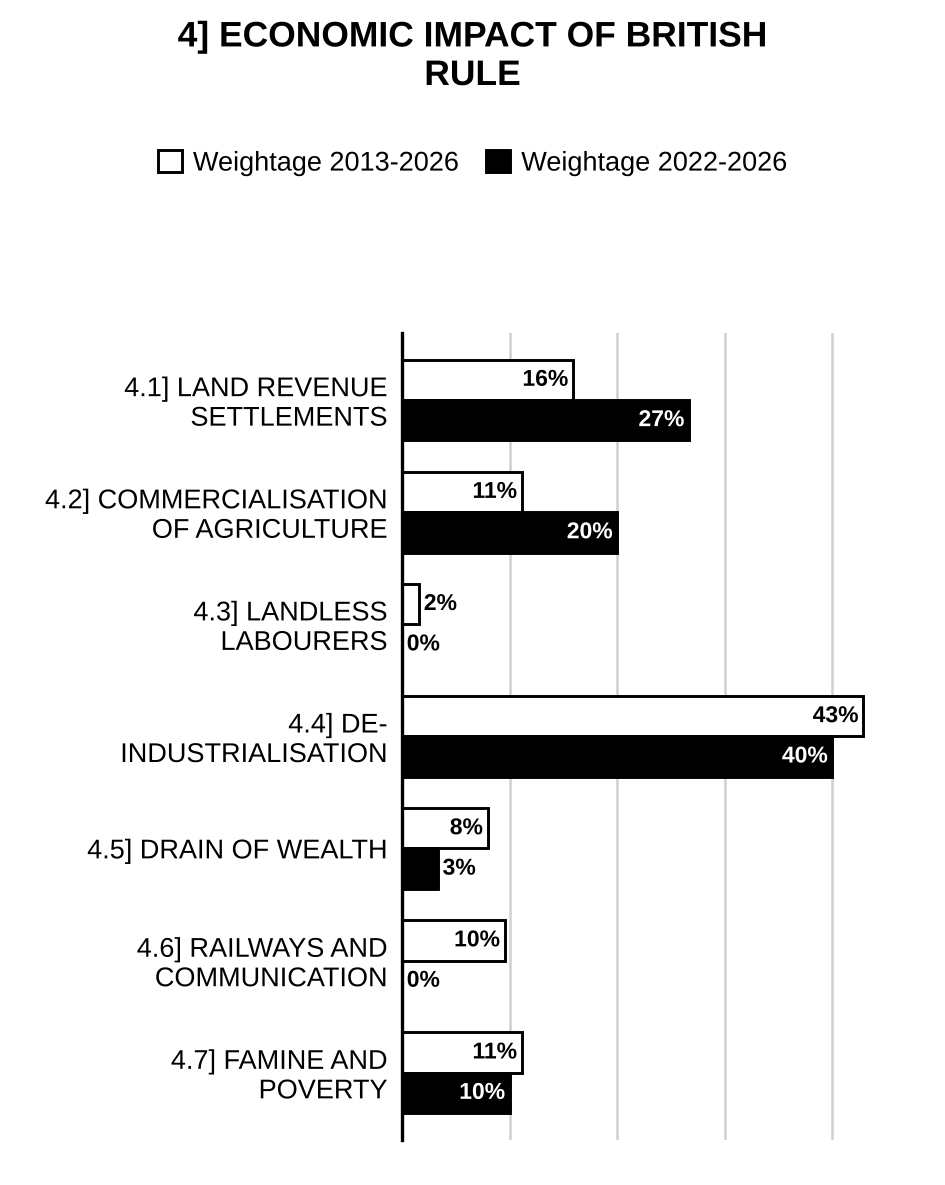
The earliest question here dates from 1996 and the latest from 2026; UPSC has drawn on this unit in 28 of the 32 years. In the last five years (2022–2026), 12 questions were set from it.
Official Syllabus
4. Economic Impact of British Colonial Rule
- (a) Land revenue settlements in British India; The Permanent Settlement; Ryotwari Settlement; Mahalwari Settlement; Economic impact of the revenue arrangements; Commercialization of agriculture; Rise of landless agrarian labourers; Impoverishment of the rural society.
- (b) Dislocation of traditional trade and commerce; De-industrialisation; Decline of traditional crafts; Drain of wealth; Economic transformation of India; Railroad and communication network including telegraph and postal services; Famine and poverty in the rural interior; European business enterprise and its limitations.
Source: UPSC Civil Services Examination 2026 notification.
Where this unit stands in Modern India
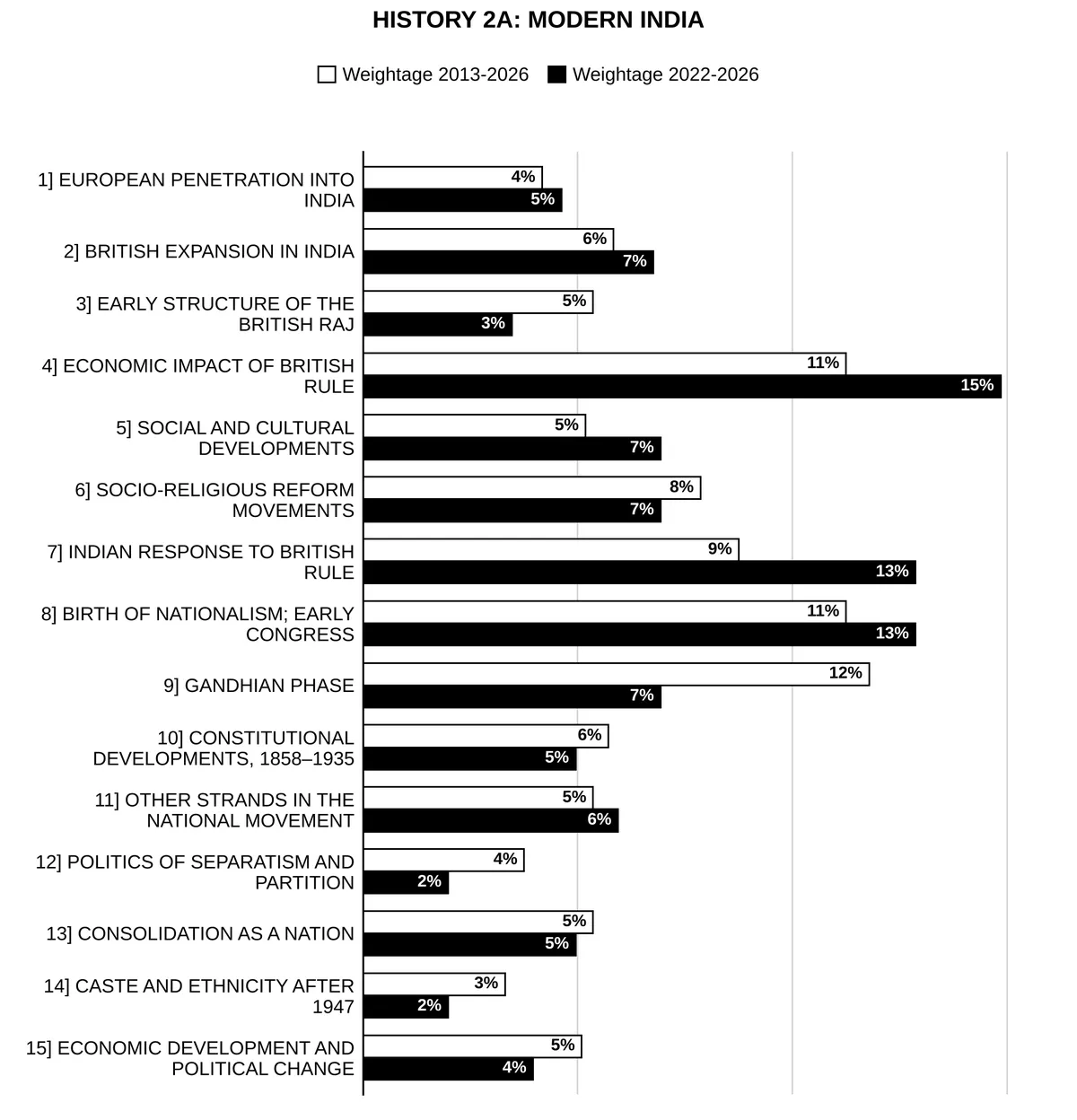
Economic Impact of British Colonial Rule accounted for about 15% of the marks asked in Modern India in 2022–2026, up from 11% over 2013–2026, ranking 1st of the 15 units in the section by recent weightage.
How to use these PYQs
- Read the syllabus line in the box above alongside the questions and mark which phrases UPSC keeps returning to; those are the areas to prepare first.
- Questions run from the latest year to the oldest, so read the top of each list first for the current pattern, then use older ones for practice of content.
- Use the question code to set the length of your practice answer – marks and word limit tell you how much depth UPSC expected.
Frequently Asked Questions
How many History Optional questions have been asked from Economic Impact of British Colonial Rule?
This collection lists 60 question entries from Economic Impact of British Colonial Rule (unit 4 of Paper 2) between 1996 and 2026, of which 50 are unique questions; the rest are listed under more than one sub-topic. They were asked in 28 of the 32 years and 12 came in 2022–2026.
When was Economic Impact of British Colonial Rule last asked in History Optional?
Most recently in 2026, with 4 questions (2026/10m/150w/1c, 2026/20m/2a, 2026/20m/7a, 2026/10m/150w/1d). Before that, it was asked in 2025.
Where can I find all History Optional PYQs topic-wise?
All units of Paper 1 and Paper 2, the map question and the earlier-syllabus questions are linked from History Optional PYQs Topic-wise (1995–2026).
« Previous: Early Structure of the British Raj – History Optional PYQs (1995–2026)
Next: Social and Cultural Developments – History Optional PYQs (1995–2026) »
Back to: History Optional PYQs Topic-wise (1995–2026) | Also see: History Optional year-wise question papers (1995–2026)