
Here is the complete set of Early Medieval India (750-1200) History Optional PYQs from UPSC Mains 1995–2026, taken from our topic-wise question bank. It is unit 13 of Paper 1, Section B – Medieval India, with 46 questions, the latest from 2026.
Early Medieval India (750-1200) – History Optional PYQs (1995–2026)
13.1] Polity: major political developments in Northern India and the peninsula
1. Evaluate the importance of tripartite struggle for the domination over North India during the eighth and ninth centuries. [2022/20m/4a]
2. Explain the ingredients of the transitory nature of the early medieval India. [2016/15m/6a]
3. Did the triangular conflict between the Rashtrakutas, Gurjara Pratiharas and Palas create a political vacuum in northern India which facilitated the invasions of Mahmud of Ghazni? [2001/60m/3]
4. “Achieving dominance in the south of the Vindhyas did not satisfy the ambitions of the Rashtrakutas; they also wanted to achieve dominance over the Gangetic Plains.” Elaborate and comment. [1997/60m/6]
5. “Of all the events that had a singular bearing on the history of India, Harsha’s death in 647 A.D. is significant.” Why? Explain. [1996/60m/2]
6. Give an account of the society in Northern and Central India since the death of Harsha to the Muslim conquest of North India. [1996/60m/4]
13.2] Origin and the rise of Rajputs
1. Critically examine the theories on the origin of the Rajputs. How do the indigenous evidences contradict the European theorists? [2026/20m/6a]
2. “The inferior cavalry of the Rajputs was not the only cause of their defeat at the hands of Turko-Afghans and Mughals.” Comment. [2001/60m/4]
3. Write a short essay on: Social structure of the Rajputs. [1998/20m/200w/5a]
13.3] The Cholas: administration, village economy and society
1. Chola maritime expansion was driven largely by concerns of overseas commerce. Elucidate. [2022/20m/6c]
2. “The Chola rulers were not only mighty conquerors, efficient administrators but also builders of fine temples.” Comment. [2021/15m/8a]
3. “Doubtless it was not a free state; it was any rate a state” (K A N Sastri). Reflect upon the nature of local self government institutions in the Chola country. [2018/15m/3c]
4. Analyze the significance of the Uttaramerur inscriptions of the Chola King Parantaka I. [2016/10m/5b]

Preparing for Prelims too?
Our UPSC Prelims Topic-wise PYQ eBook covers every Prelims question with detailed explanations, so you can see exactly where UPSC asks from.
View the BookDownload Free Sample5. How could the local self-government under the Cholas adjust with their centralised administrative structure? [2015/20m/4c]
6. Evaluating various theories regarding the Chola State, throw light on its village assemblies. [2014/15m/6a]
7. Evaluate the role of nadu and nagaram in the growth of urbanisation under the Cholas. [2012/30m/7a]
8. How far can the village assemblies or communities under the Cholas be really called democratic? [2009/30m/6a]
9. Show that the administrative system in India reached a very high level during the Chola period. [2007/60m/6]
10. The Cholas are said to have established a strong and well organized administration with an element of self-government at the local level. Do you agree? Give reasons. [2004/60m/6]
11. Were the Chola village assemblies democratic in nature? Give reasons for your answer. [2000/60m/6]
12. Critically evaluate the achievements of the Cholas. [1998/60m/6]
13. Assess the importance of the Cholas in the history of South India. [1996/60m/7]
13.4] “Indian Feudalism”
1. Discuss the various proponents of Indian feudalism. [2023/10m/150w/5a]
2. Discuss the different stages of Indian feudalism and analyze its impact on Indian political system. [2021/10m/150w/5a]
3. Explain the ingredients of the transitory nature of the early medieval India. [2016/15m/6a]
4. Do the evidences of land ownership at our disposal support the theory of the prevalence of feudalism in early medieval India? [2015/15m/6a]
5. What kind of changes were visualised by historians on Indian feudalism? Examine critically. [2012/30m/6a]
6. Evaluate the socio-economic conditions from the Gupta Period to 1200 C.E. as gleaned from the various types of grants or dana shasana. [2011/60m/6]
7. Write a short essay on: Applicability of the term ‘Indian Feudalism’ to early Medieval society. [2009/20m/200w/5a]
8. Write a short essay on: The Samanta system. [2005/20m/200w/5a]
9. Comment on: Land charters of north India (c. A.D. 750–1200) [1995/20m/200w/6a]
13.5] Agrarian economy and urban settlements
1. What were ‘Brahmadeya’ grants? How do you account for the large number of such grants in the early medieval period? [2022/10m/150w/5a]
2. Large number of land grants in hitherto non-arable tracts invariably meant expansion of agriculture in early medieval India. How did the management of hydraulic resources (different types of irrigation works) facilitate expansion of agriculture in this period? [2021/15m/4b]
3. How did the temples of South India, as financial institutions, have deep impact on the social institutions of early medieval period? Critically examine. [2016/15m/4c]
4. Critically analyse the agricultural economy from 750 to 1200 CE. [2014/10m/150w/5a]
5. Evaluate the ownership of land in ancient India on the basis of literary and epigraphic sources. [2013/15m/4b]
6. Assess the Lekhapaddhati as an important source for evaluating the society and economy of the thirteenth century CE with special reference to Gujarat. [2013/15m/8b]
7. Evaluate the role of nadu and nagaram in the growth of urbanisation under the Cholas. [2012/30m/7a]
8. Discuss the types of lands and the science of agriculture mentioned in the literature and epigraphs of ancient India. [2011/20m/4b]
13.6] Trade and commerce
1. Chola maritime expansion was driven largely by concerns of overseas commerce. Elucidate. [2022/20m/6c]
2. To what extent “monetary anaemia” afflicted the erstwhile commercial economy during the early medieval period? [2010/30m/6b]
13.7] Society: the status of the Brahman and the new social order
1. “The dynamics of social mobility in early medieval India were shaped by a complex interplay of caste hierarchies, religious legitimation, economic transformation and political patronage.” Critically assess how these factors collectively reconfigured the structure of early medieval Indian society. [2025/15m/4a]
2. Critically analyze the changing nature of caste and gender relations during the early medieval period. [2018/15m/6a]
3. Give an account of the society in Northern and Central India since the death of Harsha to the Muslim conquest of North India. [1996/60m/4]
13.8] Condition of women
1. Critically analyze the changing nature of caste and gender relations during the early medieval period. [2018/15m/6a]
13.9] Indian science and technology
1. Write a short essay on: Alberuni on science in India. [2007/20m/200w/5a]
Summary of Early Medieval India (750-1200) PYQs (1995–2026)
| Total questions (1995–2026) | 46 (41 unique – a few questions are listed under more than one sub-topic) |
| Total marks asked | 1195 (unique questions) |
| Questions in last 5 years (2022–2026) | 7 (6 unique) |
| Most recent year asked | 2026 |
| Sub-topics | 9 (13.1 to 13.9) |
The earliest question here dates from 1995 and the latest from 2026; UPSC has drawn on this unit in 23 of the 32 years. In the last five years (2022–2026), 7 questions were set from it.
Official Syllabus
13. Early Medieval India, 750–1200
- Polity: Major political developments in Northern India and the peninsula, origin and the rise of Rajputs.
- The Cholas: administration, village economy and society.
- “Indian Feudalism”.
- Agrarian economy and urban settlements.
- Trade and commerce.
- Society: the status of the Brahman and the new social order.
- Condition of women.
- Indian science and technology.
Source: UPSC Civil Services Examination 2026 notification.
Where this unit stands in Medieval India
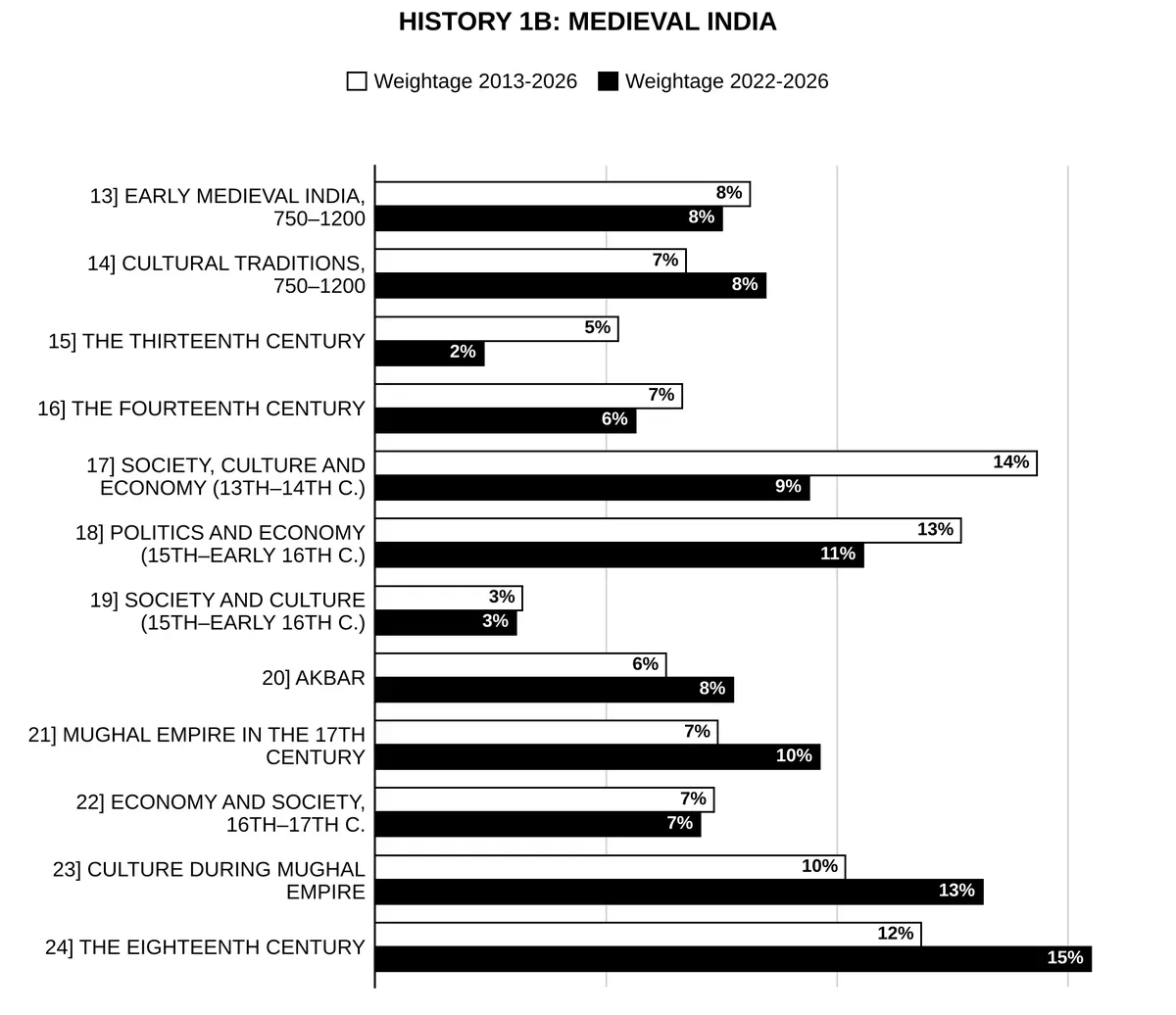
Early Medieval India (750-1200) accounted for about 8% of the marks asked in Medieval India in 2022–2026, the same as 8% over 2013–2026, ranking 8th of the 12 units in the section by recent weightage.
How to use these PYQs
- Read the syllabus line in the box above alongside the questions and mark which phrases UPSC keeps returning to; those are the areas to prepare first.
- Questions run from the latest year to the oldest, so read the top of each list first for the current pattern, then use older ones for practice of content.
- Use the question code to set the length of your practice answer – marks and word limit tell you how much depth UPSC expected.
Frequently Asked Questions
How many History Optional questions have been asked from Early Medieval India (750-1200)?
This collection lists 46 question entries from Early Medieval India (750-1200) (unit 13 of Paper 1) between 1995 and 2026, of which 41 are unique questions; the rest are listed under more than one sub-topic. They were asked in 23 of the 32 years and 7 came in 2022–2026.
When was Early Medieval India (750-1200) last asked in History Optional?
Most recently in 2026, with 1 question (2026/20m/6a). Before that, it was asked in 2025.
Where can I find all History Optional PYQs topic-wise?
All units of Paper 1 and Paper 2, the map question and the earlier-syllabus questions are linked from History Optional PYQs Topic-wise (1995–2026).
« Previous: Themes in Early Indian Cultural History – History Optional PYQs (1995–2026)
Next: Cultural Traditions in India (750-1200) – History Optional PYQs (1995–2026) »
Back to: History Optional PYQs Topic-wise (1995–2026) | Also see: History Optional year-wise question papers (1995–2026)