
Consolidation as a Nation History Optional PYQs from 1995 to 2026 are compiled here exactly as UPSC set them in the Mains examination, sorted by syllabus topic.
Consolidation as a Nation – History Optional PYQs (1995–2026)
13.1] Consolidation as a nation; integration of Princely States; princes in electoral politics
1. How were the Princely States integrated in the Indian Union after the partition? What role did Sardar Patel play in it? [2021/10m/4c]
2. Throw light on the nature of ‘Instrument of Accession’ and ‘Standstill Agreement’ signed by the Princely States with the Indian Union. [2017/10m/4c]
3. “Sardar Patel accomplished a silent revolution by ensuring the absorption and assimilation of a multitude of principalities without shedding even a drop of blood.” Elucidate. [2014/10m/3c]
4. “Nehru favoured the policy of integrating the tribal people in Indian society, of making them an integral part of the Indian nation even while maintaining their distinct identity and culture.” — Elaborate with special reference to Northeastern India. [2012/30m/4a]
5. “With great skill and masterful diplomacy and using both persuasion and pressure, Sardar Vallabhbhai Patel succeeded in integrating the hundreds of princely states with the Indian Union.” Discuss. [2007/60m/4]
6. Comment on: Towards the Princes, Canning adopted a policy of “punishing resistance and rewarding obedience.” [2000/20m/200w/1b]
7. Comment on: The British policy towards Indian States in 1818–1858 was one of “isolation and non-interference tempered by annexation.” [1996/20m/200w/1b]
8. Trace the course of the people’s movement in Indian States after 1937. How did the Congress leadership react to it? [1996/60m/3]
9. Comment on: “Having won political freedom, India had to win economic and cultural freedom.” [1995/20m/200w/1d]
13.2] Nehru’s foreign policy; India and her neighbours (1947–1964)
1. In the light of contentions over the McMahon Line, analyse the India-China relations in the 1950s and 1960s. [2022/20m/4b]
2. “After Indian Independence India-China relations started on a high note, but during the course of the coming years India had to face a bitter experience due to the Chinese aggression.” Elaborate. [2020/20m/4b]
3. Critically examine: “Nehru’s policy of Non-Alignment came to symbolize the struggle of India and other newly independent nations to retain and strengthen their independence from colonialism.” [2012/12m/150w/1e]
4. Would you agree that India’s effort to pursue an independent foreign policy was a highlight of post-1947 politics? [2011/30m/4b]
5. Analyse Indian foreign policy of Non-alignment between 1947 and 1964. [2004/60m/4]
6. Jawaharlal Nehru was the architect of India’s policy of non-alignment. In the light of this statement discuss India’s relations with the two ‘Power Blocks’ between 1947–1964. [2001/60m/4]

Preparing for Prelims too?
Our UPSC Prelims Topic-wise PYQ eBook covers every Prelims question with detailed explanations, so you can see exactly where UPSC asks from.
View the BookDownload Free Sample13.3] Linguistic reorganisation of States; the question of national language
1. “The movement for linguistic States generated deep apprehensions among the nationalist elite. They feared it would lead to the Balkanization of India.” Examine. [2025/10m/2c]
2. “The Reorganisation of the states on the basis of language was a major aspect of national consolidation and integration.” Comment. [2020/10m/4c]
3. Critically examine: “States’ reorganization did not, of course, resolve all the problems relating to linguistic conflicts.” [2018/10m/150w/1e]
4. “The reorganization resulted in rationalizing the political map of India without seriously weakening its unity. If anything, its result has been functional, in as much as it removed what had been a major source of discord, and created homogeneous political units which could be administered through a medium that the vast majority of the population understood. Indeed, it can be said with the benefit of hindsight that language, rather than being a force for division, has proved a cementing and integrating influence.” Examine. [2013/25m/4b]
13.4] Regionalism and regional inequality
1. Regionalism in India after 1947 was occasioned by developmental imperatives as much as linguistic particularism. — Elucidate. [2024/20m/3b]
2. Planning was seen as a powerful instrument that could be used to remove regional inequality. Examine. [2020/10m/3c]
Summary of Consolidation as a Nation PYQs (1995–2026)
| Total questions (1995–2026) | 21 |
| Total marks asked | 527 |
| Questions in last 5 years (2022–2026) | 3 |
| Most recent year asked | 2025 |
| Sub-topics | 4 (13.1 to 13.4) |
The earliest question here dates from 1995 and the latest from 2025; UPSC has drawn on this unit in 17 of the 32 years. In the last five years (2022–2026), 3 questions were set from it.
Official Syllabus
13. Consolidation as a Nation: Consolidation as a Nation; Nehru’s Foreign Policy; India and her neighbours (1947–1964); The linguistic reorganisation of States (1935–1947); Regionalism and regional inequality; Integration of Princely States; Princes in electoral politics; the Question of National Language.
Source: UPSC Civil Services Examination 2026 notification. The notification gives no title for this unit; the short title used here is editorial.
Where this unit stands in Modern India
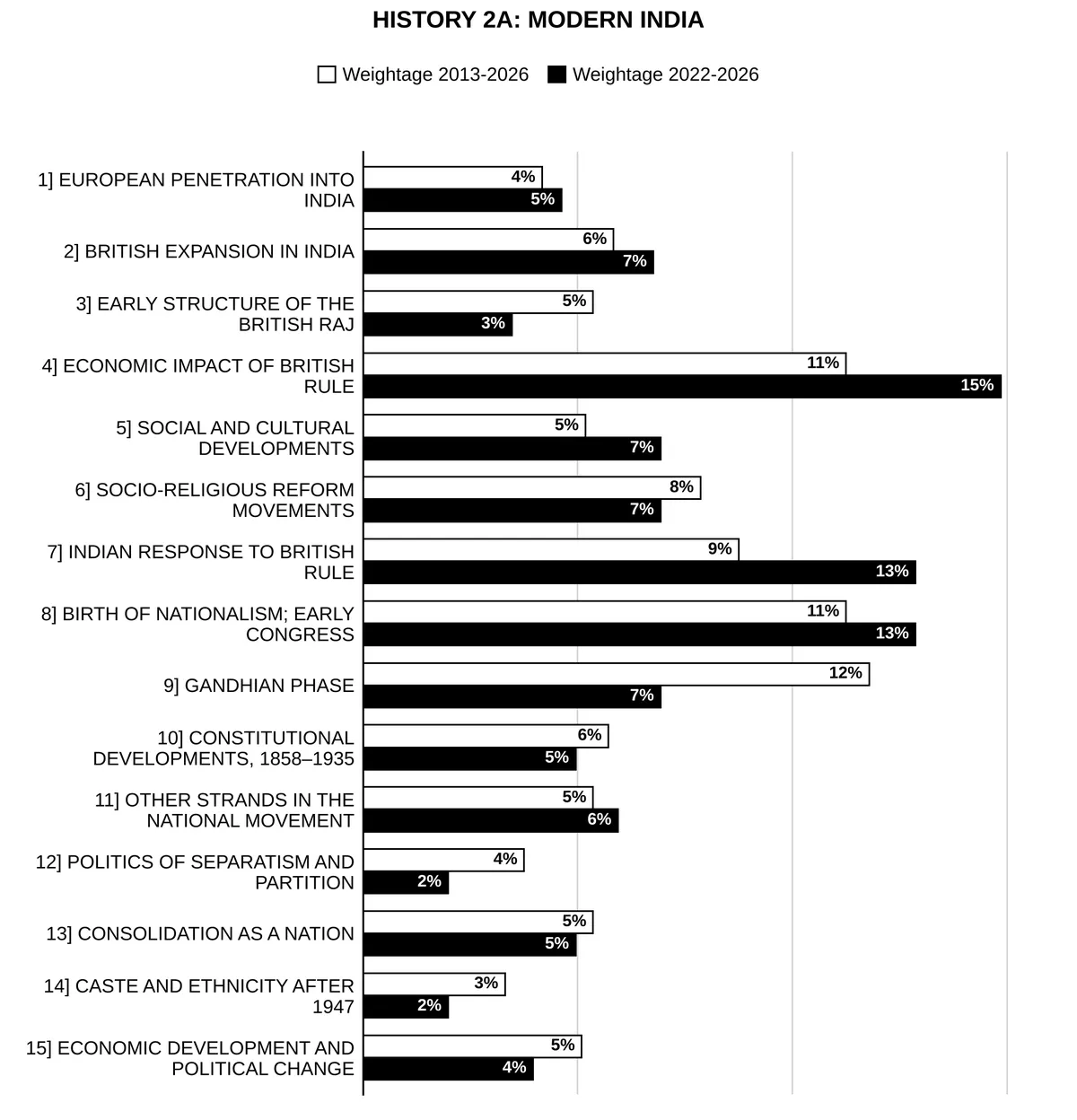
Consolidation as a Nation accounted for about 5% of the marks asked in Modern India in 2022–2026, the same as 5% over 2013–2026, ranking 9th of the 15 units in the section by recent weightage.
How to use these PYQs
- Read the syllabus line in the box above alongside the questions and mark which phrases UPSC keeps returning to; those are the areas to prepare first.
- Questions run from the latest year to the oldest, so read the top of each list first for the current pattern, then use older ones for practice of content.
- Use the question code to set the length of your practice answer – marks and word limit tell you how much depth UPSC expected.
Frequently Asked Questions
How many History Optional questions have been asked from Consolidation as a Nation?
This collection lists 21 question entries from Consolidation as a Nation (unit 13 of Paper 2) between 1995 and 2025. They were asked in 17 of the 32 years and 3 came in 2022–2026.
When was Consolidation as a Nation last asked in History Optional?
Most recently in 2025, with 1 question (2025/10m/2c). Before that, it was asked in 2024.
Where can I find all History Optional PYQs topic-wise?
All units of Paper 1 and Paper 2, the map question and the earlier-syllabus questions are linked from History Optional PYQs Topic-wise (1995–2026).
« Previous: Politics of Separatism and Partition – History Optional PYQs (1995–2026)
Next: Caste and Ethnicity after 1947 – History Optional PYQs (1995–2026) »
Back to: History Optional PYQs Topic-wise (1995–2026) | Also see: History Optional year-wise question papers (1995–2026)