
Here are all 182 Atomic and Molecular Physics questions asked in UPSC Physics Optional Paper II from 1995 to 2026, arranged under the 9 topics of the official syllabus. Within each topic the latest questions come first.
Each question ends with a code such as [2024/15m/3b] – the year, the marks, the word limit (where UPSC set one) and the question number in the paper.
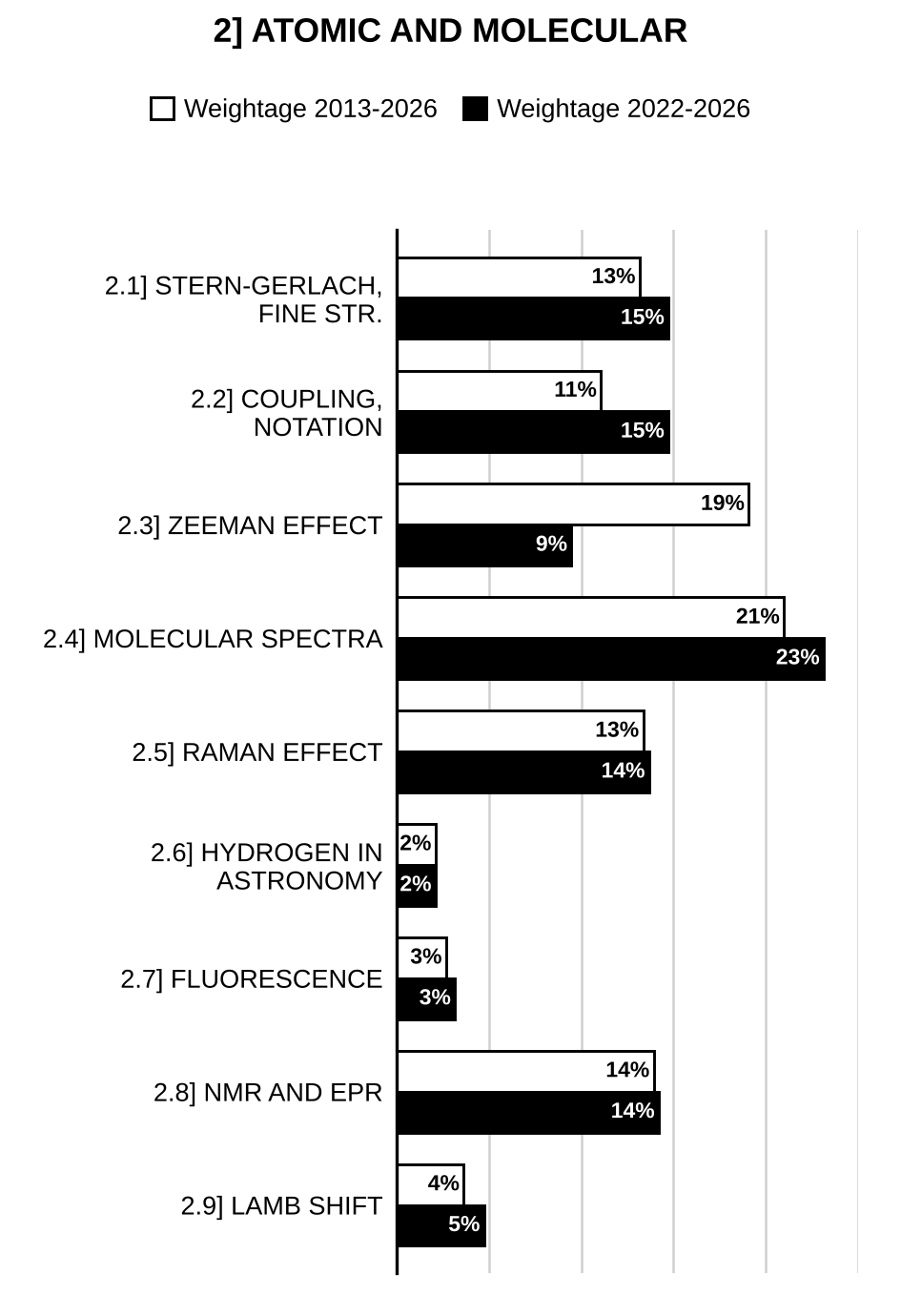
2.1] Stern-Gerlach experiment and fine structure
24 questions
In a Stern-Gerlach experiment, the magnetic field varies with distance in the z-direction according to . The speed of silver atoms coming from the oven is 725 m/s. Silver atoms travel a distance of 3 cm through the magnet. Calculate the separation of the two beams of atoms when they leave the magnet. [Given: The mass of a silver atom = kg and its magnetic moment is 1 Bohr magneton.]. [2026/10m/1c]
The Stern-Gerlach experiment is a landmark experiment in quantum mechanics. Discuss about the most important findings of this experiment. [2025/15m/3b]
A beam of hydrogen atoms emitted from an oven at 400 k is sent through a Stern-Gerlach experiment having magnet of length 1 m and a gradient field of 10 tesla/m. Calculate the transverse deflection of an atom at the point where the beam leaves the magnet. [2023/10m/1d]
What is vector atom model? How the principal features of vector atom model were explained by Stern-Gerlach experiment? [2023/15m/3a]
(i) Why does Stern-Gerlach experiment enjoy so much importance in atomic physics? (ii) Draw the schematic diagram of this experiment and comment on the shapes of the magnet pole pieces. (iii) Why was the atomic beam of silver used in this experiment? [2022/20m/3b]
Explain spin-orbit coupling. Discuss the splitting of spectral lines of H-atom due to spin-orbit coupling. [2021/15m/3b]
Explain how the magnetic moments of atoms, the space quantization of angular momentum and the spin of electron are measured using Stern-Gerlach experiment. [2020/15m/3b]
Discuss the fine structure of hydrogen spectrum. How is it of importance in the astronomical observations? [2018/15m/4b]
In the Stern-Gerlach experiment using Ag atoms, the oven temperature is 1000 K, cm and Tesla/m. Calculate the separation of the two components. [2016/10m/1d]
Describe Stern-Gerlach experiment. Discuss how it has explained space quantization and electron spin. Find the value of angle between the spin angular momentum and its z-component of an electron moving along the external magnetic field . [2016/30m/2a]
Discuss the fine structure of sodium D line. Draw and lines due to the transitions between and levels. [2013/25m/4b]
Discuss the fine structure of hydrogen atom spectrum. Draw the compound doublet spectrum arising as a result of transitions between and levels. [2011/10m/1d]
What is spin-orbit interaction? Calculate the energy shift due to spin-orbit interaction term in H-like system. Discuss the significance of this shift in relation to the fine structure of hydrogen spectral lines. [2010/30m/3b]
What was the aim of Stern – Gerlach experiment? Why were silver atoms chosen instead of electrons in the experiment? What was the outcome of the experiment? [2009/20m/3c]
(i) Explain spin-orbit coupling of an atomic electron. (ii) Show that the 2p state in the H atom splits up into two substates due to spin-orbit coupling. (iii) Calculate the energy of separation in eV, resulting from the spin-orbit coupling when the magnetic field experienced by the electron is 0.4 T. [2009/20m/4b]
Describe Stern-Gerlach experiment. Explain how it demonstrates the discrete nature of the magnetic moment of an atom. [2007/15m/3c]
Determine the order of magnitude of the energy involved in the spin-orbit interaction of 2p state of an atom with an electron. Given the magnetic field due to the state is 0.28 T. [2006/20m/1d]
Describe Stern-Gerlach experiment and discuss its implications. [2005/20m/3b]
Derive an expression for the spin-orbit interaction energy in one electron system. Calculate the energy separation between the levels and . [2002/20m/3a]
Describe the Stern-Gerlach experiment and discuss its significance. [2000/20m/8a]
What is spin-orbit coupling? Considering the sodium doublet (5890 Å and 5896 Å), calculate the effective magnetic field experienced by the electron in the 3p state. [1999/20m/5a]
The atomic number of Na is 11. (i) Write down the electronic configuration for the ground state of the Na atoms (ii) Give the standard spectroscopic notation for the ground state. (iii) The lowest frequency in the absorption spectrum of Na is a doublet. What are the spectroscopic designations of the pair of energy levels to which the atom is excited as a result of this absorption process? (iv) What is the mechanism responsible for the splitting between the pairs of energy levels? (v) Does the level corresponding to the higher value of j lie lower or higher? [1998/20m/8a]
Explain the fine structure of line of H-atom arising due to LS coupling. [1996/30m/6a]
What is space quantisation? Discuss the Stern Gerlach experiment establishing the space quantisation. [1995/30m/6a]
2.2] Coupling and spectroscopic notation
19 questions
(i) Calculate the number of permitted electrons in a sub-shell and a shell in an atom. (ii) Explain how Pauli’s exclusion principle helps in determining the electronic configuration in a many-electron system. [2026/20m/3a]
The quantum numbers of two electrons in a two-valence electron atom are Assuming – coupling, find the possible values of and . [2025/10m/1e]
Show that the energy of the triplet state () is not equal to the energy of the singlet state (). [2025/10m/5a]
Differentiate between L-S coupling and J-J coupling. What are the possible orientations of for the and states that correspond to ? [2024/15m/4c]
(i) Show that for a given principal quantum number , there are possible states of the atom. (ii) An atomic state is denoted by . Find the values of , and . For this state, what should be the minimum number of electrons involved? Suggest a possible electronic configuration. [2022/15m/2c]
The quantum numbers of two electrons in a two valence electron atom are; (i) Assuming – coupling, find the possible value of and hence of . (ii) Assuming – coupling, find the possible values of . [2021/15m/3c]
Describe the importance of L-S and J-J coupling in atomic spectroscopy. What are experimental evidences of their existence? [2018/20m/3c]
Compute the allowed spectral terms for two non-equivalent p-electrons on the basis of Pauli’s exclusion principle. [2016/10m/2c]
Explain in detail L-S coupling and j-j coupling schemes. [2016/10m/3b]
How are electrons distributed in the various sub-shells for ? Give the quantum numbers for the electrons in the second shell. [2013/10m/1d]
The term symbol for atomic states are quoted as and . What are the values of L, S and J? [2013/10m/4a]
What do you mean by ‘term symbols’? Obtain term symbols for the following sets of values of S and L: (i) (ii) (iii) [2011/10m/1e]
(i) Find the ground state total orbital (L) and total spin (S) quantum numbers for nitrogen. (ii) Find the L and S values of the two “first excited states” of helium atom. [2009/10m/1d]
What are the term symbols for atoms with the following S (total spin) and L (total orbital) quantum numbers, , ? [2004/8m/1d(ii)]
Write the spectral symbol of the term with S = 1/2, J = 5/2 and g = 6/7. [2002/10m/1b(ii)]
Write the electronic configuration of mercury (Z = 80). Obtain the spectral term for the normal and the first excited configuration of the atom. [2002/20m/3b]
(i) On the basis of vector atom model, discuss briefly the L-S and J-J coupling schemes. (ii) Write down expressions for spin angular momentum, orbital angular momentum and total angular momentum under L-S coupling scheme. (iii) Obtain the energy states for atom for n = 1, 2, 3 levels (n is principal quantum number). Draw the energy level diagram. Does L-S coupling scheme hold good in atom which like He has 2 optical electrons ()? Comment. [2001/30m/3b]
Determine all the term [?] symbols of equivalent electrons and arrange these states in increasing order of energy. Justify your answer. [2000/20m/8b]
What are the term symbols of 2 equivalent p electrons? Write down the term symbols in ascending order of energies. [1995/20m/5a]
2.3] Zeeman effect
28 questions
Draw the normal Zeeman pattern for transition. [2025/10m/1c]
If an atom is placed in a magnetic field of strength , then calculate the rate of precession and torque on an electron with in the atom. Given that the magnetic moment of the electron makes an angle of 30° with the magnetic field. [2023/10m/1e]
What is Lande’s g factor? Evaluate the Lande’s g factor for the level in the configuration of the atom. Also calculate the splitting of the level when the atom is placed in an external magnetic field of 0.1 tesla. [2023/15m/3b]
Show that the Landé -factor for pure orbital angular momentum and pure spin angular momentum are 1 and 2 respectively. Further, evaluate the -factor for the state . [2022/10m/1d]
Find the minimum magnetic field needed for the Zeeman effect to be observed in a spectral line of 400 nm wavelength when a spectrometer whose resolution is 0.010 nm is used. Write the answer in the nearest high integer. [2021/10m/1a]
Calculate the Larmor precessional frequency for a magnetic induction field of 0.5 T. Hence calculate the splitting in wave numbers of a spectral line due to normal Zeeman effect for the same field. [2021/10m/1d]
Describe normal and anomalous Zeeman effect. Explain how it lifts the degeneracy in hydrogen atom. [2021/20m/4c]
In the metallic state the transition metal scandium has a single electron in subshell. Calculate the values of total angular momentum and the Lande splitting factor and use these values to determine the energy of the lowest energy dipole moment in a field of 0.5T. [2021/20m/7b]
Determine the normal Zeeman splitting of the cadmium red line of 6438 Å, when the atoms are placed in a magnetic field of 0.009 T. [2020/15m/3a]
What is Zeeman effect? Explain Zeeman effect on the basis of classical electron theory. [2020/15m/8b]
Describe normal and anomalous Zeeman effect. Explain how it lifts the degeneracy in hydrogen atom. [2019/20m/3a]
What is Zeeman effect? Discuss the factors on which Larmor frequency is dependent. [2018/15m/4a]
What is Zeeman effect? How can it be understood on the basis of quantum mechanics? [2015/25m/3a]
Obtain Zeeman splitting for sodium D-lines. [2015/15m/3b]
Find the magnetic moment of an atom in state, assuming that LS coupling holds for this case. [2015/10m/3c]
A sample of a certain element is placed in a magnetic field of flux density 0.3 tesla. How far apart is the Zeeman component of a spectral line of wavelength 4500 Å? Given: c/kg, . [2014/10m/2c]
Obtain an expression for the normal Zeeman shift. Illustrate the Zeeman splitting of spectral lines of H atom and the allowed transitions for the and states. [2014/20m/4a]
Sodium doublets are produced by transitions and . Calculate the Landé g-factors for these levels. [2012/12m/1d]
Show that , and levels of sodium spectrum are split in the ratio of due to anomalous Zeeman effect. [2011/30m/3a]
What is Zeeman effect? How it can be understood on quantum mechanical basis? Obtain an expression for Zeeman splitting of atomic energy levels in a magnetic field B. Explain the magnetic splitting of sodium D-lines. [2010/30m/3a]
For the radiation of wavelength 6000 Å, determine the wavelength separation between its two component lines which are observed in the normal Zeeman effect. The magnetic field used is and the specific charge of the electron = . [2006/10m/1b(ii)]
What are the gyromagnetic factors of the three cases, viz., a spinning electron, an orbiting electron and a free proton? [2006/15m/4a]
How many lines occur in the multiplet arising from and transitions of alkali metal atoms placed in a weak magnetic field, why? [2005/10m/1b(i)]
Calculate the Zeeman shift observed in the normal Zeeman effect when a spectral line of wavelength 5000 Å is subjected to the magnetic field of . [2004/10m/1b(i)]
Define the gyromagnetic ratio and obtain an expression for the Lande g factor. What is the importance of g factor in spectroscopy? [2003/30m/3b]
Draw the energy level diagram showing the Zeeman splitting of and levels in a weak magnetic field. Give the selection rules and the resulting transitions, between the sub-levels. Does the magnetic interaction lift the degeneracy of the level only partially or wholly? [1998/20m/8c]
Draw the expression for Lande’s g-factor for LS coupled state. [1997/20m/6a]
Draw the energy level diagram and show the allowed transitions for Zeeman pattern for transition line of a hydrogen atom placed in a uniform magnetic field of 1 kg. Calculate the doublet splittings. [1997/20m/6b]
2.4] Molecular spectra
51 questions
The OH-radical has a moment of inertia of . For , calculate its angular velocity and angular momentum. Find the energy absorbed in the transition. [2026/10m/1b]
(i) What are hot bands in vibrational spectroscopy? Why are they called so? (ii) The fundamental and 2nd harmonic transitions of are recorded at and , respectively. Calculate the equilibrium vibrational frequency, the anharmonicity constant and the zero-point energy of the molecule. [Given: Mass of kg, Mass of kg]. [2026/15m/4a]
In case of pure rotational states, if the temperature will be doubled, then calculate the rotational quantum number corresponding to maximum population density. [Assume that temperature is high]. [2025/10m/1d]
From the pure rotational absorption spectra of a diatomic molecule (HF), the wave number difference between the consecutive rotational lines is found to be . Calculate the following: (1) Rotational constant (2) Moment of inertia (3) Distance between two atoms (bond length) [Given, u, u]. [2025/10m/3c(i)]
Show that for a diatomic molecule with two nuclei of mass ‘M’ separated by a distance ‘a’, the rotational energy of nuclear motion is lower than electronic energy by a factor of . [2024/15m/4b]
Define Franck-Condon principle. How does it help in explaining the intensity distribution of vibrational-electronic spectra of diatomic molecules. [2022/15m/3c]
(i) In a diatomic molecule when one constituent atom is replaced by one of its heavier isotopes, what change takes place in the rotational spectrum? (ii) Calculate the change in rotational constant when hydrogen is replaced by deuterium in the hydrogen molecule. (iii) Draw the spectra of rigid and non-rigid rotors by using the schematic representation of the rotational energy levels and comment on it. [2022/20m/4a]
(i) Briefly explain the effect of anharmonicity on the vibrational spectra of diatomic molecules. (ii) Calculate the average period of rotation of HCl molecule if it is in the state. The internuclear distance and the moment of inertia of HCl are 0.1274 nm and respectively. [2022/15m/4b]
The first line in the pure rotational spectrum of HCl appears at . Calculate bond length of the molecule. Given atomic masses of H and Cl are 1.008 and 35.45 amu, respectively. [2021/10m/1e]
The potential energy of a diatomic molecule in terms of the interatomic spacing R is given by where and . Calculate the equilibrium spacing, and the dissociation energy. [2020/20m/7c]
What is Franck-Condon principle? Discuss the intensity distribution in the vibrational electronic spectra of a diatomic molecule on the basis of this principle. [2019/15m/4c]
Discuss the theory of rotational and vibrational spectra of diatomic molecules. What is the difference between fluorescence and phosphorescence? [2018/20m/4c]
Show that the lines in the absorption spectra corresponding to the rotational transitions from two adjacent energy levels of a medium sized molecule at room temperature have comparable intensities. [2017/10m/1d]
Given the force constant of HCl molecule = 516 , determine the wave number of the fundamental mode of vibration of the molecule. How many transition lines one can expect in the vibration spectra of HCl molecule at room temperature? [2017/10m/1e]
State Franck-Condon principle. Define Franck-Condon factors. Using schematic diagram, explain the decay of excited states leading to the phenomena of fluorescence and phosphorescence. [2017/20m/3c]
Two successive lines in the rotational emission spectrum of HCl molecule appear at wave numbers and . Calculate the position of the next line appearing at the higher wave number. [2015/10m/1c]
Hydrogen molecule is diatomic. Obtain the rotational energy levels of this molecule. Write down the selection rules. Obtain the smallest energy required to excite the lowest rotational mode. [2015/30m/4a]
The observed vibrational frequency of CO molecule is Hz. What is the effective force constant of the molecule? [2015/10m/4b]
Given that the spacing between vibrational levels of CO molecules is eV of energy. Find the force constant of the molecule. [2014/10m/1d]
Discuss the vibrational spectra of a diatomic molecule treating it as an anharmonic oscillator. [2014/20m/3b]
Describe the vibration-rotation spectra of a polyatomic linear molecule. What are P, Q and R branches? Draw rotational energy levels of the vibrational states and and perpendicular vibrational-rotational transitions of a linear polyatomic molecule. [2012/40m/4b]
On the basis of three principal moments of inertia , and each about X, Y and Z axes respectively, how can you classify molecules? [2011/30m/3b]
Treating a diatomic molecule as a simple harmonic oscillator, obtain its vibrational energy levels. [2011/20m/4a(i)]
The observed vibrational frequency of the CO molecule is Hz. What is the effective force constant of this molecule? (Mass of carbon atom = 12 u and mass of oxygen atom = 16 u, where u is atomic mass unit) [2011/10m/4a(ii)]
Discuss pure rotational spectra of linear molecules. [2011/25m/4b(i)]
State and explain Franck-Condon principle. Discuss its applications in molecular spectroscopy. [2010/10m/1e]
Discuss occurrence of rotational energy levels of a diatomic molecule and show that the pure rotation spectrum of such a molecule consists of a series of equally spaced lines separated by a constant wave number difference 2 B. Write down the selection rules. [2010/15m/4a(i)]
Is it possible to obtain pure rotational spectra of , HF, and NO molecules? [2010/5m/4a(ii)]
In CO molecule line occurs at a frequency Hz. Calculate the moment of inertia of CO molecule. [2010/10m/4a(iii)]
Discuss the vibrational spectra of a diatomic molecule treating it as a harmonic oscillator as well as an anharmonic oscillator and compare them. [2009/20m/4a]
Explain Born – Oppenheimer approximation. Discuss the intensity distribution in the vibrational electronic spectra of a diatomic molecule on the basis of Franck – Condon principle. [2009/20m/4c]
State and explain Franck-Condon principle. [2007/5m/1c(i)]
In three separate pairs of electronic states (one ground and another upper state) of diatomic molecules, the average internuclear distances are – 1. equal; 2. slightly greater; 3. appreciably greater. In accordance with Franck-Condon principle, obtain most favorable transitions from the ground state vibrational levels in each of the above situations. Illustrate the transitions by drawing suitable energy-level diagrams. [2007/15m/1c(ii)]
Write an expression for the energy of a diatomic molecule executing both rotation and vibration in a given electronic state. Explain the observed spectra giving a schematic diagram. What are O, P, Q, R and S branches? [2007/20m/4a]
Examine whether the molecule can show – (i) a pure rotation specturm; (ii) a vibration-rotation spectrum. Give reasons. [2006/10m/1c]
State and discuss the Franck-Condon principle giving special reference to its applications. [2006/20m/3b]
The constants B and for a KCl molecule have values eV respectively. Determine the number of rotational levels between the vibrational levels and . [2005/10m/1c(ii)]
How can the pure rotation spectrum of molecule be observed? If the bond length of molecule is 0.07417 nm, what would be the spacing of lines in its spectrum? [2005/10m/1d(ii)]
Obtain an expression for the vibration-rotation energy levels of a diatomic molecule in a given electronic state. The wave numbers of the vibrational transitions occuring in HF, HCl and HI molecules are , and respectively. Compare the force constants of these three molecules. [2005/30m/4b]
What are the typical energies (eV) of the radiations, required to excite (i) electronic transitions. (ii) vibrational transitions and (iii) rotational transitions in a molecule? [2003/6m/1c(i)]
The rotational spectrum of HI consists of equidistant lines with a separation of . Calculate the (a) M.I. and (b) bond length of HI molecule. [2003/14m/1c(ii)]
Discuss the salient features of O, P, Q, R and S branches of electronic spectrum of diatomic molecules. Which spectrum contains only branches, both branches and bands, branches and progressions? [2003/25m/4a]
Explain, both red and violet degraded bands have been observed in electronic band systems, but rotation-vibration spectra show bands degraded to red only. [2002/10m/1c(ii)]
Treating CH molecule as an united atom, derive its resultant molecular electronic states. [2002/10m/1d(i)]
Calculate the moment of inertia of HCl molecule from the expression , where J = 0, 1, 2, …. [2002/10m/1d(ii)]
A diatomic gas is found to have a number of absorption bands in the ultraviolet region. Each band is also observed to have a fine structure. How can the observed spectrum be explained and analyzed? [2002/25m/4a]
Calculate the change in rotational constant () when deuterium is substituted for hydrogen in a hydrogen molecule. [2002/15m/4c]
(i) State and explain Franck-Condon principle. (ii) In three separate pairs of electronic states (one ground and another upper state) of diatomic molecules, the average internuclear distances are: (1) equal, (2) slightly greater, and (3) appreciably greater. In accordance with Franck-Condon principle, obtain most favourable transitions from the ground state vibrational levels to the upper state vibrational levels in each of the three situations. Illustrate the transitions in all the aforesaid situations by drawing suitable energy level diagrams. [2001/20m/1c]
(i) Discuss qualitatively the occurrence of rotational energy levels at a diatomic molecule. Write down the selection rule. (ii) Is it possible to obtain rotational spectra of , HF, , and NO molecules? Can one obtain pure rotational spectra in emission? Comment (on both of the above-mentioned querries). (iii) In CO molecule J = 0 → J = 1 line occurs at frequency Hz. Calculate the moment of inertia of CO molecule. [2001/30m/4a]
Calculate the force constant for the coupling between H and Cl, given that the fundamental frequency of molecule is Hz. Assuming the force constant of to be the same as that of , calculate the vibration frequency of . [1998/20m/8b]
Calculate the bond length and force constant of the bond of molecule; given rotational line in state is at 115.3 GHz and the wavelength of the vibrational frequency is 14.7 µm. [1996/30m/6b]

Preparing for Prelims too?
Our UPSC Prelims Topic-wise PYQ eBook covers every Prelims question with detailed explanations, so you can see exactly where UPSC asks from.
View the BookDownload Free Sample2.5] Raman effect
19 questions
(i) Explain why the rotational transition is often not the most intense. (ii) Find the positions of the first four rotational Raman lines in the spectrum of , if its bond length is 0.742 Å. What will be the effect of nuclear spin on the spectrum? [Given: Mass of kg]. [2026/15m/4c]
The force constant of HCl molecule is dyne/cm. Calculate the wave numbers of Stokes and anti-Stokes lines, when excited with a radiation of wavelength 4358 Å. [Given, g]. [2025/10m/3c(ii)]
How do Stokes lines appear in Raman spectrum as per classical and quantum theory of Raman effect? [2024/20m/3a]
What is Raman effect? Explain Quantum theory of Raman effect and Rotational Structure of a Raman spectrum. [2023/20m/3c]
In observing the Raman spectrum of a sample using 3637Å as the exciting line, one gets stoke line at 3980Å. Deduce the Raman shift in units. Compute the wavelength in Å for corresponding stokes and antistokes lines if the exciting line is 6465Å. [2021/20m/3a]
Why are Raman active vibrations and IR vibrations in molecule complementary to each other? [2019/10m/1e]
Explain Stokes and anti-Stokes Raman scattering with the help of energy level diagram. For a diatomic molecule, obtain expressions for transition energies of its Raman spectra with rotational fine structure and hence the wave numbers of the Stokes lines. [2017/20m/3a]
Explain why lines in some Raman spectra are found to be plane polarized to different extents even though the exciting radiation is completely unpolarized? [2017/10m/3b]
What is Raman effect? Describe briefly the chief characteristics of pure rotational spectra. The small rotational Raman displacement for HCl molecule is . Find the internuclear distance between the atoms forming the molecule. [2016/30m/3a]
Why are Raman active vibrations and infrared vibrations in molecule complementary to each other? [2013/10m/3b]
In a Raman spectrum of a linear triatomic molecule, the first three lines are 4.86, 8.14 and . Calculate the rotational constant, B and the moment of inertia of the molecule. (Given J.s, cm/sec.) [2013/10m/3c]
Why should rotational Raman spectrum show a separation of the first Raman line from the exciting line equal to , while the separation between successive lines equals to , where B is the rotational constant? [2012/12m/1e]
What is Raman effect? How does it differ from Rayleigh scattering? Explain Raman effect on the basis of quantum mechanical theory. How is Raman effect experimentally studied? What are the advantages of using laser sources in the study of Raman effect? [2010/30m/4b]
Differentiates between Rayleigh and Raman scatterings. Why is Raman scattering considered to be a breakthrough in molecular spectroscopy? What are the advantages of using laser light in Raman spectroscopy? [2005/30m/4a]
Water vapor shows Infrared absorption bands at , at and at . If the Raman spectrum is observed with the Argon Ion Laser 514.5 nm, at what wavelengths would you expect to find the Raman Stokes lines? [2004/20m/1c]
A sample is irradiated by a 5000 Å radiation to give a Raman line at 5050.5 Å. Calculate the Raman frequency. [2002/10m/1c(i)]
(i) What is Raman effect? How does it differ from Rayleigh scattering? Write down its important applications. (ii) Explain Raman effect with the aid of quantum mechanical theory. (iii) Why is Raman effect considered complimentary to infrared absorption spectra? (iv) A Raman Stokes’ line is observed at 552 nm when a sample is excited by Hg green line of wavelength 546 nm. Calculate the wavelength of anti-Stokes’ line. [2001/30m/4b]
Write in brief the differences between the IR active and Raman active bands. [1997/20m/6c]
Explain the origin of anti-Stokes lines in Raman spectra. [1995/30m/6b]
2.6] Hydrogen in astronomy
6 questions
Explain how the hydrogen spectrum is used for imaging the universe. [2024/10m/1d]
Discuss the fine structure of hydrogen spectrum. How is it of importance in the astronomical observations? [2018/15m/4b]
What do you understand by H-one (HI) interstellar clouds and their importance to understand the universe. [2013/10m/1e]
How does the 21 cm hydrogen line originate? Comment on its astronomical applications. [2007/10m/1d(ii)]
Explain the nature, origin and significance of 21 cm hydrogen line. [2002/20m/4b]
(i) What is Lamb shift? Explain it by illustrating through a suitable energy level diagram. Has Lamb shift been observed in any atom other than hydrogen? (ii) How does the 21 cm hydrogen line originate? Comment on its astronomical applications. [2001/20m/1d]
2.7] Fluorescence and phosphorescence
5 questions
Distinguish between fluorescence and phosphorescence. Explain the mechanisms responsible for these phenomena. Discuss the applications of fluorescence and phosphorescence in the fields such as biochemistry, material science, etc. [2025/15m/4c]
Discuss the theory of rotational and vibrational spectra of diatomic molecules. What is the difference between fluorescence and phosphorescence? [2018/20m/4c]
State Franck-Condon principle. Define Franck-Condon factors. Using schematic diagram, explain the decay of excited states leading to the phenomena of fluorescence and phosphorescence. [2017/20m/3c]
Explain fluorescence and phosphorescence in electronically excited molecules. [2009/10m/1e]
Explain the molecular phenomenon of spontaneous emission between two electronic states of the same multiplicity and differentiate it form that of different multiplicity. [2005/10m/1c(i)]
2.8] NMR and EPR
22 questions
(i) Why does the electron paramagnetic resonance (EPR) spectroscopy utilize the microwave region of the electromagnetic spectrum, while nuclear magnetic resonance (NMR) uses radio waves? (ii) Why can the experimental observation of the Lamb shift not be explained by the Dirac theory? [2026/15m/2c]
(i) Why is the relaxation process so important in nuclear magnetic resonance (NMR)? (ii) Why are and nuclei not suitable for the study of NMR? [2026/15m/3b]
Describe Electron Paramagnetic Resonance. Highlight its differences with NMR and discuss its applications. [2024/15m/3c]
What is nuclear magnetic resonance? Explain its working principle and use in magnetic resonance imaging systems. [2023/20m/4c]
Calculate the magnetic field strength required to observe the NMR spectrum of protons in benzene at 120 MHz. [Given the value of nuclear -factor for protons is 5.585]. [2022/10m/1c]
Write the principle of nuclear magnetic resonance (NMR). Explain the design and working of NMR, and write its important applications. [2020/20m/2c]
What is nuclear precession? How is it used in the principle of working of an NMR? [2018/10m/1d]
Explain the principle of Nuclear Magnetic Resonance (NMR) with the help of an energy level diagram. Give examples of nuclei which exhibit NMR. What major inferences can be drawn from an NMR spectra? [2017/20m/4b]
In an NMR experiment, hydrogen atoms are subjected to a magnetic field of 5.0 T. Determine the difference in energy (kJ/mol) between two spin states of the nuclei of hydrogen atom and the frequency of radiation required for NMR. [2017/15m/4c]
Obtain an expression for the resonance condition in NMR. [2014/10m/4c(i)]
Explain the relaxation processes in NMR spectroscopy. [2014/10m/4c(ii)]
With proper selection rules, construct the energy level diagram and allowed transitions for ESR spectrum of hydrogen atom. [2013/30m/3a]
When a nucleus with spin is subjected to magnetic field, how does the energy level split and what will be the energy of separation between any two adjacent levels? [2012/20m/3a]
Estimate the spin-lattice relaxation time in terms of transition probability for a nucleus with spin . [2012/20m/3b]
Why should proton chemical shift in occur when it is subjected to a magnetic field? [2012/20m/3c]
What will happen to the energy level of an unpaired electron when subjected to an external magnetic field? Find the condition for electron spin resonance. [2012/20m/4a]
Calculate, giving necessary steps, the radio frequency at which nuclear magnetic resonance occurs in water kept in a uniform magnetic field of 2.4 T. The magnetic moment of proton is . [2010/10m/1d]
Why does a spinning nucleus precess in a magnetic field? Explain the underlying principle of nuclear magnetic resonance (NMR) spectroscopy. Calculate the radio frequency at which NMR occurs in water kept in a uniform magnetic field of 2.4 T, the magnetic moment of proton being . [2007/40m/4b]
Explain and discuss the basic principle of nuclear magnetic resonance (NMR). [2006/15m/4b]
In the case of proton NMR, state the expression for the energy of the dipole in an external magnetic field. How does the NMR originate? Give the rough range of frequencies of the NMR signals, and the normal magnitude of the applied field. [2006/30m/4c]
Calculate the Larmor frequency of a spin 1/2 particle in a magnetic field B. [2003/10m/1d(ii)]
Show that a spinning nucleus precesses in a magnetic field. Explain the underlying principle of NMR spectroscopy. The magnetic moment of a position is . Calculate the radio frequency at which nuclear magnetic resonance occurs in water kept in a magnetic field of T. [2003/35m/4b]
2.9] Lamb shift
8 questions
(i) Why does the electron paramagnetic resonance (EPR) spectroscopy utilize the microwave region of the electromagnetic spectrum, while nuclear magnetic resonance (NMR) uses radio waves? (ii) Why can the experimental observation of the Lamb shift not be explained by the Dirac theory? [2026/15m/2c]
What is Lamb shift in the fine structure of hydrogen spectrum? Discuss its theory based upon second quantization. [2024/15m/3b]
What is Lamb shift? Discuss its significance in determining the fine structure of Balmer line in hydrogen atom. [2019/15m/3b]
What is Lamb shift? What is its significance in determining the fine structure of Balmer line in hydrogen atom? [2016/10m/3c]
What is Lamb shift? [2011/5m/4b(ii)]
level in H atom is 1058 MHz above the level. (i) What is this known as? (ii) Express the above frequency in . (iii) Calculate the energy difference between the above two levels in eV. [2009/10m/1f]
What is Lamb shift? Has it been observed in any atom other than hydrogen? [2007/10m/1d(i)]
(i) What is Lamb shift? Explain it by illustrating through a suitable energy level diagram. Has Lamb shift been observed in any atom other than hydrogen? (ii) How does the 21 cm hydrogen line originate? Comment on its astronomical applications. [2001/20m/1d]

Strengthen your GS papers
Our UPSC Mains Topic-wise & Year-wise PYQ eBook (2013–2026) maps every GS question to the syllabus, so you know what UPSC asks and how often.
View the BookDownload Free Sample« Previous: Quantum Mechanics | Next: Nuclear and Particle Physics »
Back to: Physics Optional PYQs – Topic-wise
Last updated: 30 October 2026