
Here are all 161 Electricity and Magnetism questions asked in UPSC Physics Optional Paper I from 1995 to 2026, arranged under the 6 topics of the official syllabus. Within each topic the latest questions come first.
Each question ends with a code such as [2024/15m/3b] – the year, the marks, the word limit (where UPSC set one) and the question number in the paper.
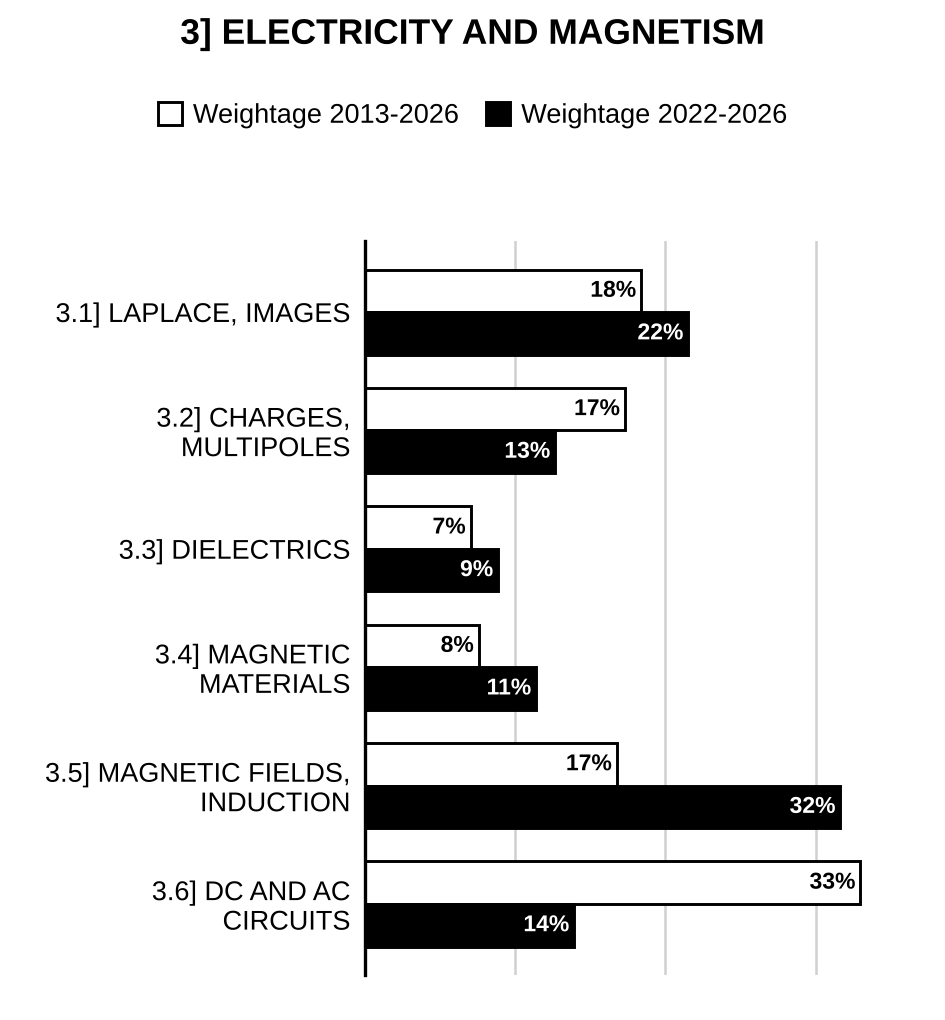
3.1] Laplace and Poisson equations, method of images
27 questions
Consider a point charge of 5 nC placed at a distance of 1 m from a perfect conducting plane () of infinite extent. Find the electric field at a point (2, 2, 0) m and show that it is normal to the plane. [2025/10m/5a]
Consider a conducting sphere of radius ‘a’ in a uniform electric field . Find the induced surface charge density on the sphere and determine the electric field at a point P characterized by radius vector . [2025/20m/7c]
In spherical coordinates, on a conductor at and on another conductor at . The space between the conductors is a dielectric for which . Find the surface charge densities on the conductors. [2024/10m/5a]
Using Maxwell’s equations, obtain Poisson’s equation and Laplace’s equation. The region has a charge density . Elsewhere the charge density is zero. Find the electric potential and electric field from the Poisson’s equation. [2024/15m/6a]
Two charges and are placed at the cartesian points m and m, respectively. The plane is connected to the ground. Calculate the electric potential and the electric field at the point (3, 2, 4) m using the method of images. [2023/15m/8b]
Starting from the Laplace’s equation in a cylindrical polar coordinate system and using the method of separation of variables, obtain the differential equations for the solutions of , and components of the potential. [2022/15m/8c]
A vertically oriented electric dipole having dipole moment is kept at height h above an infinitely large horizontal conducting plate, which is grounded as shown in the diagram. Calculate the force between the electric dipole and the conducting plate by using method of images.
[Figure: A vertical electric dipole: charge +q at the top and charge −q below it, separated by distance d (marked between them); the −q charge is at height h (arrow from −q down to the plate) above an infinite horizontal line labelled “Conducting plate”, which is connected to an earth symbol and labelled “Grounded”.] [2020/10m/5a]
Write expressions for divergence and curl of an electrostatic field. From these, obtain Poisson and Laplace equations. Two concentric conducting spherical shells having radii and () are charged to potentials and , respectively. What are the electric potential and hence electric field in the space between the shells? Also find the charge on the inner shell. [2020/15m/6a]
Starting from the expression for the electrostatic potential obtain Poisson’s equation . [Symbols have their usual meanings]. [2019/10m/150w/5a]
Two conducting planes, intersecting at right-angles to each other, are kept at a potential . Calculate the potential at a point in space if the total charge on a plane of area be Q. [2019/15m/6a]
A 0.5 m long cylindrical medium between two conducting plates has uniform charge density of 100 nC/m³. The axis of the cylindrical medium is along z-axis. The left plate is at z = 0 and has a potential of 10 kV and the right plate is grounded. Determine the electric field at axial distance z = 0.2 m. [2018/15m/8a]
A charge is placed at cm from an infinite grounded conducting plane sheet. Find the (i) total charge induced on the sheet, (ii) force on the charge q and (iii) total work required to remove the charge slowly to an infinite distance from the plane. [2017/10m/5c]
Under one-dimensional configuration, the charge density is given by ; where is a constant charge density. If the electric field at and potential at , determine V and . [2015/10m/5a]
The electric potential of a grounded conducting sphere of radius a in a uniform electric field is given as Find the surface charge distribution. [2011/10m/6d]
Obtain Poisson’s equation in electrostatics from Gauss’ law. What form does it take when the charge density is zero? [2010/10m/5a]
Derive Poisson equation starting from the Coulomb’s law for a set of point charges. [2007/20m/6a]
Obtain the solution of the Laplace equation in cylindrical coordinates. [2007/20m/6b]
Starting from Maxwell’s equation, , where D is the electric displacement density and ρ is the charge density, derive Poisson’s equation. Deduce Laplace’s equation for charge-free region from Poisson’s equation. [2006/20m/6a]
A potential in cylindrical coordinates is a function of r and ϕ but not of z. Obtain the separated differential equations for R and Φ, where and solve them. [2006/20m/6b]
Prove the relation and hence show that is a solution of the Poisson equation [2005/20m/5a]
What is the volume density of the charge in a region of space, where the electrostatic potential is given by where a, b, c are constants? [2004/20m/5a]
A point charge q is held at a distance d in front of an infinite grounded conducting plane. What is the electric potential in front of the plane? [2004/20m/6a]
Consider an infinite grounded conducting plane. If a point charge is held at a distance d from the plane, compute by method of images, the electric potential above the plane and the induced charges on the conductor. [2003/20m/6a]
What is Laplace equation? Determine the average electric potential over a spherical surface, due to a point charge q placed at a distance r from the centre of the sphere. Assume r to be greater than the radius of the sphere. [2003/30m/7a]
A conducting sphere of radius ‘a’ is placed in a uniform electric field . Using the method of images, show that the potential function is given by . [2001/20m/6c]
A potential field is given by: Find the electric field at a point (x, y, z) and the charge density in the region. [1999/20m/1a]
Determine the energy of attraction between an electric dipole and a plane conducting surface at zero potential. [1998/20m/1a]
3.2] Charges, dipoles and multipoles
27 questions
A charge of is fixed at a point. From a horizontal distance of 0.0455 m, a charged particle of mass kg and charge is fired with an initial velocity 62.5 m/s directly towards the fixed charge. How far does this charge travel before its speed becomes zero? [2026/10m/5b]
The magnitude of the average electric field normally present in the Earth’s atmosphere just above the surface of the Earth is about 150 N/C, directed radially inward, toward the centre of the Earth. What is the total net surface charge carried by the Earth? Assume the Earth to be a conductor. (The radius of the Earth is ) [2024/10m/5c]
Find the energy stored in a system of four charges , , and placed at the cartesian coordinates , , and , respectively. Assume free space. [2023/10m/5a]
A circular ring of radius R lying on the x-y plane and centred at the origin, carries a uniform line charge . Find the first three terms (monopole, dipole and quadrupole) of the multipole expansion of potential . [2023/20m/8a]
Given that the electric potential of a system of charges is volt. Calculate the electric field vector at the Cartesian point (4, 2, 3) m. [2021/10m/5a]
Given an infinite line charge of charge density parallel to the -axis and passing through the point (3, 0, 4) m and an infinite sheet of charge of charge density parallel to the – plane and passing through the point (0, 0, 6) m. Calculate the electric field intensity at the point (10, 10, 10) m. Assume free space. [2021/15m/8c]
Find the capacitance of two concentric spherical metal shells having radii a and b. [2019/10m/150w/5b]
(i) Why does a soap bubble expand upon electrification? (ii) A sphere of radius R contains a charge +Q and a charge −Q distributed uniformly in the upper and lower hemispheres respectively. Show that the dipole moment of charge distribution is , where is directed along the polar axis of the spherical coordinate system. [2017/15m/7a]
(i) Discuss briefly the features of ‘guard rings’. (ii) The plates of a capacitor are square-shaped, each of side l. The plates are inclined at an angle to each other. The smallest distance between the plates is a. Calculate the capacitance when is small. [2017/15m/7b]
With the help of a neat diagram, show that the potential due to a dipole at a point is given by , where is the dipole moment of the charge distribution, is the angle between the line joining the centre of the dipole to the point of interest and the axis of the dipole. [2016/10m/6a]
A conducting sphere of radius 5 cm has a total charge of 12 nC uniformly distributed on its surface in free space. Determine the displacement vector on its surface and outside at a distance r from the centre of the sphere. [2015/10m/5b]
Using the fundamental concepts of electromagnetism, determine the electric field of an electric dipole at a distance and its energy in an electric field . [2013/15m/6c]
ABCD is a rectangle in which charges of C, C and C are placed at corners B, C and D, respectively.
[Figure: Rectangle ABCD with A at bottom left, B at bottom right, C at top right, D at top left; AB (horizontal) = 4 cm, AD (vertical) = 3 cm.]
Calculate the potential at the corner A and the work done in carrying a charge of 2 coulombs to A. [2013/10m/6d]
Define a conservative field. Determine if the field given below is conservative in nature: where c is a constant. [2012/12m/1b]
Assume inside a perfect conductor. Elaborate on any other four electrostatic properties that arise from this property. [2012/15m/4c]
Find out the total electric potential energy of a single spherical object of uniform charge density , total charge Q and radius R. [2011/10m/5d]
Determine the torque experienced by an electric dipole of moment if placed in an electric field in nonaligned state. Also show that the interaction energy of two dipoles of moments and separated by a displacement is assuming the expression for field due to a dipole. [2011/20m/6c]
For an arbitrary localised charged distribution, obtain an expression of electrostatic potential V in terms of multipole expansion. [2009/25m/6a]
Derive approximate expressions for the potential and the radial as well as the azimuthal components of the field due to and electric dipole at points far away from it. Also derive expression and hence describe the effect of a unifrom electric field on a dipole which can rotate freely. [2005/30m/6b]
A cylinder of length L and radius b has its axis coincident with z-axis. The electric field in the region is . Find the electric flux through (i) the top circular end (ii) the bottom circular end (iii) the curved wall of the cylinder (iv) the closed surface of the cylinder. [2003/20m/5a]
Solve any three of the following: Calculate the electric field for a point on the axis of a uniform ring of a charge ‘q’ and radius a. Show that the maximum value occur at . [2002/20m/5a]
Solve any three of the following: Show that the potential energy of a charge Q uniformly distributed throughout the sphere of radius R is given by [2002/20m/5b]
A Geiger tube consists of a wire of radius 0.2 mm and length 12 cm and a co-axial metallic cylinder of radius 1.5 cm and length 12 cm. Find (i) the capacitance of the system, and (ii) the charge per unit length of the wire when the potential difference between the wire and the cylinder is 1.2 kV. (Assume the dielectric constant of the gas in the tube to be 1) [2002/20m/6b]
Calculate the electric field as a function of position due to a dipole whose potential is given by The dipole is located at the origin of the x, y axis system. [2001/20m/5d]
Using Gauss law find the electric field inside a cylindrical capacitor and hence derive the expression for its capacitance. Find the dielectric constant of the material inside a 50 mm long capacitor of capacitance 40 μF having inner conductor of radius 1 mm, outer conductor of radius 10 mm. Which of the materials has such a value of the dielectric constant? [1997/20m/1a]
An electric dipole moment, , is placed at in the electric field of another dipole moment , placed at the origin. Assuming that the electric potential, V, at due to is find the dipole-dipole interaction energy. [1996/20m/1a]
An electric dipole is placed in an external electric field. Find the interaction energy between the electric dipole and the field. And hence find the force and the torque acting on the dipole. [1995/20m/1a]
3.3] Dielectrics and polarisation
11 questions
The space between the plates of a parallel-plate capacitor is filled with a dielectric material whose susceptibility varies linearly from 0 at the bottom plate () to 1 at the top plate (). The capacitor is connected to a battery of voltage . Calculate all the bound charges and check that the total charge is zero. Assume that the battery is connected in such a way that the electric field points along the -direction while the free charge density, , is positive at the bottom plate and negative at the top plate. [2026/20m/8a]
A neutral atom consists of a point nucleus surrounded by a uniformly charged spherical cloud of radius r. Show that when such an atom is placed in a weak external electric field , the atomic polarizability of the atom is proportional to the volume of the sphere. [2023/15m/7a]
A region 1, , has a dielectric material with and a region 2, has a dielectric material with . Let the displacement vector in the region 1 be, . Assume the interface charge density is zero. Find in the region 2, the and , where is the electric polarization vector in the region 2. [2021/20m/7a]
Discuss the principle of ‘artificial dielectric’. Where do you find its use? [2017/10m/5a]
The volume between two concentric conducting spherical surfaces of radii a and b is filled with an inhomogeneous dielectric with , where c is a constant and r is the radial coordinate. A charge is placed on the inner surface, while the outer surface is grounded. Determine– in the region ;. [2012/15m/2a]
The volume between two concentric conducting spherical surfaces of radii a and b is filled with an inhomogeneous dielectric with , where c is a constant and r is the radial coordinate. A charge is placed on the inner surface, while the outer surface is grounded. Determine– capacitance of the device;. [2012/15m/2b]
The volume between two concentric conducting spherical surfaces of radii a and b is filled with an inhomogeneous dielectric with , where c is a constant and r is the radial coordinate. A charge is placed on the inner surface, while the outer surface is grounded. Determine– polarization charge density in the region ;. [2012/15m/2c]
The volume between two concentric conducting spherical surfaces of radii a and b is filled with an inhomogeneous dielectric with , where c is a constant and r is the radial coordinate. A charge is placed on the inner surface, while the outer surface is grounded. Determine– surface polarization charge densities at and . [2012/15m/2d]
What is meant by a dielectric? Define polarization vector P and relate it with the average molecular dipole moment. Obtain expression for the potential due to a polarized dielectric in terms of the polarization vector. [2010/20m/6a]
A thin dielectric cylindrical rod of cross-section A is situated along z-axis from to . The polarisation of the rod is along its length and it is given by . Calculate bound volume charge density at each end of the rod. [2009/10m/5f]
What is molecular polarizability? Derive Clausius – Mossotti equation relatig the molecular polarizability with the dielectric constant of a dielectric material. [2006/20m/5a]

Preparing for Prelims too?
Our UPSC Prelims Topic-wise PYQ eBook covers every Prelims question with detailed explanations, so you can see exactly where UPSC asks from.
View the BookDownload Free Sample3.4] Magnetostatics and magnetic materials
8 questions
Discuss the origin of hysteresis in ferromagnetic materials on the basis of domain theory. Explain how domain wall motion and pinning lead to energy loss during cyclic magnetization. [2026/20m/6a]
Consider a uniformly magnetized sphere of radius and magnetization surrounded by a vacuum region. Obtain an expression for scalar magnetic potential for . [2024/10m/6b(ii)]
A current sheet having is located at . The interface is between the region 1, , , and region 2, , . Given that . Find and . [2022/15m/7c]
Based on the hysteresis loops for soft iron and steel as shown in the diagram, which material would you prefer to utilise for making transformer cores and why?
[Figure: B–H graph (B on the vertical axis, H on the horizontal axis) showing two hysteresis loops: a tall, narrow loop labelled “Soft iron” (steep, almost vertical sides close to the B axis, small coercivity, crossing the B axis high up, high maximum B) and a shorter, wider S-shaped loop labelled “Steel” (cuts the H axis farther from the origin, i.e. larger coercivity, spread wider along H, lower maximum B); no numerical values are given.] [2020/10m/5c]
A uniformly magnetized sphere of radius R has magnetization . If the scalar magnetic potentials inside and outside the sphere are given as under and where, r, are two spherical coordinates, find the magnetic field inside and outside the sphere. [2018/15m/8b]
Consider in the region m an infinite slab made of a material with relative permeability, . If within the slab, determine magnetisation . [2009/15m/6c]
What is a magnetic shell? Define the strength of a magnetic shell. A 2 mm thick magnetic shell weighing 100 gm has magnetic moment of 1000 units. The density of the shell material is 10 gm/cc. Calculate the intensity of magnetisation and the strength of the shell. [2007/20m/6c]
Define the strength of a magnetic shell and calculate the magnetic potential at any neighbouring point due to this shell. Does the potential depend on the shape of the shell? [2004/20m/6c]
3.5] Magnetic fields and induction
27 questions
A wire of length 2 m is perpendicular to the – plane. It is moved with velocity through a region of uniform magnetic induction . Compute the potential difference induced between the ends of the wire. [2026/15m/6c]
A very long solenoid of radius , with turns per unit length, carries a current . Coaxial with the solenoid, at radius , is a circular ring of wire with resistance . When the current in the solenoid is gradually reduced, a current is induced in the ring. Calculate in terms of . Also, calculate the power dissipated through Joule effect and the electric field near the solenoid. [2026/15m/7c]
A rectangular coil consists of 50 closely wrapped turns and has dimensions of 0.5 m × 0.4 m. It carries a current of 1.5 A. If a uniform magnetic field T is applied such that the direction of the magnetic field makes an angle of 60° with respect to the plane of the coil, what is the torque exerted on the coil by the magnetic field? [2025/10m/5b]
Find the magnetic field strength () at the centre of a square current loop of side . [2024/10m/5b]
Consider a situation shown in the figure below. The wire has mass , resistance and can slide on the smooth, horizontal parallel rails separated by a distance . The resistance of rails is negligible. A uniform magnetic field exists in the rectangular region and a resistance connects the rails outside the field region. At , the wire is pushed towards right with a speed . Find (i) the current in the loop at an instant when the speed of the wire is and (ii) the acceleration of the wire at this instant:
[Figure: Two horizontal parallel rails (upper and lower). A sliding wire PQ is placed across the rails near their left end, with P on the upper rail and Q on the lower rail. A uniform magnetic field directed into the page (shown by crosses, ×) fills the rectangular region around and to the right of PQ, between and just outside the rails (five columns and four rows of crosses). At the right end, beyond the field region, a resistor R connects the upper rail to the lower rail.] [2024/20m/7c]
Derive the expression for the inductance per unit length of two long parallel wires each of radius a, separated by distance d from their axes and carrying equal and opposite current I. [2023/10m/5b]
Two inductors having inductances and are connected in parallel. The inductors have a mutual inductance M. Derive the expression for the effective inductance. Assume the inductors have negligible resistances. [2023/15m/6a]
Consider two point particles of charge each, separated by a distance , and travelling at non-relativistic velocity . If the line joining the two charges is perpendicular to , then write an expression for the magnetic force between the two particles, and illustrate the direction of the force on each particle. [2022/10m/5c]
A metal guitar string with a length of 70 cm vibrates at its fundamental frequency of 246.94 Hz in a uniform magnetic field of 10 T oriented perpendicular to the plane of vibration of the string. Assume a sinusoidal form for the amplitude of the vibrational mode, and a maximum displacement of 3 mm at the centre of the string. What is the maximum e.m.f. generated across the length of the guitar string, and at what point in time in the string’s motion does that occur? What would be the e.m.f. if the same guitar string vibrates at its second harmonic frequency? Briefly explain. [2022/20m/7a]
A rod of length is perpendicular to a uniform magnetic field . The rod revolves at an angular speed about an axis passing through one end of the rod and parallel to the magnetic field . Find the voltage induced across the rod’s ends. [2021/10m/5c]
A current carrying circular wire loop of radius 1.0 cm has a magnetic moment 2.0 mJ/T. Determine the magnetic field at an axial distance of 3.0 cm from the centre of the loop. [2018/10m/1d]
Two solenoids have 500 and 800 turns of wire and are placed co-axially close to each other. A current of 5.0 A in the first solenoid produces an average flux of 200 Wb through its each turn and a flux of 100 Wb through each turn of the second solenoid. Find the self-inductance of the first solenoid and the mutual inductance of the solenoids. [2018/10m/5b]
A long solenoid has 220 turns/cm; its diameter is 3.2 cm. Inside the solenoid at its centre, we place a 130-turn close-packed coil of diameter 2.1 cm along its axis. The current in the solenoid is increased from zero to 1.5 amperes at a steady rate over a period of 0.16 second. What is the magnitude of the induced e.m.f. that appears in the central coil when the current in the solenoid is being changed? [2011/10m/5e]
A wire of length 2 m is perpendicular to X-Y plane. It is moved with a velocity through a region of uniform induction . Compute the potential difference between the ends of the wire. [2010/10m/5b]
A long solenoid of radius R and n turns per unit length carries a sinusoidal current . Determine the magnitude of induced electric field (E) outside the solenoid. [2009/10m/5c]
State Biot-Savart law. Calculate the magnitude of axial magnetic induction due to a circular loop of area A carrying current I. [2009/20m/6b]
State Amperes law of magnetostatics. Using this law, find the magnetic field at a point due to an infinitely long filamentary current. [2007/20m/5d]
Find the magnetic field at the point P due to a short straight length of wire carrying current ‘i’. Length of the wire is l. Point P is at a distance r away from the centre of the wire. Angle between and is θ. [2006/20m/5b]
Consider two long and straight current carrying wires placed parallel to each other a certain distance apart. Derive and expression for the force per unit length experienced by these wires. Discuss that the attractive (repulsive) nature of this force is related to the directions of flow of currents in the two wires. [2005/30m/6a]
A proton, deuteron and α-particle accelerated through the same potential difference, on entering a region of uniform magnetic field applied normal to their plane of motion, move in circular orbits. Compare the radii of the orbits described by them. [2005/5m/5d(iii)]
Find out the magnetic field inside a long solenoid carrying current i and having n turns per unit length. [2004/20m/6b]
Current is flowing in a single-turn circular coil of radius 0.1 m such that at a point 5mm from the centre of the coil on the axis perpendicular to the plane of the coil the magnetic field is 0.1 mT. Find the current in the coil. Hence calculate the magnetic moment of the current carrying coil. [2000/20m/1a]
Two inductance coils having inductances and and negligible resistances are connected in parallel. The coils have a mutual inductance M. Obtain an expression for the effective inductance of the combination. [1999/30m/2b]
Two coils are connected in series and their total self inductance is 4.40 mH. When one coil is reversed, the total self-inductance is 1.60 mH. All the flux due to the first coil links the second coil, but only 40% of the flux due to the second coil links the first coil. Find the self-inductance of each of the coils and their mutual inductance. [1998/30m/3b]
A deuteron of kinetic energy 40 keV is describing a circular orbit of radius 0.6 m in a plane perpendicular to a magnetic induction . Calculate the kinetic energy of a proton that describes a circular trajectory of radius 0.8 m in the same plane with the same . [1998/20m/5b]
Calculate the magnetic moment of a coil having 100 turns, each of area carrying a current of 1 mA, flowing for 1 ms. The coil is placed in a magnetic field of 0.5 kg which is perpendicular to the magnetic moment. Calculate the torque acting on the coil and the angular momentum transferred to it. [1997/20m/1b]
Self inductance of two coils, A and B, connected in series is 25 mH or 10 mH, depending on the relative current directions in the coils. Self inductance of the isolated coil. A, is 10 mH. Calculate mutual inductance M of the pair of coils coupling factor and leakage factor. If the current in coils is changing at the rate of 1000 A/s, find the induced electromotive forces across the coil A. [1996/20m/1c]
3.6] DC and AC circuits
61 questions
Calculate the effective resistance of the following combination of resistances as shown in the figure and determine the voltage drop across each resistance when a potential difference of 120 volts is applied between points and :
[Figure: Circuit between terminals A (left) and B (right). From A the upper path goes through a parallel pair of resistors 3 Ω (upper) and 6 Ω (lower), then through 18 Ω in series, to a junction; from that junction 8 Ω leads to B. A 5 Ω resistor (lower branch) connects the node just right of A (before the 3 Ω/6 Ω pair) directly to the junction between the 18 Ω and 8 Ω resistors, i.e. 5 Ω is in parallel with the (3 Ω ∥ 6 Ω) + 18 Ω branch, and this combination is in series with 8 Ω.] [2026/10m/5a]
State and explain Kirchhoff’s current law and Kirchhoff’s voltage law. Derive these laws from the principles of charge conservation and energy conservation. [2025/10m/5c]
As shown in the figure, a series circuit connected across a 200 V, 60 Hz line consists of a capacitor of capacitive reactance of 30 Ω, a non-inductive resistor of 44 Ω and a coil of inductive reactance 90 Ω and resistance 36 Ω. Determine: (i) Power factor of the circuit (ii) Power absorbed by the circuit (iii) Power dissipated in the coil.
[Figure: Series loop: AC source (200 V, 60 Hz) on the left side; along the top a capacitor = 30 Ω; on the right side a resistor = 44 Ω; along the bottom a coil labelled “Coil with = 90 Ω, = 36 Ω”, closing the loop back to the source.] [2025/15m/6b]
A cell of internal resistance 1 ohm, 1.5 volt e.m.f. and another cell of internal resistance 2 ohm, 2 volt e.m.f. are connected in parallel across the ends of an external resistance of 5 ohm. Find the current in each branch of the circuit. [2022/10m/5d]
Consider the –– circuit shown here. Calculate the -factor of the circuit. Does the circuit have a resonant frequency? Justify your answer:
[Figure: Circuit with three parallel vertical branches between a top wire and a bottom wire: left branch – a 4 V battery; middle branch – a 1 mH inductor in series with a 4 Ω resistor; right branch – a 2 mF capacitor. A key (switch) K is in the top wire between the battery branch and the junction of the inductor–resistor and capacitor branches.] [2022/10m/5e]
Consider the two branch parallel circuit shown in the diagram. Determine the resonant frequency of the circuit.
[Figure: Two-branch parallel circuit between a pair of input terminals (top and bottom, shown as open circles on the left): left branch – resistor in series with inductor ; right branch – resistor in series with capacitor .] [2021/10m/5e]
In the given circuit, , , and V. Find the amount of heat generated in the coil after the switch is disconnected. The internal resistance of the source is negligible.
[Figure: Three parallel branches between two vertical connecting wires: top branch – the coil (inductance L with resistance R, labelled “L, R”); middle branch – resistor ; bottom branch – switch S in series with the source (battery) E.] [2021/10m/6b]
Describe the oscillations of electric and magnetic fields in an ideal LC circuit. The applied voltage phasor in a circuit is volt and resulting current phasor is ampere. Draw the phasor diagram. Determine the impedance of the circuit and indicate whether it is inductive or capacitive in nature. Also find the power dissipation in the circuit. [2020/15m/6b]
A resistor is connected in series with a capacitor of and a battery with emf 12.0 V. Before the switch is closed at time , the capacitor is uncharged. Calculate the following: (i) The time constant. (ii) What fraction of the final charge is on the plates at the time seconds? (iii) What fraction of the initial current remains at the time seconds? Consider that the internal resistance of the battery is zero and neglect the resistance of all the connecting wires. [2020/15m/8c]
Why do we prefer to work with a critically damped ballistic galvanometer in a laboratory? What is external critical damping resistance? [2019/10m/150w/1c]
Three cells are connected in parallel with similar poles connected together with wires having negligible resistance. The emfs of the cells are 2, 1 and 4 volts respectively and the corresponding internal resistances are 4, 3 and 2 ohms. Calculate the current flowing through the 4 V cell. [2019/15m/6b]
A 12.0 V battery is connected at t = 0 to a series combination of a resistor and an inductor L = 5.0 H. At what rate is energy being stored in the inductor when the current in the circuit is 0.4 A? [2018/10m/5a]
How large an inductance needs to be connected in series with a 120 V, 60 W lightbulb if it is to operate normally when the combination is connected across a 240 V, 60 Hz supply? [2017/10m/5b]
When a person carrying something metallic walks through the doorway of a metal detector, it emits a sound. Explain the reason behind it. A 200 resistor and a 15 F capacitor are connected in series to 220 V, 50 Hz a.c. supply. Calculate the current in the circuit and the r.m.s. voltage across the resistor and the capacitor. Is the algebraic sum of these voltages more than the supply voltage? If yes, resolve the paradox. [2017/15m/6a]
A current charges up a 120 nF capacitor for a period of 2 seconds. If the final voltage across the capacitor is 15 V, what was the initial voltage across it? [2017/10m/6d]
In the circuit diagram shown below, the voltmeter reads 50 volts when it is connected across the 400 Ω resistance. Calculate what the same voltmeter will read when connected across the 300 Ω resistance.
[Figure: A 400 Ω resistor and a 300 Ω resistor connected in series; a 100 volts supply is connected across the series combination (terminals shown on the lower wire); a voltmeter V is connected across the 400 Ω resistor only.] [2016/10m/5a]
An alternating current varying sinusoidally with a frequency of 50 Hz has an r.m.s. value of 40 A. Find the instantaneous value of the current at 0.00125 second after passing through maximum positive value. [2016/10m/6b]
A series RLC circuit has a resistance of 100 Ω and an impedance of 210 Ω. If this circuit is connected to an a.c. source with an r.m.s. voltage of 220 V, how much is the average power dissipated in the circuit? [2015/10m/5c]
A series RLC circuit has . The energy stored in the circuit decreases by 1% per period of oscillation. Its natural undamped frequency is 2 kHz. Determine the values of inductor L and the quality factor. [2015/15m/7b]
In the circuit given below, find the values of currents , and I.
[Figure: A two-loop d.c. network with three vertical branches between a top wire and a bottom wire. Left branch (top to bottom): 6 Ω resistor, then a 12 V battery (long plate, i.e. positive terminal, on the upper side). Middle branch (top to bottom): a 3 V battery (long plate, i.e. positive terminal, on the upper side), then plain wire; current I is marked by an upward arrow in this branch. Right branch: 5 Ω resistor. Top wire: from the top-left corner a 9 Ω resistor runs to the top of the middle branch; from there a 6 V battery (long plate, i.e. positive terminal, on the left side, towards the middle branch) runs to the top-right corner. Bottom wire: current is marked by an arrow pointing left (from the bottom of the middle branch towards the left branch) and current by an arrow pointing right (towards the right branch).] [2015/15m/8a]
For initial current conditions and at t = 0, show that the time dependent current in the critical damping case for an LCR circuit is given by where , , and . [2014/20m/6b]
When connected in series, , have the same resonant frequency as , also connected in series. Prove that if all these circuit elements are connected in series, the new circuit will have the same resonant frequency as either of the circuits first mentioned. [2014/15m/7c]
In the circuit diagram shown below, calculate the current passing through the milliammeter.
[Figure: Circuit with four corner nodes: S (top left), R (top right), Q (bottom right), P (bottom left). Branch P–S (left side): a 5 V cell, longer (positive) plate on the P side, shorter plate on the S side; arrow pointing upward from P towards S. Branch S–R (top): 200 Ω resistor; current I – I₁ marked with arrow from S towards R. Branch R–Q (right side): 60 Ω resistor; current I marked with arrow from R down towards Q. Branch Q–P (bottom): a 4 V cell, longer (positive) plate on the P side, shorter plate on the Q side; current I marked with arrow from Q towards P. Diagonal branch P–R: milliammeter (mA) of resistance 20 Ω; current I₁ marked with arrow from P towards R.] [2013/10m/5a]
Consider the equation for a series RLC circuit and compare this to the parallel resonant circuit shown below:
[Figure: Parallel resonant circuit of three vertical branches connected between a common top wire and a common bottom wire: left branch a capacitor C, middle branch a resistor , right branch an inductor L. Mesh current is marked above the left mesh (C–) and mesh current above the right mesh (–L); a curved arrow in each mesh indicates the circulating current (left mesh clockwise, right mesh anticlockwise).]
Calculate the value of if a series RLC circuit and the parallel RLC circuit are to have same equations for the potential of capacitance while they both have the same L, C and Q with Q being the total charge. [2013/10m/5b]
A series LCR circuit has resonant frequency and a large quality factor Q. Write down in terms of R, , and Q, its (i) impedance at resonance, (ii) impedance at half-power points and (iii) the approximate forms of its impedance at low and high frequencies. [2013/15m/6a]
A resistance R and a lossless capacitor C are connected through a switch. The capacitor is charged to potential , and the switch is closed at . Prove that the energy stored in the capacitor is equal to the energy dissipated in the resistor. [2012/12m/1d]
Find whether the discharge of a condenser through the inductive circuit is oscillatory when , and . If it is oscillatory, calculate its frequency. [2011/10m/5a]
The four arms of a Wheatstone bridge have the following resistances: A galvanometer of resistance is connected across BD. Calculate the current through the galvanometer when a potential difference of 10 volts is maintained across AC. [2011/10m/5b]
An electrical circuit consists of a resistance R, inductance L and capacitance C in series. If a charge is put on the capacitor at some instant, determine the condition that , the voltage across the capacitor, is subsequently oscillatory. Derive an expression for the quality factor Q of the circuit by considering the decay of the oscillation, using the result that the amplitude falls by a factor of e in period. [2011/20m/6a]
A resistor and a capacitor are connected in series and a 12 V battery of negligible internal resistance is connected across their combination. (i) What is the capacitive time constant of this circuit? (ii) At what time, after the battery is connected, does the potential difference across the capacitor become 5.6 V? [2011/10m/6b]
What happens if the primary winding of a transformer is connected to a battery? [2010/10m/5c]
Discuss the growth of current when an e.m.f. is suddenly applied to a circuit containing resistance, inductance and capacitance in series. What is the time constant of the circuit? [2010/20m/6b]
A series circuit has an inductance of 200 microhenries, a capacitance of 0.0005 microfarad and a resistance of 10 ohms. Find the resonant frequency and quality factor of the circuit. [2010/20m/6c]
A series R-L-C circuit is connected across a voltage source . If , and , calculate the average power delivered to the circuit. [2009/10m/5d]
In an ac. circuit, a resistance () and a capacitance () in series are connected to an a.c. source . Calculate the current through the circuit and the voltages across R and C. Draw a vector diagram representing the magnitudes and phases of the voltages. [2007/20m/5c]
A network PQRS is connected as shown in the figure below. Apply Kirchhoff’s law and show that the current flowing through the 20 Ω resistor PR is 0.029 A.
[Figure: Rectangle with corners S (top left), R (top right), Q (bottom right), P (bottom left). Side SR: 200 Ω resistor. Side RQ: 60 Ω resistor. Side QP: 4 V cell. Side PS: 5 V cell. Diagonal PR: 20 Ω resistor. For both cells the longer (positive) plate is drawn on the side towards P.] [2004/20m/5b]
A bridge network with resistance, capacitance and inductance is given in the above figure. Show that the conditions for balancing the bridge are independent of the frequency of applied voltage.
[Figure: Printed before the text: a four-arm bridge drawn as a diamond. Upper-left arm: an inductor labelled in series with a resistor , from the left node to the top node; upper-right arm: resistor , from the top node to the right node; lower-left arm: capacitor , from the left node to the bottom node; lower-right arm: capacitor , from the bottom node to the right node. A detector (labelled “Detector”) is connected between the top and bottom nodes. An a.c. source (circle with ~) is connected through the outer rectangular loop between the left and right nodes. No component values are given.] [2003/20m/5b]
A parallel LC circuit is operated at a frequency ω, which is less than the resonant frequency of the LC circuit. Explain whether the reactance is inductive or capacitative.
[Figure: Printed before the text: an inductor L (top branch) and a capacitor C (middle branch) connected in parallel between two vertical side wires, fed by an a.c. source (circle with ~) in the bottom branch.] [2003/20m/6c]
Using Kirchoff’s laws find currents in each branch of the circuit shown in the following diagram.
[Figure: Two-loop circuit with nodes a (top left), b (top middle), c (top right), d (bottom right), e (bottom middle), f (bottom left). Branch a–b: 12 Ω resistor. Branch b–c: 8 Ω resistor. Left branch f–a: 18 V cell, positive (longer) plate towards a (marked +), negative towards f. Middle branch b–e: 6 Ω resistor. Right branch c–d: 21 V cell, shorter plate towards c and longer plate towards d. Bottom wire f–e plain; between e and d a 3 Ω resistor (upper) in parallel with a 6 Ω resistor (lower).] [2002/20m/6a]
A series LCR circuit with L = 2 H, C = 2 μF and R = 20 Ω is powered by a source of 100 volts and variable frequency. Find (i) the resonance frequency, , (ii) the value of Q (iii) the width of resonance and (iv) the maximum current at resonance. [2002/20m/6c]
What value of inductance has to be used so that a lamp with rating of 200 volt and 10 Amperes lights the same way with 250 V source at 50 Hz. [2001/20m/5a]
An inductance is connected to 6 volt [?] battery through a resistance R. What is the steady state current in the circuit? After what time the battery would be delivering one half its steady state current? [2001/20m/6a]
Explain the use of a parallel resonance circuit (i) as a rejector circuit (ii) for current amplification. [2001/20m/6b]
For an R-L- C series resonant circuit, show that , where is the resonance frequency and , and are the half-power frequencies. Is this relation true for a parallel resonance circuit in which R, L and C are connected in parallel to each other? Explain. [2000/20m/1b]
A series R-L circuit has a constant d.c. voltage V applied at the time t = 0 by closing a switch. Derive an expression for the current in the circuit. [2000/15m/2a]
A series R-L circuit has a constant d.c. voltage V applied at the time t = 0 by closing a switch. Calculate the voltage drops across R and across L. [2000/10m/2b]
A series R-L circuit has a constant d.c. voltage V applied at the time t = 0 by closing a switch. At what time are these voltage drops equal? [2000/10m/2c]
A series R-L circuit has a constant d.c. voltage V applied at the time t = 0 by closing a switch. Find the power dissipated by R and power stored in L. [2000/10m/2d]
A series R-L circuit has a constant d.c. voltage V applied at the time t = 0 by closing a switch. Show that the steady-state energy is stored in the magnetic field. [2000/15m/2e]
In the given circuit the output voltage at time t second after closing the key K is 1 volt. Calculate the rate of change of current in the inductance coil at this moment.
[Figure: Circuit: a 2 V battery on the left side; from its top terminal the top wire runs through key K (open switch) and a 1 Ω resistor to a top rail. Between the top rail and the bottom (return) wire are connected in parallel: a vertical branch containing a 2 Ω resistor, and a second vertical branch containing a 1 Ω resistor in series with a 0.5 H inductance coil (resistor above, coil below). The output voltage is taken between two terminals at the right-hand ends of the top rail and the bottom wire, i.e. across the parallel combination (across the 2 Ω resistor and across the 1 Ω + 0.5 H branch).] [1999/20m/1b]
An L–C–R circuit has a resistance of 100 ohms, a capacitance of 0.2 μF and an inductance of 5 H. An ac source E = 50 sin (1000 t) volt is connected in the circuit. Calculate the average power dissipated. [1999/20m/1c]
In a series L–C–R circuit connected to an alternating constant voltage source the current amplitude is (1/n) times the amplitude at resonance at frequencies and . Obtain an expression for its quality factor at resonant frequency. [1999/30m/2a]
A series LCR circuit has L = 20 mH, C = 0.5 μF and R = 10 Ω. The circuit is driven by an alternating emf with amplitude 200 V. Calculate (i) resonance frequency (ii) the current at resonance frequency (iii) Q value and (iv) half width of the resonance current. [1998/20m/1c]
A potential difference with a frequency of 50 cycles per second is applied to a coil of resistance 1 k ohms and inductance 2H. Calculate the power factor of the circuits. [1998/20m/1b]
Define quality factor for an A.C. circuit and discuss the meaning of electrical resonance in a series LCR circuit. Explain the term sharpness of resonance. [1998/30m/3a]
An alternating voltage, is applied to a series RL circuit through a switch. Find the sum total of the transient and steady currents. Find the conditions when transient current becomes (i) zero, and (ii) maximum. [1997/30m/2a]
The self inductance of primary and secondary coils of a R.F. transformer is 10 mH each. When the coils are connected in series self resonating frequencies are 132.6 kHz and 108.3 kHz. Calculate the mutual inductance between the coils and the winding capacitance. [1997/30m/2b]
A relay has a coil resistance of 10 Ω and inductance of 1 H. It is energized by a single voltage pulse of 10 V which remains constant for 250 ms and then falls to 0 V. Relay contact closes when the increasing current reaches 200 mA and opens when the decreasing current is at 100 mA. Calculate the time for which the relay contact is closed. [1996/30m/2a]
An alternating voltage is applied to the circuit shown in Fig. 1. Show that it has two resonant frequencies, and interrelated as Where
[Figure: Fig. 1 – An AC source (~) connected across two parallel branches: branch 1 is an inductor L in series with a capacitor ; branch 2 is a capacitor alone. The two branches join at a common top node (connected to one terminal of the source) and a common bottom node (connected to the other terminal of the source), and the bottom node is earthed. No component values are given.] [1996/30m/2b]
An alternating voltage is applied to CR circuit connected in series. Under what conditions it acts as an (i) integrator and (ii) a differentiator? [1995/30m/2a]
An alternating voltage of varying frequency is applied across a two-branch parallel circuit of and L in series and and C in series as shown in Fig. below.
[Figure: An AC source connected across two parallel branches: the first branch is resistor in series with inductor L; the second branch is resistor in series with capacitor C. The two branches are joined at a common top node and a common bottom node, which connect to the two terminals of the source. No component values are given.]
Find its resonant frequency. If and are not zero, state the conditions when the resonant frequency is given by [1995/30m/2b]

Strengthen your GS papers
Our UPSC Mains Topic-wise & Year-wise PYQ eBook (2013–2026) maps every GS question to the syllabus, so you know what UPSC asks and how often.
View the BookDownload Free Sample« Previous: Waves and Optics | Next: Electromagnetic Waves and Blackbody Radiation »
Back to: Physics Optional PYQs – Topic-wise
Last updated: 30 October 2026