
Economics Optional PYQs Topic-wise for UPSC Mains (2004–2026) are listed below unit by unit, in the order of the official syllabus – 1067 questions in all. Click any unit to open all its previous year questions, arranged topic-wise with the latest first.
Want full papers instead? Open the Economics Optional year-wise question papers for Paper I and Paper II.
Paper I
| Unit | Topic (click to open PYQs) | Sub-topics | Questions | Link |
|---|---|---|---|---|
| 1 | Advanced Micro Economics | 4 | 100 | Click here → |
| 2 | Advanced Macro Economics | 4 | 91 | Click here → |
| 3 | Money-Banking and Finance | 5 | 93 | Click here → |
| 4 | International Economics | 8 | 120 | Click here → |
| 5 | Growth and Development | 7 | 134 | Click here → |
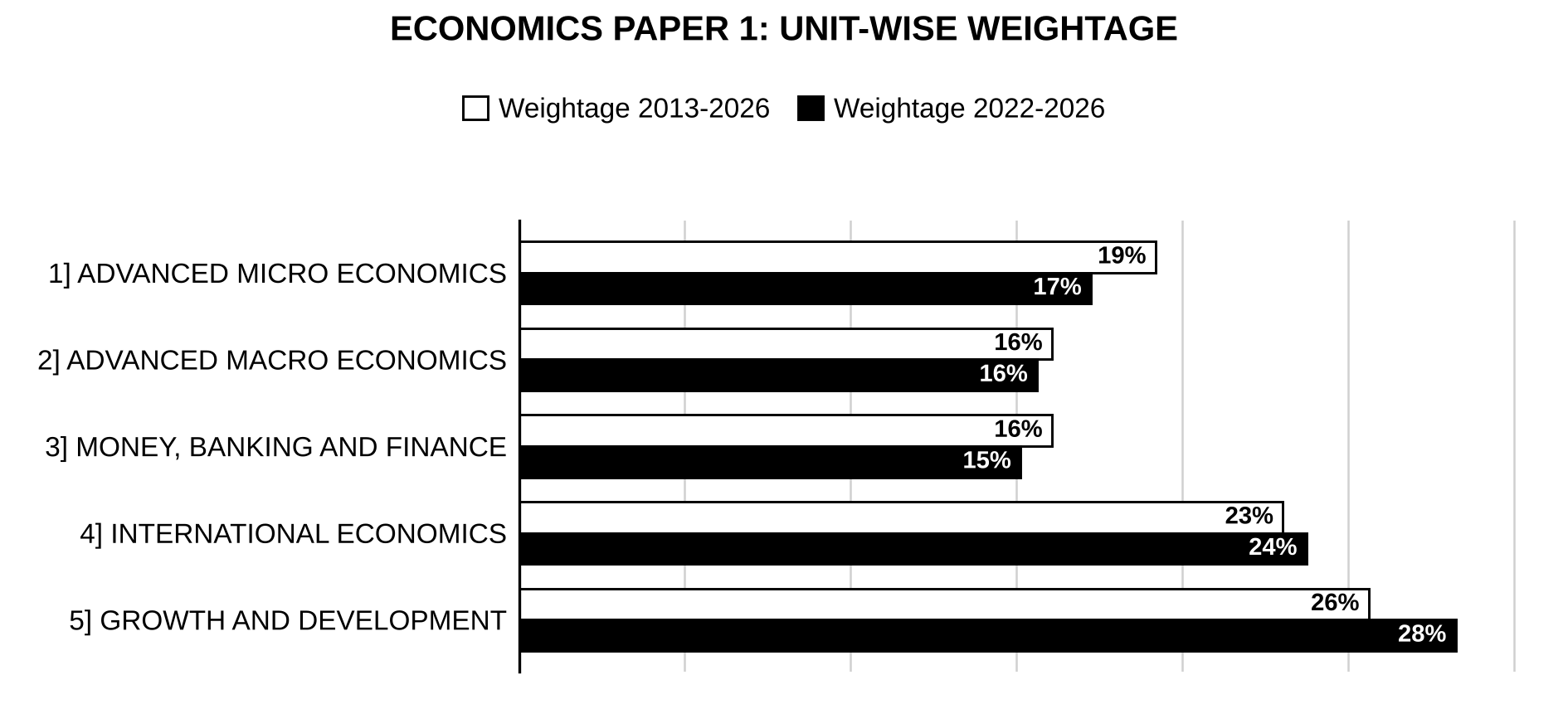
Trend: Paper I is spread fairly evenly across its five units. Growth and development (unit 5) carries the most marks – about a quarter since 2013 and a little more in the last five years – led by theories of growth and environment and sustainability, with welfare indicators rising sharply in recent papers. International economics (unit 4) follows with about 23%, where trade theories and tariffs have gained and the open-economy (Mundell–Fleming) model has declined. Micro economics (unit 1, about a fifth) is dominated by market structure – oligopoly, duopoly and game theory. In macro economics (unit 2) the Keynesian and IS-LM questions dominate, while new classical questions have fallen; in money, banking and finance (unit 3) the demand for and supply of money is the most-asked topic.

Preparing for Prelims too?
Our UPSC Prelims Topic-wise PYQ eBook covers every Prelims question with detailed explanations, so you can see exactly where UPSC asks from.
View the BookDownload Free SamplePaper II
| Unit | Topic (click to open PYQs) | Sub-topics | Questions | Link |
|---|---|---|---|---|
| 1 | Indian Economy in Pre-Independence Era | 4 | 64 | Click here → |
| 2 | Indian Economy after Independence: A. The Pre-Liberalization Era | 5 | 157 | Click here → |
| 3 | Indian Economy after Independence: B. The Post Liberalization Era | 8 | 308 | Click here → |
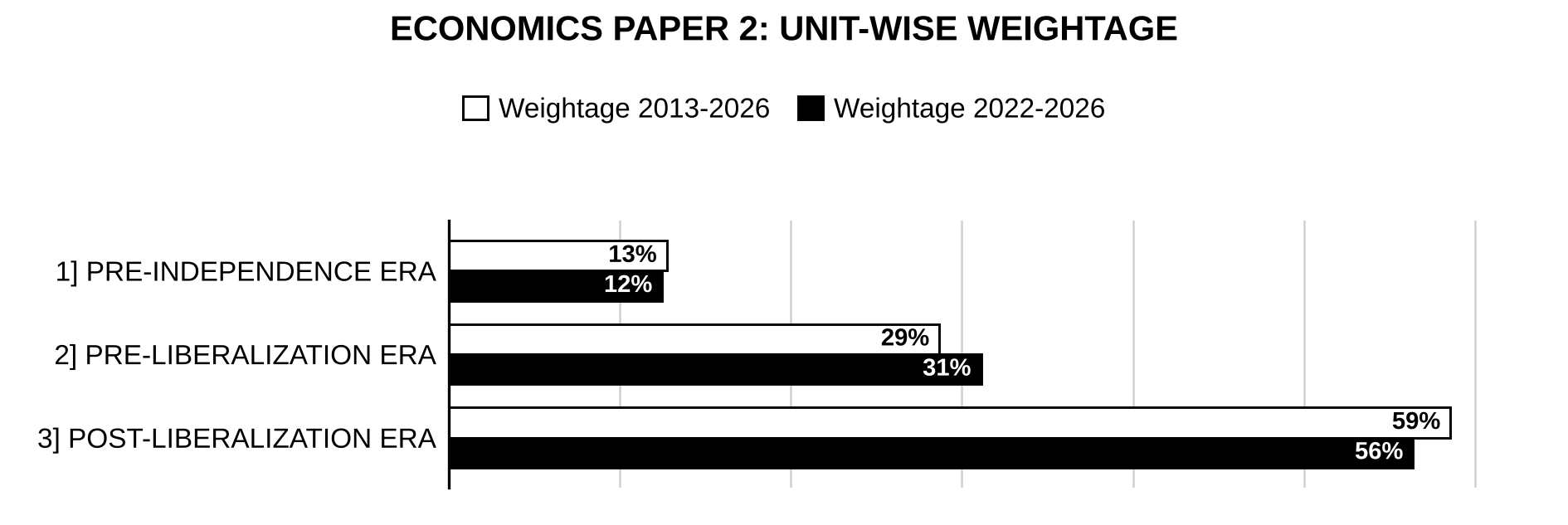
Trend: Paper II is weighted heavily towards the post-liberalization era (unit 3), which carries well over half the marks, led by agriculture, industry and employment and poverty programmes. The pre-liberalization era (unit 2) carries about 30% and has gained slightly in the last five years; within it, poverty and inequality remain the largest topic but have declined, while agriculture and industry have risen. The pre-independence era (unit 1) steadily carries about an eighth of the marks, mostly on manufacture and de-industrialisation, the drain theory and colonial land systems.
More questions
Other questions (outside the present syllabus) – 6 questions
How this collection is organised
Considering the changing exam pattern over two decades, we felt it necessary to declare some practices we’ve adopted in this collection.
Units and topics follow the official syllabus. Paper 1 units are numbered as in the notification; Paper 2’s three parts (pre-independence era, pre-liberalization era and post-liberalization era) are numbered 1 to 3. Where the notification numbers its own items (Paper 1 – 1.1 to 1.4; Paper 2 – 2.1 to 2.5 and 3.1 to 3.8), the topic numbers follow them; elsewhere the official text is divided into topics numbered in the same style (for example Paper 1 – 4.8 WTO). Where a unit has many questions, they are further divided by these topics.
The syllabus names only a few areas of micro and macro economics, while UPSC asks widely around them. Such questions are placed under the nearest topic: for example, consumer theory, production and costs under price determination (1.1); game theory and pricing under market structure (1.3); consumption and investment theories and the multiplier under Keynes and IS-LM (2.2); the Phillips curve and rational expectations under new classical economics (2.3); and exchange rate theories under balance of payments adjustment (4.4). In Paper 2, current issues are placed under the post-liberalization topic they concern (for example GST under public finance, inflation targeting and banking under the monetary system, and MGNREGA under employment).
Some questions cover more than one topic. We’ve kept such questions in each topic of relevance. A few questions fit no topic of their paper’s present syllabus; they are kept under “Other Questions (Outside the Present Syllabus)” at the end of the paper concerned.
Graphs at the start of each paper show the weightage of every unit in that paper, and graphs for each unit show the weightage of its topics. Weightage is the share of marks asked from a unit or topic, compared for 2013–2026 (white bars) and the last five years, 2022–2026 (black bars). A question placed under two topics has its marks split equally between them.
Each of the topicwise question is suffixed by a question code like this [2024/10m/150w/5e]. This code indicates a) year in which the question was asked, b) maximum marks the question carried, c) prescribed word limit and, d) the question number in actual paper, in given order. Where UPSC prescribed no word limit, that field is skipped.
Until 2012, each paper carried 300 marks (60 per question); since 2013 each paper carries 250 marks (50 per question). Where a question offered more parts than were to be answered (for example “answer any three” of four parts, up to 2009), every part is included with its own marks.
No complete question paper could be found for 1995–2003, 2006 and 2008, so those years are not included. The 2004, 2005 and 2007 papers are taken from retyped copies, as no scan of them is available; all other years are transcribed from scans of the printed papers.
The wording of the questions is as printed, including the papers’ own grammar; equations are set as Word equations.
Spotted an error? Use the “Report an Error” box at the end of any page – we review every report and update the page.

Strengthen your GS papers
Our UPSC Mains Topic-wise & Year-wise PYQ eBook (2013–2026) maps every GS question to the syllabus, so you know what UPSC asks and how often.
View the BookDownload Free SampleLast updated: 30 October 2026