
Here are all 100 Advanced Micro Economics questions asked in UPSC Economics Optional Paper I from 2004 to 2026, arranged under the 4 topics of the official syllabus. Within each topic the latest questions come first.
Each question ends with a code such as [2024/15m/3b] – the year, the marks, the word limit (where UPSC set one) and the question number in the paper.
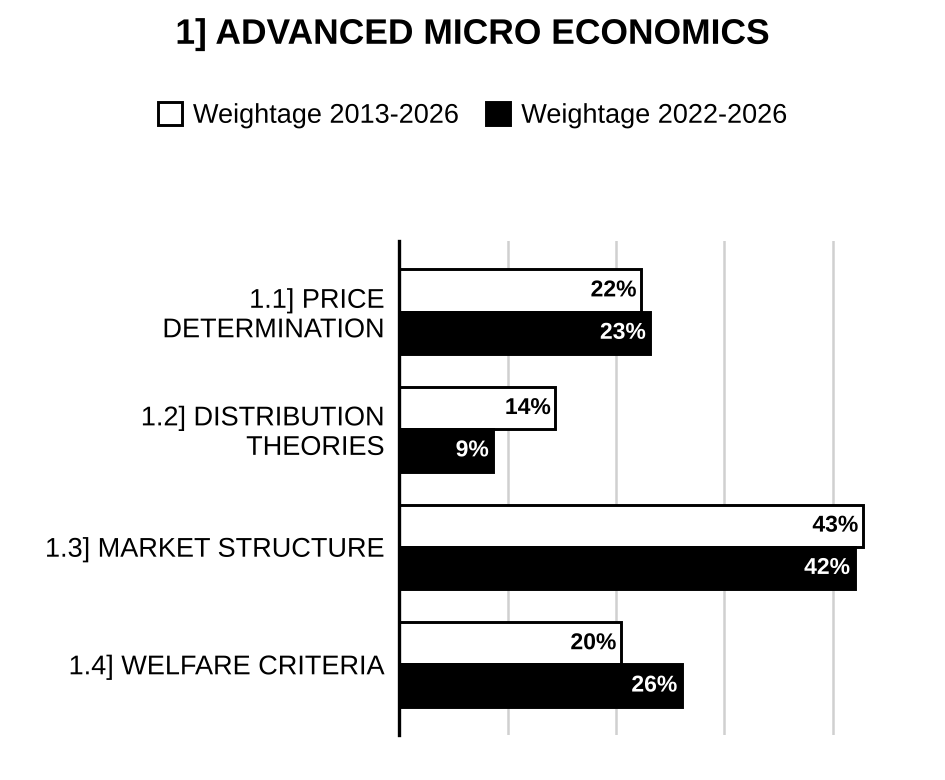
1.1] Marshallian and Walrasian approaches to price determination
21 questions
Under what conditions, does a market reach equilibrium? Analyse the differences in stability between Marshallian and Walrasian approaches. [2026/20m/2a]
Show that when prices and income increase in the same proportion, there will be no change in quantity demanded for a commodity in Marshallian approach. [2025/10m/150w/1a]
Derive Marshallian demand curve for an inferior good in a two-commodity framework by using income and substitution effects. Is this demand curve always negatively sloped? Explain. [2025/20m/2a]
Write down the behavioural assumptions used in Marshallian and Walrasian approaches of market stability. Show that these two approaches become conflicting when both the demand and supply curves are positively sloped. [2024/15m/2b]
“Perfect competition is incompatible with increasing returns to scale.” Examine the statement. [2023/15m/2b]
Compare and contrast Marshallian and Walrasian approaches of the stability in equilibrium. [2021/10m/150w/1a]
Under competition, the cost function is given as , where is output. Derive the inverse supply curve and show how the supply curve looks like. [2019/10m/150w/1a]
How is the Marshallian equilibrium different from Walrasian equilibrium? [2019/15m/6a]
Derive the expansion path for a firm operating with the Cobb-Douglas Production Function. [2017/10m/150w/1a]
State Marshallian and Walrasian stability condition of market equilibrium. Do you think that existence of Marshallian stability necessarily ensures Walrasian stability and vice versa? Explain. [2016/10m/150w/1a]
What is a Lemon Market? What is the role of signalling and screening in it? Explain. [2016/15m/3c]
What is asymmetric information? How could it lead to adverse selection and market failure? Discuss. [2016/20m/4a]
Under perfect competition, in the short run, find out graphically, without using average cost curve, the conditions in equilibrium for the existence of (i) normal profit, (ii) supernormal profit and (iii) loss. [2015/10m/150w/1b]
Examine the relationship between own and cross price elasticities for a compensated demand function. [2014/10m/150w/1a]
What do you mean by existence and uniqueness of equilibrium in a market? Examine these concepts in a market where both demand and supply curves are downward sloping. [2014/10m/150w/1d]
Discuss the cobweb model of dynamic equilibrium with lagged adjustment. Explain how the existence of a stable equilibrium depends on the nature of the demand and supply curves. [2014/20m/2a]
“The conventional analysis of profit maximisation breaks down if the entrepreneur sells his output and possesses a production function which is homogenous of degree one.” Explain. [2014/10m/3c]
Consider a perfectly competitive exchange economy with no production, and two different goods 1 and 2. Let and be the prices of the goods. The economy is populated by two people A and B. A’s initial endowment of the two goods is given by , and B’s initial endowment is . A can choose any bundle and B can choose any bundle . In this pure exchange economy write out the conditions for a Walrasian equilibrium. Show that for such an economy for any equilibrium set of prices that the absolute price level is indeterminate. [2013/10m/150w/1a]
“Validity of Marshall’s equi marginal utility depends on the assumption of unitary elasticity of the marginal utility curves of the commodities under the budget.” Clearly explain this assertion. [2012/12m/150w/1a]
Derive Marshall’s welfare economics from his concept of consumer surplus after explaining consumer’s surplus along with the underlying assumptions. [2012/12m/150w/5b]
State and explain the Law of Equi-marginal Utility and also state clearly the limitations of this law. [2010/20m/200w/2c]
1.2] Alternative distribution theories
18 questions
According to Michal Kalecki, how the degree of monopoly and the level of investment interact to determine the functional distribution of income between wages and profits? [2026/10m/150w/1a]
Explain the backward bending supply curve of labour as a choice between income and leisure. [2023/10m/150w/1b]
Stating major assumptions in the Kaldor model of disbribution, establish that share of profits in national income depends on the ratio of investment to total output. [2022/10m/150w/5a]
Examine how profit, wage and rent in Ricardian system move differently with the movements in level of income. [2021/20m/2c]
Briefly state the Kaldor’s theory of distribution in determining the share of profit and the share of wages in national income. Explain the mechanism behind Kaldor’s model. [2020/15m/4b]
Give an outline of Kaldor’s theory of distribution. Also explain the implications of an increase in the wage level and a reduction in the saving rate on the distribution of income. [2018/20m/2c]
Examine Kaldor and Kalecki theory of distribution. [2016/10m/150w/1e]
Explain the backward sloping supply curve of labour as a choice between income and leisure. [2015/10m/150w/1a]
In what way Kaldor’s model of income distribution is basically a Keynesian theory? [2015/20m/2a]
Examine the process of reaching the Ricardian steady state. How can the tendency towards steady state be countered? [2014/20m/3b]
Kaldor in his theory of distribution argues, unlike Kalecki, that it is not reasonable to neglect the constraint of labour shortage, and analyse a situation of full employment. Show how investment and savings propensities determine distributive shares in the Kaldor approach. Suppose that investment is not exogenous as in Kaldor’s original model but that it varies with profits. What does this mean for the stability of the Kaldor model of distribution? [2013/10m/150w/1b]
Is rent a surplus? Give reasons in support of your assertion and point out the difference between ‘rent’ and ‘quasi-rent’. [2012/20m/2c]
Examine Kalecki’s model of distribution. Do you consider it a correct explanation of distribution? [2012/20m/8c]
Elucidate how does Kalecki’s theory of distribution share the value of output between labour and capital. [2011/20m/200w/1a]
State and explain the theory of distribution in which the exhaustion of the total product is taken care of without leaving any residual claimant and also state clearly the assumptions necessary for the success of the theory. [2010/20m/200w/1b]
What is the backward rising input supply curve? Illustrate with the help of suitable example. [2007/20m/200w/1a]
“Marginal Productivity Theory of Income Distribution is analytically sound but in real life equally inapplicable.” Discuss this statement. [2005/60m/4]
Show that the exponents of the Cobb-Douglas production function are a measure of the factor share in output as well as the elasticity of output with respect to the factor. [2004/20m/200w/1a]

Preparing for Prelims too?
Our UPSC Prelims Topic-wise PYQ eBook covers every Prelims question with detailed explanations, so you can see exactly where UPSC asks from.
View the BookDownload Free Sample1.3] Market structure
40 questions
The following data are given for a duopoly market: , , . Suppose the duopolists recognise the mutual interdependence and decide to act as one group to maximize the total profit of the industry. Find out , , and the profits of the firms denoted as & . [2026/15m/2c]
Consider a firm in a Duopoly market with product differentiation in which, Duopolist I faces a demand function given by: The cost function of Duopolist I is: Assume that Duopolist II has rd share of the whole market. Find out optimal price, output and profit for Duopolist I. Also find out the output of Duopolist II. [2025/15m/2b]
Differentiate between perceived demand curve and proportional demand curve in a monopolistic competitive market. Explain why the proportional demand curve is steeper than the perceived demand curve. [2024/10m/150w/1a]
Describe the short-run and long-run equilibrium of a firm under monopolistic competition. [2024/15m/2c]
Examine the role of price elasticity of demand in determining the price set by a discriminating monopolist. [2023/10m/150w/1a]
Explain the Cournot model of duopoly using reaction functions and interpret it as a Nash equilibrium. [2023/20m/2a]
Describe a model of oligopoly that explains price stickiness. [2023/15m/2c]
Explain briefly Chamberlin’s concept of excess capacity in monopolistic competition. [2022/10m/150w/1a]
Consider a duopoly market, , and where : Market price; : Total output or the sum total of both firms’ output; & : Firm 1 and Firm 2’s output respectively; : Marginal cost. Suppose Firm 1 is the market leader and Firm 2 is the follower. Firm 1 decides its output first and then Firm 2 takes its output decision. Find equilibrium output, price and profit of both the firms. [2022/20m/2a]
Do you think Firm 1 would have had the first mover advantage if it had gone for the price adjustment? Explain your answer. [2022/15m/2b]
Explain the differences between Cournot model of duopoly with similar product and differentiated product. [2021/15m/2a]
What type of conjecture is involved in the existence of kinked demand curve? Do you think that kinked demand curve model is a price determination model in an oligopoly market? Justify your answer. [2021/15m/2b]
What is conjectural variation? Show how some models of oligopoly are derived on the basis of it. [2020/15m/2a]
Suppose that we have only two firms in the market with constant marginal costs of and respectively such that . What is the Bertrand equilibrium in this market? How is it different from the competitive equilibrium? [2020/15m/3a]
Two firms produce homogeneous outputs with cost functions , and the inverse market demand function . Show that at the Cournot-Nash equilibrium, firm 2 makes higher profit than at the joint profit maximizing equilibrium. Explain why this is so. [2020/20m/7c]
What determines the degree of price discrimination under monopoly market? [2019/10m/150w/1b]
Reflect on the inefficiency and socially undesirable aspects of monopolistic competition market situation vis-à-vis the perfect competition, both in the short and in the long run. [2019/20m/3c]
What is the follower’s problem in a duopoly model and how does it differ from the leader’s problem? [2019/15m/4a]
Does a monopolistically competitive market lead to excess capacity under price competition? [2018/10m/150w/1a]
Explain some of the measures for assessing the monopoly power of a firm. [2018/10m/150w/1b]
Explain why in a duopoly model of collusion, each firm has an incentive to cheat the other. [2018/15m/2a]
Show how a dominant firm with a competitive fringe can act as a price leader in an oligopoly market. [2018/15m/2b]
“Under monopolistic competition a firm enjoys monopoly power without enjoying monopoly profit.” – Explain. [2017/10m/150w/1b]
How Chamberlin uses planned sales curve to explain equilibrium of a firm and group when the entry of firms is permitted? [2017/15m/3a]
State Bain’s limit price theory. [2016/10m/150w/1b]
Explain kinked demand curve theory with the help of diagram. [2016/10m/150w/1c]
Write on Prisoners’ dilemma and Nash equilibrium. [2016/15m/2b]
Explain how Nash equilibrium provides a solution to the problem of strategic interdependence among firms in an oligopolistic market. [2015/20m/2b]
Suppose an industry is characterized by the following three conditions: (i) there are a large number of small firms, each producing a differentiated product and facing a downward sloping demand curve; (ii) each firm ignores the effects of its actions on the decisions taken by other firms; and (iii) new firms producing close substitutes for the product of the existing firms can enter the industry. Then, derive the equilibrium conditions of an individual firm and of the industry. [2013/10m/150w/1e]
Under Bertrand price competition with homogeneous products in an oligopoly demonstrate how is the equilibrium price that will prevail arrived at? [2013/25m/2a]
Let the market demand curve for carbonated water be given by where P is the price and Q is the market output. Let there be two firms producing carbonated water, each with a constant marginal cost of INR 2, or, . What is the market equilibrium price and quantity when each firm behaves as a Cournot duopolist? What are the firms’ profits? What is the market equilibrium price and quantity when each firm behaves as a Bertrand duopolist? What are the firms’ profits? [2013/25m/2b]
Show how price output decision is taken by duopolists, taking into account, their mutual reaction. Under what condition will the duopolistic market be in equilibrium? [2012/12m/150w/1c]
“If firms produce differentiated products it is neither possible to identify the industry nor possible to draw its supply curve.” Discuss and show how Chamberlin handles the problem. [2012/12m/150w/1d]
What is prisoner’s dilemma? How is it related to a strictly dominant industry? [2012/12m/150w/5c]
A supply curve is not used to determine the equilibrium price and quantity in a market under monopoly because (i) a supply curve derived by using relevant cost curves in a market under monopoly may give more than one price for different quantities and also more than one quantity for the same price; and (ii) for determining profit maximizing price and quantity of a monopolist, supply curve is not necessary. Explain (i) and (ii) above with graphical illustration. [2010/20m/200w/1a]
What are the ways in which a perfectly competitive market may become imperfect? Examine whether advertisement helps an imperfectly competitive market become a perfectly competitive one. [2010/20m/4b]
Demand for light bulbs can be characterised by , where is millions of boxes of lights sold and is the price per box. There are two producers of lights having identical cost functions: (a) Unable to recognise the potential for collusion, managers of the two firms act as short-run perfect competitors. What are the equilibrium values of , and ? What are each firm’s profits? (b) Manager of each firm independently recognises the oligopolistic nature of light bulbs industry and plays Cournot. What are the equilibrium values of , and ? What are each firm’s profits? (c) Suppose Firm I guesses correctly that Firm II has Cournot conjectural variation, so it plays Stackelberg. What are the equilibrium values of , and ? What are each firm’s profits? (d) If the managers of two firms collude, what are the equilibrium values of , and ? What are each firm’s profits? [2009/60m/2]
“A dominant firm acts as a price leader and other firms adjust their outputs accordingly.” Comment. [2009/20m/200w/3a]
With the help of suitable diagram, elaborate Cournot Model. What is the significant of reaction curve in the model? [2007/20m/200w/1b]
What is meant by oligopoly? In what respects is it different from other forms of market? Show that an oligopolist may face a kinked demand curve. [2005/20m/200w/1a]
1.4] Modern welfare criteria
21 questions
Critically examine the statement, “Pareto optimally does not give a sufficient basis for ordering economic states from the perspective of social welfare”. Can an economy with extreme inequality be considered Pareto efficient? [2026/15m/2b]
What are the major reasons for market failure? Explain the role of the government in this context. [2025/10m/150w/1d]
What is Scitovsky Paradox? Explain it in the context of Kaldor-Hicks compensation test. [2025/15m/2c]
Derive Pareto optimality conditions in production in a two commodities-two factors-two producers framework. Show that Pareto optimality does not necessarily guarantee for equity. [2024/20m/2a]
Distinguish between public goods and private goods. Explain how market failure occurs in the case of public goods. [2024/15m/4b]
A competitive equilibrium is both Pareto efficient and equitable. Do you agree? Justify your answer. [2022/15m/2c]
Using generalised Lorenz dominance show that lower inequality represents a higher social welfare state. [2021/10m/150w/1b]
What is Buchanan’s criticism of Arrow’s theorem? Show how A. K. Sen proved Arrow’s theorem without the overall consistency of social choice to avoid the criticism of Buchanan. [2021/20m/8c]
State Arrow’s five reasonable conditions which a social welfare function must satisfy. [2020/10m/150w/5a]
In an economy with only two commodities, two consumers and two producers with single factor of production, derive the necessary conditions for Pareto optimality in a ‘perfect’ economy. [2020/15m/8b]
What criteria will have to be satisfied to obtain a Pareto efficient allocation? [2019/10m/150w/5c]
What are the causes of market failure in agriculture? How may government intervention mitigate this? [2019/15m/8c]
How do externalities lead to market failure? How can this situation be remedied? [2018/10m/150w/5d]
“Pareto optimality conditions are necessary but not sufficient conditions for social welfare maximisation.” Comment. [2017/15m/2a]
State and discuss Arrow Impossibility theorem. How does Sen modify it for social welfare maximisation? [2017/15m/7b]
How is Kaldor-Hicks compensation principle an improvement over Pareto optimality criterion? What are Scitovsky’s views in this regard? [2015/10m/2c]
“Pareto-optimality is a necessary but not sufficient condition for welfare maximization.” Develop this idea highlighting the role of ‘social welfare contours’ and ‘utility possibility contours’ in welfare maximizing state. [2010/20m/200w/1c]
What, according to Arrow, are the axioms required for translating individual preference into social preferences? Why is it impossible to construct social preferences satisfying those axioms? [2009/20m/200w/1a]
What is “Scitovsky’s paradox”? How far has Scitovsky been successful in removing contradictions in Kaldor-Hicks compensation criteria of welfare? [2009/20m/200w/3c]
“Welfare Economic is a branch of economic theory which provides a theoretical framework for optimum use of resources”. In the Light of above statement, examine the main areas of welfare economics. [2007/60m/2]
Elucidate the concept of Social Welfare Function. Critically examine this approach. [2005/20m/200w/1d]

Strengthen your GS papers
Our UPSC Mains Topic-wise & Year-wise PYQ eBook (2013–2026) maps every GS question to the syllabus, so you know what UPSC asks and how often.
View the BookDownload Free SampleNext: Advanced Macro Economics »
Back to: Economics Optional PYQs – Topic-wise | Also see: Economics Optional year-wise question papers
Last updated: 30 October 2026