
Here are all 134 Growth and Development questions asked in UPSC Economics Optional Paper I from 2004 to 2026, arranged under the 7 topics of the official syllabus. Within each topic the latest questions come first.
Each question ends with a code such as [2024/15m/3b] – the year, the marks, the word limit (where UPSC set one) and the question number in the paper.
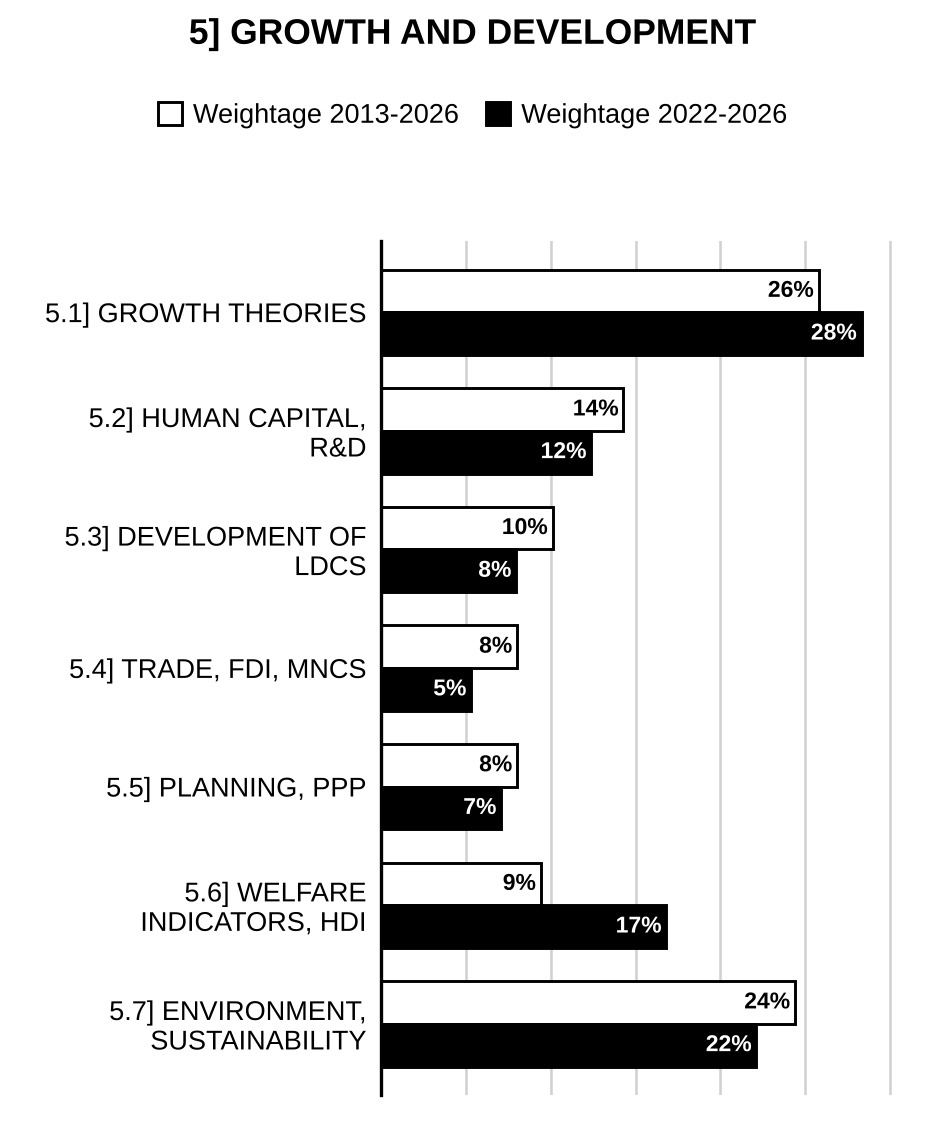
5.1] Theories of growth
34 questions
Write down the implications of knife-edge problem in Harrod’s model of growth. [2025/10m/150w/5d]
Define the concept of natural growth in Harrod’s model. What are the implications of deviation of actual growth from natural growth? [2025/15m/7c]
Explain how the structural transformation, in the economy, takes place with surplus labour as per Lewis theory of economic development. [2024/20m/7a]
Distinguish between warranted rate of growth and natural rate of growth. Explain how knife-edge instability problem occurs in Harrod’s model of economic growth. [2024/15m/8c]
Explain the concept of steady-state in the context of Solow model. [2023/15m/7b]
What is the golden rule of capital accumulation? Explain it using a growth model. [2023/15m/7c]
“Balanced and unbalanced growth strategies are not substitutes but complementary to each other.” Discuss. [2023/15m/8b]
According to Hirschman, unbalanced growth can be through ‘Social Overhead Capital (SOC)’ or ‘Direct Productive Activities (DPA)’. Discuss. [2022/10m/150w/1e]
Show that in Domar’s growth model, in equilibrium, path of investment is exponential. [2022/10m/150w/5d]
What do you mean by the warranted rate of growth? Explain the knife edge instability problem in Harrod’s growth model. [2022/15m/6a]
Following Arthur Lewis, briefly state the sources of unlimited supply of labour and explain the mechanism of development of a dual economy of a less developed country. [2022/20m/6b]
Explain Rosenstein-Rodan’s view that economic underdevelopment is the outcome of a massive coordination failure. [2021/10m/150w/5a]
Explain how Harrod’s warranted rate of growth is similar to Domar’s required rate of growth. How has Solow improved upon Harrod-Domar’s growth model? [2021/20m/6c]
Describe Lewis model of development in an economy with unlimited supply of labour. Is Lewis model really capital-driven? Give reasons. [2020/15m/7a]
In Harrod’s model of growth, if the expected growth rate exceeds the warranted growth rate, what will be the relation between the actual growth rate and the expected growth rate? [2018/10m/150w/5c]
Examine Arthur Lewis model of economic development with unlimited supplies of labour. What is A. K. Sen’s critique of that approach? [2018/20m/7c]
“In view of economic uncertainties, Hirschman approach to economic development makes more sense.” Discuss. [2017/15m/8a]
Describe the growth path, which once the economy attains it, will give a higher level of per capita consumption than any other growth path for all time. [2016/20m/6a]
To counteract under-development stagnation, discuss Leibenstein’s critical minimum effort theory. [2016/10m/7c]
Indicate the Ricardo legacy which is inherent in the Lewis model of economic development. [2016/15m/8c]
Do you think that the root of Harrod’s instability problem lies in the assumption of wage-price rigidity? Give arguments in favour of your answer. [2015/10m/150w/5a]
“Balanced and unbalanced growth strategies are not substitutes but complementary to each other.” Explain this statement. [2015/10m/150w/5e]
“Balanced growth strategy of development in terms of pattern of investment has to be in conformity not only with derived demands but final demands as well.” Argue whether this statement is about avoiding bottlenecks for certain sectors and excess capacities in others or promoting import substitution. [2014/20m/6b]
Explain the Lewis model of structural change from an agricultural economy to a modern industrial economy. State three major criticisms of the Lewis model. [2013/20m/8a]
It is said that a characteristic of the Harrod-Domar model is that even for the long run the economy is at best balanced on a knife-edge of equilibrium growth. Explain the Harrod-Domar model and the reason for this characteristic. [2013/15m/8b]
“The assumption of fixed coefficient production function is at the root of Harrod’s instability.” Discuss and explain whether giving up the assumption really helps. [2012/12m/150w/5a]
How can the structural independence between A-sector and K-sector in the dualistic economy foster growth in the absence of external stimuli? [2011/20m/200w/5b]
How is warranted growth different from natural rate of growth? Explain why Harrod’s growth model is called ‘knife-edge’. [2011/20m/7b]
“There is one saving rate that is best in the sense of maximizing per capita consumption in steady state.” Explain this statement and illustrate the idea graphically. [2010/20m/200w/5a]
“Expansion of high productivity sector absorbs more and more labour from subsistence sector indicating that dualism is a powerful tool of development planning.” Critically evaluate Lewis model of development in the light of the above statement and examine relevance of the model for contemporary India. [2009/60m/7]
Discuss the Lewis Model of economic growth. Do you think the model is applicable to the Indian Development progress? [2007/20m/200w/5b]
Explain how Neo-Classical growth theory removes the rigidity in Harrod-Domar growth model in explaining the growth process. [2005/20m/200w/5a]
Major theories of growth namely, Classical, Marxian, Keynesian and Schumpeterian, all predict crisis in the later stages of capitalist development. Comment and give reasons for your answer. [2004/60m/7]
What are the main features of Neoclassical growth theory? Explain them with the help of Solow’s growth model. [2004/60m/8]
5.2] Human capital, R&D and economic growth
14 questions
Analyse the role of Research and Development (R&D) in fostering economic growth and strengthening competitiveness in a knowledge-based economy. [2026/10m/150w/5d]
Analyse the role of human capital as a driver of economic development in developing countries. How can education and healthcare investment overcome the “Low productivity trap” in developing nations? [2026/20m/7a]
Analyse critically the role of human capital and Research and Development (R&D) expenditure on economic growth in the framework of endogenous growth model. [2025/20m/7a]
Human capital and components of research and development are determining factors of economic growth. Explain using appropriate endogenous growth model. [2023/20m/7a]
Does human capital cause economic growth? Explain how human capital formation can be enhanced. [2021/15m/6b]
(i) What makes technical progress endogenous? Do you think that technology is a ‘non-rival’ good? (ii) Show that if the research becomes more successful, the growth rate will increase and hence the standard of living. [2020/20m/2c]
Show how the idea of monopolistic competition becomes intrinsic to the endogenous growth theory as postulated by Romer. [2020/20m/4c]
Discuss the essential features of the growth models which incorporate research and development. [2019/15m/6b]
Development of human capital may lead to constant returns and propel an economy to self-sustaining economic growth. Explain. [2018/15m/7a]
What is ‘solow-residual’? What are its implications? [2017/10m/150w/5d]
Show that Cobb-Douglas Production Function exhibits both Hicks and Harrod neutral technical progress. [2017/20m/7c]
In an economy having two sectors, namely, goods-producing sector and Research and Development (R & D) sector, prove with the help of new growth theory that (i) both capital and aggregate output must grow at the same rate and (ii) per capita output must grow at the rate of growth of technology. [2015/20m/7b]
How does Solow incorporate investment in education in the growth model to achieve long-run growth? [2011/20m/8a]
Develop the idea that endogenous technological progress, driven by investment in human capital formation and R & D, offsets diminishing returns to physical capital. [2010/60m/8]
5.3] Process of economic development of less developed countries
17 questions
Compare Gunnar Myrdal’s “backwash effects” with Simon Kuznets’ “structural transformation” in the context of developing economies. [2026/15m/7b]
What strategies are required for Agriculture Sector transformation to ensure rapid economic development of a developing country? Discuss. [2026/15m/8b]
Discuss the inverted ‘U’ shaped hypothesis by Kuznets in describing the relationship between inequality and economic growth. How is this hypothesis useful for developing countries? [2024/15m/8b]
Evaluate Kuznets’ inverted U shaped curve hypothesis of income distribution. Does it hold good for less developed countries as well? [2021/15m/6a]
Explain Myrdal’s cumulative causation theory as the theory for development. [2020/10m/150w/1e]
In the contemporary world, many countries are not following Kuznets’ pattern of structural change. Give reasons. [2019/20m/6c]
Kuznets hypothesis predicts decline in income inequalities in the long run. In recent decades do trends in income inequalities in developed and developing economies support this hypothesis? Give reasons for your answer. [2018/15m/7b]
Explain Kuznets’ inverted ‘U’ hypothesis. Is growth good for the poor? Explain. [2016/10m/150w/5d]
Under what conditions economic growth reduces employment growth? Discuss. [2016/10m/150w/5e]
State five reasons that support government intervention in agricultural markets. [2013/10m/150w/5d]
Expand on the following three explanations for the Kuznets hypothesis about inequality and development–(i) the cohort size hypothesis, (ii) the effect of openness on inequality, and (iii) the strong versus the weak version of the hypothesis. [2013/10m/150w/5e]
“Agriculture is not just a sector contributing a small proportion of GDP, it is a way of life for the Indians.” Discuss. [2012/12m/150w/1e]
Distinguish between backwash and spread effects of Myrdal. How do they operate in backward economies? [2012/20m/8a]
What do the following terms signify in structural transformation and growth? (i) Kuznets’ U-shaped curve (ii) Environmental Kuznets curve (iii) N-shaped Kuznets curve in the long-run. [2011/20m/200w/5a]
Critically evaluate Kuznets inverted U-shaped curve hypothesis of income distribution. Does it hold good for less developed countries as well? [2009/20m/200w/5d]
What are the desired structural changes required for achieving the objective of economic development. [2007/20m/200w/1d]
What is Kuznet’s hypothesis? What are its implications for a developing economy? [2004/20m/200w/5a]

Preparing for Prelims too?
Our UPSC Prelims Topic-wise PYQ eBook covers every Prelims question with detailed explanations, so you can see exactly where UPSC asks from.
View the BookDownload Free Sample5.4] Economic development and international trade and investment
9 questions
Explain the factors contributing to the rise of MNCs. Discuss whether their efficiency is driven by superior technology or anti-competitive practices. [2026/15m/7c]
“Increasing role of multinationals has reduced the significance of foreign aid during post-World Trade Organization (WTO) regime.” Do you agree with this statement? Explain. [2025/15m/7b]
Explain the recent changes in the trade and investment flows among different countries in the world. Discuss the major factors that led to these changes. [2020/15m/8a]
Can multinational investment defeat the objective of inclusive growth? Give reasons for your answer. [2019/20m/7c]
Explain Dunning’s eclectic theory of FDI. [2016/10m/150w/5b]
“As long as the substitution possibilities between foreign and domestic resources are limited, the dual-gap analysis is relevant.” Critically examine this statement. [2015/20m/7a]
“Apart from bringing capital into a country, multinational corporations provide many other advantages that cannot be obtained by borrowing from international capital market.” Discuss. [2014/20m/8b]
Discuss the role of multinationals in employment creation, income generation and transfer of technology. [2012/20m/4b]
Discuss the impact of FDI on level of output and employment of the host country. Why do we need some precaution in allowing FDI in retail sector in India? [2012/20m/7a]
5.5] Planning and economic development
13 questions
Throw light on the changing role of markets in economic development of developing countries. How it has affected planning process? Discuss. [2026/10m/150w/5c]
Explain the role of planning in the development process in the context of increasing significance of market economy. [2025/15m/8c]
What are the advantages and disadvantages of public-private partnership model for economic development? What are the key prerequisites for success of PPP model? Explain giving examples. [2024/15m/7b]
Explain how public-private partnership helps in the rapid economic development of a country. [2020/10m/150w/5e]
Can public-private partnership function effectively in the area of physical infrastructure? [2019/15m/4b]
What are shadow prices? Why are these preferred over market prices in project evaluation? [2018/10m/150w/5b]
Explain why the market and the State have complementary roles in economic development. [2018/15m/8a]
What is indicative planning? In this context, explain how State and markets can play a synergetic role in economic development. [2015/10m/7c]
Point out the critical elements in typical Public-Private-Partnership (PPP) agreements in the infrastructure projects to safeguard the interests of the public. [2014/10m/150w/5d]
Our development strategy has been proposed in terms of ‘faster’, ‘more inclusive’ and ‘sustainable’ growth. Do the three components sit together well? Argue for your answer. [2014/10m/7c]
For optimal allocation of resources, which of the options – market forces, planning exercise or a combination of both – should be suitable for the third world countries? Defend your stand. [2012/20m/4c]
“The solution of long term development needs of India lies in promoting public-private partnership.” Discuss. [2012/20m/8b]
“With the change in economic policies, relative role of market and state also change”. Do you agree with the statement? Illustrate your answer with the help of suitable examples. [2007/60m/8]
5.6] Welfare indicators and measures of growth
14 questions
What are the various approaches to Human Development? Elaborate Basic Needs Approach. [2026/15m/8c]
Write down the major limitations of HDI developed by the UNDP. [2025/10m/150w/5e]
Critically examine ‘per capita’ GDP as a crude indicator of development. [2024/10m/150w/5a]
Describe the major components used in Human Development Index (HDI) by the United Nations Development Programme (UNDP). Write down the methodological limitations of this index. Suggest appropriate method to eliminate these limitations. [2024/20m/8a]
Explain how modified HDI is an improved measure of development over HDI. [2023/10m/150w/5d]
“Income inequality is not a cause of concern as long as per capita income is rising.” Critically examine this statement. [2023/15m/8c]
Distinguish between Gender Development Index (GDI) and Gender Empowerment Measure (GEM) in terms of their components and constructions. [2022/15m/6c]
Explain how gender sensitive human development index can be constructed. [2021/10m/150w/5b]
How is Human Development Index calculated by UNDP? Can there be a better method of assigning weights to various indicators? [2019/10m/150w/1d]
Describe the different indicators that are used by UNDP to construct the Human Development Index (HDI). Why is a logarithmic transformation applied only to per capita income in the calculation of HDI? [2014/20m/8a]
Compare Human Development Index (HDI) with Human Poverty Index (HPI) as a measure of development. How is the Human Poverty Index different from the Happy Planet Index? [2011/20m/200w/5c]
What is Human Development Index (HDI)? Give its limitations as a measure of economic development and suggest improvement(s). [2009/20m/200w/8c]
What are the human development indices used for international comparison of status of development? Elaborate the methodology used for developing Human Development Index. [2007/60m/7]
Examine the efficacy of HDI as indicator of human welfare. [2005/20m/200w/5c]
5.7] Development and environmental sustainability
33 questions
“Earth provides enough to satisfy every man’s needs, but not every man’s greed”. Analyse this statement in the context of environmental degradation and the rights of future generations. To what extent does the rapid, industrial-driven depletion of non-renewable resources constitute a violation of intergenerational equity. [2026/20m/8a]
Do you think that economic growth and sustainable development are contrary to each other? Justify your answer. [2025/15m/8b]
Discuss how carbon trading is helpful in reducing environmental degradation. [2024/10m/150w/5c]
Can Kuznet’s hypothesis of an inverted U-curve be extended to analyse environmental degradation? Explain. [2023/10m/150w/5c]
How renewable energy use can help attain environmental sustainability? Explain. [2023/10m/150w/5e]
How important is rent from extraction of renewable and non-renewable resources to distinguish between Net Domestic Product (NDP) and Environmentally adjusted Domestic Product (EDP). Will the distinction be valid if we have an economy with only renewable resources and the economy reaches the point of maximum sustainable yield? [2023/20m/8a]
With appropriate examples, discuss the difference between the flow and the stock concept of renewable resources. Can the availability of one of these two resources be less for the consumption of future generations? Justify your answer. [2022/10m/150w/5e]
Why do developing countries rely on specifying a permissible level of pollution and impose it uniformly across all polluting units of the same kind? What are the problems associated with such a control method? [2022/15m/8b]
What are the major achievements and failures of COP (Conference of Parties) 26? [2022/15m/8c]
Do you agree whether sustainable use of energy ensures economic sustainability? Explain. [2021/10m/150w/5e]
Explain how renewable resources will play a role in future economics. [2020/10m/150w/1c]
“Even green energy is not always green.” Do you agree? Illustrate your answer taking biofuels as an example. [2020/15m/3b]
Discuss the issue of compatibility between international trade and environment sustainability. [2020/10m/150w/5c]
How does ‘carbon trading’ help in reducing environment degradation? [2019/10m/150w/1c]
‘Tragedy of the commons’ leads to over-exploitation of resources. Analyze. [2019/15m/2a]
How does rural economic activity create environmental degradation in developing economies? [2018/15m/8b]
What policies would you suggest to combat negative environmental externalities? [2018/20m/8c]
“The trade-off between environment and development remains unresolved.” Comment in view of the United States exiting from Paris Climate Agreement. [2017/15m/8b]
Illustrate the notion of perverse subsidy in the context of natural resource sector. [2016/15m/4b]
“Pollution-income progression of agrarian communities (clean) to industrial economies (pollution intensive) to service economies (cleaner) would appear to be false if pollution increases again at the end due to higher levels of income and consumption of the people at large.” Discuss. [2016/15m/8b]
How does carbon trading help in reducing environmental degradation? [2015/10m/150w/5c]
What do you mean by ‘green accounting’? Discuss how this concept can be incorporated in national income accounting. [2015/10m/8a]
Discuss the role of renewable energy resources in order to maintain environmental sustainability with special reference to India. [2015/20m/8b]
“Global warming will certainly increase the cry of the earth and the cry of the poor.” In this context, examine the international efforts to reduce global warming. [2015/20m/8c]
Can Kuznets’ hypothesis of inverted-U curve be extended to environmental degradation? Explain. [2014/10m/150w/5b]
Our development strategy has been proposed in terms of ‘faster’, ‘more inclusive’ and ‘sustainable’ growth. Do the three components sit together well? Argue for your answer. [2014/10m/7c]
“Industrial development and environmental degradation are highly correlated.” If it is true what should be, in your opinion, the policy options for industrialization process vis-a-vis pollution control? [2012/20m/4a]
What do the following terms signify in structural transformation and growth? (i) Kuznets’ U-shaped curve (ii) Environmental Kuznets curve (iii) N-shaped Kuznets curve in the long-run. [2011/20m/200w/5a]
Why do energy elasticities tend to unity in industrially advanced countries? [2011/20m/6a]
What are the negative externalities of high energy coefficients? [2011/20m/6b]
What are the objectives of National Environment Policy, 2006? [2011/20m/8b]
Explain Sustainable development. [2007/20m/200w/5d]
Do you agree with the ‘Limits to Growth’ thesis? Is it relevant in the context of developing economies? In this context discuss the concept of sustainable development. [2005/60m/7]

Strengthen your GS papers
Our UPSC Mains Topic-wise & Year-wise PYQ eBook (2013–2026) maps every GS question to the syllabus, so you know what UPSC asks and how often.
View the BookDownload Free Sample« Previous: International Economics | Next: Indian Economy in Pre-Independence Era »
Back to: Economics Optional PYQs – Topic-wise | Also see: Economics Optional year-wise question papers
Last updated: 30 October 2026