
Here are all 64 Indian Economy in Pre-Independence Era questions asked in UPSC Economics Optional Paper II from 2004 to 2026, arranged under the 4 topics of the official syllabus. Within each topic the latest questions come first.
Each question ends with a code such as [2024/15m/3b] – the year, the marks, the word limit (where UPSC set one) and the question number in the paper.
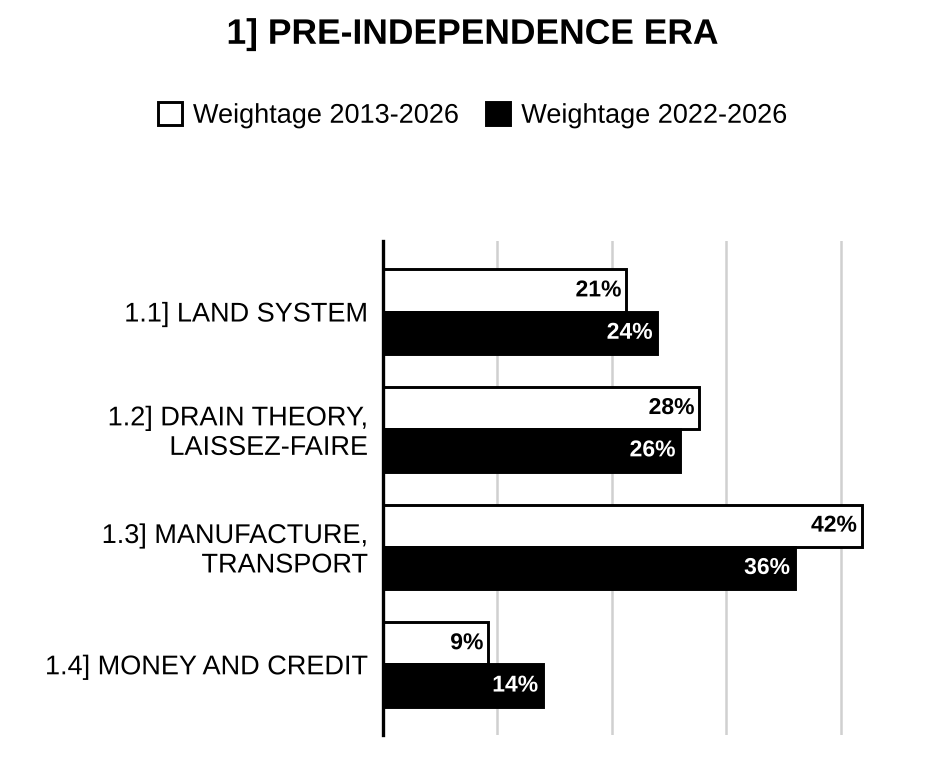
1.1] Land system and commercialization of agriculture
15 questions
“Commercialization of agriculture in British India was a forced process rather than a natural one.” Elucidate with reference to cash crops like indigo. [2026/10m/150w/1b]
Distinguish between the Zamindari system and the Ryotwari system of land revenue under the British rule in India. [2025/10m/150w/1a]
What were the major impacts of ‘commercialisation of agriculture’ on Indian farmers during the pre-Independence India? Discuss. [2025/10m/150w/1b]
Describe why farmers derived little benefits from the commercialisation of agriculture in pre-independence India. [2024/10m/150w/1d]
Land system during the British rule was responsible for sustained poverty and stagnant growth in India. Comment. [2023/10m/150w/1a]
Examine the impact of land tenure system during British India on Indian agriculture. [2022/10m/150w/1e]
Examine the factors that facilitated commercialisation of Indian agriculture during the British rule. [2021/10m/150w/1a]
Assess the impact of land tenure system adopted by the British on the peasants and productivity of Indian agriculture. [2020/10m/1c]
Account for the commercialisation of Indian agriculture during the second half of the 19th century and analyse its effects. [2019/10m/150w/1a]
Examine the features of permanent land settlement as introduced by Lord Cornwallis. [2018/20m/2a]
What were the broad considerations underlying the different types of land settlements in India during the colonial rule? Discuss. [2017/15m/2c]
Critically examine condition of Agriculture and rural economy during the pre-independence era. [2016/15m/2b]
Land system during the British period was responsible for sustained poverty in India and stagnant growth of Indian economy. Discuss. [2014/10m/150w/1a]
During the British rule, commercialisation of agriculture was forced on the farmers, while now it is the need of the hour. Discuss. [2012/12m/150w/1b]
Discuss the process of ‘forced commercialization’ of agriculture under colonial rule. [2009/20m/200w/1a]
1.2] Drain theory; laissez-faire theory and critique
22 questions
Critically examine the ‘drain theory’ as propounded by Dadabhai Naoroji. How did it explain the root cause of poverty in colonial India? [2026/10m/150w/1a]
Discuss the application of laissez-faire theory in colonial India. Why did the nationalist economists criticize this policy as a tool for deindustrialization? [2026/15m/3c]
What were the economic consequences of the ‘Drain of Wealth’ theory as practised during the British rule in India? Analyse. [2025/10m/150w/1c]
Describe the phases of colonisation in British India. [2025/10m/150w/1e]
Mention the items of ‘Economic Drain’ from India as conceived by Dadabhai Naoroji. [2024/10m/150w/1a]
Discuss why ‘Laissez Faire’ was not good for India during the pre-independence India. [2024/10m/150w/1c]
Examine the arguments to explain the theory of ‘economic drain’ from India in the second half of the 19th century. [2021/10m/150w/5a]
Examine how the laissez-faire policy was responsible for the famine in the late 19th century India. [2020/10m/1a]
Examine the theory of “Economic Drain” in the second half of the 19th century in India and discuss its economic effects. [2019/15m/2c]
Do you agree with the view that the objective of industrial and commercial policies of British was to transform India as a complementary economy of England? Give reasons. [2018/10m/150w/1a]
‘British rule led to India’s underdevelopment’. Do you agree? Give reasons in support of your answer. [2018/15m/2c]
What is drain theory? How does it explain the backwardness of India in the 19th century? [2017/20m/2a]
Do you think that the attitude of the British Government towards the Indian economy changed markedly at the turn of the 19th century? Give specific instances supporting your argument. [2017/15m/2b]
What specific trade policies during the British period led to the decline of Indian industry? Explain. [2015/10m/150w/1c]
During the British Rule, India was rooted with seeds of modernisation, but the country remained underdeveloped. Discuss. [2015/15m/2c]
Write on ‘Drain Theory’ as developed by Dadabhai Naoraji. How does it explain sustained poverty during the British Rule in India? [2013/10m/150w/1a]
Compare and contrast the ‘Swadeshi’ of 1905 and the ‘Swadeshi’ promoted later by Mahatma Gandhi. [2010/20m/200w/1c]
Gunder Frank held that development of one part of the world causes underdevelopment of another part. Does it explain industrialisation of Britain and the de-industrialisation of India during the British Raj? Assess. [2010/30m/2a]
Give a critical account of the development of India during British Rule. [2007/20m/200w/1a]
What was the impact of the Great Depression in 1873–1896 on India? [2005/20m/200w/1a]
Write an essay on the ‘drain of wealth’ controversy in India in the nineteenth century. [2005/60m/2]
Discuss the ‘Drain of Wealth Controversy’ of the late 19th century. [2004/20m/200w/1a]

Preparing for Prelims too?
Our UPSC Prelims Topic-wise PYQ eBook covers every Prelims question with detailed explanations, so you can see exactly where UPSC asks from.
View the BookDownload Free Sample1.3] Manufacture and transport
23 questions
“Railways in India were the forerunner in facilitating modern industries.” Discuss. Critically analyze the role of railways in the economic development of India. [2026/15m/4c]
Why did the British lead to the destruction of India’s traditional cotton industry? Discuss. [2025/10m/150w/1d]
Discuss why the railway system developed by the East India Company went against the Indian interest. [2024/10m/150w/1b]
Explain the problems faced by the Jute industry during pre-independence India. Why the problem aggravated after partition of the country? [2024/15m/2c]
Explain the development of cotton industry in India during pre-Independence era. Also point out its growth constraints. [2023/15m/4c]
Outline the factors that caused decline of handicrafts during British rule in India. [2022/10m/150w/1a]
Discuss the development of Jute industry during pre-independent India. What were the main problems faced by this industry? [2022/15m/3b]
Do you think that the ‘new guarantee’ system was better than the ‘old guarantee’ system in the history of Railways in India? Give reasons. [2021/10m/150w/1b]
Compare the main features of development of jute and cotton textile industry in India during the British period. [2021/20m/2a]
Evaluate the development of the transport system in India during 1857 to 1947. [2020/15m/2b]
Analyse the effects of colonialism on de-industrialisation in India during the 18th century. [2020/15m/3c]
Do you agree that the development of Indian railways during the British Rule helped facilitate the process of industrialisation? Give reasons. [2019/10m/150w/1b]
Trace the development of the cotton textile industry in India during the British period. Discuss the major problems faced by the industry in different stages of its growth during this period. [2019/20m/2a]
Explain the underlying causes and effects of deindustrialisation in India during the 19th century. [2019/15m/2b]
Explain the problems faced by jute mills in India during the early years of their existence. [2018/15m/2b]
What were the considerations underlying the initiation of the railways and the road transport system in India in the 19th century? [2017/10m/150w/1d]
Write a brief note on the state of manufacturing in India in the 18th century and the subsequent de-industrialisation. [2017/10m/150w/1e]
What were the economic consequences of discriminating protection in the trade policy during British Regime? [2016/10m/150w/1e]
Discuss the manufacturing condition prevailed during pre-independence period. Do you feel that private sector did not come forward for investment due to fear of Nationalisation? Give reasons. [2016/20m/2a]
Explain how Railways played an important role in unifying the people of India during pre-independence period. [2016/15m/6c]
How did railways contribute to India’s economic development in the pre-independence era? [2015/10m/150w/1a]
Write about the policy of discriminating protection during the British rule and its impact on industrial development in India. [2014/10m/150w/1b]
Discuss policy of Discriminating Protection and its impact on Indian industrial development during the British period. [2011/15m/150w/1c]
1.4] Money and credit
4 questions
Explain the main features of money and credit policies in India during the pre-Independence era. [2023/20m/2a]
Describe in brief the factors that led to the establishment of Reserve Bank of India (RBI) in the country. [2022/15m/2b]
Examine how the currency policy of the British affected the growth of monetisation in the Indian economy during 19th century. [2020/20m/2a]
How did Gold Bullion Standard end with ‘ratio controversy’ in British India? [2018/10m/150w/1c]

Strengthen your GS papers
Our UPSC Mains Topic-wise & Year-wise PYQ eBook (2013–2026) maps every GS question to the syllabus, so you know what UPSC asks and how often.
View the BookDownload Free Sample« Previous: Growth and Development | Next: Indian Economy after Independence: A. The Pre-Liberalization Era »
Back to: Economics Optional PYQs – Topic-wise | Also see: Economics Optional year-wise question papers
Last updated: 30 October 2026