
English Literature Optional PYQs Topic-wise for UPSC Mains (2009–2026) are listed below unit by unit, in the order of the official syllabus – 924 questions in all. Click any unit to open all its previous year questions, arranged topic-wise with the latest first.
Want full papers instead? Open the English Literature Optional year-wise question papers for Paper 1 and Paper 2, or the official syllabus.
Want the trends behind these questions? See the English Literature Optional PYQ analysis: marks by unit, repeated questions and a paper-wise analysis for every year from 2020 to 2026.
Paper I
| Unit | Topic (click to open PYQs) | Sub-topics | Questions | Link |
|---|---|---|---|---|
| 1 | Topics and movements (1600–1900) | 9 | 74 | Click here → |
| 2 | Texts: poetry and drama (section a) | 7 | 164 | Click here → |
| 3 | Texts: fiction (section b) | 7 | 144 | Click here → |
| 4 | Critical analysis of unseen passages | – | 86 | Click here → |
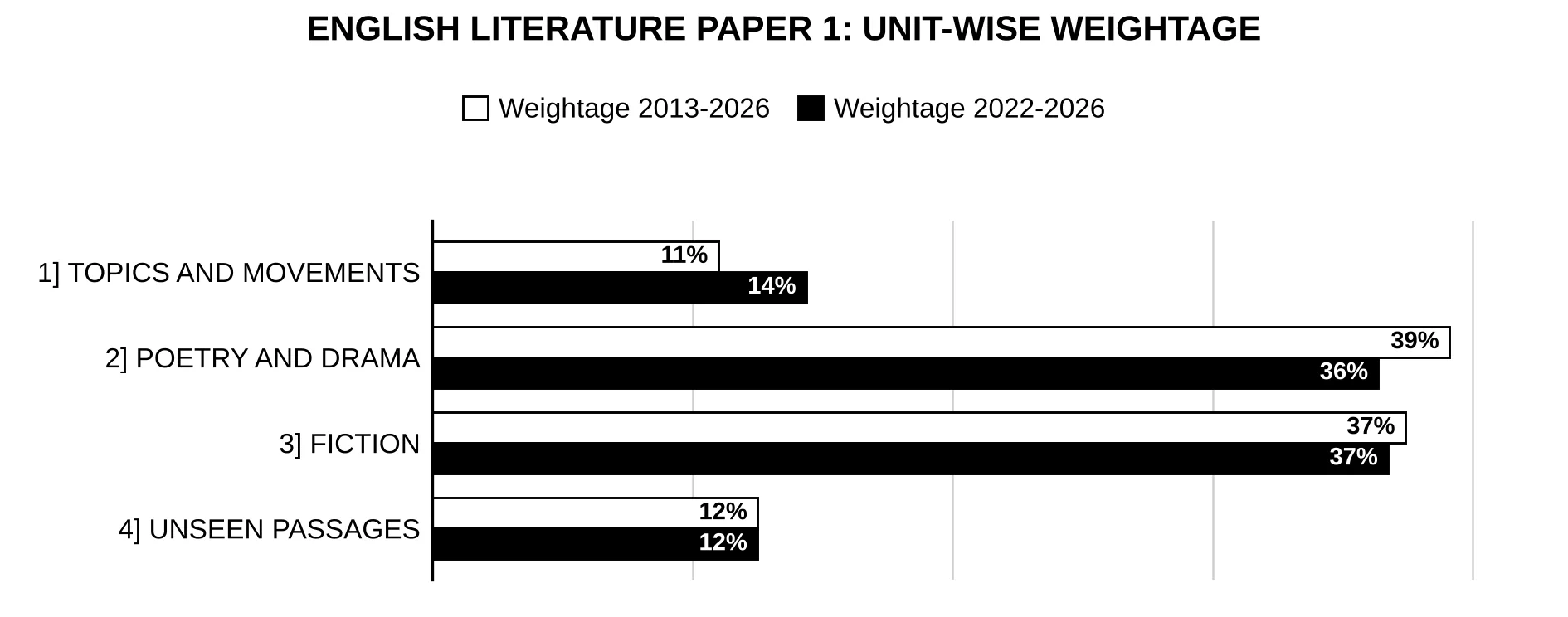
Trend: The prescribed texts carry most of the marks: poetry and drama (Shakespeare to Ibsen) about 39% and fiction about 37% since 2013, with the topics and movements and the unseen poem about 11–13% each. Shakespeare is the single most-asked author (about a quarter of the poetry-and-drama marks), followed by Milton and Wordsworth; among the novelists, Austen, Dickens, Swift, Hardy and George Eliot are asked almost equally. Among the movements, the Romantic Movement, the Victorian Age and the Rise of the Novel come up most often.

Preparing for Prelims too?
Our UPSC Prelims Topic-wise PYQ Book covers every Prelims question with detailed explanations, so you can see exactly where UPSC asks from. Now available as a hard copy and an eBook.
Buy Hard Copy on AmazonBuy eBook (PDF)Paper II
| Unit | Topic (click to open PYQs) | Sub-topics | Questions | Link |
|---|---|---|---|---|
| 1 | Topics and movements (1900–1990) | 8 | 45 | Click here → |
| 2 | Texts: poetry and drama (section a) | 7 | 195 | Click here → |
| 3 | Texts: fiction (section b) | 7 | 201 | Click here → |
| 4 | Critical analysis of unseen passages | – | 27 | Click here → |
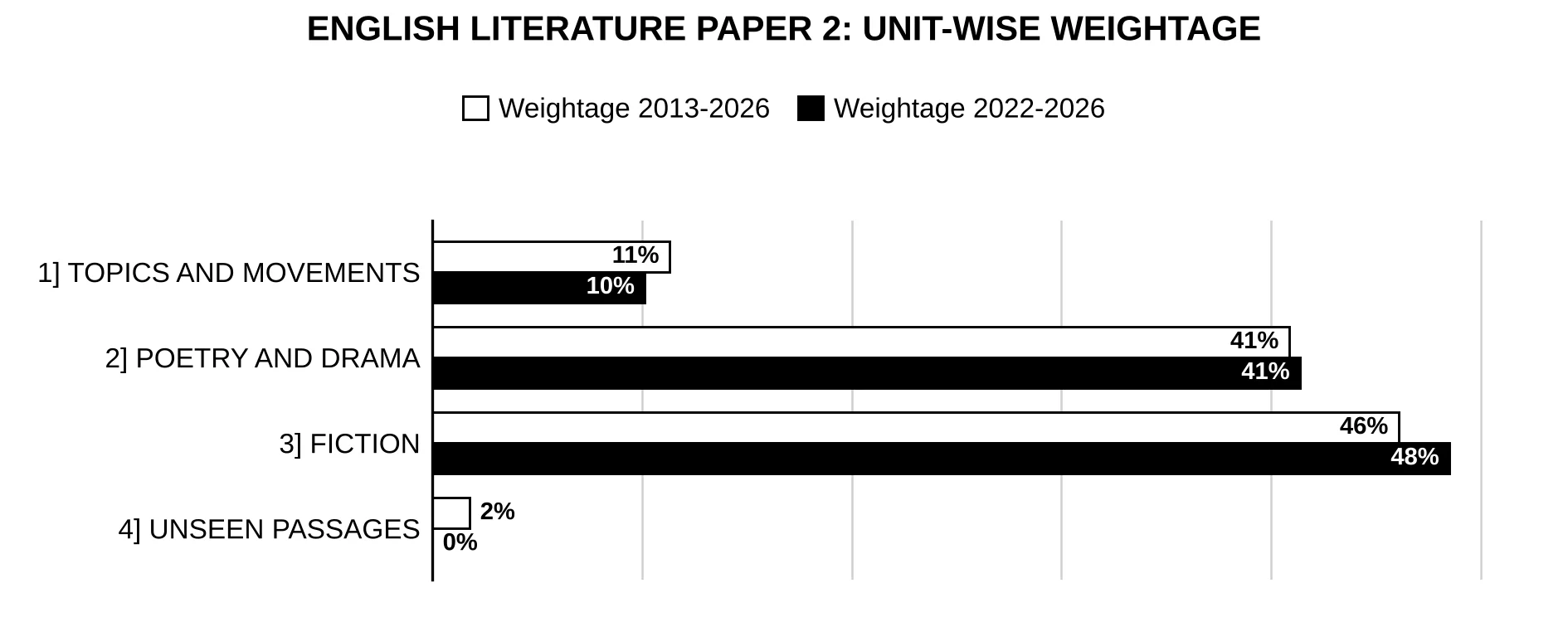
Trend: Fiction (about 46%) and poetry and drama (about 41%) take almost the whole paper; the topics and movements carry about 11%, and the unseen prose passage of the older papers has given way to explanation passages from the prescribed poets. All seven novelists and seven poets/dramatists are asked almost every year in roughly equal measure, with Forster, Joyce, Raja Rao and Naipaul slightly ahead among the novelists and Ramanujan and Larkin among the poets. Modernism and Indian Writing in English are the most frequent movements, and Modernism has risen sharply in 2022–2026.
More questions
Other questions (outside the present syllabus) – 1 question
Frequently asked questions
How many English Literature Optional PYQs are there?
There are 924 English Literature Optional questions from 2009 to 2026, across Paper I and Paper II, arranged under 8 units of the official syllabus. A question that covers two topics is listed under both.
Which English Literature Optional units are asked most often?
By number of questions – Texts: fiction (section b) (Paper II, 201); Texts: poetry and drama (section a) (Paper II, 195); Texts: poetry and drama (section a) (Paper I, 164); Texts: fiction (section b) (Paper I, 144). The weightage graphs on these pages compare the share of marks across periods.
What does a code like [2024/15m/3b] after a question mean?
It gives the year, the marks, the word limit (where UPSC set one) and the question number in the paper. So [2024/15m/3b] is Question 3(b) of the 2024 paper, worth 15 marks.
Where can I download the full English Literature Optional question papers?
Every available paper is free as a PDF on our English Literature Optional year-wise question papers page, for both Paper 1 and Paper 2.
How should we use these PYQs in our preparation?
Read the syllabus for a unit first, then go through its questions, starting with the most recent years. In Paper II, read each prescribed text in the original and note which passages and themes UPSC returns to. Practise writing answers within the word limit and time.
How this collection is organised
Units follow the official syllabus – in each paper: 1 Topics and Movements, 2 Texts: Poetry and Drama (Section A), 3 Texts: Fiction (Section B), and 4 Critical Analysis of Unseen Passages. Each prescribed author is a topic of its own (for example Paper 2 – 2.1 W.B. Yeats).
A question on a prescribed author or text is placed under that author, even when it mentions a movement; it is also placed under the movement only when the question is as much about the movement itself. Passages printed for explanation from a prescribed text are placed under its author; the unseen poems and prose passages for critical analysis are placed in unit 4 with all their sub-questions.
Questions on authors or texts that are no longer prescribed are placed under the nearest movement, or under “Other Questions (Outside the Present Syllabus)” at the end of the paper.
Some questions cover more than one topic. We’ve kept such questions in each topic of relevance.
Graphs at the start of each paper show the weightage of every unit in that paper, and graphs for each unit show the weightage of its topics. Weightage is the share of marks asked from a unit or topic, compared for 2013–2026 (white bars) and the last five years, 2022–2026 (black bars). A question placed under two topics has its marks split equally between them.
Each of the topicwise question is suffixed by a question code like this [2024/10m/150w/1a]. This code indicates a) year in which the question was asked, b) maximum marks the question carried, c) prescribed word limit (where UPSC set one, e.g. 150w) and, d) the question number in actual paper, in given order.
Until 2012, each paper carried 300 marks (60 per question); since 2013 each paper carries 250 marks (50 per question). Where a question offered more parts than were to be answered (“any three” of four, “any five” of six), every part is included with its own marks.
All papers are transcribed from the official UPSC question papers (scans). Every page was transcribed and then checked a second time by an independent reader against the scan. The wording, spelling and punctuation are as printed, including the papers’ own misprints.
Spotted an error? Use the “Report an Error” box at the end of any page – we review every report and update the page.

Strengthen your GS papers
Our UPSC Mains Topic-wise & Year-wise PYQ Book (2013–2026) maps every GS question to the syllabus, so you know what UPSC asks and how often. Now available as a hard copy and an eBook.
Buy Hard Copy on AmazonBuy eBook (PDF)Last updated: 2 November 2026