
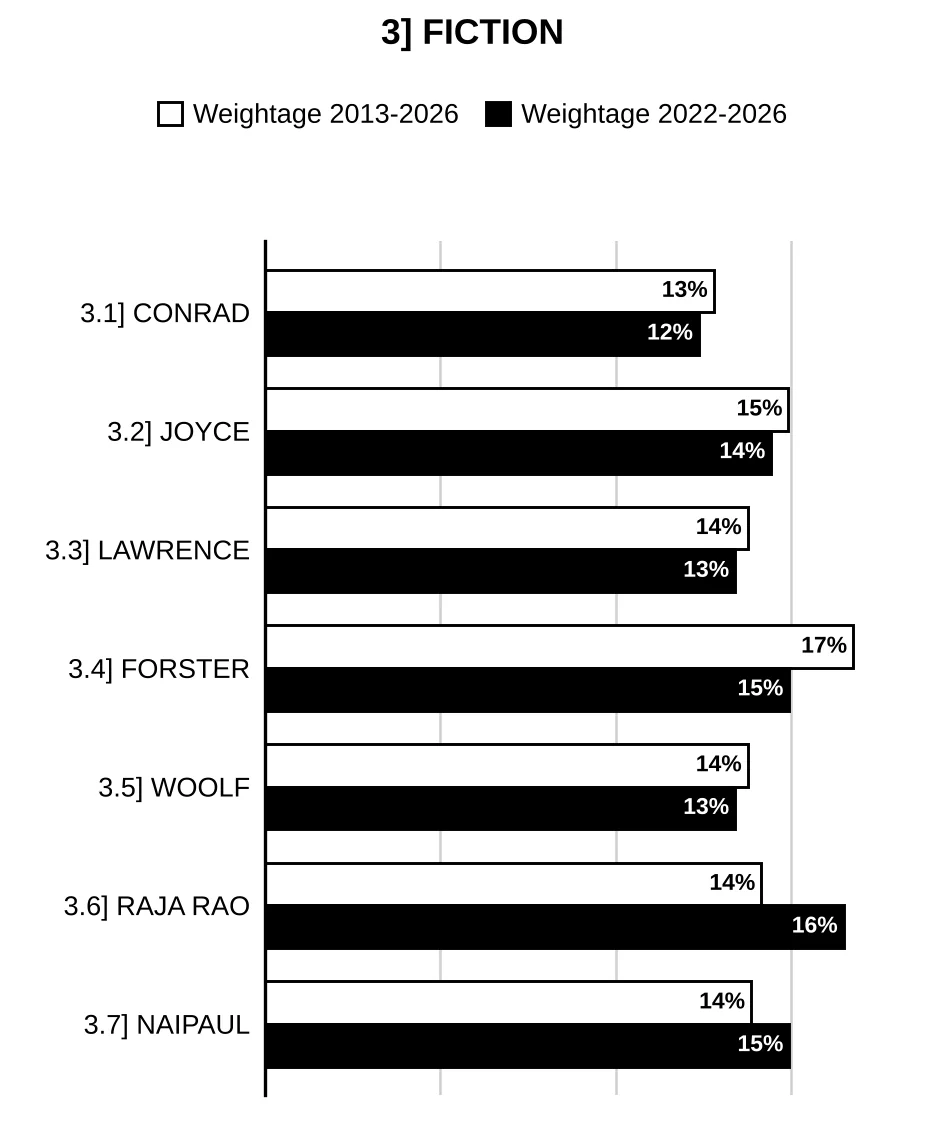
Here are all 201 questions on Texts: fiction (section b) asked in UPSC English Literature Optional Paper II (2009–2026), arranged under the 7 topics of this unit. Within each topic the latest questions come first.
Each question ends with a code such as [2024/15m/3b] – the year, the marks, the word limit (where UPSC set one) and the question number in the paper.
3.1] Joseph Conrad
29 questions
Analyse the ways in which Joseph Conrad’s Lord Jim addresses the ideological and moral consequences of colonialism and racism. [2026/10m/150w/5a]
Discuss how Joseph Conrad explores the complex issues of honour, guilt and heroism in his novel Lord Jim. [2026/15m/7a]
Conrad’s Lord Jim documents the exploitative nature of European colonialism. Discuss. [2025/15m/6a]
Discuss the role of Marlow as a narrator in Lord Jim. [2024/15m/6a]
Critically analyse how the elements of realism and fantasy are conflated in Conrad’s Lord Jim in order to produce an image of the Orient through Patusan. [2024/15m/7b]
“Jim (in the novel, Lord Jim) embodies Conrad’s finest moral vision.” Argue for or against the statement. [2023/10m/150w/5a]
Discuss Patusan as a psychological landscape in Lord Jim. [2023/15m/6a]
One of the striking features of Lord Jim is its narrative style. Analyse. [2022/10m/150w/5d]
Discuss how Joseph Conrad narrates the saga of Jim’s lifelong search to regain his honour. [2022/15m/7b]
Analyse the motif of courage in Conrad’s Lord Jim. [2021/10m/150w/5d]
Lord Jim is characterised as a romantic idealist with a lack of self-knowledge, stubborn, egoistical and self-deceptive. Would you agree? Elucidate with an analysis of Conrad’s novel. [2021/15m/6a]
In Lord Jim, Joseph Conrad presents the theme of isolation and search for identity. Elaborate. [2020/10m/5a]
Lord Jim is “predicated on dramatizing the process of Marlowe’s discovering the subtleties of another character, … the epistemological problem of how we can possibly understand and empathize with another character.” Discuss. [2020/15m/6a]
Is it valid to say that Lord Jim is all about coping with guilt, shame and remorse felt by Jim? [2019/10m/5a]
What role do the memories of the past, haunting Jim, Marlow, Jewel and Stein play in making Lord Jim an unforgettable tale of human nature? [2019/15m/8c]
The theme of alienation and isolation in Lord Jim. [2018/10m/150w/5d]
“A man that is born, falls into a dream like a man who falls into the sea.” To what extent could Stein’s comment in Lord Jim be taken as a final assessment of the character of Jim? [2018/20m/7c]
Explain the civilizing mission of Lord Jim as a heroic adventure. [2017/10m/150w/5a]
Discuss how the narrative technique of Lord Jim adds to the impact of the theme. [2017/15m/6b]
Lord Jim is “the development of one situation, only one really, from beginning to end”. [2016/10m/150w/5a]
What role does the “Patna Affair” play in compelling Jim of Lord Jim to look into his deepest self? [2016/15m/6b]
How does Conrad depict the difficulty of finding a secure moral base in the ambience of political violence, economic oppression, isolation and existential dread in Lord Jim? [2015/15m/6a]
Argue why Lord Jim is considered the Hamlet of Joseph Conrad. [2015/15m/8c]
Examine the narrative technique in Lord Jim. [2014/15m/6c]
Examine the elements of Impressionism in Lord Jim. [2014/10m/7c]
Show how Joseph Conrad’s ‘Lord Jim’ explains, the crisis faced by an individual through an elaborately woven scheme of narration. [2012/30m/6a]
What makes Lord Jim a complex character even in a contemporary setting? Elaborate. [2011/30m/7a]
After his failure in two crucial tests of his life, is Jim in Lord Jim redeemed? [2010/20m/6b]
Consider the view that Conrad proves through his Lord Jim that imperialism is expounded as a variety of brutish idealism and that colonialism alienates the native and the settler alike. [2009/60m/6]

Preparing for Prelims too?
Our UPSC Prelims Topic-wise PYQ Book covers every Prelims question with detailed explanations, so you can see exactly where UPSC asks from. Now available as a hard copy and an eBook.
Buy Hard Copy on AmazonBuy eBook (PDF)3.2] James Joyce
29 questions
Elaborate how guilt, sin and confession contribute to Stephen’s moral and psychological development in James Joyce’s A Portrait of the Artist as a Young Man. [2026/10m/150w/5b]
Discuss the interplay between Stephen’s personal experiences and his emerging ideas about the role of the artist in society. [2026/20m/8c]
Discuss Joyce’s A Portrait of the Artist as a Young Man as a rumination on Irish nationalism. [2025/10m/150w/5c]
How does Joyce portray the artist’s struggle for independence and the role of creativity in Stephen Dedalus’ life? Elaborate. [2025/15m/8a]
Analyse James Joyce’s interweaving of ‘myth’ in the narrative of his novel A Portrait of the Artist as a Young Man. [2024/10m/150w/5c]
Critically examine the reflections of the religious, political and cultural contexts discernible across the narrative in A Portrait of the Artist as a Young Man. [2024/20m/8c]
Discuss A Portrait of the Artist as a Young Man as a Bildungsroman. [2023/10m/150w/5b]
What are the chief symbols that Joyce has woven into the structure and texture of A Portrait of the Artist as a Young Man? [2023/20m/6c]
The theme of innocence and experience is central to the novel A Portrait of the Artist as a Young Man. Discuss. [2022/10m/150w/5b]
In A Portrait of the Artist as a Young Man, the author makes extensive use of the stream of consciousness technique to represent the fluid and turbulent nature of the human mind. Elaborate. [2022/15m/6a]
Discuss James Joyce’s novel, A Portrait of the Artist as a Young Man as a Künstlerroman. [2021/10m/150w/5a]
Joyce’s A Portrait of the Artist as a Young Man challenges social institutions such as family and religion thereby reflecting aspects of modernism. Evaluate by a critical analysis of the novel. [2021/20m/8c]
Discuss the use and significance of epiphanies in A Portrait of the Artist as a Young Man. [2020/10m/5b]
Stephen Dedalus articulates an aesthetic framework that is problematic; at the same time it seems to promise him freedom from Ireland. Would you agree? Give reasons for your arguments. [2020/15m/6b]
Discuss the significance of the scene in A Portrait of the Artist as a Young Man, when Stephen sees a beautiful young girl by the river at the end of Chapter Four. [2019/10m/5b]
Note the features of Künstlerroman you can find in A Portrait of the Artist as a Young Man, which justify its categorization as a novel about the development of an artist. [2019/20m/6b]
Examine the view that A Portrait of the Artist as a Young Man was innovatively daring for its time – its challenging attitude to family, homeland and the Catholic Church – which made it a classic of Modernism. [2019/15m/8b]
The significance of dreams in A Portrait of the Artist as a Young Man. [2018/10m/150w/5b]
What are the ways in which Stephen prepares himself for life as an artist? How is the process related to Joyce’s view of the role of the artist in society? [2018/15m/7b]
How does Stephen’s personality develop through an interaction between religion and awakening sexuality in his mind? [2017/20m/6a]
Critically appreciate A Portrait of the Artist as a Young Man as a Bildungsroman. [2017/20m/8c]
How does Joyce use a complex narrative perspective in The Portrait of the Artist as a Young Man, employing what he termed the “Uncle Charles Principle”? [2016/20m/6a]
Discuss Stephen’s theory of the depersonalization of the artist in The Portrait of the Artist as a Young Man, in the context of Modernism. [2016/15m/8c]
The novel, A Portrait of the Artist as a Young Man, is structured in the manner of a classical drama. [2015/10m/150w/5a]
Joyce freed himself from socially structured emotions – by means of creating art as a new religion he detached fiction from one particular ideological base. Discuss with reference to Portrait of an Artist as a Young Man. [2015/20m/7a]
What role does Stephen’s burgeoning sexuality play in his development as a character? [2014/15m/6a]
Critically analyse how the stream of consciousness technique, used to depict the labyrinth of the subtleties of human mind, is executed with prowess and precision in Mrs Dalloway and A Portrait of the Artist as a Young Man. [2012/30m/4a]
What conflicting views of the body and spirit inform A Portrait …… Man? [2011/30m/7b]
The artist ‘is at once a member of his society, a rebel, a martyr and the possible saviour, in whose imagination the spirit of man is continually affirmed.’ Explain how this definition applies to Stephen in A Portrait of the Artist as a Young Man. [2010/40m/6a]
3.3] D.H. Lawrence
29 questions
Examine the characters in Sons and Lovers from a psychoanalytical perspective. [2026/10m/150w/5c]
Discuss the representation of colliery life in D.H. Lawrence’s Sons and Lovers. [2026/15m/8b]
Discus how industrialization impacts the characters and their relations in Lawrence’s Sons and Lovers. [2025/10m/150w/5a]
Critically comment on exploitation and dehumanisation as brutal realities of industrialization with reference to Lawrence’s Sons and Lovers. [2025/20m/8c]
Comment on the ending of the novel Sons and Lovers after the death of Gertrude Morel. [2024/10m/150w/5a]
Bring out the conflicts arising out of Paul Morel’s relationships with three women characters, namely Gertrude, Miriam and Clara in the novel Sons and Lovers. [2024/15m/7a]
Would you agree that the exegesis of Sons and Lovers as a presentation of Oedipus complex robs the novel of some of its nuances? Answer with illustrative references. [2023/10m/150w/5c]
“Lawrence’s characters illustrate the class contradictions at the heart of modern industrial society.” Discuss the statement with reference to Sons and Lovers. [2023/15m/7b]
Evaluate how Sons and Lovers is a suitable title for D. H. Lawrence’s novel. [2022/10m/150w/5a]
Sons and Lovers examines the emotional dynamics of the Morel family. Analyse. [2022/15m/7a]
Comment on D.H. Lawrence’s narrative technique in Sons and Lovers. [2021/10m/150w/5b]
In Sons and Lovers, D.H. Lawrence depicts the Oedipus complex and reveals the working of the unconscious mind. Elucidate. [2021/20m/7c]
“The values and traditions comprising the social milieu tend to condition and reduce the family to little more than moral automatons.” Do you agree? State your opinion with an analysis of D.H. Lawrence’s Sons and Lovers. [2021/15m/8a]
The conflict between Gertrude and Walter in Sons and Lovers is often compared to the social conflict between the middle class and the working class. Elaborate. [2020/10m/5c]
The representation of women in Sons and Lovers, especially Paul Morel’s two love interests, Miriam and Clara, is problematic insofar as they exist primarily to help Paul work out his existential angst. Argue for or against this statement with examples from the novel. [2020/15m/7a]
What differences do you find between Mrs. Gertrude Morel and Miss Gertrude as a maiden? [2019/10m/5c]
“As Paul Morel struggles in his relationships with Clara and Miriam, he realizes in his sub-conscious mind that the shadow of his mother’s possessive love for him is the basic reason for his unstable emotional state.” Discuss this statement about Sons and Lovers. [2019/15m/7b]
The relationship between Paul Morel and his father in Sons and Lovers. [2018/10m/150w/5c]
How far is it correct to claim that the theme of Sons and Lovers is the growth of individual beings in a working-class environment? [2018/15m/6b]
Discuss Paul Morel’s relationship with Clara. [2017/10m/150w/5b]
If you were to read Sons and Lovers from a Feminist perspective, what would be the position of the three women in relation to Paul? [2017/20m/7a]
The conflict between Mrs. Morel and Miriam in Sons and Lovers. [2016/10m/150w/5b]
From a psychoanalytical critic’s perspective, pose the question “What is Paul Morel’s problem?” and attempt a suitable answer. [2016/20m/7a]
“Oedipus complex” as the basis of Sons and Lovers. [2015/10m/150w/5b]
Lawrence’s writings transcribe the most elusive sensations and emotions – the moments of life of men and women and in the physical world of nature. Discuss. [2015/15m/6b]
“My great religion is a belief in the blood.” Analyze Sons and Lovers in the light of this statement. [2014/20m/6b]
D. H. Lawrence’s ‘Sons and Lovers’ is as much autobiographical as Dicken’s David Copperfield. [2012/12m/1d]
What interest is a contemporary reader likely to have in a novel like Sons and Lovers? [2011/30m/6b]
In Sons and Lovers, what does the nature of how Paul Morel relates to his women lovers tell us about the meaning of the novel? [2010/25m/7b]
3.4] E.M. Forster
32 questions
Analyse how E.M. Forster employs the tripartite structure in A Passage to India to explore the limits of cross-cultural understanding. [2026/10m/150w/5d]
Analyse the significance of the ending of A Passage to India in terms of colonial separation and the politics of desire. [2026/15m/7b]
Attempt a postcolonial reading of A Passage to India by E.M. Forster. [2025/10m/150w/5e]
Examine Mrs. Moore’s character as a bridge between British and Indian cultures in A Passage to India. To what extent does she succeed or fail in this role? [2025/15m/7a]
Comment on the portrayal of women characters in E.M. Forster’s novel A Passage to India from a feminist perspective. [2024/15m/6b]
The concluding statement of A Passage to India – “Not now, not yet” – locates the estrangement between individuals on the axis of power. Do you agree? Give the answer on the basis of your understanding of the novel. [2024/15m/8a]
“The theme of sexuality, especially interracial sexual attraction, and its possibilities, is coded into the theme of Adela’s ‘molestation’.” Analyse Forster’s A Passage to India in the light of the above statement. [2023/10m/150w/5e]
Write an essay on the aptness of the title of the novel, A Passage to India. [2023/20m/7c]
Bring out the dynamics of relationship between Dr. Aziz and Fielding in A Passage to India. [2022/20m/7c]
In the novel A Passage to India, E. M. Forster analyses the possibility of Indians and Englishmen becoming friends in the colonial context. Discuss. [2022/15m/8a]
The ideological indeterminacy in Forster’s A Passage to India is rooted in the humanist perception of cultural identities thereby providing a platform for colonial expansion. Discuss. [2021/20m/6c]
In A Passage to India, Forster uses Nature as a trope to bring out the nuances of human relationships as they unfold before us. Do you agree? Give a reasoned response. [2021/15m/7a]
Discuss the social and political contexts of human behaviour in A Passage to India. [2020/10m/5e]
E.M. Forster’s characterization of India and Indians in A Passage to India is well-intentioned but flawed. Discuss with specific textual references. [2020/15m/7b]
How does Forster depict the British colonial bureaucrats in A Passage to India? [2019/10m/5d]
In A Passage to India, what portrait of India does Forster present – India as a “muddle” (as perceived by Fielding and Adela) or a “mystery” (as realized by Mrs. Moore and Godbole)? Explicate. [2019/20m/7a]
The repetition and evolution of the symbol of ‘echo’ in A Passage to India. [2018/10m/150w/5a]
“Generally the Indian characters in A Passage to India are less convincingly portrayed than the English characters.” Do you agree? Give reasons for your answer. [2018/15m/8a]
Comment upon the use of symbols in A Passage to India. [2017/10m/150w/5c]
Examine A Passage to India as a study in the clash of cultures. [2017/15m/7b]
“A Passage to India is a valuable critique of the British rule in India.” Analyze the implications of the comment. [2017/15m/8b]
The balance of antipathy and sympathy in A Passage to India. [2016/10m/150w/5c]
In spite of the general view that Forster’s A Passage to India is a critique of “Orientalist” stereotypes, the novel still clings to some racial stereotypes while depicting Indian characters. Do you agree? [2016/15m/7b]
Among the theories about the incident in Marabar Caves involving Adela – Adela hallucinated, the guide is the culprit, or a stranger did it – which is the most acceptable to you? Can you offer your own theory? [2016/20m/8b]
Forster’s Passage to India exists on two plains and it has different meanings on different plains. Elaborate. [2015/20m/6c]
How does E.M. Forster portray the common racial tensions and prejudices between the Indians and the British in his A Passage to India? [2015/15m/8b]
Discuss how A Passage to India reveals the complexities of a colonial discourse. [2014/20m/8b]
Compare the significance of locale/space in A Passage to India and A House for Mr. Biswas. [2014/15m/8c]
Comment critically on the view that A Passage to India presents a muddle–the whole country as a place of division and disjunction. [2013/25m/6b]
The thematic and symbolic significance of the Mosque, Caves and Temple in E. M. Forster’s ‘A Passage to India’ [2012/12m/1c]
E. M. Forster’s A Passage to India is replete with “liberal dilemmas in England and India.” Discuss. [2012/30m/8a]
Critically analyse A Passage to India as an Englishman’s view of the Indian scenario. [2010/40m/8a]
3.5] Virginia Woolf
28 questions
Examine Mrs. Dalloway as a novel that explores its deepest concerns through the themes of medicine, empire, and love. [2026/10m/150w/5e]
Examine the features and significance of the stream of consciousness technique in modernist literature with reference to Mrs. Dalloway. [2026/20m/6c]
Analyse the treatment of Time in the novel Mrs. Dalloway. [2025/10m/150w/5d]
Mrs. Dalloway merges psychological realism with an evolved aesthetic or poetic self-consciousness. Illustrate with examples from the text. [2025/15m/7b]
Illustrate the use of ‘stream of consciousness’ as a narrative technique in the novel Mrs. Dalloway. [2024/10m/150w/5d]
Discuss Virginia Woolf’s Mrs. Dalloway as a feminist novel. [2024/15m/8b]
Clarissa Dalloway endeavours “to balance a need for privacy with a need for communication with other people”. Do you agree? Give a reasoned response. [2023/15m/7a]
Examine the narrative style used by Virginia Woolf in Mrs Dalloway. [2023/20m/8c]
Shakespeare is a central motif in the novel Mrs. Dalloway. Elaborate. [2022/10m/150w/5e]
In Mrs. Dalloway, Clarissa and Septimus never meet; but the connection between them plays an important role in the novel. Do you agree? [2022/15m/8b]
Examine the significance of women characters in Woolf’s Mrs. Dalloway. [2021/10m/150w/5c]
“Woolf’s Mrs. Dalloway seems to be based on an irreconcilable opposition between individuality and universality.” Elucidate. [2021/15m/6b]
Mrs Dalloway is a complex rendition of modernist desires and anxieties in its portrayal of life impacted by World War I. Discuss. [2020/20m/7c]
“Life is not a series of gig-lamps symmetrically arranged, but a luminous halo, a formless, shapeless something ….” Elucidate the statement with textual references from the novel Mrs Dalloway. [2020/15m/8c]
Critically examine the significance of the motifs used in Mrs. Dalloway – the Big Ben, Shakespeare’s quotes, trees and flowers, etc. and their contribution to your understanding of the novel. [2019/15m/6a]
“Mrs. Dalloway explores the fragmented yet fluid nature of time and the inter-connectedness of perception and reality, across individuals and social spheres, through its depiction of Clarissa and Septimus.” Discuss. [2019/20m/8a]
Examine the relationship between war and madness as represented in Virginia Woolf’s Mrs. Dalloway. [2018/15m/6a]
“Mrs. Dalloway has no conventional plot or action. It conveys to us only some moments of psychological illumination.” Discuss. [2018/20m/8c]
Elucidate the theme of communication versus privacy in Mrs Dalloway. [2017/10m/150w/5d]
The use of imagery in Mrs. Dalloway. [2016/10m/150w/5d]
Mrs. Dalloway is constructed in terms of the two dimensions of space and time. [2015/10m/150w/5c]
With something of the passion of the mystic Virginia Woolf in Mrs. Dalloway values reality of the perceptive moment and of inner wonder. Elaborate. [2015/20m/7c]
Clarissa Dalloway and Septimus Smith both live in ‘continuous present’ and thus suffer from post-traumatic stress disorder. Comment. [2014/20m/7a]
How does Mrs Dalloway capture the sense of rupture caused by a catastrophic war? [2013/25m/8a]
Critically analyse how the stream of consciousness technique, used to depict the labyrinth of the subtleties of human mind, is executed with prowess and precision in Mrs Dalloway and A Portrait of the Artist as a Young Man. [2012/30m/4a]
Show that, although Mrs. Dalloway is centred on the protagonist’s consciousness, it has an outside, socio-historical dimension as well. [2011/30m/6a]
In Mrs. Dalloway, we stay with Clarissa’s consciousness for the most part. – Do you agree? [2010/35m/7a]
Consider Clarissa as a foil to Septimus. Does the narrator of Mrs. Dalloway take sides? [2009/60m/7]
3.6] Raja Rao
28 questions
Analyse the role of oral narrative style and mythic framework in shaping the structure of Kanthapura. [2026/15m/6a]
Examine how Kanthapura portrays poverty, illiteracy, and superstition. [2026/20m/7c]
The presence of a female narrator underlines the feminized Gandhian approach of submission and non-aggression in Kanthapura. Elucidate. [2025/10m/150w/5b]
Evaluate Raja Rao’s Kanthapura as a critique of British colonial and imperial rule. [2025/20m/7c]
Discuss Raja Rao’s success in fusing ‘history’ and ‘myth’ in the novel Kanthapura. [2024/10m/150w/5b]
Comment on Raja Rao’s delineation of Gandhian ideology in the novel Kanthapura. [2024/20m/7c]
The gender of the narrator affects the narration at the lexical level in Kanthapura. Discuss. [2023/10m/150w/5d]
Is the ending of Kanthapura symptomatic of the socio-economic predicament of a colonised society? Give reasons. [2023/15m/8a]
Achakka, in the novel Kanthapura, is not an individual; she is the voice of the entire group of Brahmin women she represents. Elucidate. [2022/20m/6c]
Kanthapura is a reminder of the effect of British colonialism in India and why Gandhism was so appealing. Substantiate. [2022/20m/8c]
Discuss Raja Rao’s Kanthapura as a rewriting of Gandhian ideology. [2021/10m/150w/5e]
Postcolonial writing conflates history and myth to create new centers. Examine how this is achieved in Raja Rao’s Kanthapura. [2021/15m/8b]
Critically analyse representations of the colonial and the post-colonial with reference to the novel Kanthapura. [2020/20m/6c]
“Indians can write in English, but they ‘cannot write like the English’ – rather, Indian English must become a ‘distinctive and colourful’ dialect of the language, which ‘time alone will justify’.” Analyse Kanthapura as an Indian English novel in the context of Raja Rao’s statement. [2020/15m/8a]
Analyze the presentation of the caste problem and untouchability as part of the Varnashrama system in the novel Kanthapura. [2019/10m/5e]
Even though Kanthapura, a small village, is the setting for Raja Rao’s novel, he has successfully projected the whole gamut of India, its politics, its caste system, its religious and social traditions in it. Do you agree? [2019/15m/7c]
Is Kanthapura more concerned with reform in our dominant religion and culture than with political protest against colonial domination? Explain from the perspective of colonialism and post-colonialism. [2018/20m/6c]
Raja Rao was greatly influenced by what the Irish politician, Daniel O’Connell said, “Nothing is politically right which is morally wrong” and this was supported by Gandhi. How far is it correct to read Kanthapura in the light of this statement? [2018/15m/8b]
Discuss the narrative technique of Kanthapura as ‘Sthalapurana’. [2017/10m/150w/5e]
“Kanthapura explores the impact of the freedom struggle at the microcosmic level of a small village.” Discuss. [2017/15m/7c]
Raja Rao’s use of English to depict rural Indian experience. [2016/10m/150w/5e]
Consider the statement that “the subaltern nature of Kanthapura arises when the women of the village assume power in the absence of their men, who have fled to the jungle.” [2016/15m/7c]
Ratna [Kanthapura] is a symbol of some aspects of the social injustice done to women. [2015/10m/150w/5d]
How does the narrative of Kanthapura establish the parameters of the story within old and new legends? [2015/20m/8a]
Discuss how deep and wide is the impact of Gandhi’s personality and his thought on the theme of Kanthapura. [2014/20m/7b]
How would you respond to the view that of all the Indian novels Kanthapura is the most comprehensively and intimately Gandhian? [2012/30m/4b]
What key role does Kanthapura play in the theories of reading postcolonial literatures? [2011/30m/8a]
Would it be appropriate to comment that the real protagonist of Kanthapura is India, the idea, the metaphysic India that Moorthy finally awakens to? [2009/60m/8]
3.7] V.S. Naipaul
28 questions
Explore V.S. Naipaul’s use of comic situations and satiric characterisation in A House for Mr. Biswas. [2026/15m/6b]
Examine how V.S. Naipaul uses the physical and social landscape in A House for Mr. Biswas to mirror the struggles, aspirations, and isolation of Mr. Biswas. [2026/15m/8a]
Analyse V.S. Naipaul’s A House for Mr. Biswas in the light of the following quotation:
“They had grown up in the heart of darkness, and at the edge of the world. And beyond was the real world, cold and unexotic, where their fate was written.” [2025/15m/6b]Bring out V.S. Naipaul’s vivid portrayal of the decay of Hindu culture and cultural clash in the multi-racial society of Trinidad in reference to A House for Mr. Biswas. [2025/15m/8b]
Comment on the significance of the title of the novel A House for Mr Biswas. [2024/10m/150w/5e]
Critically analyse the father – son relationships as depicted in A House for Mr Biswas in the context of tradition and exile. [2024/20m/6c]
“A House for Mr Biswas depicts the exile’s desire to strike roots and attain an authentic selfhood.” Examine the statement with reference to Naipaul’s novel. [2023/15m/6b]
What is the significance of the title, A House for Mr Biswas? [2023/15m/8b]
“How terrible it would have been…to have lived and died as one had been born, unnecessary and unaccommodated.” How does this sentence throw light upon the troubled mind of the protagonist in A House for Mr. Biswas? [2022/10m/150w/5c]
Comment on how V. S. Naipaul in his A House for Mr. Biswas views the colonial world with post-colonial views. [2022/15m/6b]
“The past could not be ignored; it was never counterfeit; he carried it within himself.” Discuss with reference to the novel, A House for Mr. Biswas. [2021/15m/7b]
“For the next thirty-five years he was to be a wanderer with no place he could call his own, with no family except that which he was to attempt to create out of the engulfing world of the Tulsis.” Discuss the significance of the statement with reference to the novel A House for Mr Biswas. [2020/10m/5d]
“Realities such as poverty and degradation are made to seem grotesque: their social and ideological contexts are quite removed.” Discuss A House for Mr Biswas in the context of Naipaul’s failure to deal with ‘social and ideological contexts.’ [2020/20m/8b]
Explain the cryptic comment on A House for Mr. Biswas as “Great in macrocosm, the novel is also flawless in microcosm.” [2019/15m/6c]
The significance of the different ‘houses’ in A House for Mr. Biswas. [2018/10m/150w/5e]
“A House for Mr. Biswas is a bildungsroman with a difference.” Discuss. [2018/15m/7a]
Explain the significance of the title A House for Mr Biswas in the context of the Caribbean Indian community. [2017/15m/6c]
How does Naipaul bring out the themes of exile and alienation in A House for Mr Biswas? [2017/15m/8a]
“Lively, funny and malicious, Naipaul’s novel is an ecstatic evocation of Caribbean life.” Elucidate. [2016/15m/6c]
While A House for Mr. Biswas is great in macrocosm, it is also flawless in microcosm. Do you agree? [2016/15m/8a]
Naipaul’s use of imagery and symbolism to enhance the meaning of his novel A House for Mr. Biswas. [2015/10m/150w/5e]
Describe Naipaul’s depiction of humour in raucous scenes of life in Mr. Biswas’s career and in the language of the characters. [2015/10m/7b]
Explicate the significance of the title A House for Mr. Biswas. [2014/15m/8a]
Compare the significance of locale/space in A Passage to India and A House for Mr. Biswas. [2014/15m/8c]
What memories of childhood and family inform A House for Mr Biswas? [2013/25m/6a]
Critically analyse ‘A House for Mr. Biswas’ from a diasporic perspective. [2012/30m/6b]
Is Mr. Biswas a caricature rather than a full-fledged character? Explain your view. [2011/30m/8b]
What do the problems faced by Mr. Biswas with the Tulsis, tell us about both? [2010/20m/8b]

Strengthen your GS papers
Our UPSC Mains Topic-wise & Year-wise PYQ Book (2013–2026) maps every GS question to the syllabus, so you know what UPSC asks and how often. Now available as a hard copy and an eBook.
Buy Hard Copy on AmazonBuy eBook (PDF)« Previous: Texts: poetry and drama (section a) · Next: Critical analysis of unseen passages »
Back to: English Literature Optional PYQs – Topic-wise
Last updated: 2 November 2026