
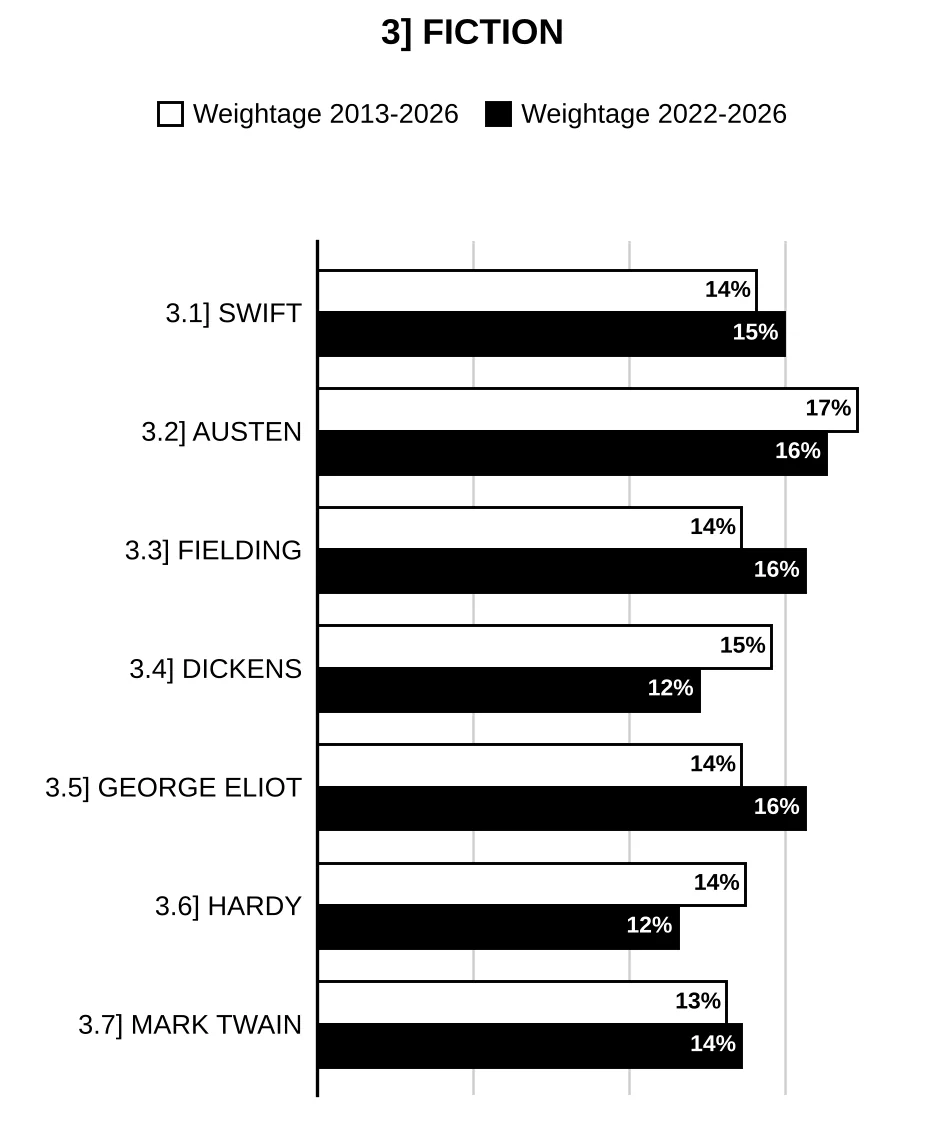
Here are all 144 questions on Texts: fiction (section b) asked in UPSC English Literature Optional Paper I (2009–2026), arranged under the 7 topics of this unit. Within each topic the latest questions come first.
Each question ends with a code such as [2024/15m/3b] – the year, the marks, the word limit (where UPSC set one) and the question number in the paper.
3.1] Jonathan Swift
21 questions
Jonathan Swift transports the reader to strange imaginary lands to vex and unsettle assumptions about the human world. Discuss. [2026/20m/6a]
How does Swift use satire in Gulliver’s Travels to critique his contemporary society? Explain with textual references. [2025/20m/6a]
In the guise of a travel narrative, Gulliver’s Travels satirizes the English customs and politics of the day. Discuss with suitable illustrations from the novel. [2024/20m/6a]
Gulliver’s Travels has ever been a very attractive adventure story for children and a pungent critique of humanity addressed to the adult. Analyse. [2023/20m/6a]
Analyse the philosophical and political background of Gulliver’s Travels. [2022/15m/6b]
Jonathan Swift pitches Lemuel Gulliver as an unreliable narrator. Discuss with examples from Gulliver’s Travels. [2022/15m/8c]
Through Gulliver’s Travels Jonathan Swift comments on England’s growing power. Justify. [2021/15m/6a]
How does Swift address the ‘ancients versus moderns’ controversy in Gulliver’s Travels? [2020/20m/6b]
Man is utterly wicked, desperate, and imbecile as portrayed in the fourth voyage of Gulliver. Do you agree? [2019/15m/6a]
Do you agree with the view that Gulliver suffers from a sense of identity crisis? [2019/15m/8c]
What are the objects of Swift’s satire in Gulliver’s journey to Laputa in Part III of Gulliver’s Travels? [2018/15m/8c]
“The surface of the book (Gulliver’s Travels) is comic but at its centre there is tragedy”. Elucidate with reference to Gulliver’s Travels. [2017/15m/6a]
Mention the ways in which Swift gets the reader to accept the fantastical people, places and phenomena in Gulliver’s Travels. [2017/20m/8b]
Describe Gullivers’ Travels as an individual’s constant attempt to integrate himself into a society in which he doesn’t belong. [2016/15m/6c]
Discuss Gulliver’s Travels as a tale with an element of the ridiculous and the fantastic which has a universal appeal. Elaborate. [2015/15m/6a]
This question has three parts:– What aspects of contemporary British life does Jonathan Swift satirise in Gulliver’s Travels? [2014/15m/6a]
This question has two parts. Each part should be answered in about 400 words:– ‘In a sense Book II of Gulliver’s Travels is a reversal of Book I.’ Do you agree? Give reasons for your answer. [2013/25m/400w/6b]
Gulliver’s four voyages display different aspects of Swift’s critique of his age. Discuss with illustrative references. [2012/30m/400w/6a]
In Gulliver’s Travels does the satirist’s ‘fierce indignation’ verge on misanthropy? Justify your answer. [2011/30m/6b]
Gulliver’s Travels and The Adventures of Huckleberry Finn are known as children’s classics. What appeal do they hold for the adult reader? Discuss. [2010/30m/6a]
How does Swift portray Gulliver as a divided person in the fourth book of Gulliver’s Travels? [2009/60m/7]

Preparing for Prelims too?
Our UPSC Prelims Topic-wise PYQ Book covers every Prelims question with detailed explanations, so you can see exactly where UPSC asks from. Now available as a hard copy and an eBook.
Buy Hard Copy on AmazonBuy eBook (PDF)3.2] Jane Austen
27 questions
How do Maggie Tulliver and Elizabeth Bennet represent contrasting models of female selfhood in the nineteenth century novel? [2026/20m/7a]
Critically analyse Pride and Prejudice as a timeless critique of social pressures and as a search for the self within a mundane life. [2026/15m/8b]
Discuss how Jane Austen uses irony as a narrative technique in Pride and Prejudice to reveal characters. [2025/15m/6b]
Critically comment on the representation of the money and marriage theme in Pride and Prejudice. [2024/15m/6b]
Discuss the significance of the title Pride and Prejudice and how far it suits the characters of the novel. [2023/15m/6b]
Analyse the importance of personal relationships in the novel, Pride and Prejudice. [2023/15m/8c]
Examine the late eighteenth century English class system as revealed in Pride and Prejudice. [2022/20m/6c]
How does Pride and Prejudice satirise women’s education, employment and marital status during the time of Jane Austen? [2022/15m/8b]
Elaborate how Jane Austen in Pride and Prejudice depicted a world in all its narrow pride and prejudice with unswerving accuracy and satire. [2021/15m/6b]
Pride and Prejudice opens up with the ironic narrative voice and it is the one the reader hears throughout the novel. Illustrate. [2020/15m/6c]
What attitudes to marriage can be discerned in Jane Austen’s account of Mr. and Mrs. Bennet, Charlotte Lucas and Mr. Collins, and Lydia Bennet and Mr. Wickham in Pride and Prejudice? [2020/15m/7c]
Most of our amusement in reading Pride and Prejudice comes from our being aware of differences between appearance and reality that go unperceived by the characters themselves. Discuss and illustrate this statement. [2019/20m/6b]
In Pride and Prejudice, Jane Austen combines the essence of conservative as well as reformist issues concerning rights, education, marriage, authority and gender discourse. Discuss. [2018/15m/7a]
The apparently superficial concern with marriage in Pride and Prejudice masks a deeper social critique. Discuss with reference to the novel. [2018/20m/8b]
Jane Austin is a critical observer who uses irony as a means of ‘moral and social judgement’. Examine Pride and Prejudice in the light of this statement. [2017/20m/6b]
“The women in Jane Austin’s novels are more life-like than the men”. How far is this comment applicable to Elizabeth in Pride and Prejudice. [2017/15m/8c]
“Within the narrow limits she set for herself, she achieved a finished realism with qualities of the highest wit and elegance.” Discuss with reference to Jane Austen’s art. [2016/20m/7b]
Critically examine the comment that Pride and Prejudice is a journey into self-understanding and a realistic assessment of an earlier misjudgement. [2016/20m/8b]
In Pride and Prejudice first impressions, illusions and subjective opinions give way to attachment, balance, reasonableness and, more painfully to humiliating reassessments. Discuss. [2015/20m/6b]
This question has three parts:– Pride and Prejudice is on the surface a novel depicting genteel life, but the motive force is a desperate man-hunt for social survival. Examine. [2014/15m/6b]
This question has three parts:– Elizabeth Bennet, Maggie Tulliver and Tess were strongly constrained by the society they lived in. Do you think they passively accept life as it comes or do they exercise choice? [2014/15m/8a]
This question has two parts. Each part should be answered in about 400 words:– Show what part is played by the other characters in bringing about the changes in Darcy and Elizabeth which lead to their final reconciliation in Pride and Prejudice. [2013/25m/400w/7a]
This question has three parts (a), (b) and (c). Each part should be answered in about 250 words: How do gender and class play an important role in the development of the plot in Pride and Prejudice? [2012/20m/250w/7b]
This question has three parts (a), (b) and (c). Each part should be answered in about 250 words: Do you think Darcy and Elizabeth are the main protagonists for the development of the plot in Pride and Prejudice? Or do you think Bingley and Jane are parallel protagonists in this novel? Answer your question on the basis of a close reading of the novel. [2012/20m/250w/7c]
Is it correct to describe Pride and Prejudice as a novel about the education of Elizabeth Bennett? Justify your answer. [2011/20m/7b]
“The tale is that of a man-hunt.” Do you agree with this critical view with reference to Pride and Prejudice? [2010/30m/6b]
Jane Austen focuses on the inner workings of the mind. In the light of this remark comment on Pride and Prejudice. [2009/60m/8]
3.3] Henry Fielding
20 questions
How is Fielding’s Tom Jones “a comic epic poem in prose”? [2026/20m/8a]
Substantiate your understanding of Tom Jones as a bildungsroman and a picaresque novel. [2025/15m/6c]
Examine the concept of virtue constructed and challenged through the characters of Tom and Sophia in the novel Tom Jones. [2025/20m/7a]
How does the author of Tom Jones convey a sense of morality to 18th century English readers? Discuss. [2024/15m/6c]
Comment on the role of Master Blifil in Tom Jones. [2024/15m/8c]
“Fielding in his novel, Tom Jones does not intend to make any judgments on human nature but rather presents it as a mixture of contradictions.” Critically examine the statement. [2023/15m/6c]
Attempt an exposition of the character of Tom Jones. [2022/15m/6a]
Discuss Tom Jones as a bildungsroman and a picaresque novel. [2021/20m/6c]
Tom Jones is the story of the protagonist’s journey from innocence, via experience, to wisdom. Elaborate the statement with events from the novel. [2020/15m/6a]
Fielding is not as sympathetic towards women as he is towards men. Do you agree? Give a reasoned answer. [2019/15m/6c]
Assess the role of the narrator in Tom Jones. [2018/15m/6a]
Explore the theme of charity in Fielding’s Tom Jones. How does Fielding emphasize this theme by contrast? [2017/15m/6c]
Sketch the development of the travel motif through the novel Tom Jones. [2016/15m/8a]
Dr Johnson called Tom Jones an “immoral text”. Would you agree? Write a reasoned answer. [2015/15m/6c]
In Tom Jones, Fielding’s scathing satire is reserved for the London upper classes. Discuss. [2015/15m/7a]
This question has three parts:– Describe your response to Tom Jones, a leisurely novel of a by-gone era. [2014/20m/6c]
This question has two parts. Each part should be answered in about 400 words:– ‘Though Tom’s heart is in the right place, his instincts are not always in his control.’ Do you agree? Justify your answer with illustrations from Tom Jones. [2013/25m/400w/6a]
This question has three parts (a), (b) and (c). Each part should be answered in about 250 words: In what way did Tom Jones contribute to the development of the novel in terms of both the form and content? Substantiate your answer with reference to the novel. [2012/20m/250w/7a]
‘Tom Jones is a panorama of the follies, vices and hypocrisies of the world?’ Discuss. [2011/30m/6a]
Consider Tom Jones as a comic epic in prose about a foundling. [2010/30m/7a]
3.4] Charles Dickens
20 questions
Analyse how Dickens offers a critique of capitalism in Hard Times. [2026/15m/6b]
Analyze the novel Hard Times under the statement “It was the best of times, it was the worst of times”. [2025/15m/7b]
Discuss the significance of the title of Dickens’ novel Hard Times. [2024/15m/7c]
Comment on the narrative structure of Dickens’ novel Hard Times. [2024/15m/8a]
Discuss the theme of education in Hard Times and how it is portrayed through the various characters and their experiences. [2023/15m/7b]
Hard Times lingers around questions of Utilitarianism, education and industrialization in the Victorian era. Discuss with illustrations from the novel. [2022/15m/7b]
Explain Dickens’ criticism of the Gradgrind Theory of Education in Hard Times. [2021/15m/7a]
How may one apply the pattern of ‘retributive justice’ to the principal characters in Hard Times? Illustrate. [2021/15m/8b]
Hard Times is built on the opposition between fact and fancy–a contrast which gives it both tension and unity. Elaborate. [2020/15m/7b]
Discuss Hard Times as a critique of industrial society. [2020/15m/8b]
Comment on the socio-economic and political issues that Dickens takes up in Hard Times. [2019/20m/7a]
Show how Dickens represents the impact of the Industrial Revolution in Hard Times, not only from the material, but also from the moral and philosophical perspectives. [2018/20m/6b]
How does Charles Dickens attack the typical ideology of the contemporary education in England and satirize the utilitarian philosophy of education in Hard Times. [2017/15m/7a]
On what grounds can you justify the division of the novel, Hard Times, into three parts with separate titles? [2016/15m/6a]
The novel Hard Times depends on the opposition between Fact and Fancy, the contrast which gives it both tension and unity. Discuss. [2015/20m/7b]
This question has three parts:– Hard Times was condemned by Macaulay for its “sullen Socialism”. In the next century it became more popular. How do you account for this? [2014/20m/7c]
This question has three parts:– E.M. Forster described Dickens’s men and women as “flat characters”. Which of the characters from Hard Times do you find conforming to or deviating from this description? [2014/20m/8c]
This question has two parts. Each part should be answered in about 400 words:– In Hard Times Dickens makes moral comments on the industrialization of society. Can you find instances to show how he incorporates such comments into a realistic narrative? [2013/25m/400w/7b]
This question has three parts (a), (b) and (c). Answer each part in about 250 words: Discuss Hard Times as a satire on several contemporary value systems–Utilitarianism, Materialism, Capitalism and Rationalism. [2012/20m/250w/8a]
Comment on the symbolic use of the urban setting in Hard Times. [2011/30m/8b]
3.5] George Eliot
20 questions
How do Maggie Tulliver and Elizabeth Bennet represent contrasting models of female selfhood in the nineteenth century novel? [2026/20m/7a]
Explore how The Mill on the Floss depicts the complexities of familial relationships through the characters of Maggie and Tom Tulliver. [2026/15m/8c]
Consider The Mill on the Floss interrogates the theme of education, particularly in relation to gender and class, through the contrasting experiences of Tom and Maggie. [2025/15m/7c]
The theme of conflict between personal desire and social expectation manifests in Maggie’s life choices in the novel The Mill on the Floss. Discuss. [2025/20m/8a]
The Mill on the Floss is a female crusade against the harsh constraints in which Victorian women suffered. Discuss. [2024/20m/7b]
The Mill on the Floss articulates the tension between circumstances and the spiritual energies of individual characters struggling against those circumstances. Would you agree? [2023/20m/7c]
Consider The Mill on the Floss as a subversion of the traditional bildungsroman. [2022/15m/7a]
The conclusion of The Mill on the Floss reiterates the nature-nurture debate in a subtle way. Elaborate. [2021/20m/7b]
Comment on the significance of the epigraph “In their death they were not divided”. How does George Eliot portray the relationship of the siblings in The Mill on the Floss? [2020/20m/7a]
Discuss the predicament of the self in conflict with the social milieu in The Mill on the Floss. [2019/15m/7b]
“Maggie Tulliver’s intelligence, scholarly competence and wide-ranging imagination become liabilities for a woman.” Discuss this statement with reference to social determinism. [2018/15m/7c]
Discuss the role of the narrator in George Eliot’s The Mill on the Floss. What values does the narrator uphold? [2017/20m/7b]
Treatment of Nature by George Eliot and Thomas Hardy in their novels. [2016/10m/150w/1e]
Critically comment on ‘point of view’ as a narrative technique in The Mill on the Floss. [2016/20m/6b]
How do patriarchist rules control and define the life of Maggie Tulliver in Mill on the Floss? Discuss. [2015/20m/8b]
This question has three parts:– Would you consider the course that Maggie Tulliver’s life takes, an inevitable consequence of her circumstances? Did she have choice? [2014/15m/7b]
This question has three parts:– Elizabeth Bennet, Maggie Tulliver and Tess were strongly constrained by the society they lived in. Do you think they passively accept life as it comes or do they exercise choice? [2014/15m/8a]
This question has two parts. Each part should be answered in about 400 words:– Discuss the role of society in the shaping of individual life and destiny in The Mill on the Floss and Tess of the d’Urbervilles. [2013/25m/400w/8a]
Analyse the position of women in the Victorian era with special reference to Maggie Tulliver and Tess. [2012/30m/400w/6b]
Maggie Tulliver’s two relationships with Philip Wakem and Stephen Guest were both doomed to failure. Analyse the reasons behind this. [2010/60m/8]
3.6] Thomas Hardy
23 questions
Explore Tess of the d’Urbervilles as a critique of sexual violence, misogyny and victim-blaming. [2026/15m/6c]
Elaborate the role of social class played in Tess’s life in the novel Tess of the d’Urbervilles. [2025/15m/8b]
Through the portrayal of Tess’ character, Hardy presents a critique of the social and moral evils of Victorian England. Discuss. [2024/20m/8b]
Discuss the division of the novel, Tess of the d’Urbervilles into seven phases and how each phase signifies Tess’s life and destiny. [2023/15m/8a]
Elaborate upon the conflicting moral values and confusions of a changing society in Tess of the D’Urbervilles. [2022/20m/7c]
Hardy makes coincidence an integral part of the structure of his novels and Tess of the d’Urbervilles is no exception to this rule. Elaborate the statement with illustrations from the novel. [2021/15m/7c]
In what ways might knowledge of the social context in which Tess of the d’Urbervilles was written and first published contribute to an understanding of the novel? [2021/15m/8c]
Hardy subtitled Tess of the d’Urbervilles as ‘A Pure Woman Faithfully Presented’ to express his rejection of the conventional heroine of Victorian fiction. Substantiate your answer with reference to the novel. [2020/15m/8c]
Do you find any similarity between Tess of the D’Urbervilles and a Greek Tragedy? [2019/15m/7c]
Examine the role of determinism in Tess of the D’Urbervilles. [2019/15m/8b]
Would you agree that Tess of the D’Urbervilles portrays the decadence of late Victorian England? Substantiate your answer with reference to the novel. [2018/20m/7b]
Hardy uses several symbols skillfully in Tess of the D’Urbervilles and they are too deep to be missed at first reading. Discuss. [2018/15m/8a]
Comment on the theme of the old social order versus the new in Thomas Hardy’s Tess of the d’Urbervilles. [2017/15m/7c]
Treatment of Nature by George Eliot and Thomas Hardy in their novels. [2016/10m/150w/1e]
Do Tess’s major actions arise out of her desire for social climbing or from her determination to exist? [2016/15m/7a]
How does Thomas Hardy dramatize his ideas of man’s cruelty to woman in Tess of the d’ Urbervilles? [2016/15m/8c]
Discuss the significance and relevance of the sub-title “A Pure Woman” appended by Thomas Hardy to Tess of the D’Urbervilles. How did the debate reveal the attitudes of Victorian society towards morality? [2015/15m/8a]
This question has three parts:– “Chockful of faults and falsity” is how a critic found Tess of the d’urbervilles. Consider this statement and give your opinion. [2014/15m/7a]
This question has two parts. Each part should be answered in about 400 words:– Discuss the role of society in the shaping of individual life and destiny in The Mill on the Floss and Tess of the d’Urbervilles. [2013/25m/400w/8a]
Analyse the position of women in the Victorian era with special reference to Maggie Tulliver and Tess. [2012/30m/400w/6b]
This question has three parts (a), (b) and (c). Answer each part in about 250 words: Many nineteenth century reviewers were critical of Tess of the d’Urbervilles accusing Hardy of depicting immorality in the novel. In what ways might Nineteenth-century readers have found this novel ‘immoral’? [2012/20m/250w/8c]
Critically examine Tess of the d’Urbervilles in the light of Thomas Hardy’s statement that he was a meliorist. [2011/40m/7a]
Critically examine the role played by coincidence in Tess of the O’Urbervilles. [2010/30m/7b]
3.7] Mark Twain
19 questions
Is Huckleberry Finn a realist novel or does it move beyond realism into satire and moral allegory? [2026/15m/7b]
Interpret how Mark Twain’s portrayal of race and slavery reflects the attitudes of his time in the novel The Adventures of Huckleberry Finn. [2025/15m/8c]
Explain how the character of Huckleberry Finn underlines the relationship between White and Black culture in the USA. [2024/15m/7a]
Mark Twain explores the various aspects of freedom in the novel, Huckleberry Finn. Discuss. [2023/15m/7a]
The author makes use of regional dialects and colloquial language in the novel, Huckleberry Finn. How does it contribute to the realism of the work? [2023/20m/8b]
The Adventures of Huckleberry Finn is not about the American Dream but its paradoxes. Illustrate. [2022/20m/8a]
How does Mark Twain’s use of the Mississippi River as the setting for The Adventures of Huckleberry Finn help define the theme of freedom versus slavery? [2021/20m/8a]
“A sound heart is a surer guide than an ill-trained conscience.” How far is this comment applicable in the context of The Adventures of Huckleberry Finn? [2020/20m/8a]
Critically examine The Adventures of Huckleberry Finn as an attack on the institution of slavery. [2019/20m/8a]
The Mississippi river is a striking metaphor for Huck Finn’s journey, his great escape and quest for freedom. Do you think the river is the main structural principle of the novel? [2018/15m/6c]
Mark Twain’s The Adventures of Huckleberry Finn is more than a straightforward story about a boy and a runaway slave floating down the Mississippi River. What are the serious issues it addresses? [2017/15m/8a]
The river is one of the most powerful motifs in Huckleberry Finn. Show its relationship to the lives of Huck and Jim. [2016/15m/7c]
The Adventures of Huckleberry Finn shows the growth of consciousness of an innocent young orphan into an adolescent who understands the evil world around him. Discuss. [2015/15m/7c]
How does Mark Twain address the question of slavery in Huckleberry Finn? Discuss. [2015/15m/8c]
This question has three parts:– The Adventures of Huckleberry Finn is more than a boy’s tale. What are the serious issues it addresses? [2014/15m/8b]
This question has two parts. Each part should be answered in about 400 words:– Consider Twain’s handling of the ‘outlaw figure’ in The Adventures of Huckleberry Finn. [2013/25m/400w/8b]
This question has three parts (a), (b) and (c). Answer each part in about 250 words: Critically consider Huckleberry Finn as a novel about the conflict between society and the individual. [2012/20m/250w/8b]
What is your opinion of the way in which Twain handles the issue of race in The Adventures of Huckleberry Finn? Explain with reference to the text. [2011/30m/8a]
Gulliver’s Travels and The Adventures of Huckleberry Finn are known as children’s classics. What appeal do they hold for the adult reader? Discuss. [2010/30m/6a]

Strengthen your GS papers
Our UPSC Mains Topic-wise & Year-wise PYQ Book (2013–2026) maps every GS question to the syllabus, so you know what UPSC asks and how often. Now available as a hard copy and an eBook.
Buy Hard Copy on AmazonBuy eBook (PDF)« Previous: Texts: poetry and drama (section a) · Next: Critical analysis of unseen passages »
Back to: English Literature Optional PYQs – Topic-wise
Last updated: 2 November 2026