
Here are all 27 questions on Critical analysis of unseen passages asked in UPSC English Literature Optional Paper II (2009–2026), with the latest questions first.
Each question ends with a code such as [2024/15m/3b] – the year, the marks, the word limit (where UPSC set one) and the question number in the paper.
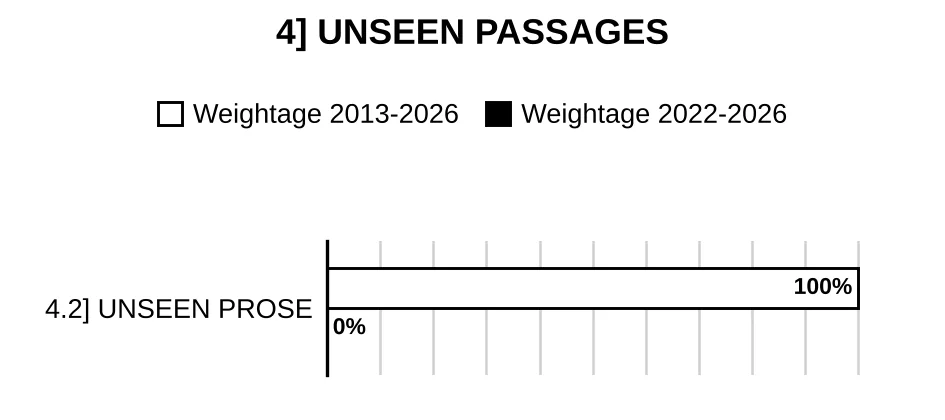
27 questions
Read the following passage and answer the questions that follow: What does the epochal analysis usually take into account? [2014/10m/5a]
Read the following passage and answer the questions that follow: What has traditionally been the treatment of cultures in relation to the culture? [2014/10m/5b]
Read the following passage and answer the questions that follow: What should be the ideal way to study the historical processes of cultural formation? [2014/10m/5c]
Read the following passage and answer the questions that follow: Explain the viewpoint of the author towards cultural study at a given point in history. [2014/10m/5d]
Read the following passage and answer the questions that follow: Bring out the relation between dominant, residual and emergent cultures. [2014/10m/5e]
What possible meanings exist beyond mere lexical meaning? [2013/10m/5a]
How differently significant are the two questions concerning Cordelia’s silence in King Lear? [2013/10m/5b]
What special meaning to a speech does ‘dramatic irony’ give? [2013/10m/5c]
In what way is the meaning of a character’s utterance limited and limiting in narrative fiction? [2013/10m/5d]
Explain the phrase ‘the sense of the design’. [2013/10m/5e]
Read the following passage and answer the questions that follow: In what way does a study of literature become a literary act? Why is this element supposed to be missing on the elementary level? [2011/10m/5a]
Read the following passage and answer the questions that follow: How is a creative act also a critical act? Explain: “rewarding confusions of this sort”. [2011/10m/5b]
Read the following passage and answer the questions that follow: When does the study of literature lose its value and become a tyranny? [2011/10m/5c]
Read the following passage and answer the questions that follow: What does the author mean by “fastidious”? Does it have a negative meaning in this context? [2011/10m/5d]
Read the following passage and answer the questions that follow: Who is a “tyrannical teacher”? Why would some students go along with him? [2011/10m/5e]
Read the following passage and answer the questions that follow: Why are critical acts so seldom free? [2011/10m/5f]
Read the following passage and answer the questions that follow: What does the author say about cows and calves? [2010/10m/5a]
Read the following passage and answer the questions that follow: On which occasions did he ask Tess about the wedding? [2010/10m/5b]
Read the following passage and answer the questions that follow: Comment on the changing season as depicted by the author. [2010/10m/5c]
Read the following passage and answer the questions that follow: What led the man to remind the woman of “the date”? [2010/10m/5d]
Read the following passage and answer the questions that follow: Why did not Tess name the wedding day? [2010/10m/5e]
Read the following passage and answer the questions that follow: Explain the meaning of any five of the six underlined words/terms in the passage, keeping in mind the context in which these are used. [2010/10m/5f]
Read the following passage and answer the questions that follow: How do ‘meaningless black marks’ already involve us in meanings? [2009/12m/5a]
Read the following passage and answer the questions that follow: What do the two metaphors of ‘a row of black marks’ and ‘a large grey patch’ achieve in juxtaposition? [2009/12m/5b]
Read the following passage and answer the questions that follow: What does reading a poem involve? [2009/12m/5c]
Read the following passage and answer the questions that follow: What advantage does a face-to-face dialogue have over a printed poem? [2009/12m/5d]
Read the following passage and answer the questions that follow: “And such contexts are in embarrassingly plentiful supply.” Explain the italicised phrase. [2009/12m/5e]

Preparing for Prelims too?
Our UPSC Prelims Topic-wise PYQ Book covers every Prelims question with detailed explanations, so you can see exactly where UPSC asks from. Now available as a hard copy and an eBook.
Buy Hard Copy on AmazonBuy eBook (PDF)
Strengthen your GS papers
Our UPSC Mains Topic-wise & Year-wise PYQ Book (2013–2026) maps every GS question to the syllabus, so you know what UPSC asks and how often. Now available as a hard copy and an eBook.
Buy Hard Copy on AmazonBuy eBook (PDF)« Previous: Texts: fiction (section b) · Next: Other questions »
Back to: English Literature Optional PYQs – Topic-wise
Last updated: 2 November 2026