
This page brings together all Politics of Separatism and Partition History Optional PYQs asked in UPSC Civil Services Mains from 1995 to 2026, arranged topic-wise. It is unit 12 of Paper 2, Section A – Modern India, with 22 questions, the latest from 2024.
Politics of Separatism and Partition – History Optional PYQs (1995–2026)
12.1] Politics of separatism: the Muslim League; the Hindu Mahasabha
1. Critically examine: The strength of the Pakistan programme was its vagueness. It meant everything to everyone. [2024/10m/150w/1e]
2. How did Dr. B.R. Ambedkar try to seek a political solution to the problem of caste in India? [2016/10m/3c]
3. Comment on: “Please remember, in granting separate electorates we are sowing the dragon’s teeth and the harvest will be bitter.” (Morley) [2009/20m/200w/1c]
4. Comment on: “There is no other instance in the history of mankind of a poet and philosopher working such a miracle in shaping the destiny of his people” (A Tribute to M. Iqbal) [2007/20m/200w/1d]
5. Trace the origin and growth of the Indian Muslim League. [1999/60m/3]
6. The Pakistan movement converted a cultural and religious entity of a people into a separatist political force. Elucidate. [1996/60m/4]
12.2] Communalism and the politics of partition
1. Critically examine: The strength of the Pakistan programme was its vagueness. It meant everything to everyone. [2024/10m/150w/1e]
2. Critically examine the turns and twists in the politics of partition in 1930’s and 1940’s. [2018/20m/4b]
3. “The developments during 1937–1939 greatly undermined the ability of the Indian National Congress to push through the agenda of national unity.” Comment. [2010/20m/2c]
4. Discuss as to why the Congress accepted the partition of India in 1947. [2009/30m/4a]
5. Comment on: “I felt that if we did not accept partition, India would be split into many bits and would be completely ruined.” [2006/20m/200w/1d]
6. The Pakistan movement converted a cultural and religious entity of a people into a separatist political force. Elucidate. [1996/60m/4]

Preparing for Prelims too?
Our UPSC Prelims Topic-wise PYQ eBook covers every Prelims question with detailed explanations, so you can see exactly where UPSC asks from.
View the BookDownload Free Sample12.3] Transfer of power; Independence
1. Critically examine: “If abdication of British responsibility at the time of transfer of power was callous, the speed with which it was done made it worse.” [2023/10m/150w/1e]
2. Critically examine: “Based on his discussion with Indian leaders, as well as his own perception, Lord Mountbatten soon came to the conclusion that partition was the only practicable and feasible solution.” [2020/10m/150w/1e]
3. Explain why the efforts at finding solution to India’s constitutional impasse failed during 1942–1946. [2017/20m/3b]
4. “The Royal Indian Navy Revolt was seen as an event which marked the end of the British rule almost as finally as Independence Day.” Explain. [2015/10m/3c]
5. “… instead of rejecting the plan (Cabinet Mission Plan), they (the Congress Leadership) resorted to a half-baked legalistic stratagem to reserve their position on its long-term arrangements and accepted its short-term provisions.” Critically examine. [2014/20m/2b]
6. “Why did the British finally quit India on 15th August, 1947? The Imperialist answer is that independence was simply the fulfilment of Britain’s self-appointed mission to assist the Indian people to self-government.” Examine. [2014/20m/4b]
7. Discuss as to why the Congress accepted the partition of India in 1947. [2009/30m/4a]
8. Comment on: “I felt that if we did not accept partition, India would be split into many bits and would be completely ruined.” [2006/20m/200w/1d]
9. Comment on: ‘We are therefore unable to advise the British Government that the power which at present resides in British hands should be handed over to two entirely separate sovereign States.’ [2004/20m/200w/1d]
10. Comment on: “Both freedom and partition were the work of Indian middle classes.” [1998/20m/200w/1d]
Summary of Politics of Separatism and Partition PYQs (1995–2026)
| Total questions (1995–2026) | 22 (18 unique – a few questions are listed under more than one sub-topic) |
| Total marks asked | 400 (unique questions) |
| Questions in last 5 years (2022–2026) | 3 (2 unique) |
| Most recent year asked | 2024 |
| Sub-topics | 3 (12.1 to 12.3) |
The earliest question here dates from 1996 and the latest from 2024; UPSC has drawn on this unit in 16 of the 32 years. In the last five years (2022–2026), 3 questions were set from it.
Official Syllabus
12. Politics of Separatism and Partition: Politics of Separatism; the Muslim League; the Hindu Mahasabha; Communalism and the politics of partition; Transfer of power; Independence.
Source: UPSC Civil Services Examination 2026 notification. The notification gives no title for this unit; the short title used here is editorial.
Where this unit stands in Modern India
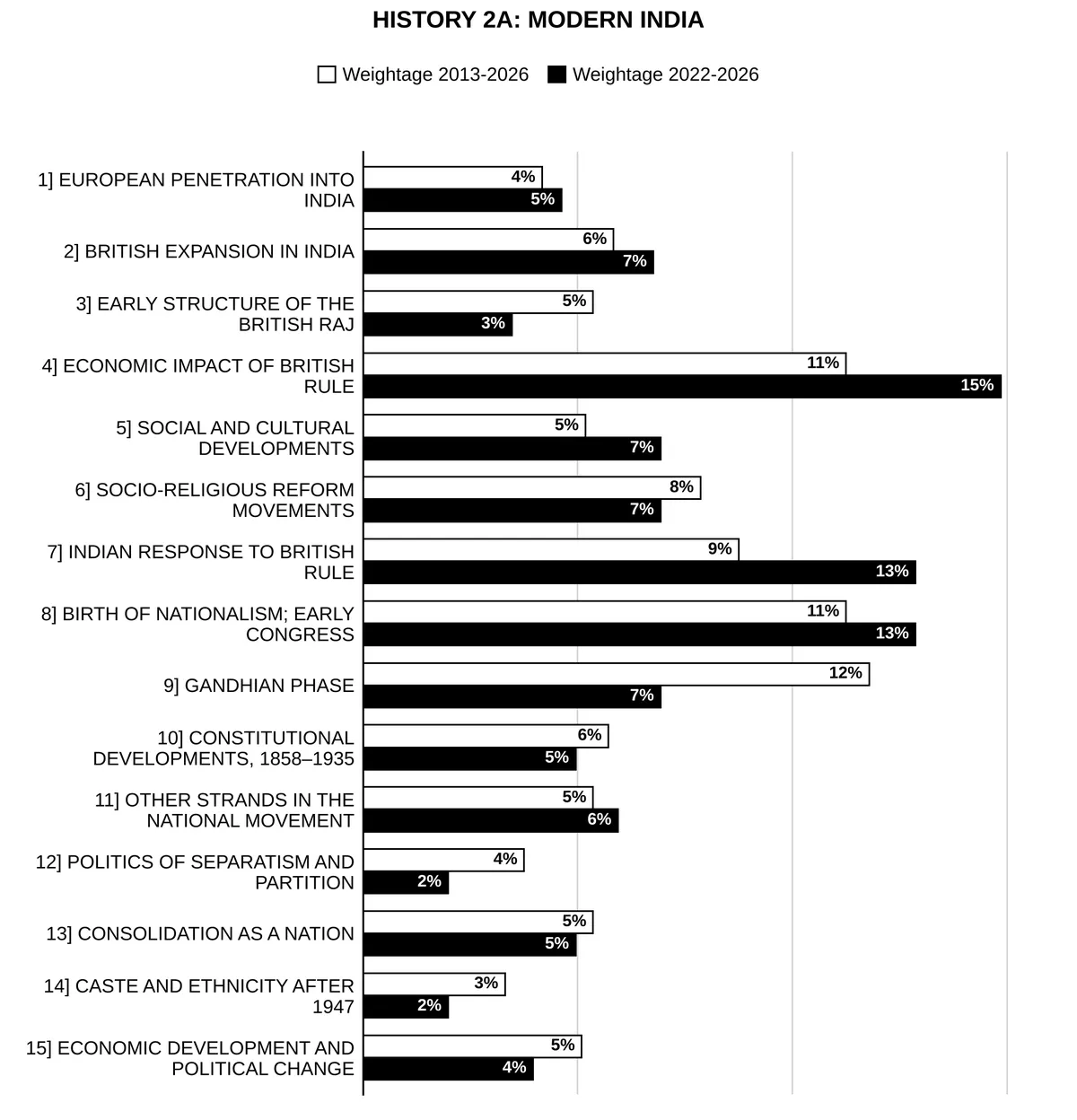
Politics of Separatism and Partition accounted for about 2% of the marks asked in Modern India in 2022–2026, down from 4% over 2013–2026, ranking 15th of the 15 units in the section by recent weightage.
How to use these PYQs
- Map every question to a phrase of the official syllabus shown above; recurring phrases show where UPSC’s interest lies.
- Start with the latest questions at the top of each list to see how UPSC frames this unit today; the older 60-mark questions are still useful for depth and content.
- Write timed answers to a few questions every week, keeping to the marks and word limit in each code, and revisit questions you found difficult.
Frequently Asked Questions
How many History Optional questions have been asked from Politics of Separatism and Partition?
This collection lists 22 question entries from Politics of Separatism and Partition (unit 12 of Paper 2) between 1996 and 2024, of which 18 are unique questions; the rest are listed under more than one sub-topic. They were asked in 16 of the 32 years and 3 came in 2022–2026.
When was Politics of Separatism and Partition last asked in History Optional?
Most recently in 2024, with 1 question (2024/10m/150w/1e). Before that, it was asked in 2023.
Where can I find all History Optional PYQs topic-wise?
All units of Paper 1 and Paper 2, the map question and the earlier-syllabus questions are linked from History Optional PYQs Topic-wise (1995–2026).
« Previous: Other Strands in the National Movement – History Optional PYQs (1995–2026)
Next: Consolidation as a Nation – History Optional PYQs (1995–2026) »
Back to: History Optional PYQs Topic-wise (1995–2026) | Also see: History Optional year-wise question papers (1995–2026)