
Every question in this collection of Other Strands in the National Movement History Optional PYQs (1995–2026) is given below with its year, marks and question number. It is unit 11 of Paper 2, Section A – Modern India, with 20 questions, the latest from 2026.
Other Strands in the National Movement – History Optional PYQs (1995–2026)
11.1] The Revolutionaries
1. Critically examine: “Bhagat Singh and his comrades significantly expanded the meaning and scope of revolution, redefining it beyond mere political upheaval to include social and ideological transformation.” [2025/10m/150w/1c]
2. Analyse how the revolutionaries taught people self confidence and widened the social base of the freedom movement. [2022/10m/3c]
3. Do you agree with the fact that the virtual failure of the Non-Cooperation Movement and the gloom that descended on the nationalist scene, created conditions for revolutionary activities? Discuss. [2020/20m/3b]
4. Trace the origin of the Ghadar movement and discuss its impact on the revolutionaries in India. [2017/20m/3a]
5. Critically examine: “The very idea of the bomb and the secret society, and of propaganda through action and sacrifice were imports from the West.” [2015/10m/150w/1d]
6. Describe the changing nature of revolutionary activities in India between 1905–1946. [2008/60m/4]
7. Examine the causes of the rise and progress of revolutionary movements in India from 1905 to 1931. [2003/60m/4]
11.2] The Left: the Left within the Congress
1. “Subhas Chandra Bose and the Indian National Army awakened an unprecedented sense of national consciousness among both the Indian armed forces and masses.” Evaluate. [2026/20m/4b]
2. The Congress Socialist Party agenda was not to cut off from the Congress, but ‘intended to give the Congress and the national movement a socialist direction’. Analyse. [2023/20m/4b]
3. Assess the role of Subhas Chandra Bose in India’s struggle for independence. [2019/20m/4b]
4. Underline the growth of various forms of Socialist ideologies in the Indian National Movement between World Wars I and II. [2018/20m/3a]
5. “A powerful left-wing group developed in India in the late 1920s and 1930s, contributing to the radicalization of national movement.” Critically examine. [2015/10m/2c]
6. Critically evaluate: “The emergence of left-wing group in the Congress radicalized its social and economic agenda.” [2011/20m/200w/1c]

Preparing for Prelims too?
Our UPSC Prelims Topic-wise PYQ eBook covers every Prelims question with detailed explanations, so you can see exactly where UPSC asks from.
View the BookDownload Free Sample7. Account for the emergence of the left-wing within the Congress. How far did it influence the programme and Policy of the Congress? [2006/60m/4]
8. Comment on: “The ideology of Subhash Chandra Bose was a combination of nationalism, fascism and communism.” [2002/20m/200w/1d]
9. Discuss the nature of the leadership and programme of the Congress Socialist Party. [2002/60m/4]
10. Account for the rise and growth of leftism in the Congress movement. What impact did it have on contemporary Indian politics? [1997/60m/4]
11.3] The Communist Party of India and other left parties
1. Critically examine: The rise of the Communist Movement in India in the 1920s lent a militant and revolutionary content to the Trade Union Movement. [2021/10m/150w/1d]
2. Underline the growth of various forms of Socialist ideologies in the Indian National Movement between World Wars I and II. [2018/20m/3a]
3. “A powerful left-wing group developed in India in the late 1920s and 1930s, contributing to the radicalization of national movement.” Critically examine. [2015/10m/2c]
Summary of Other Strands in the National Movement PYQs (1995–2026)
| Total questions (1995–2026) | 20 (18 unique – a few questions are listed under more than one sub-topic) |
| Total marks asked | 510 (unique questions) |
| Questions in last 5 years (2022–2026) | 4 |
| Most recent year asked | 2026 |
| Sub-topics | 3 (11.1 to 11.3) |
The earliest question here dates from 1997 and the latest from 2026; UPSC has drawn on this unit in 16 of the 32 years. In the last five years (2022–2026), 4 questions were set from it.
Official Syllabus
11. Other Strands in the National Movement: The Revolutionaries: Bengal, the Punjab, Maharashtra, U.P., the Madras Presidency, Outside India. The Left: The Left within the Congress: Jawaharlal Nehru, Subhas Chandra Bose, the Congress Socialist Party; the Communist Party of India, other left parties.
Source: UPSC Civil Services Examination 2026 notification. The notification gives no title for this unit; the short title used here is editorial.
Where this unit stands in Modern India
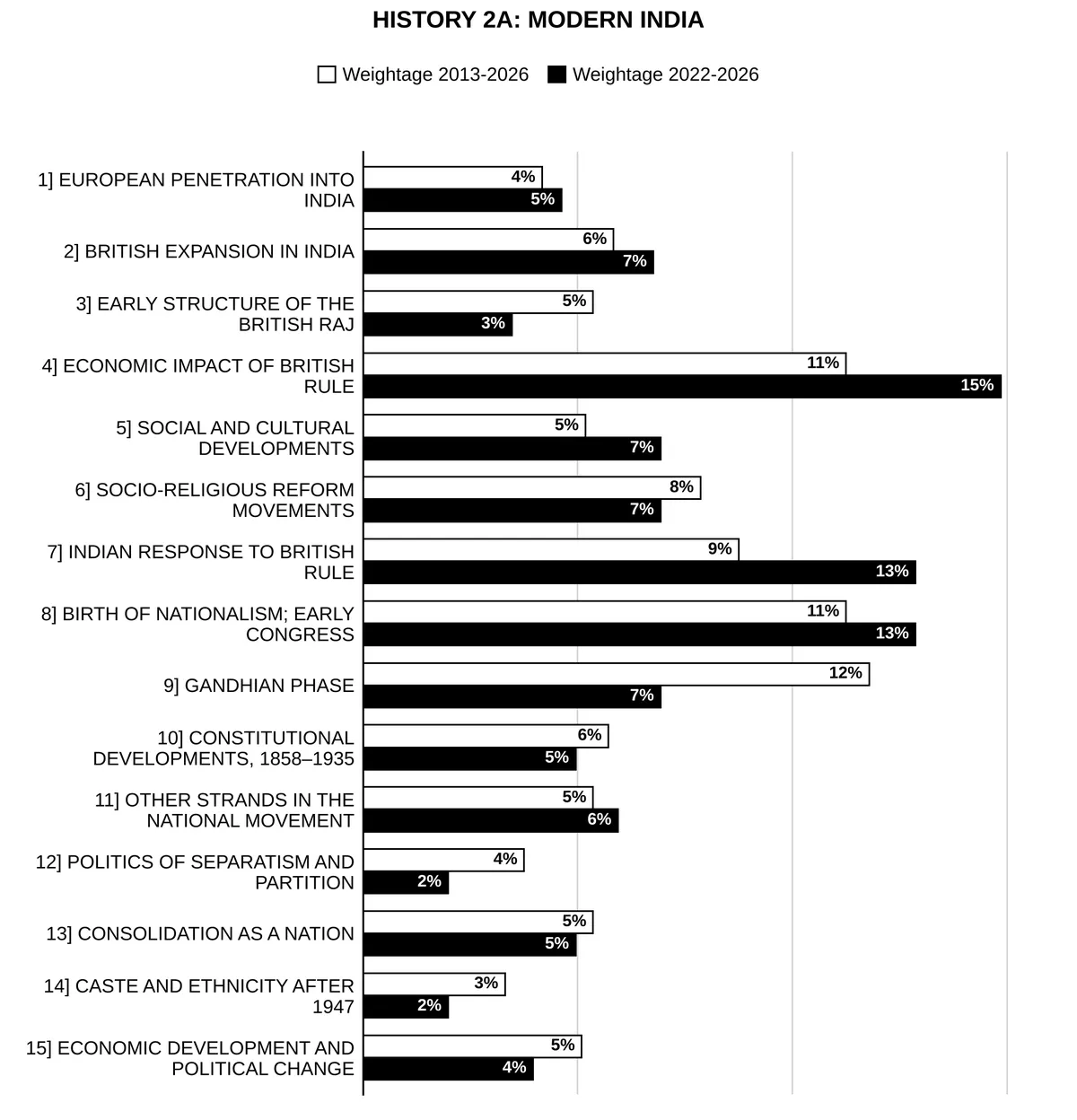
Other Strands in the National Movement accounted for about 6% of the marks asked in Modern India in 2022–2026, up from 5% over 2013–2026, ranking 8th of the 15 units in the section by recent weightage.
How to use these PYQs
- Compare the questions with the official syllabus wording above – themes that recur across years deserve the deepest notes.
- Give priority to the recent questions (2013 onwards follow the present 250-mark paper pattern); use the pre-2013 questions to test your depth of content.
- Practise answers within the word limit shown in the question code (for example 150w or 250w) and under timed conditions, then revise them after a week.
Frequently Asked Questions
How many History Optional questions have been asked from Other Strands in the National Movement?
This collection lists 20 question entries from Other Strands in the National Movement (unit 11 of Paper 2) between 1997 and 2026, of which 18 are unique questions; the rest are listed under more than one sub-topic. They were asked in 16 of the 32 years and 4 came in 2022–2026.
When was Other Strands in the National Movement last asked in History Optional?
Most recently in 2026, with 1 question (2026/20m/4b). Before that, it was asked in 2025.
Where can I find all History Optional PYQs topic-wise?
All units of Paper 1 and Paper 2, the map question and the earlier-syllabus questions are linked from History Optional PYQs Topic-wise (1995–2026).
« Previous: Constitutional Developments – History Optional PYQs (1995–2026)
Next: Politics of Separatism and Partition – History Optional PYQs (1995–2026) »
Back to: History Optional PYQs Topic-wise (1995–2026) | Also see: History Optional year-wise question papers (1995–2026)