
Here are all 77 Dermatology questions asked in UPSC Medical Science Optional Paper II from 1995 to 2026, arranged under the 2 topics of the official syllabus. Within each topic the latest questions come first.
Each question ends with a code such as [2024/15m/3b] – the year, the marks, the word limit (where UPSC set one) and the question number in the paper.
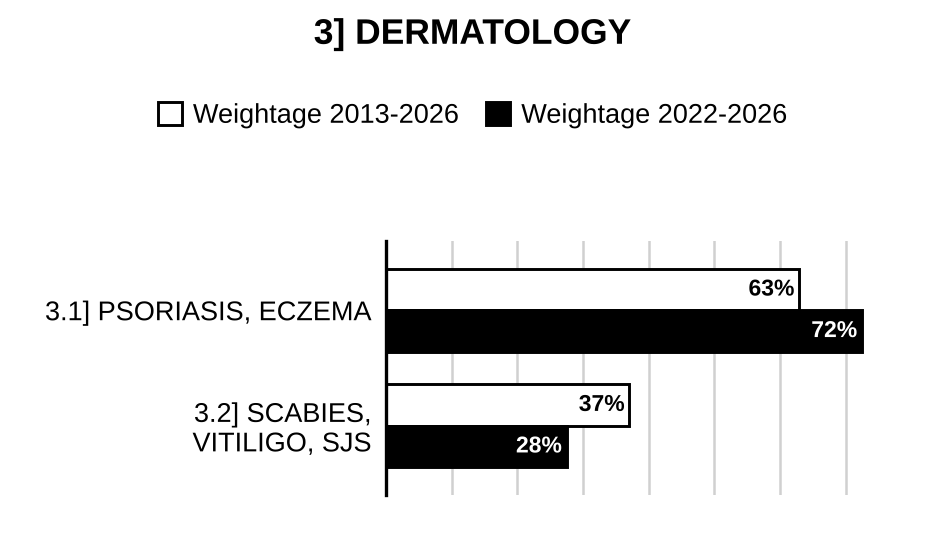
3.1] Psoriasis, eczema and dermatitis
37 questions
(i) What do you understand by a papulosquamous lesion in dermatology? Enumerate these disorders. (ii) Describe the clinical and histopathological clues for the differentiation between psoriasis and lichen planus. [2026/10m/1e]
A 1-month-old infant has yellowish greasy scaling on the vertex and frontal area of the scalp. His retroauricular and nasolabial folds show erythema and scaling. (i) What is the diagnosis? (ii) What is the aetiology of this disorder? (iii) How do you manage this disorder? [2026/10m/2c]
(i) Describe the clinical and histopathological features of acute, subacute and chronic eczema. (ii) What is Airborne Contact Dermatitis? Discuss its aetiology and clinical features. [2026/10m/3c]
(i) Define eczema. (ii) How do you classify eczema? (iii) Enumerate the differences between allergic contact dermatitis and irritant contact dermatitis. [2025/10m/2c]
A 28-year-old female with a long history of psoriasis develops symmetrical, flexural and grouped pustules with high grade fever and severe constitutional symptoms in the third trimester. (i) What is your diagnosis? (ii) How do you manage the condition? (iii) What are the complications? [2025/10m/3c]
A young female patient develops acute inflammatory papules and vesicles all over her scalp and tips of ears following repeated use of hair dye. (i) What is the diagnosis? (ii) How can the diagnosis be confirmed? (iii) How will this condition be treated? [2024/15m/3c]
(i) What is the meaning of the term ‘lichenoid’? (ii) Name the disease that is a prototype of lichenoid reaction. (iii) Describe the clinical features of the disease. [2024/10m/4c]
A 40-year-old male presented with multiple itchy, violaceous, flat-topped papules over skin for last one year. He also complained of burning sensation in mouth. (i) Diagnose this condition. (ii) What are the oral findings which can be associated with this condition? (iii) Outline its management. [2023/10m/1e]
A 48-year-old male presented with yellowish, greasy scales and redness over the scalp. (i) What is the most likely diagnosis? (ii) Mention the sites of involvement in this disease. (iii) Name the organism responsible for the pathogenesis of this disease. (iv) Outline its treatment. [2023/15m/2c]
(i) Mention the nail findings in psoriasis. (ii) Discuss the topical and systemic therapies in psoriasis. [2023/15m/3c]
(i) What are the four ‘P’s used to describe clinical manifestation of lichen planus? (ii) What are the common sites of cutaneous involvement in lichen planus? (iii) Describe Koebner phenomena. List the disorders where this phenomena can be observed. [2022/15m/2c]
Following an acute episode of diarrhoea a 3 month old infant wearing diaper daily develops rash on skin surfaces that are in direct contact with diaper. (i) What is your diagnosis? Describe clinical picture of this disorder. (ii) How do you treat skin condition of this child? [2022/15m/3c]
An adolescent girl fond of wearing artificial jewellery presented with itchy, papulo-vesicular skin lesions on the ears, wrists and neck. (i) What is the likely diagnosis? (ii) Name the gold standard test which you would use for the confirmation of diagnosis. (iii) How would you interpret the test results? (iv) State the complications of this test. [2021/10m/1e]
(i) Give the clinical findings of lichen planus at the following sites: • Nails • Scalp • Mucosa • Palms and Soles (ii) State the histopathological findings of oral lichen planus. (iii) Discuss the management of oral lichen planus. [2021/15m/3c]
(i) What is the differential diagnosis of psoriatic arthritis? How would you distinguish psoriatic arthritis from other conditions? (ii) Discuss the management of psoriatic arthritis. [2021/10m/4c]
A 30-year-old male presented with well-demarcated erythematous plaques with silvery white scales on the knees and elbows. Grattage test was positive. (i) Enlist the differential diagnosis for various clinical forms of this disorder. (ii) State briefly the treatment options for this disorder, for mild, moderate and severe presentation. (iii) What are the various disease modifying factors for this skin disorder? [2020/15m/2c]
A 4-month-old infant presented with severe itching disturbing her sleep. On examination she had redness, papules and excoriations on the cheeks. Family history revealed asthma in mother since childhood. (i) What is the most likely diagnosis? (ii) What is the clinical presentation in different age groups? (iii) State its diagnostic criteria. (iv) Discuss first, second and third line of management and the non-medical measures for this condition. [2020/20m/3a]
An elderly female developed itchy, firm, shiny, violet, polygonal, flat topped papules on her wrists and ankles. (i) What could be the associated environmental factors for this disorder? (ii) What are its clinical variants? (iii) State its histopathology findings. [2020/15m/4b]
A patient develops an acute vesicular reaction on scalp after using ‘Henna’ as black dye for colouring his hair. (i) What is your diagnosis? Describe the gold standard test done to confirm this condition. (ii) What all chemicals in Henna can cause this condition? (iii) How will you treat it? [2019/10m/3c]
(i) Enumerate various major clinical forms of Psoriasis. (ii) What are the clinical patterns of joint involvement in Psoriatic Arthritis? (iii) What are the systemic co-morbidities with Psoriasis? (iv) Describe classic histopathology findings in Psoriasis. [2019/15m/4c]
A 45-year-old gentleman, agriculturist by occupation, presents with recurrent itchy scaly lesions over face and limbs of one year duration. Examination revealed hyperpigmented scaly lesions over face, neck and upper and lower limbs. There were involvement of skin creases, eyelids, retroauricular areas and nasolabial folds. He gave history of photosensitivity. (i) What is your likely diagnosis? (ii) What tests will you perform to establish the cause of his condition? Describe in brief. (iii) How will you treat this gentleman? [2017/15m/2c]
A 30-year-old female presents with itchy lesions over upper and lower limbs of one month duration. On examination, multiple discrete flat-topped skin-coloured and violaceous papules were present around ankles, wrist and forearms. (i) Which other areas will you examine to arrive at a clinical diagnosis? (ii) What are the tests will you perform to confirm the diagnosis? (iii) How will you treat this lady? [2017/15m/3c]
A housewife develops itching and irritation in the webs of the hands, following peeling/cutting of vegetables such as jackfruit and lady’s finger. It is relieved slightly on washing with cold water. (i) What is the likely diagnosis? (ii) Discuss the etiopathogenesis, management and prevention of this condition. [2016/10m/1e]
A young adult presents with erythematous, raised, scaly plaques of various sizes, all over the body, specially the extensor aspects. (i) What other areas will you examine and what clinical tests will you perform to clinch the diagnosis? (ii) Enumerate the involvement of other systems and their presenting features. (iii) List the drugs that can be used in cases not responding to the standard management. [2016/10m/2c]
(i) Describe the clinical features of one non-infective and one parasitic, infective dermatosis. (ii) Describe the histopathological features of the above conditions in a healthy adult and in immuno-compromised individuals. [2016/10m/3c]
A 45-year-old lady develops itchy, hyperpigmented, scaly lesions on face. These lesions become worse after the use of hair dye which she started using five months earlier. (i) What is the most likely diagnosis? (ii) How can this diagnosis be confirmed? (iii) What medical advice can be given to this lady? [2015/15m/2c]
Enumerate the points of differentiation between psoriatic and rheumatoid arthropathy. [2014/10m/1e]
A mason working at a building site has developed itchy, oozing lesions of hands and feet. What is the likely diagnosis? How will you identify the causative agent in him and manage the case? [2014/10m/3c]
How will you differentiate between irritant and allergic contact dermatitis? Write the salient differentiating points of both. [2013/10m/1e]
(i) Enumerate the cutaneous, mucosal, follicular and nail manifestations of lichen planus. (ii) Describe the histopathological features in a typical lichen planus and their relevance to clinical presentation. [2013/10m/2c]
Classify eczema. What is the diagnostic test for allergic contact dermatitis? Discuss in brief the management of atopic dermatitis. [2012/15m/3d]
Enumerate the classical histopathological features of Psoriasis vulgaris and their clinical correlation. [2011/20m/2b]
Mention common incriminating allergens. Discuss the management of allergic dermatitis. [2010/20m/2b]
Enumerate types of psoriatic arthropathies. How will you manage a case of severe psoriatic arthropathy? [2010/20m/3b]
Describe Koebner’s phenomenon and enumerate various skin disorders in which it is observed. [2010/20m/4b]
Enumerate differences between Allergic and Irritant contact dermatitis. [2009/15m/1e]
Describe the clinical features and management of Psoriasis. [2005/20m/1d]

Preparing for Prelims too?
Our UPSC Prelims Topic-wise PYQ eBook covers every Prelims question with detailed explanations, so you can see exactly where UPSC asks from.
View the BookDownload Free Sample3.2] Scabies, vitiligo and Stevens-Johnson syndrome
40 questions
A joint family comprising of senior citizens, antenatal women and one-month-old infant is suffering from scabies. (i) Name the organism that causes scabies in humans. (ii) What factors are involved in the transmission of scabies in a family? (iii) How do you plan to treat scabies in this family? [2025/10m/1e]
In a confirmed case of scabies in an adult: (i) What are the primary manifestations of the disease and what is the pattern of distribution of lesions on the body? (ii) What are the complications seen in scabies? [2024/10m/1e]
A young adult female develops asymptomatic depigmented chalky white macules and patches with no sign of inflammation over face and around body orifices. (i) What is the diagnosis? (ii) What are the associated findings seen in this disorder? (iii) How is this disorder classified? (iv) Describe the clinical course of the disease. [2024/15m/2c]
(i) State the various modes of transmission of scabies. (ii) What is the mite burden in a classical case of scabies during 1. an initial infection 2. in reinfection 3. in Norwegian scabies (iii) Describe the distribution of cutaneous findings in scabies. [2022/10m/1e]
A young epileptic patient was put on antiseizure drug Lamotrigine. Three weeks later he develops an eruption consisting of purpuric macules and bullae all over skin with involvement of lips, oral mucous membrane and eyes. Skin was tender to touch. (i) What is the differential diagnosis in this case? (ii) How will you manage this condition? [2022/10m/4c]
(i) Write the atypical presentations of scabies. (ii) Describe the management of scabies in a neonate, in a child less than 2 years of age, an adult and a pregnant female. (iii) State the causes which can lead to persistent itching following the administration of scabicide therapy. [2021/15m/2c]
Parents of a 7-year-old girl noticed milky white macules on her upper eyelids and hands. Her mother had been recently diagnosed as a case of autoimmune thyroiditis. (i) What is the diagnosis for her skin lesions? Enlist the differential diagnosis of this clinical entity. (ii) Enumerate the disorders associated with this condition. (iii) How would you classify this disorder? [2020/10m/1e]
An Asian HIV patient suffering from haematologic malignancy was put on carbamazepine for epilepsy/convulsions. After 3 weeks of therapy, he developed influenza like symptoms lasting 3 days followed by development of large number of bullae on skin and mucous membranes of mouth, eyes and genitalia. On examination, skin involvement was extensive and very painful. Nikolsky sign was positive. (i) What is your diagnosis? Justify in points. (ii) What are the possible risk factors in this patient? (iii) How will you assess the severity of the disease? [2019/10m/150w/1e]
(i) Describe pointwise management of a case of Stevens-Johnson Syndrome (SJS). (ii) What is the mortality rate in SJS and Toxic Epidermal Necrolysis. [2019/15m/2c]
(i) How does Classical scabies differ from “Crusted” scabies infection? (ii) How do you treat “Crusted” scabies infection in an institution? [2018/10m/1e]
(i) Describe various theories which have been proposed to explain the pathogenesis of vitiligo. (ii) How do you assess the severity of vitiligo? (iii) Describe the lines of treatment of various grades of the disease. [2018/20m/2c]
A 5-year-old male child presents with generalized itchy excoriated papules over trunk, limbs and genitals of two weeks duration. There were few papulovesicles on palms and soles. His other sibling had similar skin problem. (i) What is the likely diagnosis? (ii) What is the cause for his condition? (iii) Enumerate the various topical preparations available to treat this condition. Describe the method of application of one preparation. [2017/15m/4c]
(i) Describe the clinical features of one non-infective and one parasitic, infective dermatosis. (ii) Describe the histopathological features of the above conditions in a healthy adult and in immuno-compromised individuals. [2016/10m/3c]
A young adult male presented to the medical intensive care unit with extensive blistering lesions of skin and mucosal surfaces. This was preceded by a history of high-grade fever and malaise for seven days. (i) What is your diagnosis and suspected etiopathogenesis? (ii) Outline the steps of management and briefly state the prognosis. [2016/10m/4c]
A 25-year-old unmarried female presents with asymptomatic depigmented macules of varying sizes over the breast, back, arms and legs for the last two years. (i) List the differential diagnosis. (ii) How would you investigate this patient? (iii) How would you treat the most common condition manifesting with the given symptomatology? [2015/10m/1e]
“Vitiligo is a multifactorial, polygenic disorder.” Give your justification to support the statement. [2014/10m/2c]
What is Stevens-Johnson Syndrome (SJS)? Enumerate the common etiological factors and pathological events leading to its clinical manifestations. [2014/10m/4c]
(i) What are various etiological factors for causation of vitiligo? (ii) Enumerate various disorders associated with vitiligo. [2013/10m/3c]
A child in 2nd class of a public school had an itchy skin lesion. Within next 1 month, this lesion spread to 10 other students in the same class. Examination revealed multiple excoriated papulovesicular itchy lesions in finger-webs and flexural aspects of wrists. (i) What is the most likely diagnosis? (ii) Outline the prophylactic measures to be undertaken to prevent the spread to other children. (iii) Outline the management of individual children in this class. [2013/10m/4c]
How is scabies transmitted? Mention the complications of scabies. Discuss the clinical features of crusted scabies and its management. [2012/12m/1c]
How will you manage a case of Stevens-Jhonson Syndrome in an adult? [2011/20m/3b]
Enumerate the various anti-scabetic drugs and the precautions to be taken to prevent the spread of scabies in healthy contacts. [2011/20m/4b]
Describe uses of intravenous human immunoglobulin (IVIG) in dermatological diseases. [2010/15m/1c]
Describe Etiology, Clinical features and Prognostic scoring points of mortality of Stevens-Johnson syndrome. [2009/20m/2c]
What are points of difference between Erythema Multiforme and Toxic Epidermal Necrolysis (TEN)? [2009/20m/3c]
Discuss Etiopathogenesis of Vitiligo. [2009/20m/4c]
Write briefly on: (i) Scabies (ii) Ichthyosis. [2007/20m/1d]
Classify Hansen’s disease. Mention salient features of tuberculoid and lepromatous leprosy. How would you treat multi drug resistant leprosy? [2006/20m/1d]
Mention common dermatological lesions associated with AIDS? [2006/20m/4a]
Enumerate various skin complications of diabetes. What is diabetic foot? Briefly mention its pathophysiology. [2006/20m/4b]
Mention cutaneous manifestations of tuberculosis. Describe lupus vulgaris. [2006/20m/4c]
Describe the characteristic features of various types of pemphigus. [2004/20m/1d]
Describe the clinical manifestations and treatment of scabies. [2004/30m/4b]
Discuss causes and treatment of common urticarias. [2003/30m/4a]
Mention various systematic symptoms and signs of progressive systemic sclerosis (PSS). What are the diagnostic tests to confirm the PSS? [2003/30m/4b]
Mention various causes of hypopigmented lesions of skin. Give a brief account of any two of such lesions. [2002/20m/1d]
Enumerate cutaneous lesions of diabetes. Write briefly the investigations and management of diabetic foot. [2002/30m/4b]
Herpes-Zoster. [2001/12m/1c]
How would you establish the diagnosis of leprosy on clinical examination? [2001/20m/4b]
Scabies. [2000/12m/1d]

Strengthen your GS papers
Our UPSC Mains Topic-wise & Year-wise PYQ eBook (2013–2026) maps every GS question to the syllabus, so you know what UPSC asks and how often.
View the BookDownload Free Sample« Previous: Paediatrics | Next: General Surgery »
Back to: Medical Science Optional PYQs – Topic-wise | Also see: Medical Science Optional year-wise question papers
Last updated: 31 October 2026