
Here are all 95 Polymers questions asked in UPSC Chemistry Optional Paper II from 2000 to 2026, arranged under the 2 topics of the official syllabus. Within each topic the latest questions come first.
Each question ends with a code such as [2024/15m/3b] – the year, the marks, the word limit (where UPSC set one) and the question number in the paper.
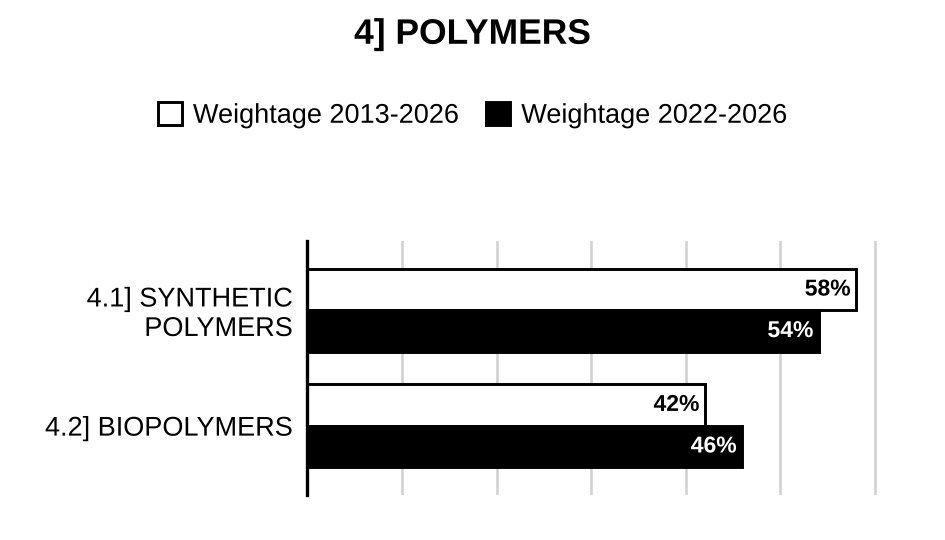
4.1] Synthetic polymers
66 questions
How are nylon 6 and nylon 6,6 prepared? [2026/5m/6b(i)]
If 20 g of polyethylene was completely burnt in the presence of excess air, how many moles of will be produced? [2026/5m/6b(ii)]
Why is polystyrene brittle in nature, while polyethylene is flexible? Explain. [2026/5m/6b(iii)]
Why is Teflon chemically inert, while PVC is reactive at high temperatures? Explain. [2026/5m/6b(iv)]
How do the physical properties of natural rubber differ from gutta-percha? Explain. Also write the structures of both the polymers. [2026/10m/6c(i)]
After polymerization of p-hydroxybenzoic acid, IR analysis shows 0.2% unreacted —COOH. Calculate the molecular weight of the polymer and categorize it. [2025/7m/4a(i)]
Write the structure of the polymer formed when p-hydroxybenzoic acid is polymerized. [2025/3m/4a(ii)]
What is the precursor of the main component of natural rubber? Draw the structures of both monomer and polymer. [2025/5m/4a(iii)]
Compare the salient properties of Nylon 6 and Nylon 6,6. [2025/5m/4b(i)]
How would you prepare syndiotactic polystyrene? [2025/5m/4b(ii)]
Explain the various steps involved in benzoyl peroxide-initiated polymerization of ethylene to give polyethylene. [2024/10m/6a(i)]
Predict the physical properties of atactic, syndiotactic and isotactic polystyrenes based on their structure. [2024/5m/6a(ii)]
(i) Identify A and B. The polymerisation of the rearranged product of B, unaided by any catalyst, gives rise to a ‘synthetic rubber’. Name this rubber along with its structural formula. (ii) When rubber balls and other objects made of rubber are exposed to the air for long periods of time, they turn brittle and crack. This does not happen to objects made of polyethylene. Explain. [2023/10m/5c]
What is meant by ‘Tacticity’ of a polymer? Distinguish among isotactic, syndiotactic and atactic polymers. [2023/5m/6b(ii)]
How will you synthesize polypropylene (PP) by using Ziegler-Natta catalysis? Discuss the mechanism and its advantages over conventional polymerization. [2022/10m/6b(i)]
How is Perlon synthesized from -Caprolactam? Give the mechanism of the reaction. [2022/5m/6b(ii)]
Arrange the above monomers in order of decreasing ability to undergo anionic polymerization.
[Figure: I = 4-methylstyrene ( and para on a benzene ring); II = 4-nitrostyrene ( and para); III = 4-methoxystyrene ( and para)] [2021/5m/5b(i)]
Draw the structures of synthetic rubber and natural rubber and discuss their configurations. [2021/5m/5b(ii)]
Complete the above reaction sequence by writing the structures of A, B and C.
[Figure: I. (excess) –n-BuLi→ A –1,3-butadiene→ B –→ C; II. cyclohexanone –→ A –55% → B –△→ C] [2021/20m/7a]
How will you prepare building block of the polymer PTFE starting with (g)? List the applications of PTFE. [2020/10m/5a]
How can Nylon-6 be prepared from cyclohexanone? What is the name of the monomer of Nylon-6? Write the mechanism of the reaction and name the reaction involved. [2019/20m/6c]
Name the monomers of the following polymers: (1) PS (2) LDPE (3) PP (4) PMMA (5) Buna-S. [2019/10m/8c(i)]
Give the synthetic schemes including reaction conditions for the preparation of the following polymers from their monomers: (i) Nylon 66 (ii) Teflon (iii) Terylene. [2018/15m/2d]
Distinguish between HDPE and LDPE with reference to their mode of production and physical properties. Mention any two applications for each. [2018/10m/5c]
Explain the mechanism of free radical chain polymerization of vinyl chloride using benzoyl peroxide as an initiator. [2018/15m/7d]
Write structures of repeating units of natural rubber, polystyrene and teflon. How will you prepare terylene and PVC? [2017/10m/7d]
Write various steps for the following conversions:
[Figure: (i) cyclohexanone → Nylon-6; (ii) 1-phenylhexa-1,3,5-triene (H5C6–CH=CH–CH=CH–CH=CH2, drawn in a cis, ring-like conformation) → Biphenyl] [2016/15m/4d]
Write the structures of repeating units of Nylon-6,6 and Terylene. How are they prepared? [2016/10m/6c]
Give any two types of synthetic rubber and write the preparation of monomeric units. [2016/10m/7c]
Write the mechanism of radical polymerization of ethylene leading to branching in the resultant polymer. [2015/10m/5a]
What is the advantage of anionic polymerization process in the formation of polystyrene? Enumerate the steps involved in the polymerization of styrene using butyl lithium as an initiator. [2015/10m/7b]
(i) Draw the structure of repeating unit of following polymers: Neoprene rubber, Gatta Percha and Polystyrene. (ii) Sketch the synthetic route for monomers of Nylon-6 and Kevlar fibres. [2014/10m/5a]
(i) Draw the structure of repeating unit of PVC, PET and SBR. (ii) Sketch the synthetic route for monomers of Nylon-6, 6. [2014/15m/7b]
What is condensation polymerization? Give structure of repeating units in terylene and show how terylene is obtained. [2014/5m/8e]
Illustrate the difference between thermoplastics and thermosetts. [2014/5m/8f]
Write the name and structure of one polymer having: (i) Linear structure (ii) Network structure (iii) Three dimensional structure. Write the mechanism for the polymerization of phenol and formaldehyde in the presence of . [2013/20m/7a]
Explain why free radical polymerization of 1, 3-butadiene leads to macromolecules having two different types of monomer units. [2013/15m/7b]
What is the structural difference between Nylon-6 and Nylon 6,6? What are the raw materials of their synthesis? [2012/7m/6d(ii)]
Give the purpose of the following compounds in polymer chemistry: (i) Benzoyl peroxide (ii) Hydroquinone (iii) (iv) Ethyl mercaptan (v) Hydrogen peroxide. [2011/10m/5e]
(i) Define thermoplast and thermosets. Which are thermoplast among the following? PVC, Phenolics, Aminoresins, Polypropylene, Teflon, Nylan, Polyster, Polystyrene, Alkyd resin, Polyethylene (ii) Differentiate between LDPE and HDPE. [2010/15m/6a]
Give the synthetic route of epoxy resin based on bisphenol-A. Mention the principal fields of applications of epoxy resins. [2010/15m/6b]
(i) Nylon 6 can be produced from a monomer. What is that monomer and what is the mechanism of polymerization? (ii) Phenol condenses with formaldehyde in acidic medium. What is the mechanism of condensation? [2009/20m/5a]
(i) DNA precipitates with cationic polymer but not with anionic polymer. Explain. (ii) Acid hydrolysis of Nylon 6 is faster than acid hydrolysis of polyester. Explain with mechanism. [2009/20m/5d]
Write equation for the formation of glyptal resin? How can it be made softer? [2009/20m/7a]
Write monomer of Teflon. How is the monomer synthesized? [2009/10m/7b]
When does p-cresol not produce thermosetting polymer with (drawn as H, H>C=O)? Explain. [2009/15m/8a]
What are the structural differences between Nylon 6.6 and Nylon 6? [2009/10m/8c]
For synthesis of polyester, glycol is treated with dimethyl terphthalate but not phthalic acid. Explain. [2008/20m/5b(ii)]
Mechanical strength of Nylon is better than polyester. Explain. [2008/10m/7c(ii)]
A cyclonitrile can be polymerized by base catalyzed reaction but not by acid catalyzed reaction. Explain. [2008/15m/8c]
(i) Write the structures of all-trans and all-cis polyisoprene. (ii) Explain the difference between silicones and silicates. (iii) Using the technique of mass spectrometry, indicate how will you distinguish between the three identical-mass-compounds (Mol. wt. 58) i.e. , and ? (iv) In the mass spectrum of acetophenone, a meta-stable peak was observed at 56.5 [?]. Explain what is it due to. [2007/20m/5a]
Write the structure of the product formed by condensation polymerisation of terephthalic acid and ethylenediamine and explain its formation. [2007/5m/6b(i)]
The glass transition temperature of a polymer is 0°C. What will be its behaviour (in terms of its mechanical properties) at (+) 25°C and at (-) 25°C? [2007/5m/6b(ii)]
What are the products formed by free-radical poymerisation of difluoroacetylene? [2007/10m/6b(iii)]
Calculate the probability of a polymer formed by condensation of monomers consisting of 25 monomers when the reaction is 75% complete. What is the value of number average degree of polymerization under these conditions? Determine the extent of reaction in order for the number of degrees of polymerization to exceed 25. [2006/20m/5c]
Outline the synthesis of 100% cis-poly(isoprene). Discuss reasons for the choice of reagents or catalysts and the mechanism of polymerization. [2005/20m/6c]
Arrange compounds in each of the following sets according to the specified order and give reasons for your choice: Increasing order of reactivity toward cationic polymerization. Methyl acrylate, propene, isobutene, vinyl acetate. [2004/15m/2a]
Write the mechanism involved: (i) In the chain termination step during the cationic ring opening polymerization of hexachlorocyclotriphosphazines. (ii) In propagation step during the anionic ring Opening polymerization of octamethylcycloterasiloxanes. [2004/30m/4a]
Account for the following: (i) In polyamide synthesis by aminolysis of diesters with diamines, phenyl esters are preferred over alkyl esters. (ii) Anionic polymerization of acrylamde using BuLi give nylon 3. [2004/30m/4b]
1000 g. of a polymer of molecular weight 1000 g/ mole was mixed with 1000 g of another polymer of molecular weight g/mole. Calculate the ratio of the weight average molecular weight to number average molecular weight of the mixed polymer. [2003/20m/7a]
(i) Free radical polymerisation of 1, 3-butadiene gives a polymer containing and units, the exact Proportion of which depends on temperature. How will you account for this observation? (ii) “Natural rubber is elastic whereas gutta percha is highly crystalline and rigid though both are formed from the same monomer.” Give reasons. [2003/20m/8a]
Explain the following: (i) Polyethylene cannot be prepared by cationic polymerization whereas polystyrene can. (ii) Anion polymerization is a good method for the preparation of n-polyacrylonitrile but not for polyisobutylene. (iii) Why radicals prefer to add at carbon 1 of isoprene rather than carbon 2, 3 and 4. (iv) Both the polymers, poly (vinyl chloride) and poly (vinylidene chloride) are prepared by free radical processes, but the former is amorphous and the Latter is highly crystalline. (v) In SBR (styrene-butadiene rubber) why do most double bonds have a trans configuration? [2002/15m/7b]
Draw structures of the repeating units of the following polymeric materials (i) Teflon (ii) Terylene (iii) Nylon (iv) Natural rubber. [2001/12m/7a]
The light catalysed reaction of nitrosyl chloride with cyclohexane gives an intermediate which has an important role in the formation of nylon 6. What is the structure of this intermediate? Outline the further steps which would be necessary for the nylon synthesis. [2001/12m/7b]
Describe the determination of mol. wt. of polymer by end group analysis method. [2000/15m/6b]
Give the synthesis, properties and use of terylene. [2000/15m/6c]

Preparing for Prelims too?
Our UPSC Prelims Topic-wise PYQ eBook covers every Prelims question with detailed explanations, so you can see exactly where UPSC asks from.
View the BookDownload Free Sample4.2] Biopolymers
29 questions
Proteins are dynamic molecules rather than static structures. Explain this phenomenon using hemoglobin as an example. [2026/10m/5a]
What are nucleic acids? Give a schematic diagram for the primary structure of a nucleic acid. [2026/10m/6c(ii)]
With example, elucidate the permanent and temporary denaturation of a protein. [2025/10m/1e]
What are the salient features of alpha helix in regards to handedness, residues per turn and elongation per residue? What are the principal stabilizing factors for an alpha helix? [2025/5m/4b(iii)]
Write the structures of the bases present in DNA and RNA. Compare the stability of DNA and RNA. [2024/10m/5a]
(i) Draw the structure of 2′-deoxycytidine-3′-monophosphate. (ii) Why nucleotides and nucleic acids are acidic? Mention the factor(s) that stabilize the DNA duplex. (iii) Show the hydrogen bonding in between cytosine and guanine base pair. [2023/15m/7a]
Write the structures of nucleosides and nucleotides, and discuss the primary structures of DNA and RNA. [2022/10m/5a]
Discuss the different types of secondary structures of proteins and compare these structures with tertiary structure of proteins. [2022/15m/7a]
Show salt bridge, hydrogen bond, van der Waals’ interaction and disulfide bridge for stabilization of protein by choosing appropriate amino acid residues in the protein chain. [2021/15m/6b]
Compare the length of an α-helix that contains 74 amino acids with that of a B-DNA having same number of base pairs. Also mention if the lengths of these biopolymers increase or decrease on denaturation. [2020/15m/7b]
Write the structure of purine and pyrimidine bases present in DNA and show their pairing. [2019/10m/5a]
What do you mean by secondary structure of proteins? Explain α-helix and β-pleated sheet structures of proteins. [2018/10m/2b]
Distinguish between DNA and RNA with regard to their nucleotide structures, location in the cells and functions. [2018/10m/5e]
Give the structures of nucleosides and nucleotides and discuss the primary structures of DNA and RNA. [2017/10m/6e]
Discuss the forces responsible for the stability of double helical structure of DNA. [2016/10m/6d]
What are the factors responsible for the stability of the double helix structures of DNA? Show the structures of hydrogen bonding between complementary bases between two DNA strands. [2015/15m/6c]
Give the structures of all the bases which occur in both RNA and DNA. Also give the structures of the bases which occur in RNA alone or in DNA alone. [2015/10m/8d]
Classify the proteins. Give a note on their 1°, 2° and 3° structures. [2014/10m/5e]
Draw the structures of DNA and RNA with all four bases. [2014/15m/6b]
Write the name and structure of two purine and pyrimidine units present in DNA. Also explain why most of the genetic materials contain DNA and not RNA. [2013/15m/7c]
(i) 1,4-butadiene carrying alkyl or aryl substitution on C-3, can photochemically rearrange to vinyl cyclopropane.
[Figure: Reaction scheme: 3,3-dialkyl-1,4-pentadiene (CH2=CH–CR2–CH=CH2, the central carbon bearing R and R) –hν→ 1,1-di-R-2-vinylcyclopropane (cyclopropane with a vinyl group on one ring carbon and two R groups on an adjacent ring carbon)]
Explain the transformation. (ii) What are the structures of pyrimidine nucleotides present in DNA? What are the structures of their purine conjugates? [2012/12m/5d]
A peptide was synthesised from phenylalanine, tyrosine and lysine in the sequential order by protecting first the amino group of phenylalanine. Write the structure of the peptide showing the reagents used in various steps. Will the newly formed peptide be acidic or basic? Give the reason. [2011/20m/6c]
Draw the structure of purine nucleotides present in DNA. [2010/10m/5a]
(i) DNA precipitates with cationic polymer but not with anionic polymer. Explain. (ii) Acid hydrolysis of Nylon 6 is faster than acid hydrolysis of polyester. Explain with mechanism. [2009/20m/5d]
What is the hybridization of DNA? [2008/10m/7c(i)]
What are nucleotides and nucleosides? Draw the structure of a nucleotide. (ii) When a nucleotide (3′, 5′-cyclic adenylic acid) is treated with aqueous sodium hydroxide the major product that is obtained is, 3′-adenylic acid (rather than 5′-adenylic acid). Give an explanation to account for the preference to the cleavage of -oxygen bond in the hydrolysis. [2001/12m/7c(i)]
Silk consists of β-sheets whose polypeptide chains are made up of the repeating amino acid sequence: Gly-Ser-Gly-Ala-Gly-Ala. What characteristics of these amino acid side chains appear to favour the stability of β-sheet structure? [2001/12m/7d]
Explain the general structure of DNA including the H-bonding. [2000/20m/5c]
Discuss the basic chemical bonding in α-Keratin including the H-bonding. [2000/15m/6a]

Strengthen your GS papers
Our UPSC Mains Topic-wise & Year-wise PYQ eBook (2013–2026) maps every GS question to the syllabus, so you know what UPSC asks and how often.
View the BookDownload Free Sample« Previous: Pericyclic Reactions | Next: Synthetic Uses of Reagents »
Back to: Chemistry Optional PYQs – Topic-wise
Last updated: 30 October 2026