
Here are all 113 Genetics questions asked in UPSC Zoology Optional Paper II from 2004 to 2026, arranged under the 8 topics of the official syllabus. Within each topic the latest questions come first.
Each question ends with a code such as [2024/15m/3b] – the year, the marks, the word limit (where UPSC set one) and the question number in the paper.
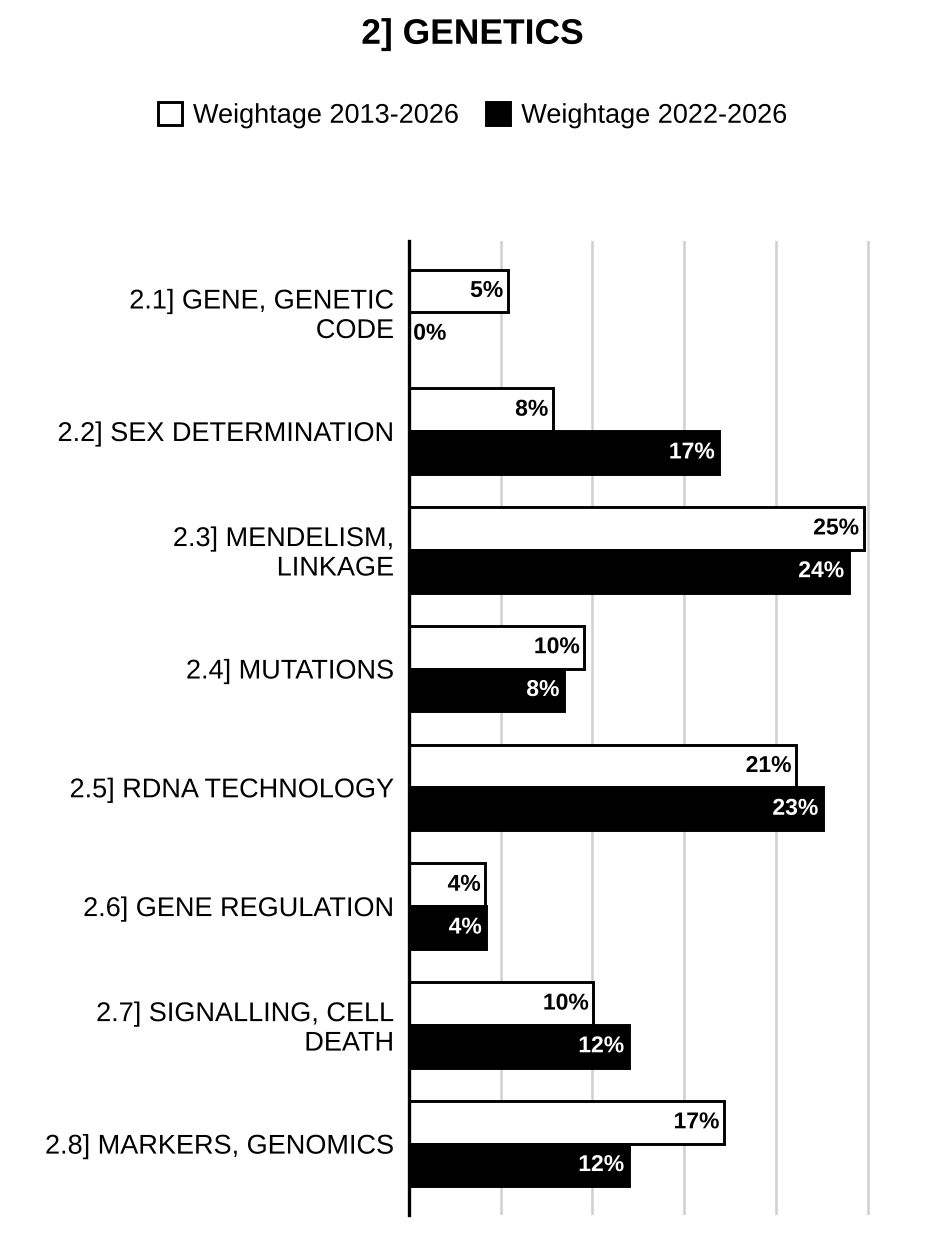
2.1] Concept of gene and genetic code
9 questions
What is modern concept of gene? Describe the test of allilism with suitable example. [2021/10m/150w/1b]
What is Wobble hypothesis? How does it explain degeneracy in genetic code? [2020/10m/1a]
Bring out the differences between prokaryotic and eukaryotic gene organisation. [2017/15m/3c]
Characterize with suitable examples, the following features of genetic code: (i) Degeneracy (ii) Universality of genetic code and add a note on Wobble hypothesis. [2014/10m/1a]
What is interrupted gene? What is its relation with exons and introns? Explain the functioning of interrupted gene in lower eukaryotes. [2013/10m/1b]
Through a chequerboard, display the various types of genetic code (). Identify the initiation, termination and nonsense codon, and explain their functions. [2012/15m/5d]
RNA processing is a characteristic of eukaryotes only and not of prokaryotes. Explain this with reference to gene organization. [2010/20m/3a]
Mobile Genetic Segment. [2007/30m/3a]
Pseudogene and Oncogene. [2005/20m/1b]
2.2] Sex chromosomes and sex determination
7 questions
What is primary and secondary sex determination? Explain hormonal regulation of sex determination in humans. [2026/15m/2b]
Difference between male heterogamety and female heterogamety with examples. [2024/10m/150w/1b]
What is sex-determination? Give an account of genic balance theory of sex-determination in Drosophila with examples from abnormal karyotypes. [2024/20m/3a]
Explain the mechanism of sex determination in human beings. [2023/15m/3b]
Describe the mechanism of sex determination in Drosophila. [2020/10m/1b]
Give a schematic representation of differentiation of sexual phenotypes during early embryonic development in mammals. [2020/10m/5d]
Compare the sex-determining mechanism of Drosophila and humans. Add a note on the genic balance theory. [2011/15m/5a]
2.3] Mendelian genetics and linkage
31 questions
Symptoms, causes and treatment of haemophilia. [2026/10m/150w/1d]
Do mitochondria contribute in the process of inheritance of characters? Explain with suitable example. [2026/15m/4c]
Symptoms, causes and treatment of thalassemia. [2025/10m/150w/1c]
Coupling and repulsion phases of linkage. [2025/10m/150w/1d]
Draw pedigrees for autosomal recessive and sex-linked inheritance using examples from human. [2025/15m/2c]
ABO system of blood groups and its basis, and erythroblastosis foetalis. [2024/10m/150w/5b]
Explain the following: (i) Haemophilia (ii) Red-green colour blindness. [2023/20m/4a]
What is chromosome theory of linkage? Describe the methods for determination of linkage using suitable examples. [2021/15m/3b]
What is Mendel’s dihybrid cross? Discuss the mechanism of independent assortment using suitable example. [2021/15m/3c]
Justify the statement, “Linkage and recombination play significant role in the process of inheritance”. [2019/20m/3a]
Comment on the following human genetic disorders: (i) Down Syndrome (ii) Klinefelter’s Syndrome (iii) Sickle Cell Anaemia. [2018/15m/2b]
Explain the phenomenon of X-linked inheritance in Drosophila. [2018/15m/4c]
What are multiple alleles? Explain the phenomenon of multiple allelism by giving suitable examples. [2017/10m/1b]
Explain ABO blood groups with its genetic basis and significance in blood transfusion. [2016/10m/1b]
Explain pedigree analysis to illustrate hereditary disease with suitable examples. [2016/15m/4b]
The Genotype of the parent is as under: Indicate the type of Gametes that will be formed and character represented by their Offsprings. Also indicate whether the parents are carriers or free from disorder. Find out: (i) Percentage of carriers. (ii) Percentage of haemophilic sons and daughters. (iii) Percentage of normal offsprings. Why does haemophilia occur? Give the symptoms of haemophilia. How is haemophilia genetically inherited? [2015/20m/4a]
Complete the table given below by inserting 0, 1, or for the probability of each genotype of progeny for each type of mating. Give reasons.
| Mating | Genotype of progeny: AA | Genotype of progeny: Aa | Genotype of progeny: aa |
| AA × AA | |||
| AA × Aa | |||
| AA × aa | |||
| Aa × Aa | |||
| Aa × aa |
[2014/10m/1e]
Describe the molecular basis of the following inherited diseases and their manifestations in humans: (i) Cystic fibrosis (ii) Sickle cell anemia (iii) Hunting chorea. [2014/15m/2a]
What are sex-linked and sex-limited characters? Explain by suitable examples their mode of transmission. [2013/10m/1d]
Delineate the production of new combinations of alleles, encoding a novel set of genetic informations. What is its role in genetic engineering? [2013/20m/4a]
Give the causes and symptoms of heritable diseases in man due to defects in Y-chromosomes and autosomes. [2012/20m/7b]
Using skin colour as an example of polygenic inheritance, work out the results of and from a mating between pure black Negro man and white woman in qualitative and quantitative terms. [2011/15m/1b]
What is H-antigen? Illustrate its role in the emergence of Bombay phenotype. [2011/20m/2a]
What is haemophilia and how is it inherited? Work out the results of and mating (with reasons) between: (i) Haemophilic woman × Normal man (ii) Haemophilic man × Normal woman (iii) Carrier woman × Haemophilic man (iv) Carrier woman × Normal man. [2011/20m/6b]
How many alleles are concerned with the determination of A, B, AB and O blood groups? Tabulate the genotype and phenotype of parents to work out the genotype of offsprings resulting from mating of A, B, AB and O blood groups. [2011/20m/8b]
Comment on phenylketonuria as a genetic disorder. [2010/15m/150w/1c]
Enunciate the Mendelian laws of inheritance. Would Mendel’s laws hold good under all conditions? Justify your contention. [2010/20m/3b]
Distinguish between sex-linked inheritance and sex-limited inheritance. [2009/20m/1a]
Write a note on application of human blood group types in pedigree analysis. [2009/30m/3b]
Different between any three of the following: Coincidence and interference. [2007/20m/1a]
Write an essay on the genetic analysis of Rh blood groups. [2004/60m/3]
2.4] Mutations and mutagenesis
10 questions
Types of chromosomal aberrations. [2024/10m/150w/1c]
Main types of molecular mutations and their effect on phenotype. [2024/10m/150w/1e]
What is mutation? Write a brief note on various types of point mutations. [2022/10m/150w/1b]
What is chromosome mutation? Describe various types of polyploidy with suitable examples. Add a note on phenotypic effects of polyploidy. [2021/20m/3a]
Define mutation. Describe the types, causes and applications of mutations. [2020/20m/3a]
Comment on the following human genetic disorders: (i) Down Syndrome (ii) Klinefelter’s Syndrome (iii) Sickle Cell Anaemia. [2018/15m/2b]
Describe the impact of gene mutation on human health. [2016/10m/1d]
What is mutagenesis? Explain with diagrams how mutagens cause genetic changes. [2015/10m/1d]
Point mutation and missense mutation. [2006/20m/200w/1c]
Explain mutations. Discuss their origin and role in evolution. [2005/60m/3]

Preparing for Prelims too?
Our UPSC Prelims Topic-wise PYQ eBook covers every Prelims question with detailed explanations, so you can see exactly where UPSC asks from.
View the BookDownload Free Sample2.5] Recombinant DNA technology
20 questions
What is recombinant DNA technology? Describe the different vectors used in DNA cloning. [2026/20m/3a]
Describe the steps of constructing a recombinant DNA and its cloning. [2025/20m/4a]
Describe the principle and method of whole animal cloning. [2023/15m/2b]
Give schematic organization of cosmid. Why is it preferred over plasmid for gene cloning? [2022/10m/150w/1c]
Illustrate the steps of constructing a recombinant c-DNA from an m-RNA. [2022/15m/3b]
What is transgenesis? Describe the methods for gene transfer in animals and its applications. [2020/15m/2b]
What is an artificial chromosome vector? Give its application. [2019/10m/1c]
Explain the distinctive features of plasmid and cosmid vectors used in recombinant DNA technology. [2018/15m/3c]
Explain ‘Whole animal cloning’ by giving suitable examples. Enumerate the steps involved in whole animal cloning. [2017/10m/1e]
Discuss the applications of recombinant technology in human health. [2016/15m/3b]
Define the characters of DNA vectors. Explain with diagrams how these vectors function in a variety of situations. [2015/15m/2c]
Which stage of the development is used to produce the transgenic animals? How is it done? [2015/15m/8c]
What are the various vectors used in genetic engineering? Write and compare the protocol for each. [2014/15m/4b]
What is recombinant DNA technology? How is it done? Discuss its applications. [2013/15m/2c]
Delineate the production of new combinations of alleles, encoding a novel set of genetic informations. What is its role in genetic engineering? [2013/20m/4a]
Differentiate between principles and methods of DNA cloning and whole animal cloning. [2012/20m/4a]
What are transgenic animals? How are they produced and utilized in eco-rehabilitation/conservation and in human welfare? [2012/20m/8c]
Discuss the role of cosmids and artificial chromosomes as vectors in recombinant DNA technology. [2011/15m/5b]
Plasmid and Cosmid. [2006/20m/200w/1b]
What is gene cloning? Give an account of standard vectors used in gene cloning. [2006/60m/3]
2.6] Gene regulation and expression
8 questions
Discuss gene regulation mechanisms in E. coli. [2024/15m/3c]
Define operon. Give the similarities and differences between tryptophan and arabinose operon, with a focus on attenuation. [2015/10m/1c]
Give an illustrated account of Lac Operon in E. Coli. [2014/10m/1c]
What are RNA genes? State the role of ribozymes and microRNA in protein synthesis. [2013/15m/4c]
Compare the manner in which genes are expressed in prokaryotes and eukaryotes. [2011/20m/8a]
Explain the differences in gene regulation and its expression in eukaryotes. [2009/30m/3a]
Tryptophan Opera. [2007/30m/3b]
Describe Gene expression in prokaryotes and eukaryotes. Define transcription. [2006/60m/2]
2.7] Signal molecules and cell death
12 questions
Define apoptosis. Explain the characteristics, molecular pathways and significance of apoptosis. [2026/20m/8a]
What are signal molecules? How do defects in signalling pathway cause pathological changes? [2024/15m/2c]
Explain the following: (i) Stepwise intrinsic mechanism of apoptotic induction (ii) Principle of DNA fingerprinting. [2022/15m/3c]
Define programmed cell death. Explain the molecular mechanism and significance of apoptosis during early embryonic development. [2020/20m/8a]
Sequentially explain the process of apoptosis. [2019/15m/4c]
What are caspase enzymes? Narrate their crucial role in cell death. [2015/15m/7a]
What is apoptosis? What are its stages? Write about the molecular mechanism of apoptosis. [2014/20m/8b]
Define the types of cell receptors and enumerate their role in signal transduction/cell-cell interaction. [2012/20m/3a]
Describe programmed cell death. [2007/60m/7]
Theories of Cancer development. [2006/20m/5d]
Pseudogene and Oncogene. [2005/20m/1b]
Cell death (Apoptosis) [2004/15m/8d]
2.8] Molecular markers and genomics
16 questions
Principle and applications of AFLP. [2026/10m/150w/1c]
Describe the mechanism of ribozyme action and comment on its technological applications. [2025/15m/3c]
Write principle and application of RFLP. [2023/10m/150w/1d]
Explain the following: (i) Stepwise intrinsic mechanism of apoptotic induction (ii) Principle of DNA fingerprinting. [2022/15m/3c]
What is RAPD? Give an account of the general methods for mapping human genome. [2020/15m/3c]
Explain the use of ribozyme technology for the treatment of diseases. [2019/10m/1b]
Differentiate between genomics and proteomics. [2019/20m/2a]
Explain the use of VNTRs in DNA fingerprinting in paternity tests. [2018/10m/1d]
What is meant by RFLP? Explain the applications of RFLP. [2017/15m/2b]
Give an account of Human Genome Project. [2016/20m/2b]
Narrate with suitable examples the use of ribozymes in health care and agriculture. [2015/10m/1e]
Define and differentiate between Genomics and Proteomics. Add a note on their biomedical applications. [2014/10m/1d]
Describe the process of DNA finger printing and indicate which of the following is used in DNA finger printing: (i) Palindromic sequences of DNA (ii) V.N.T.R (iii) Shine Dalgrano sequences (iv) TATA boxes. [2014/15m/3a]
What are RNA genes? State the role of ribozymes and microRNA in protein synthesis. [2013/15m/4c]
Differentiate between DNA fingerprinting and ribozyme technologies. Add a note on their applications. [2011/20m/4b]
Human Genome Project. [2009/20m/200w/4c]

Strengthen your GS papers
Our UPSC Mains Topic-wise & Year-wise PYQ eBook (2013–2026) maps every GS question to the syllabus, so you know what UPSC asks and how often.
View the BookDownload Free Sample« Previous: Cell Biology | Next: Evolution »
Back to: Zoology Optional PYQs – Topic-wise | Also see: Zoology Optional year-wise question papers
Last updated: 31 October 2026