
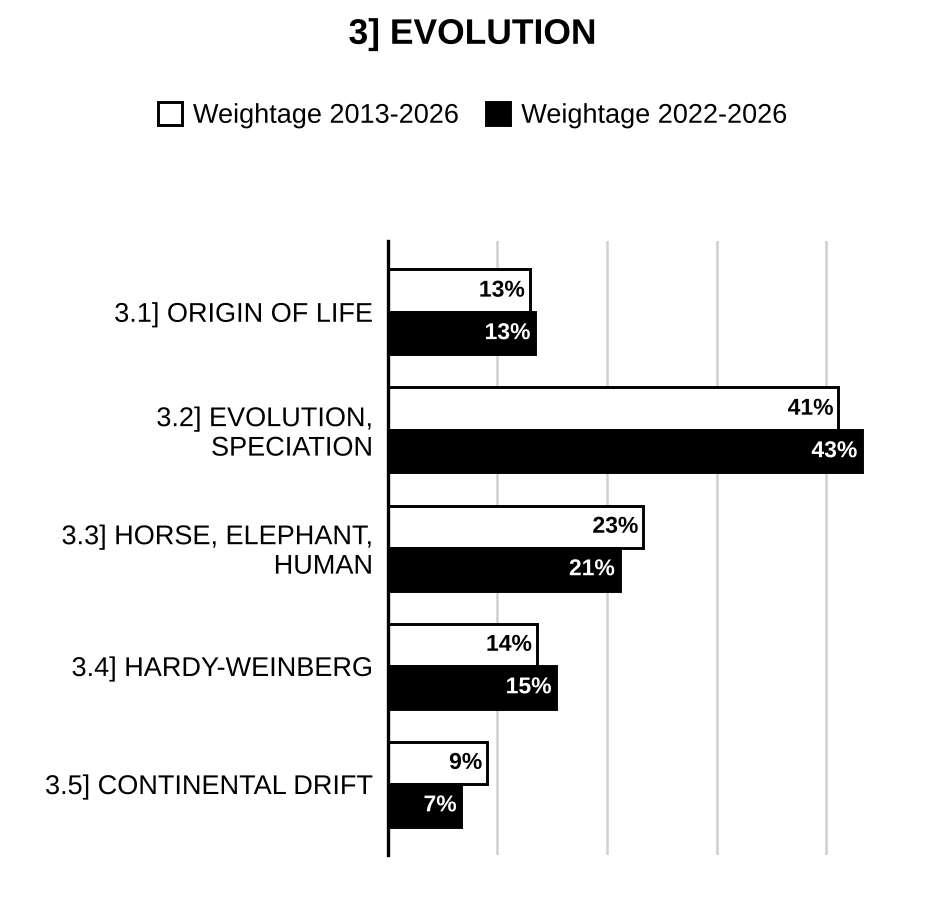
Here are all 78 Evolution questions asked in UPSC Zoology Optional Paper II from 2004 to 2026, arranged under the 5 topics of the official syllabus. Within each topic the latest questions come first.
Each question ends with a code such as [2024/15m/3b] – the year, the marks, the word limit (where UPSC set one) and the question number in the paper.
3.1] Origin of life
6 questions
What is Oparin concept? Comment on the chemical theory of origin of life. [2026/20m/4a]
Explain Stanley Miller experiment. In which way, it provided support to most acceptable theory of origin of life? [2023/15m/2c]
Enlist theories of origin of life. Explain the theory of biochemical evolution proposed by Oparin and Haldane. [2021/15m/4b]
Explain the Stanley Miller’s experiment related to origin of life. [2019/10m/1e]
Give a brief account of the various theories of ‘Origin of Life’ on earth. [2017/20m/4a]
Illustrate the different theories regarding the origin of life with special reference to protein evolution. [2015/20m/2b]
3.2] Theories of evolution and speciation
39 questions
Role of variations in evolutionary change. [2026/10m/150w/1e]
What is speciation? Elaborate the role of continental drift in the formation of new species. [2026/15m/2c]
Sympatric and allopatric speciation. [2025/10m/150w/1e]
Explain how mutations affect variations in population and natural selection. [2025/15m/2b]
Describe the synthetic theory of evolution. [2025/10m/3a(i)]
Describe common types of mimicry in insects with suitable examples. [2025/10m/3a(ii)]
Geographic versus reproductive isolation. [2024/10m/150w/1d]
Explain phenomenon of natural selection taking examples of peppered moth and sickle cell anaemia. [2023/15m/4c]
Write a note on the theory of natural selection. [2022/10m/150w/1e]
Define variation. Describe different types of variations and their role in evolution. [2022/15m/4b]
Define mimicry. Discuss the types of mimicry with suitable examples. [2021/10m/150w/1c]
What is isolation? Describe the major isolating mechanisms which lead to speciation. [2021/20m/4a]
Differentiate between sympatric and parapatric speciation with suitable examples. [2020/10m/1c]
With suitable examples, describe how adaptive radiation helps in the evolution of terrestrial and aquatic animal groups. [2018/15m/2c]
What are micro, macro and mega evolutions? Explain the terms with suitable examples. [2018/15m/3b]
Define Isolation. Explain in detail the pre-mating and post-mating isolating mechanisms. [2018/20m/4a]
Explain in brief the role of ‘isolation’ in evolution by giving suitable examples. [2017/10m/1c]
What is meant by molecular drive? Explain its significance in evolution giving suitable examples. [2017/15m/2c]
Explain the salient features in the ‘theory of natural selection’. Add a special comment on ‘synthetic theory of evolution’. [2016/15m/2c]
Discuss the role of mutation in speciation. Comment on the effect of the process of variation on evolution. [2016/20m/4a]
“Isolation is the key factor in evolution.” Justify the statement giving suitable examples from geographical and reproductive isolation. [2015/15m/3a]
Define mimicry. How does it occur? How has mimicry evolved in the animal kingdom? Give examples. [2015/15m/3c]
Describe the phenomena of mimesis and crypsis in animal with suitable examples. [2013/10m/1c]
How are evolutionary patterns and processes affected by the dual operation of mutation and natural selection? Give examples. [2013/15m/2b]
Using suitable examples of natural and induced mutations, discuss their role in the evolution of species. [2012/20m/2b]
How do isolation factors facilitate speciation? [2012/20m/7c]
Distinguish between allopatric and sympatric speciation. [2010/15m/150w/1a]
Distinguish between Darwinism and neo-Darwinism. [2010/15m/150w/1e]
What are “Darwin’s Finches”? Explain their significance in Evolution. [2010/20m/4a]
Explain mimicry and its significance in the life of animals. Mention relevant examples. [2009/20m/1b]
Distinguish between mutation and isolation in the process of evolution. [2009/20m/1c]
Factors that contribute to the speciation of animals. [2009/20m/200w/4a]
Different between any three of the following: Substantive and polymorphic variation. [2007/20m/1c]
Homologous and analogous organs. [2006/20m/200w/1d]
Natural selection. [2006/15m/4a]
Mega evolution. [2006/15m/4b]
Explain mutations. Discuss their origin and role in evolution. [2005/60m/3]
Define species. Describe the factors responsible for speciation. [2005/60m/4]
Lamarckism. [2004/15m/4a]

Preparing for Prelims too?
Our UPSC Prelims Topic-wise PYQ eBook covers every Prelims question with detailed explanations, so you can see exactly where UPSC asks from.
View the BookDownload Free Sample3.3] Evolution of horse, elephant and human
16 questions
Discuss the major morphological modifications during horse evolution. [2025/15m/4b]
Describe the stages of human evolution and mention the major hominid forms giving their time of origin. [2024/20m/4a]
What is fossil? Describe the origin and evolution of horse based on the fossil records. [2022/20m/4a]
What is fossil data? Discuss the chronological order of human evolution with suitable examples. [2021/15m/4c]
Define paleontology. Discuss the chronological order of elephant evolution. [2020/15m/2c]
Write a chronological account of human evolution as evidenced by palaeontological records. [2019/10m/1d]
Outline the course of evolution of modern day horse. [2017/15m/3b]
Give the characteristic features of ancestors of elephants and give progressive evolutions that have occurred during various geological times resulting in the emergence of the modern day elephant. [2015/20m/3b]
Identify the five important evolutionary changes led to evolution of modern Homo sapiens from the ancestral stock during various Geological era and epochs. [2014/15m/2b]
Give an illustrated account of evolution of horse, mentioning the relevant geological time periods. [2014/15m/3b]
Using the fossil history of humans, reconstruct the stages of evolution of present day Homo sapiens, mentioning the geological periods as well. [2013/20m/3b]
Discuss the trends in primate evolution that began as an adaptation for arboreal life. [2012/20m/3b]
Enumerate the selection pressures that led to bipedal locomotion in hominids. [2011/15m/1c]
Write a short note on Australopithecus. [2010/20m/4c]
Miohippus and Modern horse. [2005/20m/1c]
Eohippus and Parahippus. [2004/20m/200w/1c]
3.4] Hardy-Weinberg law
10 questions
What is Hardy-Weinberg law? How is gene frequency changed by mutation and genetic drift in populations? [2024/15m/4b]
Describe various means which result in change in gene frequencies in a population. [2023/15m/3c]
Explain Hardy-Weinberg law of equilibrium and mention the factors that upset the equilibrium. [2022/10m/150w/1d]
What is Hardy-Weinberg equilibrium? Describe the principles, mechanism and its applications in population genetics. [2020/20m/4a]
Discuss Hardy-Weinberg law and its application in evolution. [2016/10m/1c]
State and explain Hardy Weinberg’s law of genetic equilibrium. What are its limitations? Calculate the allele frequencies of and genes from the following blood group data of a population on the basis of this law.
| Blood type | Genotype | Number of individuals | |
| 1 | M | 1787 | |
| 2 | MN | 3039 | |
| 3 | N | 1303 |
[2014/20m/3c]
What is Hardy-Weinberg’s law? Give examples to establish its validity and limitations. [2013/15m/7c]
Discuss Hardy-Weinberg Law and mention its utility. [2007/60m/4]
Genetic drift. [2006/15m/4c]
Hardy-Weinberg law. [2004/15m/4d]
3.5] Continental drift and animal distribution
7 questions
What is speciation? Elaborate the role of continental drift in the formation of new species. [2026/15m/2c]
“Continental drift has resulted in discontinuous distribution of alligators and lungfishes”. Justify. [2023/10m/150w/1c]
Explain biodiversity. Discuss different grades and factors affecting the distribution of animal biodiversity. [2020/15m/4c]
Elucidate the process of continental drift and its impacts on animal diversity. [2019/20m/4a]
Explain the key features of Oriental region with its sub-regions. Add a note on the faunistic distribution of the region. [2016/10m/1e]
Define continental drift. Explain the processes by which this has impacted upon the geographical distribution of fauna restricting it to certain regions only. [2014/15m/4c]
Discuss the role of continental drift in the geographical distribution of animals with suitable examples. [2011/20m/7c]

Strengthen your GS papers
Our UPSC Mains Topic-wise & Year-wise PYQ eBook (2013–2026) maps every GS question to the syllabus, so you know what UPSC asks and how often.
View the BookDownload Free Sample« Previous: Genetics | Next: Systematics »
Back to: Zoology Optional PYQs – Topic-wise | Also see: Zoology Optional year-wise question papers
Last updated: 31 October 2026