
Here are all 86 Cell Biology questions asked in UPSC Zoology Optional Paper II from 2004 to 2026, arranged under the 5 topics of the official syllabus. Within each topic the latest questions come first.
Each question ends with a code such as [2024/15m/3b] – the year, the marks, the word limit (where UPSC set one) and the question number in the paper.
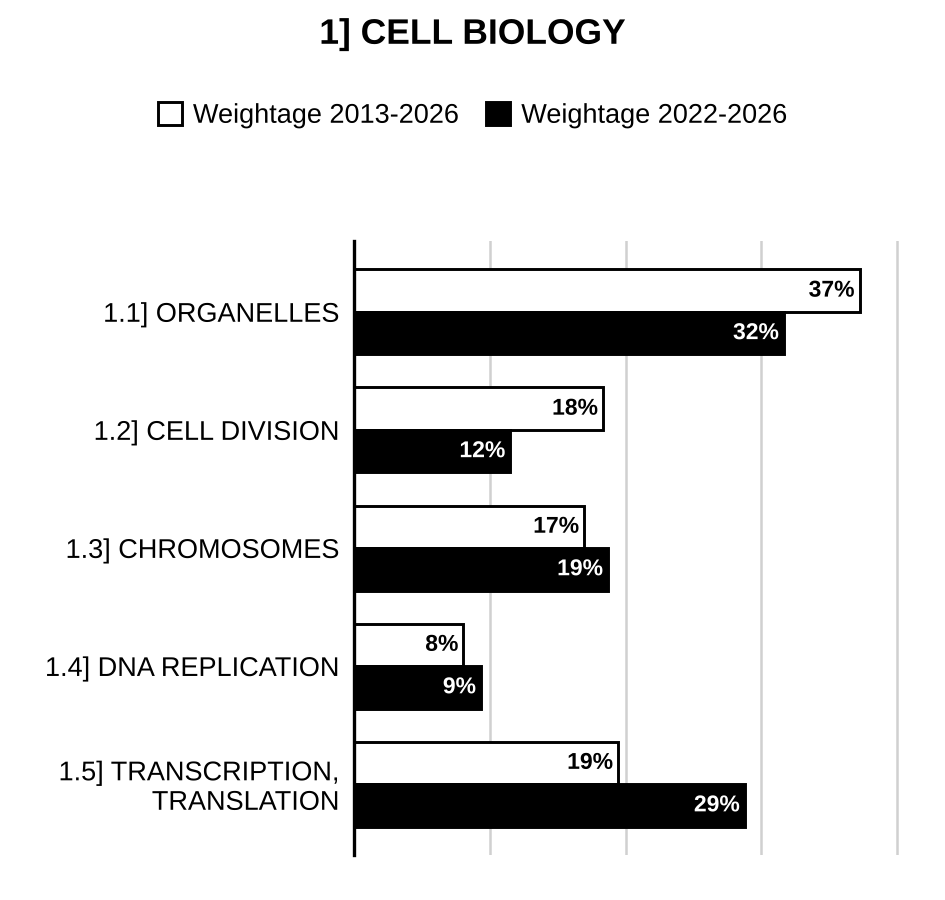
1.1] Cell organelles
31 questions
Difference between pinocytosis and phagocytosis. [2026/10m/150w/1b]
Protein sorting in Golgi apparatus. [2025/10m/150w/1a]
Describe composition of plasma membrane. [2025/10m/2a(i)]
Differentiate between facilitated and passive diffusion across the membrane with examples. [2025/10m/2a(ii)]
Give an account of ultrastructure of rough and smooth endoplasmic reticulum. Also discuss the role of endoplasmic reticulum in cell secretion. [2024/20m/2a]
Describe receptor-mediated endocytosis (RME) along with its advantage. [2023/10m/150w/1e]
Describe the structure of mitochondrion. Why is it known as powerhouse of the cell? [2023/20m/3a]
What is rough endoplasmic reticulum (RER)? Describe in detail the various modifications of secretory proteins occurring in the lumen of RER. [2022/20m/2a]
What is facilitated diffusion? Describe the mechanism of active transport across the plasma membrane with suitable example. [2022/15m/2c]
Lysosomes are polymorphic, justify. Draw a diagram representing the dynamic aspect of lysosome system. Write down the functions of lysosomes. [2021/15m/2b]
Glycoproteins are asymmetrically distributed in a plasma membrane, explain. Give an overview of membrane function. [2021/15m/2c]
Draw an ultrastructure of plasma membrane. Discuss the roles of lipids in the regulation of membrane fluidity. [2020/15m/4b]
Explain the isolation and methodology of study of the cell membrane. [2019/15m/2b]
Explain the biochemical composition of cell membrane. [2019/15m/2c]
Explain the origin and functions of lysosomes with emphasis on different enzymes. [2018/10m/1e]
Describe the structure of plasma membrane according to the fluid mosaic model with emphasis on the role of lipid molecules in maintaining the fluidity of the membrane. [2018/20m/3a]
Explain in detail the structural organisation and functions of Golgi-Complex. [2017/20m/3a]
Enumerate a comparative account of different functions of smooth and rough endoplasmic reticulum. [2016/10m/1a]
Explain the mechanism of transport of small and large molecules across plasma membrane. [2016/20m/3a]
Explain the structure and functions of lysosome. [2016/15m/4c]
List and illustrate the components of biological membranes in terms of their arrangement, role in the maintenance of feudicity, permeability and signal reception and translation. [2015/10m/1a]
Compare the function of mitochondrial and lysosomal enzymes in cellular metabolism. [2013/10m/1a]
Describe the structural organisation of a prokaryotic cell. What are the traits and functions in which it differs from a eukaryotic cell? [2013/20m/2a]
Give an account of the structure and function of the organelles considered unusual in the cell cytoplasm. [2013/15m/4b]
Compare the structure and function of 30s and 70s ribosomes. [2012/15m/5b]
Mention the role of ion channels (= ion gates) and ion pumps in cell functions with appropriate examples and diagrams. [2012/20m/8b]
Which organelle is well developed in a secretory cell? Describe the structure to justify its function. [2010/20m/2b]
What are “suicide bags” of cells? Briefly describe their structure and function. [2010/20m/3c]
Describe the structure and functions of plasma membrane and endoplasmic reticulum. [2009/30m/2a]
Describe detailed structure and functions of Mitochondria. [2005/60m/2]
Peroxysome and Glyoxysome. [2004/20m/200w/1a]
1.2] Cell division and cell cycle
12 questions
Differentiate between mitosis and meiosis division. [2026/15m/3c]
Describe various stages of prophase of meiosis-I in an animal cell. [2023/15m/4b]
Draw the structure of a microtubule and explain its role in chromosomal movements during cell division. [2022/10m/150w/1a]
What is cell cycle? Draw an overview of molecular events during cell cycle. Discuss the role of protein kinases in the regulation of meiotic cell cycle. [2021/20m/2a]
Draw an overview of eukaryotic cell cycle. Describe the roles of cyclins in the regulation of cell cycle. [2020/20m/2a]
Explain that cell cycle is fully based on molecular events. [2019/15m/3b]
Describe the role of protein kinases in the regulation of cell cycle. Add a note on the importance of check points. [2018/20m/2a]
Describe the role of microtubules in chromosome movement during cell division. [2016/15m/2a]
What are Rb and proteins? How do they regulate the cell cycle? How do they protect the cell from carcinogenesis? [2015/15m/2a]
Compare the events during mitotic and meiotic cell cycles. Add a note on role of stage-specific macromolecules and enzymes in such cycles. [2014/20m/2c]
What is mitotic cell cycle? How does it differ from meiotic cell cycle? Add a note on their molecular regulation. [2012/20m/8a]
Different between any three of the following: Mitotic and Meiotic Prophase. [2007/20m/1b]

Preparing for Prelims too?
Our UPSC Prelims Topic-wise PYQ eBook covers every Prelims question with detailed explanations, so you can see exactly where UPSC asks from.
View the BookDownload Free Sample1.3] Chromosomes and chromatin
14 questions
Explain the functional elements of eukaryotic chromosomes. [2026/15m/4b]
Structure and function of Lampbrush chromosome. [2025/10m/150w/1b]
Polytene chromosome. [2024/10m/150w/1a]
Distinguish between heterochromatin and euchromatin in their structure and function with examples. [2024/15m/2b]
Define endomitosis. Describe in detail the structure of a polytene chromosome highlighting the importance of puffs. [2022/15m/2b]
What is nucleosome? Explain the functional elements of eukaryotic chromosomes. [2020/15m/3b]
Delineate the structural and functional characteristics of polytene chromosome. [2019/15m/3c]
What are Euchromatin and Heterochromatin? Explain the events of Heterochromatin formation. [2018/10m/1a]
What is meant by a ‘Lamp brush’ chromosome? Explain its structure and functional significance. [2017/10m/1a]
Explain in detail how a DNA molecule gets organised into a chromosome? [2017/15m/4c]
What are giant chromosomes? Name them. State their locations and illustrate their structures. How do they function? [2015/15m/4b]
Which eukaryotes do not contain repetitive DNA? Give a brief account of biological macromolecules found in all living organisms. [2013/15m/3c]
Differentiate between polytene and lampbrush chromosomes on the basis of their structure and functions. [2012/20m/2a]
Explain the structure of the basic level of organization of eukaryotic genetic material. Name two higher levels of organization. [2010/20m/2a]
1.4] Nucleic acids and DNA replication
9 questions
Semiconservative replication of DNA. [2026/10m/150w/1a]
What is DNA replication? Describe the process of DNA replication in prokaryotes. [2024/15m/3b]
Illustrate the following: (i) and base pairing as a part of DNA double strand (ii) Michaelis-Menten kinetic pattern of an enzymatic reaction. [2022/15m/6b]
Describe the sequence specific DNA binding proteins. [2020/10m/1e]
Watson and Crick model of DNA. [2019/10m/5a]
Arrange the sequential enzymatic participations in DNA replication. Describe their specific role in each step. [2015/10m/1b]
What are nucleic acids? Describe the structure and functions of various types of RNAs. [2014/10m/5a]
What is DNA motif? How does it facilitate DNA replication and transcription? [2012/15m/5c]
Explain processes of DNA replication and transcription. [2009/30m/2b]
1.5] Transcription and translation
20 questions
What is DNA transcription? Explain the process of DNA transcription in eukaryotes. [2026/20m/2a]
Protein sorting in Golgi apparatus. [2025/10m/150w/1a]
Discuss the process of chain elongation during protein synthesis in prokaryotes. [2025/15m/3b]
How is hn RNA (primary transcript) modified into functional m-RNA in eukaryotes? Explain. [2023/10m/150w/1b]
Give structure of t-RNA. Write role of different RNAs in the translation process. [2023/20m/2a]
What is rough endoplasmic reticulum (RER)? Describe in detail the various modifications of secretory proteins occurring in the lumen of RER. [2022/20m/2a]
Sketch out a basic transcription unit and illustrate the RNA polymerase II associated assembly of a transcription initiation complex during expression of a eukaryotic gene. [2022/20m/3a]
Describe the requirement of proteins for the initiation of transcription in an eukaryote. [2021/10m/150w/1a]
What is transcription? Explain the process of transcription in a eukaryote. [2019/10m/1a]
What is protein targetting? Illustrate the same with reference to transport of proteins to plasma membrane. [2017/20m/2a]
Give an illustrated account of protein synthesis in eukaryotic cell. Compare this with similar events in a prokaryotic. Add a note on the mechanisms that lead to migration of such proteins in the lumen of endoplasmic reticulum. [2014/20m/4a]
How does the protein synthetic machinery operate in a prokaryote? Mention the various functions of protein in eukaryotes and prokaryotes. [2013/15m/3a]
Explain the functional differences between Shine-Dalgarno sequence and Pribnow sequence. [2010/15m/150w/1b]
List the components of prokaryotic translation initiation complex. Explain how it is assembled to initiate translation. [2010/20m/2c]
RNA processing is a characteristic of eukaryotes only and not of prokaryotes. Explain this with reference to gene organization. [2010/20m/3a]
Explain processes of DNA replication and transcription. [2009/30m/2b]
Describe transcription in pro- and eukaryotes. [2007/60m/2]
TATA box and GC Box. [2006/20m/200w/1a]
Transcription and Translation. [2005/20m/1a]
Give a detailed account of the process of protein synthesis. [2004/60m/2]

Strengthen your GS papers
Our UPSC Mains Topic-wise & Year-wise PYQ eBook (2013–2026) maps every GS question to the syllabus, so you know what UPSC asks and how often.
View the BookDownload Free Sample« Previous: Instrumentation Methods | Next: Genetics »
Back to: Zoology Optional PYQs – Topic-wise | Also see: Zoology Optional year-wise question papers
Last updated: 31 October 2026