
Sociology Optional PYQs Topic-wise for UPSC Mains (1995–2026) are listed below unit by unit, in the order of the official syllabus – 1405 questions in all. Click any unit to open all its previous year questions, arranged topic-wise with the latest first.
Want full papers instead? Open the Sociology Optional year-wise question papers for Paper I and Paper II.
Want the trends behind these questions? See the Sociology Optional PYQ analysis: marks by unit, repeated questions and a paper-wise analysis for every year from 2020 to 2026.
Paper I
| Unit | Topic (click to open PYQs) | Sub-topics | Questions | Link |
|---|---|---|---|---|
| 1 | Sociology – the Discipline | 3 | 39 | Click here → |
| 2 | Sociology as Science | 5 | 62 | Click here → |
| 3 | Research Methods and Analysis | 3 | 47 | Click here → |
| 4 | Sociological Thinkers | 6 | 150 | Click here → |
| 5 | Stratification and Mobility | 4 | 77 | Click here → |
| 6 | Works and Economic Life | 3 | 42 | Click here → |
| 7 | Politics and Society | 4 | 92 | Click here → |
| 8 | Religion and Society | 3 | 50 | Click here → |
| 9 | Systems of Kinship | 5 | 56 | Click here → |
| 10 | Social Change in Modern Society | 5 | 89 | Click here → |
| 11 | Other Questions (Earlier Syllabus) | – | 14 | Click here → |
Contribute to Optional Province
Is every Sociology question under the right topic?
We sorted 1,326 Sociology PYQs topic by topic with AI help, so a few may be in the wrong place. Help us check them: read one question, tell us if its topic is right. It takes about 10 seconds a question.
Start checking Sociology PYQs →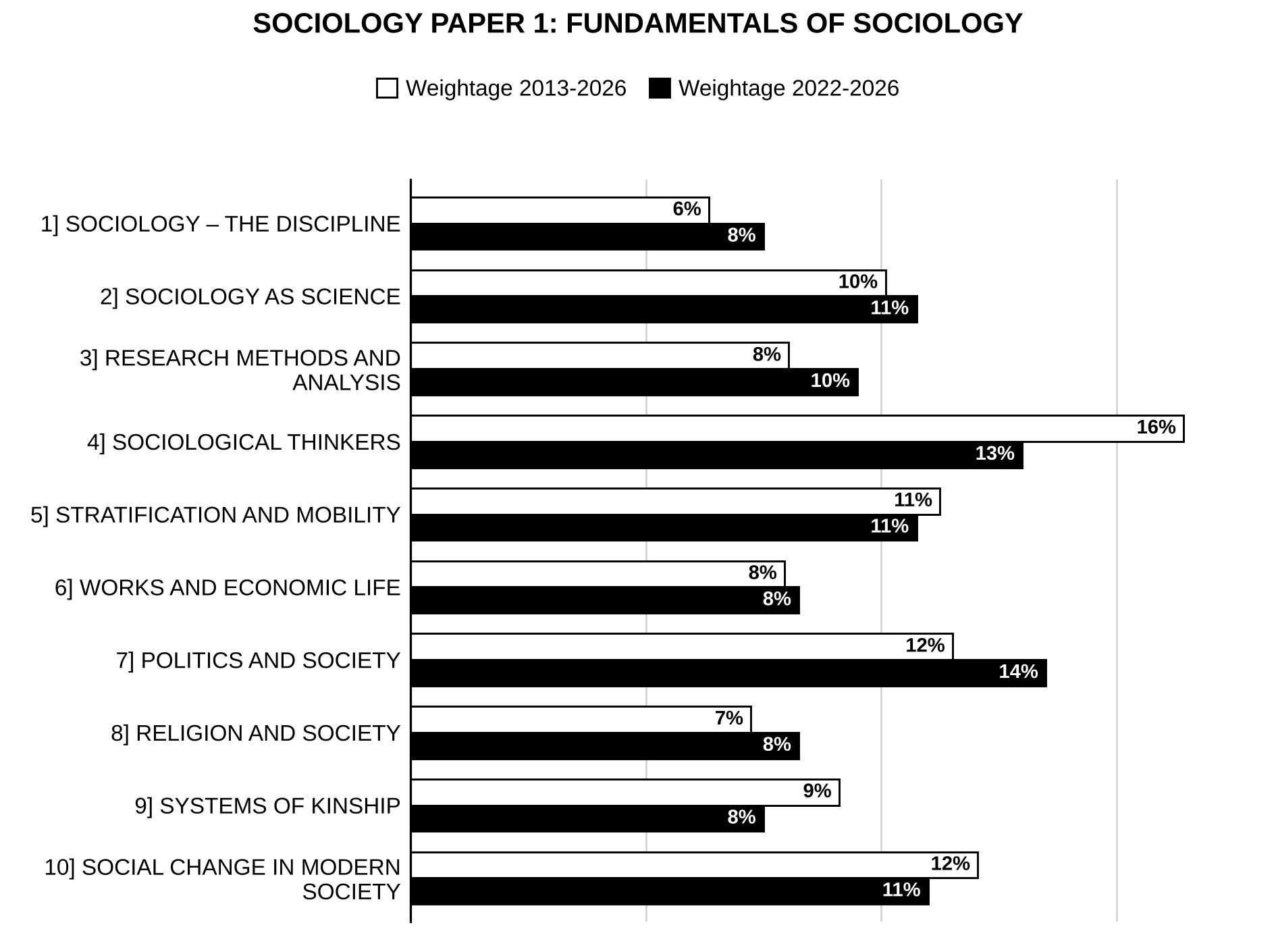
Trend: Sociological Thinkers is the heaviest unit (16% over 2013–2026, 13% in the last five years). Politics and Society has become the top unit recently (12% → 14%), followed by Social Change in Modern Society and Stratification and Mobility (11% each). Sociology – the Discipline is the lightest but rising (6% → 8%).

Preparing for Prelims too?
Our UPSC Prelims Topic-wise PYQ Book covers every Prelims question with detailed explanations, so you can see exactly where UPSC asks from. Now available as a hard copy and an eBook.
Buy Hard Copy on AmazonBuy eBook (PDF)Paper II
Part A: Introducing Indian Society
| Unit | Topic (click to open PYQs) | Sub-topics | Questions | Link |
|---|---|---|---|---|
| 1 | Perspectives on the Study of Indian Society | 4 | 39 | Click here → |
| 2 | Impact of Colonial Rule on Indian Society | 4 | 47 | Click here → |
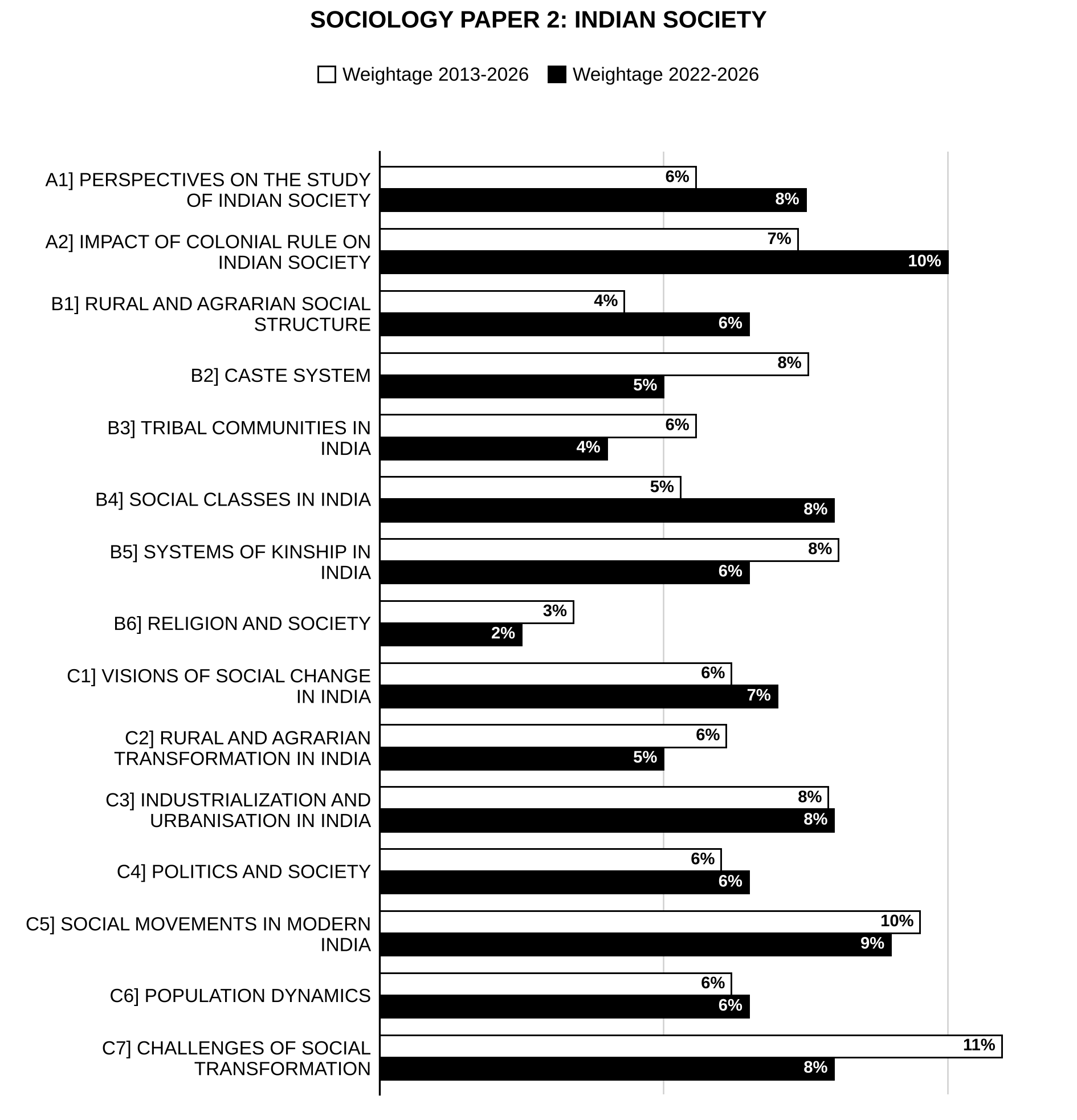
Trend: Part C (Social Changes in India) carries about half of Paper 2 marks, Part B about a third, and Part A the rest. Challenges of Social Transformation (11%) and Social Movements (10%) lead over 2013–2026. In the last five years Impact of Colonial Rule (7% → 10%), Perspectives on Indian Society and Social Classes (8% each) have risen, while Caste System has fallen (8% → 5%). Religion and Society is the lightest unit (2–3%).
Part B: Social Structure
| Unit | Topic (click to open PYQs) | Sub-topics | Questions | Link |
|---|---|---|---|---|
| 1 | Rural and Agrarian Social Structure | 2 | 30 | Click here → |
| 2 | Caste System | 3 | 52 | Click here → |
| 3 | Tribal Communities in India | 3 | 39 | Click here → |
| 4 | Social Classes in India | – | 28 | Click here → |
| 5 | Systems of Kinship in India | 5 | 47 | Click here → |
| 6 | Religion and Society | – | 24 | Click here → |
Part C: Social Changes in India
| Unit | Topic (click to open PYQs) | Sub-topics | Questions | Link |
|---|---|---|---|---|
| 1 | Visions of Social Change in India | 3 | 45 | Click here → |
| 2 | Rural and Agrarian Transformation in India | 4 | 36 | Click here → |
| 3 | Industrialization and Urbanisation in India | 5 | 56 | Click here → |
| 4 | Politics and Society | 4 | 59 | Click here → |
| 5 | Social Movements in Modern India | 5 | 62 | Click here → |
| 6 | Population Dynamics | 4 | 42 | Click here → |
| 7 | Challenges of Social Transformation | 6 | 69 | Click here → |
| 8 | Other Questions (Earlier Syllabus) | – | 12 | Click here → |
Frequently asked questions
How many Sociology Optional PYQs are there?
There are 1,405 Sociology Optional questions from 1995 to 2026, across Paper I and Paper II, arranged under 27 units of the official syllabus. A question that covers two topics is listed under both.
Which Sociology Optional units are asked most often?
By number of questions – Paper I: Sociological Thinkers (150), Politics and Society (92), Social Change in Modern Society (89); Paper II: Challenges of Social Transformation (69), Social Movements in Modern India (62), Politics and Society (59). The weightage graphs on this page compare the share of marks for 2013–2026 with the last five years.
What does a code like [2024/15m/3b] after a question mean?
It gives the year, the marks, the word limit (where UPSC set one) and the question number in the paper. So [2024/15m/3b] is Question 3(b) of the 2024 paper, worth 15 marks.
Where can I download the full Sociology Optional question papers?
Every paper is free as a PDF on our Sociology Optional year-wise question papers page, for both Paper 1 and Paper 2.
How should we use these PYQs in our preparation?
Read the syllabus for a unit first, then go through its questions, starting with the most recent years. Note the themes that repeat, and practise writing answers to them within the word limit and time.
How this collection is organised
Considering the changing exam pattern and syllabus over three decades, we felt it necessary to declare some practices we’ve adopted in this collection.
Some old questions may not be part of the present syllabus, but we’ve decided to keep them. Questions that do not fit any topic of the present syllabus are placed under “Other Questions (Earlier Syllabus)” at the end of each paper. Students should not worry about such questions being asked in exams.
Some questions cover more than one theoretical concept. We’ve kept such questions in each topic of relevance.
The Paper 2 syllabus is arranged by UPSC in three parts – A. Introducing Indian Society, B. Social Structure, and C. Social Changes in India. The words “Part A/B/C” in Part II refer to these syllabus parts, not to Section A/B of the question paper.
Graphs at the start of each paper show the weightage of every unit of that paper, and graphs for the heaviest units show the weightage of their sub-topics. Weightage is the share of marks asked from a unit or sub-topic (all optional questions counted), compared for 2013–2026 (white bars) and the last five years, 2022–2026 (black bars). A question placed under two topics has its marks split equally between them.
Each of the topicwise question is suffixed by a question code like this [2024/10m/150w/5e]. This code indicates a) year in which the question was asked, b) maximum marks the question carried, c) prescribed word limit and, d) the question number in actual paper, in given order. Where UPSC prescribed no word limit, that field is skipped. [Know that UPSC prescribes a word limit of 150 words for 10 mark questions (Q1 and Q5); for 20 mark questions, no word limit is prescribed.]
Until 2012, each paper carried 300 marks; since 2013 each paper carries 250 marks. For 1995–2008, marks follow the standard pattern of those papers (60 marks per question, 20 marks per short note), as the marks were not printed against each question in available sources.
Spotted an error? Use the “Report an Error” box at the end of any page – we review every report and update the page.

Strengthen your GS papers
Our UPSC Mains Topic-wise & Year-wise PYQ Book (2013–2026) maps every GS question to the syllabus, so you know what UPSC asks and how often. Now available as a hard copy and an eBook.
Buy Hard Copy on AmazonBuy eBook (PDF)Last updated: 30 October 2026