
Here are all 92 Politics and Society questions asked in UPSC Sociology Optional Paper I from 1995 to 2026, arranged under the 4 topics of the official syllabus. Within each topic the latest questions come first.
Each question ends with a code such as [2024/15m/3b] – the year, the marks, the word limit (where UPSC set one) and the question number in the paper.
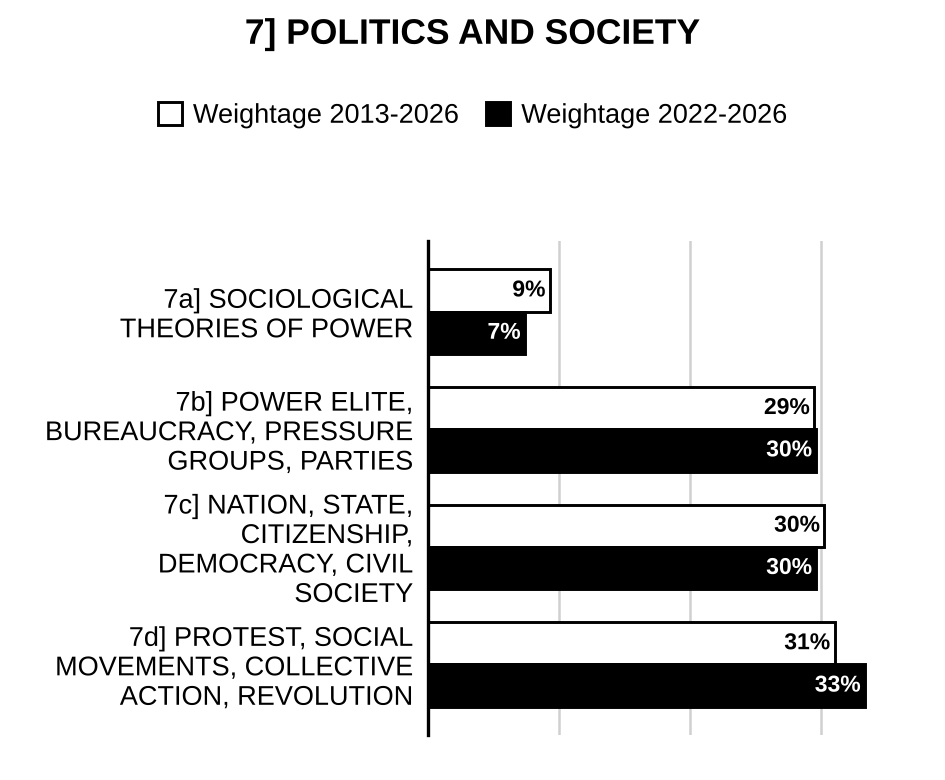
7.1] Sociological Theories of Power
11 questions
Elaborate major sociological theories of power. How do power elite shape the political process in modern societies? [2026/20m/4a]
How is ‘power’ different from ‘authority’? Discuss various types of authorities as theorized by Max Weber. [2024/10m/150w/5d]
Discuss the dimensions of power in the construction and maintenance of social hierarchies in a society. [2024/10m/7c]
What are the theoretical models of societal power? Which one of them is most applicable in advanced industrial societies? [2019/20m/6b]
“Power is not a zero-sum game.” Discuss with reference to Weber’s and Parsons’ views. [2014/20m/6a]
‘Power and authority go together.’ Examine. Explain the various types of authority also. [2012/30m/3a]
List the sources of power and explain the various indicators based on which power can be measured. [2010/30m/7a]
Write a short note on: Authority and legitimacy. [2004/20m/200w/5a]
Write a short note on: Community power. [2002/20m/200w/5b]
Write a short note on: Sources of legitimacy of power. [2001/20m/200w/1c]
Explain the concept of power. Distinguish between power and authority. [1998/60m/7]
Contribute to Optional Province
Is every Sociology question under the right topic?
We sorted 1,326 Sociology PYQs topic by topic with AI help, so a few may be in the wrong place. Help us check them: read one question, tell us if its topic is right. It takes about 10 seconds a question.
Start checking Sociology PYQs →7.2] Power Elite, Bureaucracy, Pressure Groups and Political Parties
22 questions
Elaborate major sociological theories of power. How do power elite shape the political process in modern societies? [2026/20m/4a]
Are pressure groups a threat to or a necessary element of democracy? Explain with suitable illustrations. [2025/20m/3b]
What would you identify as the similarities and differences in the elite theories of Mosca, Michels and Pareto? Discuss their main/crucial issues. [2025/20m/4b]
What, according to Robert Michels, is the iron law of oligarchy? Do lions and foxes in Vilfredo Pareto’s theory, essentially differ from each other? Substantiate. [2023/20m/2a]
Illustrate with examples the role of pressure groups in the formulation of social policies. [2022/10m/7c]
Critically examine the relevance of Vilfredo Pareto’s theory of Circulation of Elites in the present scenario. [2021/10m/150w/5b]
Explain how political parties and pressure groups are dialectically related to each other in terms of achieving their goals. [2021/20m/6b]
According to Mills, “Elites rule in institutional terms rather than psychological terms.” Comment. [2020/20m/6b]
Discuss the concept of circulation of elite. [2019/10m/7c]
What, according to Pareto, are the basic characteristics of elites? Discuss. [2018/10m/7c]
Examine the dynamics of pressure groups in multi-party political system. [2017/10m/6c]
Discuss the importance of ‘power elite’ in democracy. [2016/10m/150w/5b]
Distinguish between political parties and pressure groups. [2014/10m/150w/5d]
Examine the role of pressure groups in parliamentary democracy. [2013/10m/4c]
Write a short note on: Power elite. [2011/12m/150w/5b]
What is formal organization? “The growth of bureaucracy has resulted in extreme concentration of power at larger levels of social organization.” Discuss. [2011/20m/6a]
C. W. Mills’ Power Elite. [2009/20m/200w/5a]
Write a short note on: Power elite in society and the emergence of new elite in power structure. [2005/20m/200w/5b]
Write a short note on: Bureaucracy in new capitalist economy. [2004/20m/200w/1b]
Write a short note on: Informal structure of bureaucracy. [2001/20m/200w/5c]
Write a short note on: Role of pressure groups in democracy. [2000/20m/200w/5d]
Critically examine the role of formal and informal structures of bureaucracy in economic and social reconstruction of the developing societies. [1995/60m/4]

Preparing for Prelims too?
Our UPSC Prelims Topic-wise PYQ Book covers every Prelims question with detailed explanations, so you can see exactly where UPSC asks from. Now available as a hard copy and an eBook.
Buy Hard Copy on AmazonBuy eBook (PDF)7.3] Nation, State, Citizenship, Democracy, Civil Society, Ideology
25 questions
How are the concepts of nation, state and citizenship interrelated in a democracy? Elaborate. [2026/20m/8a]
How do ‘Civil Society Organizations’ such as ‘NGOs’ and ‘Self-Help Groups’ contribute to grassroot level social changes? Discuss. [2025/20m/8b]
Democracy needs a vibrant culture of civil society in order to strengthen its foundation of citizenship. Comment. [2024/10m/150w/1d]
How is civil society useful in deepening the roots of democracy? [2023/10m/150w/5b]
Analyse the nature of transition from ideology to identity politics in India. [2022/20m/6b]
Highlight the roles and functions of civil society in a democratic system. [2021/10m/8c]
Explain democracy as an order of society. What are the factors preventing people’s participation in politics? [2020/10m/2c]
What is civil society? Present a note on civil society engagement with science and technology policy in India. [2019/10m/150w/5c]
Discuss the changing interface between state and civil society in post-independent India. [2017/10m/5b]
“Ideology is crucial for social transformation in a democracy.” Discuss. [2015/10m/150w/5b]
Caste ideology appears to have strengthened democracy. Comment. [2015/10m/7c]
“Globalization involves deterritorialization.” Examine with reference to the nation-state. [2015/20m/8a]
Discuss T. H. Marshall’s views on citizenship. [2014/10m/150w/5c]
Evaluate how do civil society and democracy mutually reinforce each other. [2013/20m/7a]
Critically examine the role of civil society in democracy. [2013/10m/7c]
Write a short note on: Citizenship and civil society. [2012/12m/150w/5c]
What do you understand by nation? Is the nation same as the state? Discuss. [2012/20m/8b]
Explain the concept of participatory democracy. What conditions are assumed to be conducive to participation? [2011/20m/7c]
Evaluate how civil society and democracy mutually reinforce each other. [2010/30m/8a]
Explain the meaning and modes of political participation. What are the factors preventing people’s participation in politics in India? [2007/60m/8]
Discuss modes of political participation and voting behaviour in India. [2005/60m/6]
Write a short note on: Social structure and political participation. [2003/20m/200w/5d]
Write a short note on: Impact of the democratic political system on the traditional social structure. [1999/20m/200w/5b]
Discuss the meaning and role of voluntary organizations in the efforts of transformation of society through state-action. [1996/60m/7]
Critically examine the impact of traditional social structures on the development and functioning of a democratic polity. [1996/60m/8]
7.4] Protest, Agitation, Social Movements, Collective Action, Revolution
34 questions
Explain in brief the relationship between social movement, collective action and revolution in bringing about social and political changes. [2026/10m/150w/1e]
How do different theories explain social dimensions of social movements? Discuss. [2026/10m/150w/5e]
How can you assess the significance of social movements in the digital era? Explain. [2025/10m/6c]
Underline the role of social media in contemporary social movements and describe its challenges. [2024/20m/6a]
Do you think that the social media has brought significant changes in the forms of protest? Argue your case. [2023/20m/7b]
Discuss how ‘environmentalism’ can be explained with new social movements approach. [2022/20m/7b]
Examine how social movements come to an end. Illustrate with examples. [2020/10m/8c]
How is terrorism a new form of asymmetrical warfare? What are some of the challenges in trying to win the war on terrorism? [2019/10m/8c]
Are social movements primordial in means and progressive in agenda? Explain. [2018/10m/150w/5b]
What is new in ‘new social movements’? Elaborate your answer with special reference to India. [2017/20m/6b]
Examine the role of protest movements in changing the status of Dalits in India. [2016/10m/6c]
To what extent revolution replaces the existing order of society? Discuss. [2016/10m/7c]
Explain the conditions under which a collective action transforms into a social movement. [2015/20m/6b]
What do you understand by social movement? How has the mobilization by Scheduled Castes helped them in constructing a new identity? [2014/10m/8c]
Define social movement. Elucidate the role of reformist movements in social change. [2013/10m/150w/5b]
Write a short note on: Millenarian movements. [2012/12m/150w/5d]
Are social movements always influenced by ideologies? Discuss. [2012/20m/6c]
‘Revolutionary changes have some specific characteristics.’ Discuss with examples. [2012/20m/8c]
Highlight prerequisites of social movement. Bring out the differences between social movement and revolution. [2011/20m/6b]
“Collective action in politics can bring integration and disintegration in society.” Comment. [2011/20m/6c]
Write a short note on: Identity politics. [2010/15m/200w/5b]
Write a short note on: Structure of social movement. [2009/20m/200w/5d]
Write a short note on: Social movement as an expression of protest. [2008/20m/200w/1c]
What are the structural elements of a social movement? State how a social movement comes to its end. Illustrate your answer with example. [2007/60m/7]
Write a short note on: Structure of a social movement. [2006/20m/200w/5b]
Describe the ideological changes that have ushered in modern society due to social movements in India. [2005/60m/7]
Write a short note on: Ideology and strategy of social movement. [2004/20m/200w/5d]
Write a short note on: Social movement and social change. [2002/20m/200w/1d]
What social conditions cause a social movement? Explain, with illustrations, the career of a social movement. [2001/60m/7]
Is ideology an essential component of a social movement? Illustrate your answer with suitable examples from some contemporary social movements. [2000/60m/7]
Bring out the commonality between a social movement and a revolution. Would you agree with the view that each revolution is preceded by a social movement? Give reasons. [1999/60m/7]
What are the structural conditions under which movements emerge? Discuss with reference to any one theory of genesis of social movements. [1998/60m/8]
Write a short note on: Concept of social movement. [1997/20m/200w/5b]
Write a short note on: Reformative social movements. [1996/20m/200w/5d]

Strengthen your GS papers
Our UPSC Mains Topic-wise & Year-wise PYQ Book (2013–2026) maps every GS question to the syllabus, so you know what UPSC asks and how often. Now available as a hard copy and an eBook.
Buy Hard Copy on AmazonBuy eBook (PDF)« Previous: Works and Economic Life | Next: Religion and Society »
Back to: Sociology Optional PYQs – Topic-wise | Also see: Sociology Optional year-wise question papers
Last updated: 30 October 2026