
Here are all 77 Stratification and Mobility questions asked in UPSC Sociology Optional Paper I from 1995 to 2026, arranged under the 4 topics of the official syllabus. Within each topic the latest questions come first.
Each question ends with a code such as [2024/15m/3b] – the year, the marks, the word limit (where UPSC set one) and the question number in the paper.
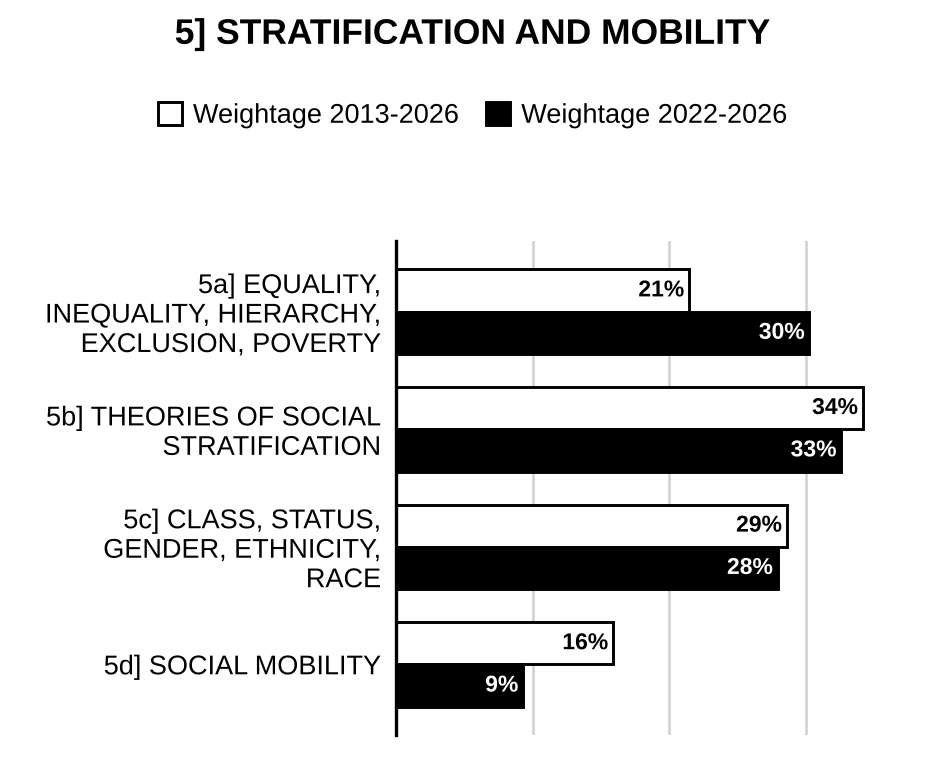
5.1] Concepts – Equality, Inequality, Hierarchy, Exclusion, Poverty and Deprivation
14 questions
Differentiate between social hierarchy and social exclusion and substantiate your answer with reference to the caste system. [2026/20m/2b]
Compare capability deprivation approach with that of social capital deprivation in understanding chronic poverty. [2025/20m/3a]
Discuss the dimensions of power in the construction and maintenance of social hierarchies in a society. [2024/10m/7c]
How is poverty a form of social exclusion? Illustrate in this connection the different dimensions of poverty and social exclusion. [2023/20m/4b]
How are Hierarchy and Exclusion the major impediments in the transformation of societies? Discuss. [2020/20m/2b]
What is affirmative action? Substantiate theoretical positions on affirmative actions with examples. [2019/10m/6c]
What is the difference between natural and social inequality? Give examples from caste and class dimensions. [2018/10m/150w/1d]
Can we equate ‘poverty’ with ‘poor living’? Elaborate your answer. [2017/10m/1e]
Discuss the relationship between poverty and social exclusion. [2016/10m/4c]
Distinguish between people being socially excluded and people excluding themselves socially in societies. [2013/10m/150w/5a]
Distinguish between people being socially excluded and people excluding themselves socially in societies. [2010/15m/6b]
How does hierarchy get built into the system of natural and social inequalities? [2008/60m/8]
Examine the conceptual distinction between social inequality and social stratification. How do the nature and forms of the social stratification system determine the patterns of social mobility? [2003/60m/6]
Write a short note on: ‘Relative deprivation’ [2000/20m/200w/5c]
Contribute to Optional Province
Is every Sociology question under the right topic?
We sorted 1,326 Sociology PYQs topic by topic with AI help, so a few may be in the wrong place. Help us check them: read one question, tell us if its topic is right. It takes about 10 seconds a question.
Start checking Sociology PYQs →5.2] Theories of Social Stratification
22 questions
According to Weber how do class, status and power interact to produce and sustain social inequality? [2026/20m/7b]
Is the social stratification theory gender-blind? Elucidate. [2025/10m/150w/1e]
Does the structural-functionalist perspective on social stratification promote a status quo? Give reasons for your answer. [2025/10m/150w/5b]
Explain Max Weber’s theory of social stratification. How does Weber’s idea of class differ from that of Marx? [2023/20m/6b]
Social stratification is claimed to contribute to the maintenance of social order and stability in society. Critically assess. [2022/20m/4b]
Critically examine Max Weber’s theory of Social Stratification. [2021/10m/150w/1e]
Davis and Moore made it clear that social stratification is a functional necessity and also an unconscious device. Discuss. [2019/10m/150w/1b]
Compare and contrast the contributions of Marx and Weber on social stratification in capitalist society. [2019/20m/4b]
Evaluate if social stratification is functional for society. [2018/10m/2c]
What is Weberian critique of Marxist notion of social stratification? [2017/20m/4a]
Elucidate the basic premises of Davis’ structural-functional theory of social stratification. How far is it relevant in understanding contemporary Indian society? [2016/20m/2a]
Differentiate between Marxian and Weberian theories of social stratification. [2015/20m/3b]
“According to Max Weber, ‘class’ and ‘status’ are two different dimensions of power.” Discuss. [2014/20m/3b]
For Marx, class divisions are outcomes of ‘exploitation’. Discuss. [2014/10m/150w/5a]
How do Karl Marx and Max Weber differ in terms of their analysis of social stratification? [2013/20m/6a]
Write a short note on: Stratification of classes. [2012/12m/150w/5a]
What is class? Do you think that Weber’s contribution to social stratification is different from that of Marx? [2011/30m/2b]
What are the reasons for calling Kingsley Davis and Wilbert Moore’s theory of social stratification a functional theory? [2009/30m/3b]
Briefly discuss the conflict perspective on social stratification and examine the view that social inequality in India is the function of rigid social stratification system. [2004/60m/4]
Explain Melvin Tumin’s critique related to the theory of social stratification. [2002/60m/8]
How would you distinguish between the stratified and the unstratified social positions? What explanation would you proffer for the universal existence of the social stratification in human society? [1999/60m/2]
Analyse critically the functional theory of social stratification. [1998/60m/3]

Preparing for Prelims too?
Our UPSC Prelims Topic-wise PYQ Book covers every Prelims question with detailed explanations, so you can see exactly where UPSC asks from. Now available as a hard copy and an eBook.
Buy Hard Copy on AmazonBuy eBook (PDF)5.3] Dimensions – Class, Status Groups, Gender, Ethnicity and Race
21 questions
In what ways do class and caste intersect and overlap in shaping social structure? [2026/10m/150w/1a]
Analyse the changing nature of caste as a status group. [2024/10m/150w/1b]
How does a multicultural society accommodate diversities of all kinds — ethnic, linguistic and religious? Discuss its major challenges. [2024/20m/6b]
Do you think that the boundary line between ethnicity and race is blurred? Justify your answer. [2023/10m/150w/1e]
How do sociologists construct gender in their analysis on social inequality? [2022/10m/150w/1e]
Explain the growing salience of ethnicity in the contemporary world with illustrations. [2021/10m/7c]
Present a sociological review on the ‘new middle-class’. [2019/10m/150w/1d]
Modernisation presupposes class society; however caste, ethnicity and race are still predominant. Explain. [2019/20m/4a]
Differentiate between ‘Life-chances’ and ‘Life-style’ with suitable examples. [2019/10m/150w/5a]
Why is gender a dimension of social stratification? How does gender intersect other dimensions of inequality based on caste, class, race and ethnicity? [2019/20m/6a]
Examine gender, ethnicity and race as major dimensions of social stratification. [2017/20m/4b]
Caste ideology appears to have strengthened democracy. Comment. [2015/10m/7c]
What do you understand by gender? How does it shape ‘male’ identity? [2014/20m/3a]
Analyse the gender bias in the present society with examples. [2013/10m/150w/5e]
Write a short note on: The problem of gender. [2011/12m/150w/1e]
Write a short note on: Ethnicity and development. [2010/15m/200w/1e]
Write a short note on: Caste-system as a principle of social stratification. [2006/20m/200w/5a]
Write a short note on: Class within caste and caste within class. [2004/20m/200w/1d]
Distinguish between sex and gender. Discuss the gender issues with suitable examples. [2002/60m/4]
Write a short note on: Caste as a class. [1998/20m/200w/1d]
Write a short note on: Social class and social status. [1995/20m/200w/1b]
5.4] Social Mobility
20 questions
What is social mobility? Critically examine the classification of ‘closed’ and ‘open’ models of social stratification. [2024/10m/2c]
Discuss social mobility in open and closed system. [2022/10m/2c]
Explain the concept of social mobility. Describe with suitable illustrations how education and social mobility are related to each other. [2021/20m/4a]
Critically assess social mobility in closed and open systems. [2020/10m/4c]
Schooling does not ensure upward mobility of all members of the society. Discuss with reference to class societies. [2018/20m/4b]
Is social mobility possible in closed systems of stratification? Illustrate from research work. [2018/10m/150w/5e]
“Vertical mobility brings structural change even in a closed social system.” Comment. [2016/10m/150w/1e]
“No society can either be absolutely open or absolutely closed.” Comment. [2015/10m/150w/1e]
How are open and closed systems of stratification undergoing transformation in the emergence of new hierarchical social order in societies? [2013/20m/4a]
In our society hierarchical relations are influenced by social mobility. Explain how. [2012/20m/6a]
What do you mean by social mobility? Discuss the major sources and causes of mobility. [2011/30m/4b]
Examine how open and closed systems of stratification are undergoing transformation in the emergence of new hierarchical social order in societies. [2010/30m/4b]
Write a short note on: Social mobility in open and closed systems. [2008/20m/200w/1b]
Write a short note on: Vertical social mobility. [2006/20m/200w/1d]
How is vertical and horizontal social mobility problematic in society? Suggest solutions. [2005/60m/4]
Write a short note on: Social mobility and social change. [2002/20m/200w/1c]
Write a short note on: Inter-generational mobility. [2000/20m/200w/5a]
Discuss the nature and characteristics of social mobility. Can the nature and the rate of social mobility be treated as an index of economic development? Comment. [1999/60m/6]
Write a short note on: Vertical and horizontal mobility. [1998/20m/200w/5c]
Write a short note on: Types of mobility. [1997/20m/200w/1d]

Strengthen your GS papers
Our UPSC Mains Topic-wise & Year-wise PYQ Book (2013–2026) maps every GS question to the syllabus, so you know what UPSC asks and how often. Now available as a hard copy and an eBook.
Buy Hard Copy on AmazonBuy eBook (PDF)« Previous: Sociological Thinkers | Next: Works and Economic Life »
Back to: Sociology Optional PYQs – Topic-wise | Also see: Sociology Optional year-wise question papers
Last updated: 30 October 2026